
Pilgrimage to Emptiness in Tang Poetry
Where the hermit is absent, the mountain teaches
The Chinese Tang dynasty (618 to 907 CE) has left us some wonderful poems. A recurring theme in these poems is a pilgrimage, a sacred journey seeking spiritual instruction or enlightenment. And frequently they convey a surprising message: there is no goal to be attained, the journey itself is the goal, and the pilgrim must embark on the long journey only to discover that s/he has always been there.
Here I would like to comment upon three Tang pilgrimage poems. Chinese is a wonderful medium for poetry in that its characters possess numerous layers of meaning and are only minimally constrained by grammatical and syntactic rules. They are like those iridescent gems that show different colors depending on the angle you look at them. Each character represents the core of an idea, or of a cluster of ideas, and not its specification in terms of person, gender, number, tense or mode. “Chinese characters,” says François Cheng, “by virtue of the threads that connect them to things and to each other, constitute a metaphoric-metonymic system. Each character is in a way a potential metaphor.”(1) In order to get a feeling for the metaphoric web Cheng is talking about, I will give you a literal word-by-word translation of the poems, thus allowing the words, as far as possible, the free interplay they have in the Chinese original. Their images hover in a liminal space between presence and absence. They can be apprehended at various degrees of rarefaction: at their core we catch a glimpse of something like a luminous void, a creative emptiness without name or form.
Chang Jian (708 to 765?), The Monastery behind Poshan Temple
常建《题破山寺后禅院》
清晨入古寺,初日照高林。
曲径通幽处,禅房花木深。
山光悦鸟性,潭影空人心。
万籁此俱寂,惟余钟磬音。
Clear morning, entering ancient temple,
Rising sun, illuminating tall trees,
Meandering footpath, leading to secluded place,
Meditation hall, deep in flowers and plants,
Mountain brightness, joyous birds’ nature,
Marsh shadows, empty human heart,
A myriad sounds, now complete silence,
Only remains the stone bell’s chime.
In this as in many Chinese poems, the personal presence of the poet is reduced to a minimum. It is not a person-centered perspective. There is no subject to the action. As we enter the ancient temple compound together with the poet, we become transparent. The clear morning enters: the archetypal quality of the situation prevails over the personal connotation. The sun is just coming up and illuminates the tops of the trees. Two dimensions meet: light above (yang), while the shadows of the early morning (yin) still prevail down below, where we walk the bending path leading to the even shadier and peaceful meditation hall, deeply immersed in plants and flowers. The interplay of these two energies is celebrated in the fifth and sixth verses:
Mountain brightness, joyous birds’ nature,
Marsh shadows, empty human heart.
As so often happens with Chinese texts, we can read these sentences in many ways. The Chinese is even more open than this word-for-word translation: since Chinese ideograms can be indifferently adjectives, nouns or verbs, “joyous” can also be read as joy, rejoicing or causing to rejoice, and “empty” can also be read as emptiness or emptying. So the first sentence could be taken as meaning:
the birds’ joy brightens the mountain,
or the mountain brightness causes the birds to rejoice.
There is an equivalence and a fluid interconnection of the two halves; together they define what we perceive as a single archetypal situation, a luminous yang presence above. The sixth verse has a structure perfectly parallel to the fifth, and it unfolds in the shady yin realm below. We can read it as:
the marsh shadows empty themselves into the human heart,
or the human heart empties itself into the marsh shadows,
or the marsh shadows cause the human heart to be empty,
or the marsh shadows mirror the emptiness of the human heart,
or, vice versa, the empty human heart is a mirror of the marsh shadows.
Let me remind you that in Chinese the heart also embraces what we call mind. So the empty heart is here also the “empty mind,” the “meditative mind,” or the state of meditation. Moreover, this word “empty,” kong (空), is the translation of the Sanskrit term sunyata, referring to the essential emptiness which is at the heart of all forms.
Now, the dance of yang images above and that of yin images below also mirror each other in rhythm and meaning: there is a rigorous symmetry between the two verses. On one hand, each states an equivalence between two terms:
mountain brightness, birds’ nature,
marsh shadows, human heart,
where the mood of the first equivalence is given by the middle term joy, and the mood of the second by the middle term empty (including the “tranquil contemplation” and “inner silence” connotations associated with it in Buddhist usage). To the dance of light and the birds above corresponds the silent peace of the shady pool and of the human heart below. But there is also a word-by-word vertical mirroring:
mountain, marsh,
brightness, shadows,
joy, emptiness,
bird, human,
nature, heart.
In this meeting of the luminous splendor of the mountain and of the shady pool of the heart, suddenly all is silent. The myriad sounds of the forest and of the temple compound suddenly cease. The mind of the poet also becomes silent. Only the music of a stone remains: it is the stone bell, which is the monastery’s clock. Let me also give you a few literary translations of the two verses we have analyzed:
Around these hills sweet birds their pleasure take,
Man’s heart as free from shadow as this lake (H. A. Giles).
Here birds are alive with mountain light,
And the mind of man touches peace in a pool (Witter Bynner).
Hark! the birds rejoicing in the mountain light
Like one’s dim reflection on a pool at night.
Lo! the heart is melted wavering out the sight (W. J. B. Fletcher).
The mountain colours have made the birds sing,
The shadows in the pool empty the hearts of men (R. Payne).
Irrespective of the poetic merit of each of these translations, I think you will agree with me that much is lost in all of them. The language of Chinese poetry, like the language of oracle, is very close to an imaginal dimension. It is a close reflection of “the play of archetypes,” as Jung said, and that is of course the difficulty in translating it into any Western language.
Liu Changqing (709 to 785?), Looking for the Taoist Monk Chang of the Southern Stream
刘长卿《寻南溪常山道人隐居》
一路经行处,莓苔见屐痕。
白云依静渚,芳草闭闲门。
过雨看松色,随山到水源。
溪花与禅意,相对亦忘言。
The visit to a sage or a hermit is a common theme in Chinese poetry, and the pilgrimage is often the occasion of a deep insight, a spiritual experience. The hermit frequently resides in a remote place, and the arduous journey to reach him is an essential part of the experience.
All the way traveling across places,
in the tender moss seeing clogs’ footprints,
white clouds surrounding the quiet islet,
fragrant grasses obstructing the idle door,
after the rain looking at the pine’s color,
going round the hill reaching the river’s spring,
stream flower offers the meaning of Chan,
face to face, equally without words.
Here the journey is the goal: many experiences happen along the way. As the pilgrim approaches his goal, his transformation begins with seeing clogs’ footprints in the moss (just as in that famous series of pictures, the “ten bulls of Zen,” where the search for the lost bull begins with seeing its footprints), white clouds surrounding the peaceful island where the monk resides, and his door, which is always open and drowned in a cascade of plants. Notice that here also there are no personal pronouns: no “I,” no “he.” Traveling happens, seeing happens. We can imagine that the monk’s hut is open and empty, and the monk is somewhere outside by the stream. But we get no sense of urgency: the traveler has come from far away, it may have been a month’s journey, but along the way he has been transformed. Now it is enough for him to look at the dark green of the pine tree after the rain. When the pilgrim reaches the river’s spring and finally finds himself face to face with the monk, neither one has anything to say; there are no words left. The stream flower has already said it all: it has revealed the meaning of Chan, of meditation (“Chan” is the Chinese equivalent of the Japanese word “Zen,” from the Sanskrit dhyana).
Some commentators read “face to face” as referring to the traveler and the flower (who are “equally without words”) rather than the traveler and the monk. It doesn’t matter; monk and flower are in a way interchangeable. The name of the monk, Chang, by the way, means “constant, eternal”: it is the same word that occurs in the first line of the Dao De Jing, “The dao that can be said is not the eternal dao.” And our poem ends on the same note: “without words.” As if, says François Cheng, the poet is “longing to move beyond words and attain to emptiness” (Cheng says “non-being,” but I would rather say “emptiness”). The whole poem is “an experience of the wordless through words.”
Jia Dao (779 to 843), Visit to a Hermit without Finding Him
贾岛《寻隐者不遇》
松下问童子,言师采药去。
只在此山中,云深不知处。
The last poem I will comment upon is called Visit to a Hermit without Finding Him. A literal translation of the title would actually be The Sought-for Hermit Not Found.
Under the pine-tree asking the young disciple,
Saying: master collect medicinal-herbs gone,
Alone in the middle of this mountain,
Deep clouds, not know where.
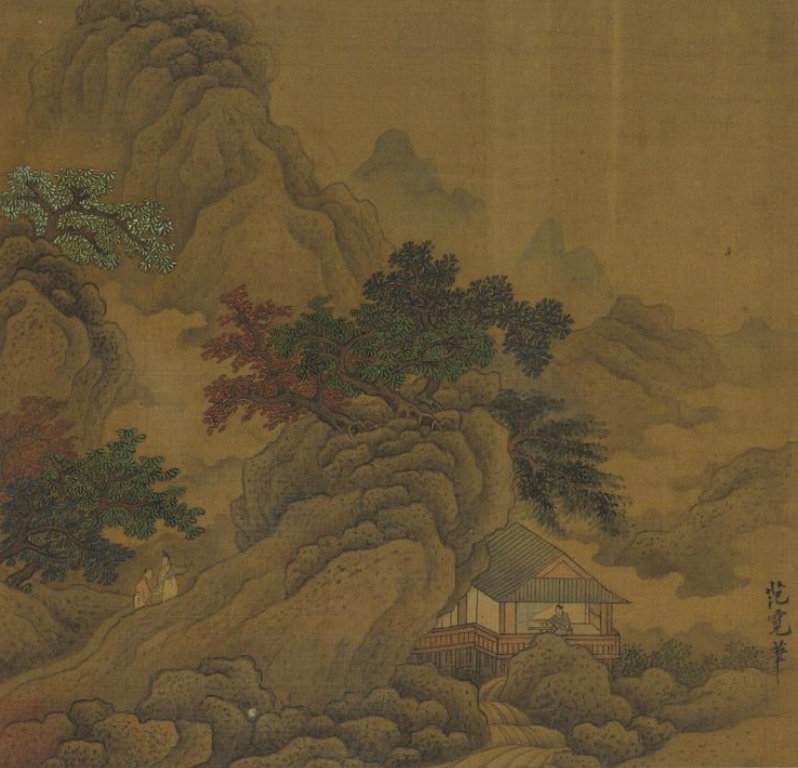
The pilgrimage journey, we have seen, is in itself a powerful spiritual experience. But here the journey seems to be in vain: when the poet reaches his destination, the hermit is absent. Under the pine tree (which we can imagine to be the abode of the hermit; to the Chinese, the pine tree is a symbol of longevity, constancy and fidelity), there is only a child (the term denoting the “young disciple” also means “child”). The pilgrim asks him about the master. The boy says: “The master has gone to collect medicinal herbs; he is alone somewhere in the middle (the word also means ‘the center’) of this great mountain, cloud-hidden, who knows where.” We can hear in the words the boy’s awe at that immense solitude, at that wilderness, to which the master also seems in a way to belong: he moves easily into it, he is at home in places untrodden by humans. And we can imagine the disappointment of the traveler, although nothing is said about it. That is all the explicit content of the poem: very simple, a “minimalist” poem in a way. Let us now listen to the resonances.
The general undertone is absence. But it is a very powerful absence, a very meaningful absence. That is how the teaching is imparted here: through the absence of the master. His absence is the presence of the mountain itself and of the clouds. That is the statement of the master, his way of saying what words cannot convey, his way of pointing to the beyond. Again: “The dao that can be said is not the eternal dao.” About the eternal, only silence can speak. Saying that it is the master’s statement is not really accurate, though: it is not his teaching. One could just as well say that it is the mountain’s teaching: the awesome presence of the mountain is the real focus of the poem. The master is somewhere in the “center” of that mountain, his identity lost in the clouds, gone on a shamanic journey into another dimension, from which he is expected to return bringing healing.
Then we begin to realize that the pilgrimage has not been in vain, and that indeed the journey is the goal. The traveler, after all, finds what he was seeking, although not in the way he anticipated. The four verses of the poem convey a sense of progressive rarefaction; something like a distillation is happening. In the first two verses we are still in the human world, on the very edge of it, assuredly: the abode of the hermit is a pine tree on a mountain. But under the pine tree, a human conversation can still take place between the traveler and the child:
Under the pine-tree asking the young disciple,
Saying: master collect medicinal-herbs gone,
The conversation already has something of the transpersonal: the personal identity of the speakers is not at all emphasized. As usual, there are no personal pronouns. There is just “asking,” “saying.” It is as if the silence of the mountain envelops both pilgrim and disciple. And the pilgrim has already been transformed by the journey: he has already taken the first step. The hermit points out the rest of the way to him by his absence. In the second verse we see (through the eyes of the child) the master walk away on a mountain path. At this stage there is still a specific goal to his journey (collecting medicinal herbs), but as he disappears in the distance, both his personal identity and the purpose of the journey seem to fade away, dissolved in the immensity of the mountain. In the third verse the master is alone in the center of the mountain: like a cat hunting at night, he is a different creature, a wilder, vaster being than the master sitting under the pine tree whom (we can imagine) the child loves and is familiar with:
Alone in the middle of this mountain,
Deep clouds, not know where.
In the end there is only “deep clouds, not know where.” No master, no mountain. An image of the empty mind (or, to say it the Chinese way, of the “empty heart”) of the hermit, and also, now, of the pilgrim. No place, no identity. Even the medicinal herbs are forgotten: they have already accomplished their healing, not only for the hermit, dissolved in the heart of the mountain, but, we feel, also for the traveler contemplating this luminous absence. At the very center of the process (at the center of the mountain), nobody is left: deep clouds, not know where. Only an empty heart can listen; then the answer comes, and it may come not through words, but beyond words.