Photographing the Delicate Bond Between Wild Beings and Vanishing Worlds
From the precipitous escarpments of Ethiopia’s Simien Mountains to the ice clad shores of the Svalbard archipelago, Marco Gaiotti, through his refined and perceptive lens, captures the profound connections between wild beings and their increasingly evanescent habitats. His visual compositions do more than depict fauna; they weave these beings into the very fabric of the earth, allowing each frame to unfold with poetic grace, articulating the planet’s most pressing narrative: a tenuous equilibrium sustained between existence and oblivion.
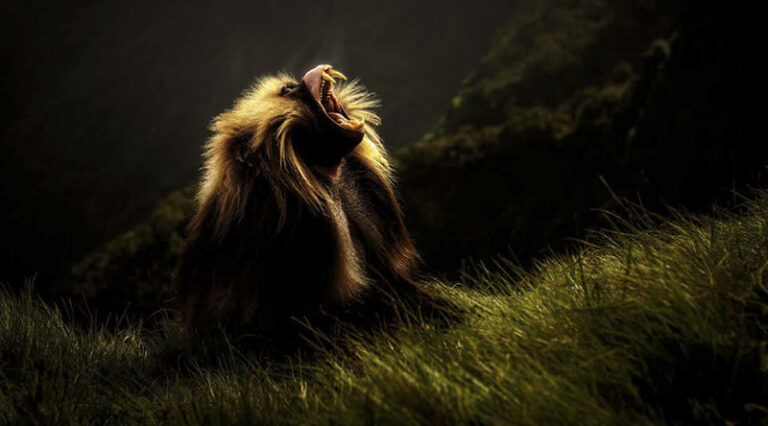
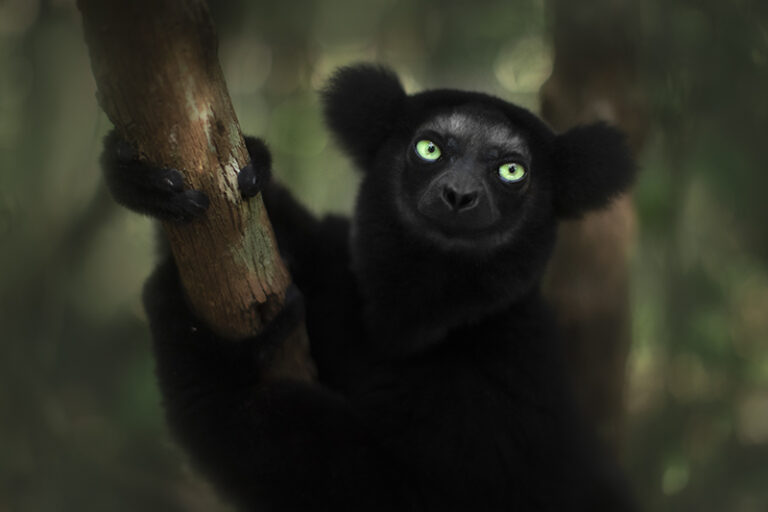
Within the profound, emerald gaze of the Madagascar black lemur, we glimpse a resonance of ancient wisdom with contemporary fragility. And in the silhouette of a gelada, arrested mid roar, as highland twilight bathes it in gold, instinctive emotion transmutes into poignant artistry, quietly blossoming against the encroaching night.
Gelada baboon at sunrise, Simien Mountains National Park., Image credit: Marco Gaiotti
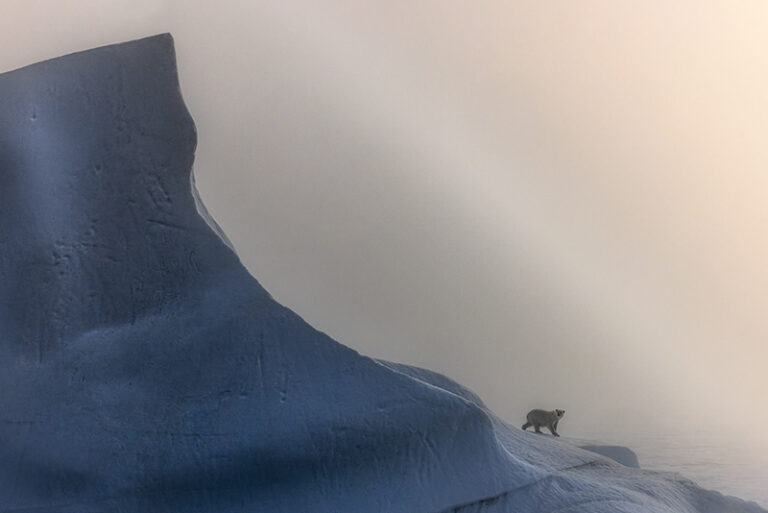
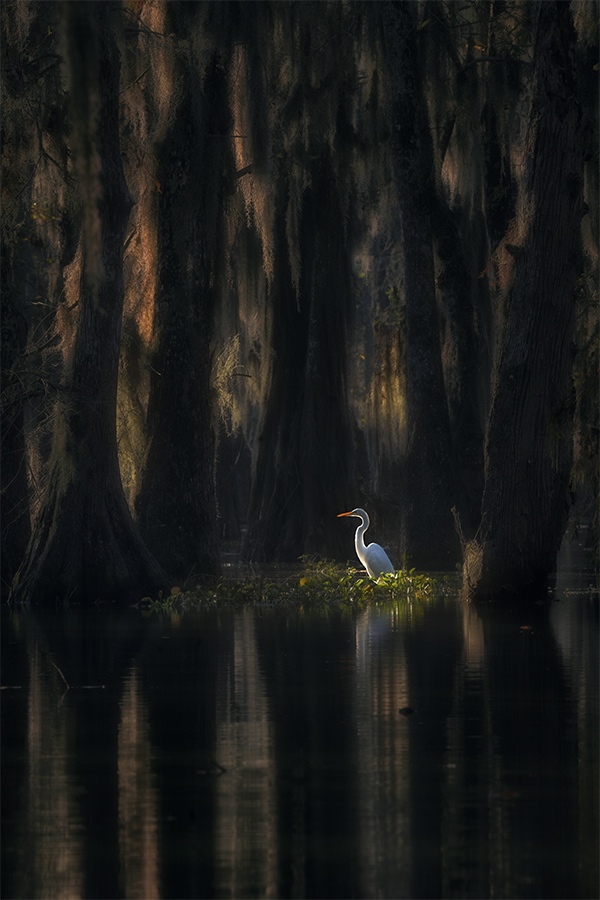
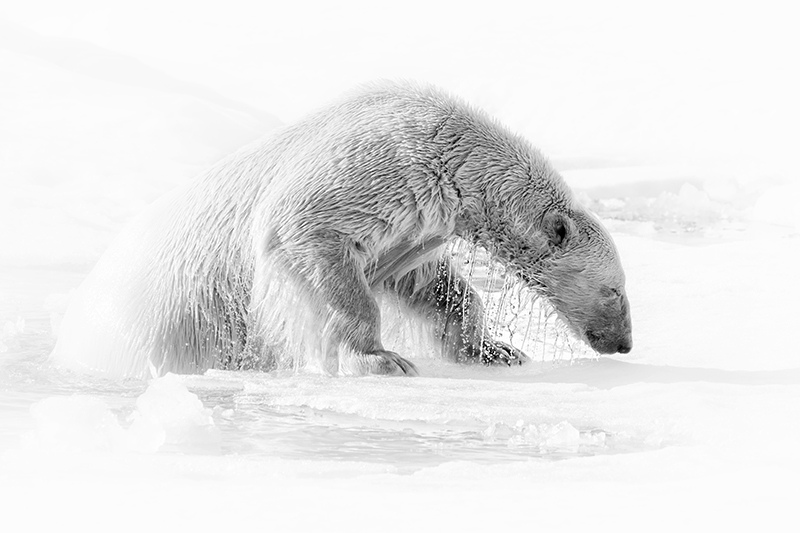
This masterful use of light extends across all of Gaiotti’s work, transforming each frame into an emotional landscape that transcends mere documentation. In the misty depths of cypress swamps, a solitary egret stands like a prayer made visible, its pristine form a beacon of grace against towering, moss-draped sentinels. His Arctic imagery carries perhaps the most poignant message of all, where polar bears navigate landscapes of sculptural ice, their powerful forms rendered almost spectral against the vast white silence. Water cascades in crystalline moments around a feeding bear, each droplet frozen in time like tears of a changing world.
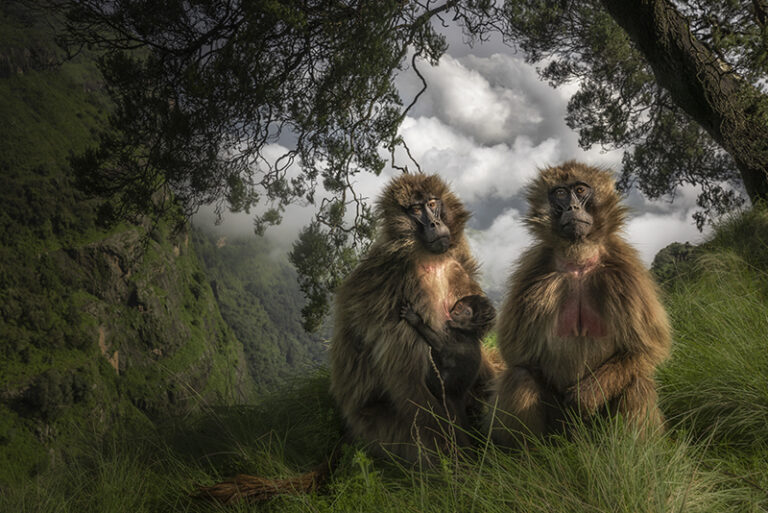
Such distinctive artistic vision finds near-perfect expression in Marco Gaiotti’s work “Gelada Family,” highly commended at the 2024 Siena International Photo Awards. In the frame, a gelada family rests upon the verdant slopes of Ethiopia’s Simien Mountains, with a mother cradling her young, her gaze contemplative and serene; beside her, a companion sits with alert, watchful eyes, posture dignified and composed. Overhead, branches cascade like curtains while behind them clouds surge and roll, hinting at an approaching storm. This moment of tranquility against the lurking turbulence in the sky creates a stirring contrast, revealing both nature’s impermanence and the quiet tension of fate.
In the following conversation, we discover the man behind these transformative images and his unwavering devotion to revealing the soul of our planet’s most remote sanctuaries.
A female Gelada monkey nursing her baby under a threatening sky, sits on the edge of a plateau in the Simien Mountains of Ethiopia., Image credit: Marco Gaiotti
Your first encounter with the wild landscapes of Southern Africa happened almost by chance. How did that unexpected moment evolve into a life-defining pursuit of nature photography? Since I was a child, I have always liked spending time immersed in nature and I have always been attracted by wild animals. However, for many years I have been more oriented towards travels to discover the different cultures of the world. The trip to Namibia was the first that led me to observe wildlife far from my home and from there I understood that I was curious to deepen this aspect.
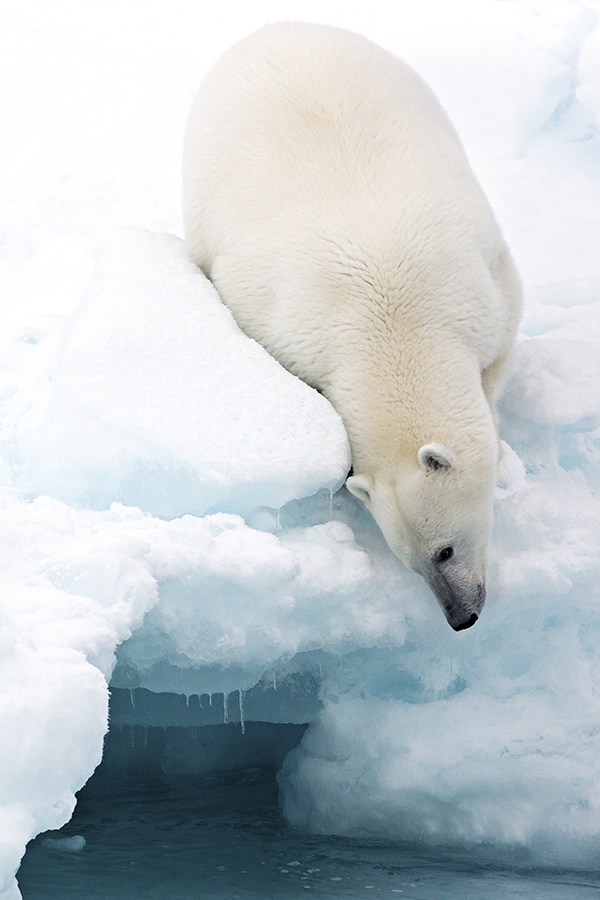
Polar bear on ice, Image credit: Marco Gaiotti
Spending a month in the Alaskan wilderness completely alone must have been transformative. How did that experience shape your relationship with nature, and with solitude? My nature has always been quite solitary. I have never had any problems spending long periods in nature without meeting other people, and that experience in Alaska was something very natural for me at that time.
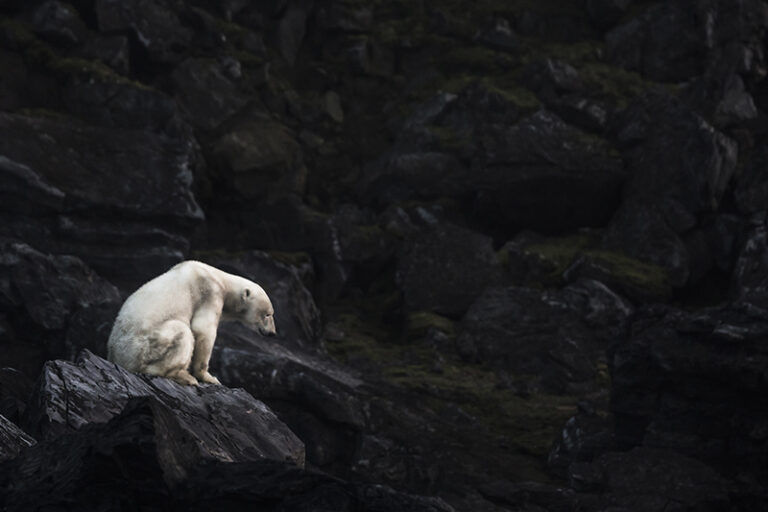
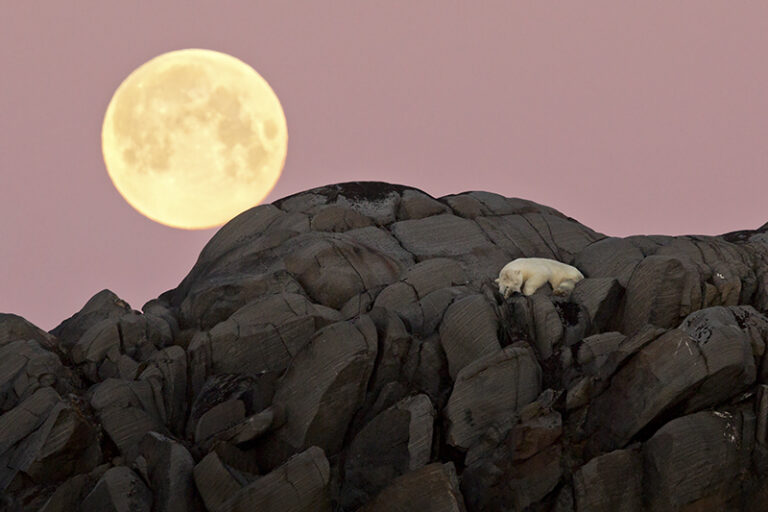
Polar bear stranded on Karl XII Island, Svalbard., Image credit: Marco Gaiotti
Your images often blur the boundary between wildlife portraiture and environmental storytelling. How do you decide when the landscape becomes the “true subject” of a photograph? I started taking pictures because I was attracted to landscape photography, and I wanted to emulate the photographers who were experimenting with new digital technologies in the early 2000s. Every now and then I took some pictures of the animals I met, and I realized that the most successful photos were those in which elements of wildlife were present. At that point I understood that nature is a combination of animal and plant life, where life is possible due to a fragile balance with the environment, and these worlds are closely connected to each other. This connection represents the most fascinating aspect for me, and it is what I try to document with my photography.
Indri indri in a forest in Madagascar, Image credit: Marco Gaiotti
Your photograph Gelada Family, highly commended at the 2024 Siena International Photo Awards, captures a powerful moment on the cliffs of the Simien Mountains in Ethiopia. What was it like to witness that scene, and what meaning does that image hold for you personally? That place for me has some of the most spectacular landscapes on our planet. Especially in the rainy season you can condense all the force of nature into a single image: wonderful and relatively confident animals, backgrounds of steep vertical walls that seem to come out of a science fiction film and storm clouds that gather to create dark atmospheres. In that image you can see the family ties of the group up close, but at the same time you can admire the threatening background showing an incoming storm, from a shooting point so high that it appears to be above the clouds at that moment.
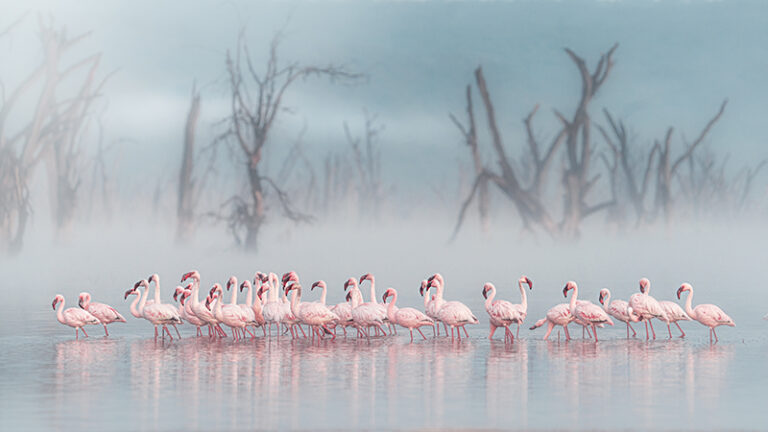
A flock of flamingos photographed on the shores of Lake Nakuru during a foggy dawn, in the rainy season, Image credit: Marco Gaiotti
From the Arctic to Africa, your work spans some of the planet’s most fragile ecosystems. How has your photography deepened your awareness of environmental urgency—and how do you aim to communicate that urgency through images? Initially, mixing landscape elements with wildlife photos had only an artistic connotation, I liked the result of what I portrayed in photos, but I did not consider conservationist aspects. Over time, awareness increased in me, and I understood that in reality many of the environments I was portraying were at risk of disappearing. Very often, we focus on the direct threats that man poses to the conservation of a species, such as hunting or poaching, but we often forget that the indirect causes are equally destructive. If land consumption leads to the deterioration, fragmentation, or destruction of a species’ habitat, it is difficult to talk about conservation.
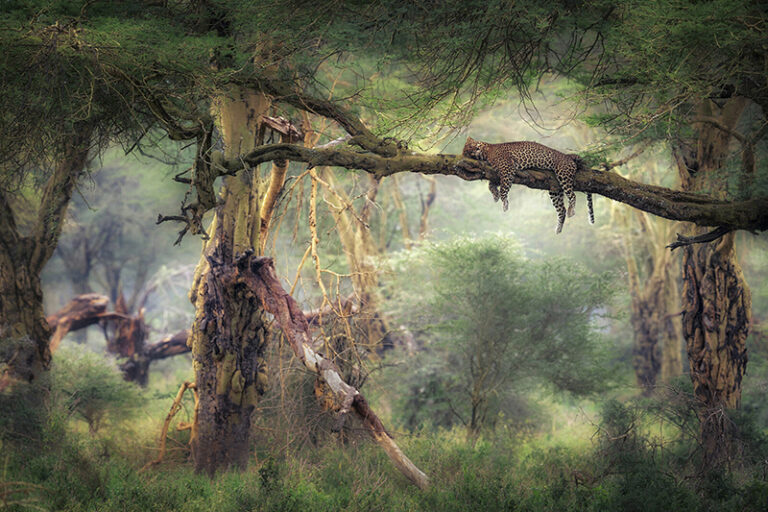
A leopard resting on a tree in Lake Nakuru National Park, Kenya, Image credit: Marco Gaiotti
In a world saturated with images, how do you craft photographs that not only capture attention but also evoke deeper reflection or action? Creating fresh, eye-catching imagery has become increasingly challenging. By incorporating landscape elements, I can expand both the compositional complexity of an image and the creative opportunities it offers, while simultaneously strengthening the conservation message tied to habitat preservation.
With a PhD in naval architecture and a role as a university professor, your background is deeply rooted in science and engineering. How do those disciplines influence your artistic vision and fieldwork approach? I actually kept these two worlds very separate inside me, I do a job where everything has to follow logical and rational processes, but at the same time in photography the creative process becomes fundamental. I struggle a bit to make the two things coexist, simply when I’m in the field it’s as if I turn off a switch and turn on another.
A wild Sumatran orangutan deep inside the Gunung Leuser National Park, Northern Sumatra., Image credit: Marco Gaiotti
You’ve contributed to projects like Prints for Wildlife and The New Big Five—initiatives that reimagine how we relate to iconic species. How do you see photography contributing to a shift in global conservation narratives? The more people you can reach, the more effective the message becomes. I think it is particularly important that people can access natural places, not just look at them in photos. I hope that with photography I can arouse curiosity and that maybe someone will want to take a look at what is happening in nature. People cannot love what they do not know, and people are not interested in protecting what they do not love. On this issue, I often disagree with some colleagues who would like for example to prohibit access to natural areas to favor their preservation, but my fear is that if nature is no longer usable by man, then the desire to conserve what remains of it will decrease.
A polar bear on a gigantic iceberg, Greenland, Image credit: Marco Gaiotti
How has your experience as an alpine skiing instructor and lover of snowy landscapes informed the way you see and move through wild environments? I worked as a full time ski instructor for almost ten years before becoming a professor. In these years, living for many months in a small mountain village, I have certainly learned to move in complex environments in adverse weather conditions and this has helped me on some trips where adaptation is essential, such as on some trips to the arctic or the Himalayas in winter.
A great egret at sunrise in the Atchafalaya Swamp, Louisiana, Image credit: Marco Gaiotti
Looking back at the journey so far—from accidental beginnings to international acclaim—what has remained constant in your creative purpose, and what continues to challenge or surprise you? I always try to have a creative approach to the image and I am very careful about everything that is the context. Before taking a photo I evaluate the background very carefully, to understand if I can position myself in order to include certain compositional elements, or to have a certain type of light. Furthermore, when I shoot I always want to have the aperture under control, to be able to decide how much to soften the foreground and the background depending on the type of atmosphere I want to create in the image.
Polar bear stranded on Karl XII Island, Svalbard., Image credit: Marco Gaiotti
Marco Gaiotti’s journey exemplifies how the most meaningful creative paths often begin with chance encounters. From his first trip to Southern Africa in 2007 to his recent acclaim at international photography competitions, his work has evolved from purely aesthetic pursuits to powerful environmental statements. As habitats continue to face unprecedented threats, Gaiotti’s distinctive approach of placing wildlife within their increasingly fragile contexts serves as both artistic expression and urgent reminder. His images don’t just show us animals; they reveal entire worlds worth preserving, inviting viewers not just to observe but to connect, care, and ultimately, to act.