Sculpture at the Threshold of Form, Material, and Imagination
When Spanish sculptor Eudald De Juana Gorriz’s work recently appeared in Hong Kong’s Harbour City Mall, thousands of passersby encountered something unexpected: sculptures that seemed to exist between worlds. These seven haunting figures, part of a commission for the film “Sons of the Neon Night” (@sons.of.the.neon.night), had traveled a remarkable journey from the artist’s studio to the Cannes Film Festival (@festivaldecannes), where the movie premiered last month after years in development.
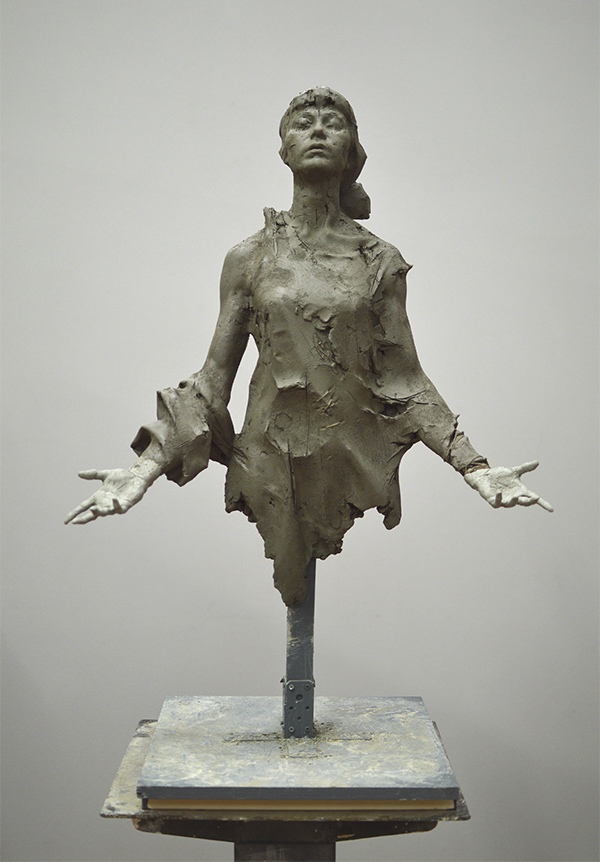
Juno from Sons of the Neon Night, Image credit: Eudald De Juana Gorriz
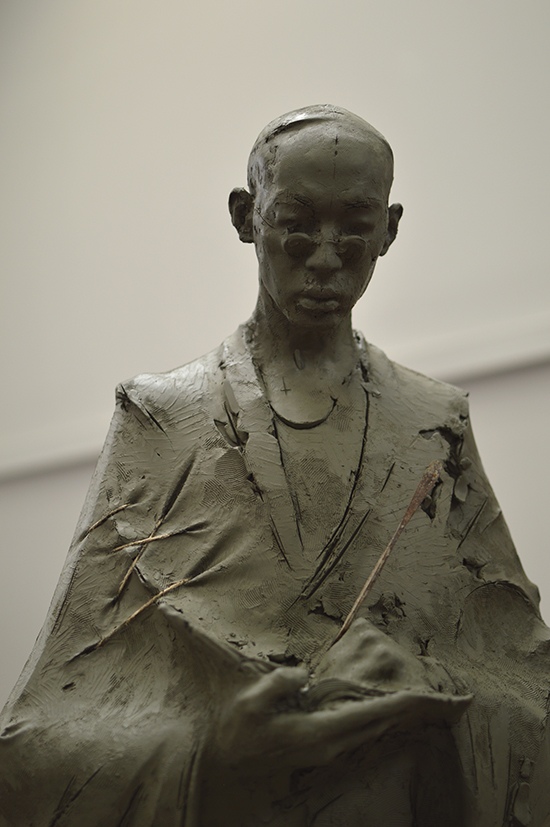
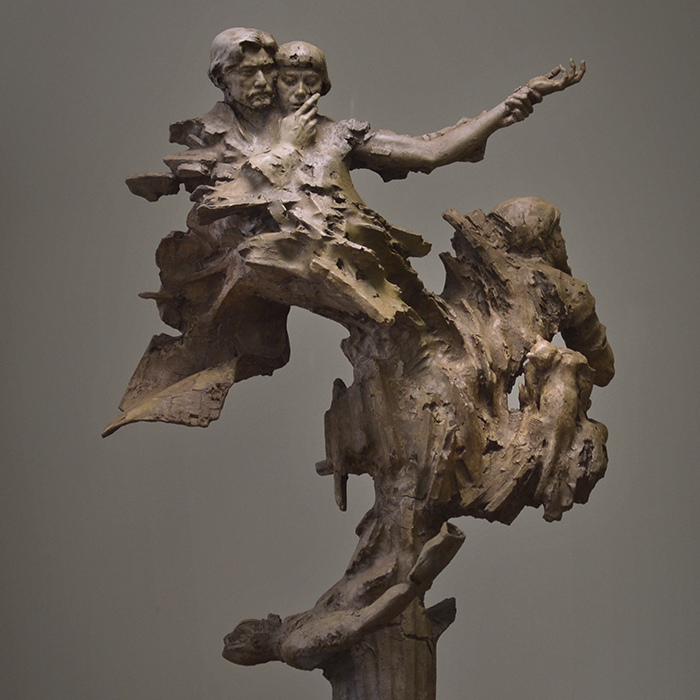
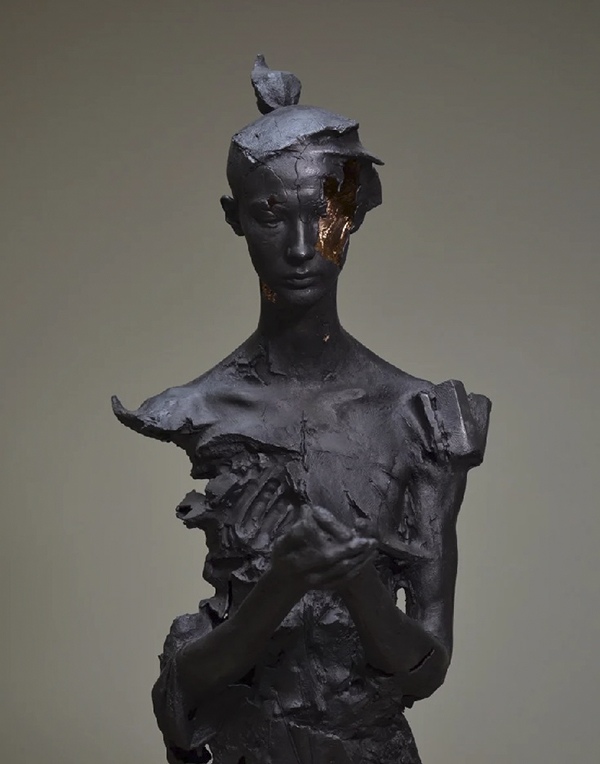
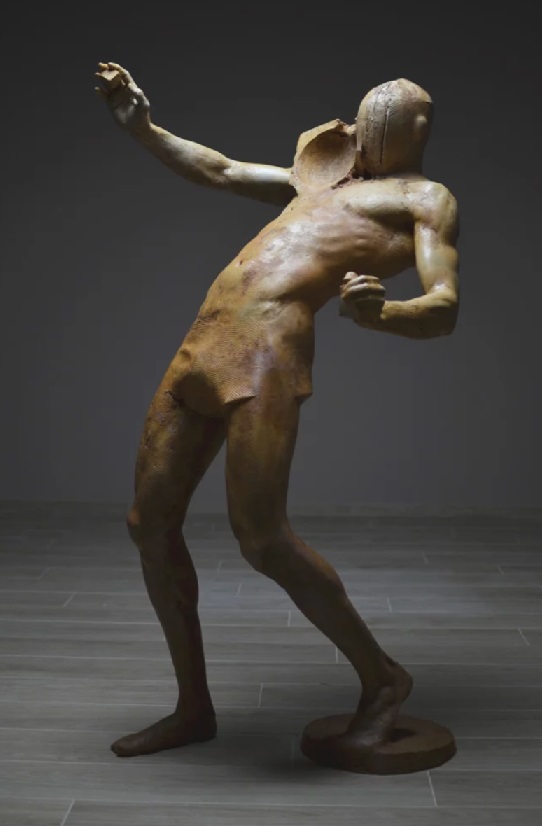
The works exemplify De Juana Gorriz’s extraordinary ability to capture psychological complexity in clay. In one piece, a female figure stands with arms outstretched in a gesture that simultaneously suggests surrender, embrace, and transcendence. Her face maintains classical serenity while her clothing appears to dissolve and fragment. Another reveals a male figure bearing the weight of complex narrative, his torso scored with deep cuts and fractures like battle scars, while his head remains meditative in its stillness. These deliberate contrasts create what the artist calls a “liminal space,” where figures seem to emerge from and return to the very material that shapes them.
In today’s art landscape, where digital mediums and conceptual installations dominate gallery spaces, Eudald De Juana Gorriz stands as a compelling anomaly. His work occupies a fascinating space where classical figuration meets contemporary abstraction, where technical mastery converges with conceptual mystery, and where the ancient medium of clay becomes a vehicle for thoroughly modern storytelling.
During our recent dialogue with de Juana Goriz in his Spanish studio, we gained profound insight into the philosophical underpinnings of these thought-provoking works, discovering an artist who inherits centuries of sculptural tradition while responding to contemporary concerns with remarkable prescience.
NIGHT SKY, Image credit: Eudald De Juana Gorriz
The Inheritance of Touch
Born into a family of sculptors, De Juana Gorriz’s relationship with clay began not as an artistic choice but as a lived reality. “We always had clay at home,” he reflects, describing a childhood where sculpture was not merely profession but lifestyle. This early intimacy with the material would prove foundational to his artistic identity, establishing what he calls “the human dimension” in his work: the visible traces of the artist’s hand that speak across centuries.
The profound impact of this tactile inheritance becomes clear when De Juana Gorriz recounts encountering a small Michelangelo terracotta: “I could feel the fingerprints, how he was passing the finger… I felt that Michelangelo was speaking to me, even 500 years after.” This moment of recognition, artist to artist across time, illuminates the deeper philosophy underlying his practice. For De Juana Gorriz, sculpture is not merely about creating objects but about encoding presence, ensuring that the human touch remains visible and meaningful.
EARTH LISTENER, Image credit: Eudald De Juana Gorriz
Academic Rebellion and Classical Mastery
De Juana Gorriz’s formal education reveals a fascinating tension between institutional expectations and personal vision. Studying Fine Arts at university in Barcelona, he navigated a curriculum that prioritized conceptual frameworks while harboring a deep desire to master figurative representation. His solution was characteristically ingenious: “I said to myself, I’m going to try to introduce figurative work, mainly figurative sculpture, in every project that I do.”
This academic period cultivated what would become a signature aspect of his mature work: the ability to embed narrative and concept within classical forms. Yet it also revealed the limitations of contemporary art education in addressing his deeper ambitions. The recognition that “there’s so many things missing” led him to the Florence Academy of Art, where he immersed himself in the rigorous training methods of nineteenth century academies.
The two years in Florence, followed by three years as an instructor, provided the technical foundation that allows his work to achieve its distinctive balance between precision and spontaneity. This classical grounding enables him to pursue what he describes as “controlled accidents,” moments where technical mastery creates space for creative surprise.
Liu from Sons of the Neon Night, Image credit: Eudald De Juana Gorriz
The Philosophy of Mystery
Central to De Juana Gorriz’s artistic vocabulary is the concept of mystery, not as obscurity but as invitation. His sculptures exist in what he eloquently describes as a “liminal space between erosion and emergence,” where forms seem to materialize from and dissolve back into the clay matrix. This aesthetic strategy serves a deeper philosophical purpose: engaging the viewer as active participant rather than passive observer.
“I want to give just enough so your mind completes it,” he explains, drawing an analogy to childhood experiences of seeing faces in wooden ceiling patterns. This approach transforms each sculpture into what might be called a “completion engine,” a work that achieves its full meaning only through the viewer’s imaginative participation.
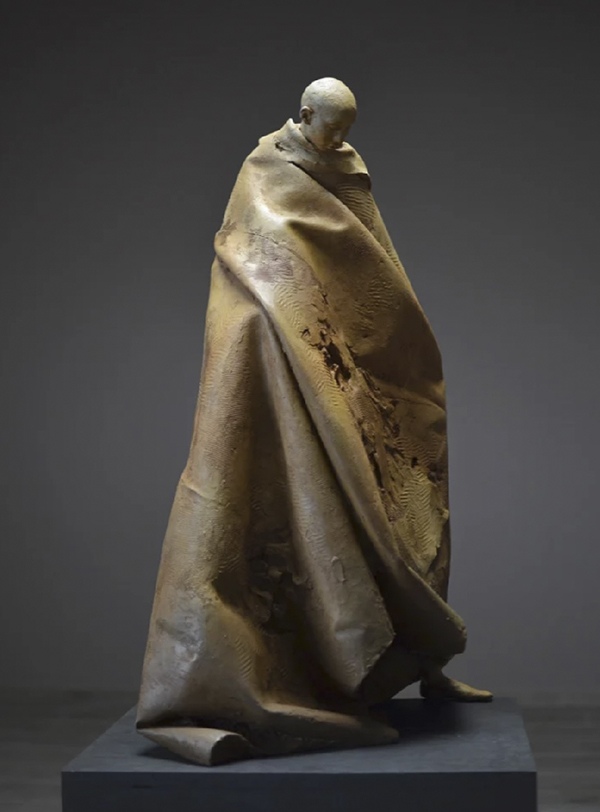
The fragmentary quality of many works serves this same purpose. Like archaeological discoveries, his sculptures suggest larger narratives while maintaining their power through incompleteness. “Maybe if it was the full figure, it wouldn’t be so interesting,” he muses, recognizing that mystery often generates more engagement than revelation.
Self-Creation in the studio, Image credit: Eudald De Juana Gorriz
Material as Medium and Message
Clay, for De Juana Gorriz, is far more than a modeling medium. It is a philosophical position. In an art world increasingly dominated by industrial materials and digital fabrication, his commitment to clay represents a conscious choice to maintain direct, physical engagement with his medium. The material’s responsiveness, its ability to capture every gesture, every tool mark, every fingerprint, makes it the perfect vehicle for his vision of sculpture as encoded presence.
This relationship with clay enables what he describes as “plastic thinking,” the ability to modify, adjust, and completely transform a work during the creative process. “There are a lot of moments where creativity really explodes,” he notes, describing those instances when the clay’s malleability allows for unexpected discoveries that redirect the entire piece.
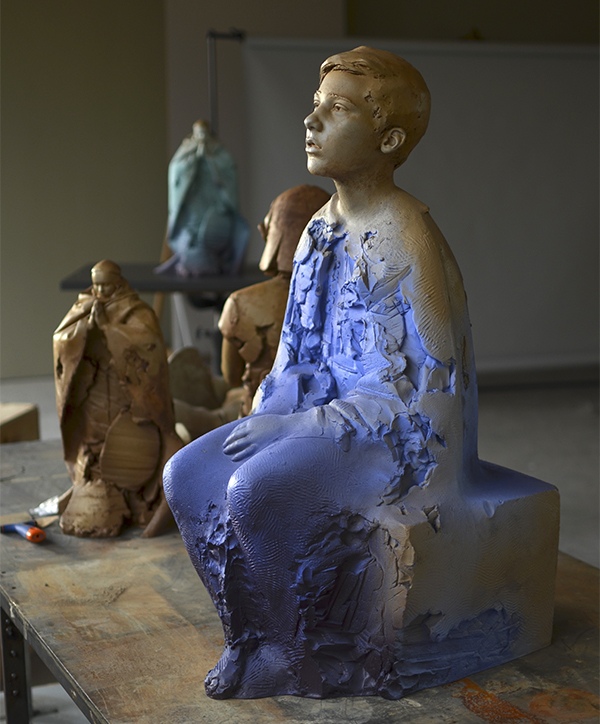
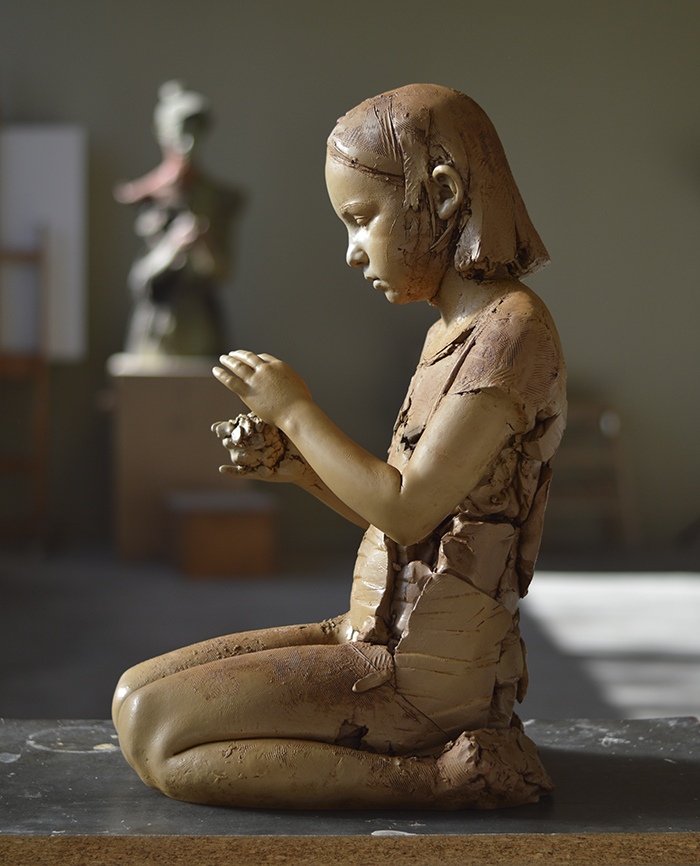
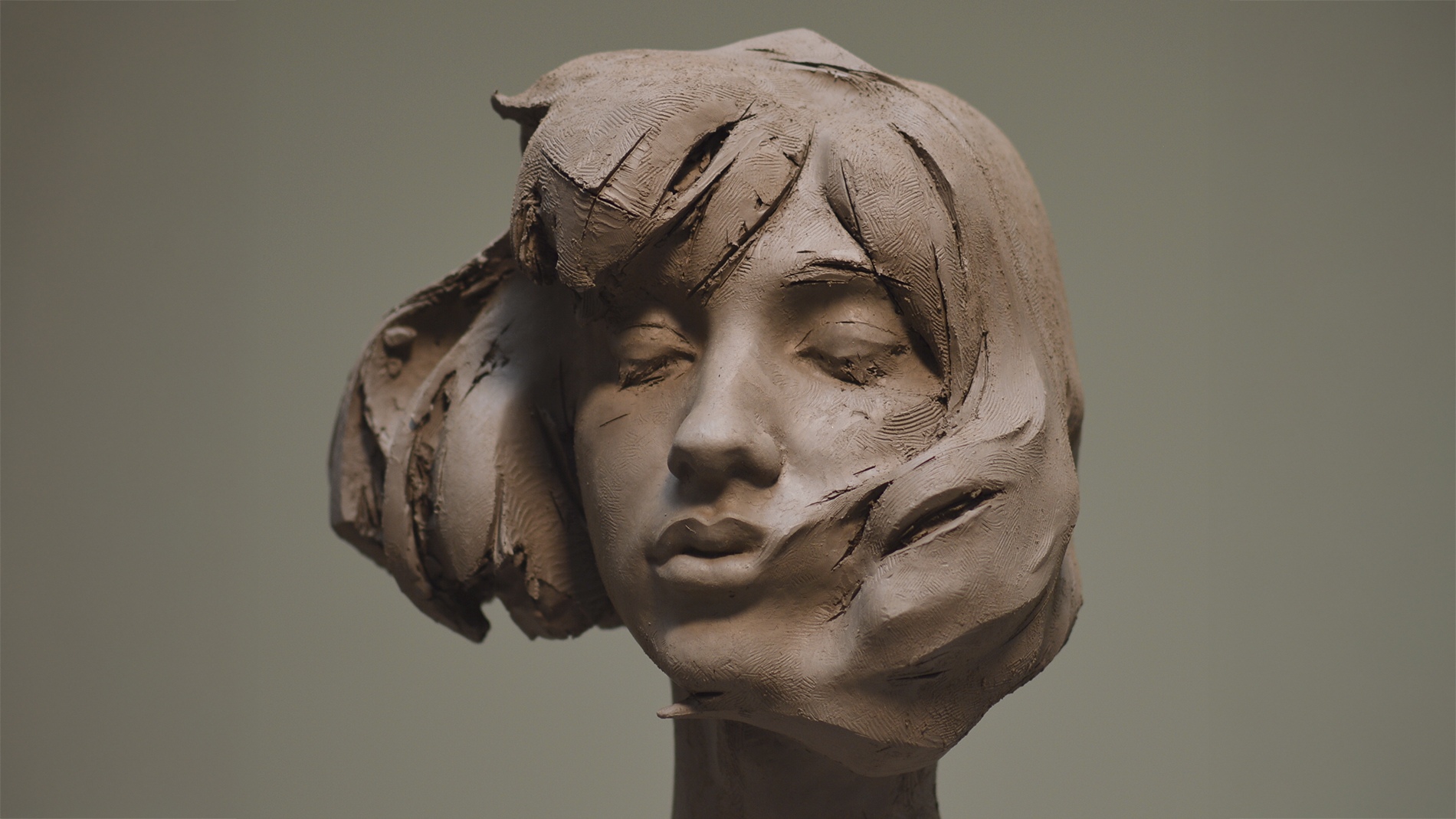
The resulting works carry what might be called a “material honesty.” Even his most realistic sculptures, when viewed closely, reveal their clay origins through subtle tool marks and surface textures. This dual reading, realistic from a distance, openly material up close, creates a sophisticated dialogue between representation and abstraction.
WIND, Image credit: Eudald De Juana Gorriz
Texture as Narrative Strategy
The evolution of De Juana Gorriz’s approach to surface treatment reveals a maturing artistic vision. While his earlier works employed more aggressive textures, his current practice favors subtlety punctuated by strategic contrasts. This refinement allows for what he calls “different subtleties of the body,” a more nuanced exploration of human form that celebrates both its anatomical precision and its expressive potential.
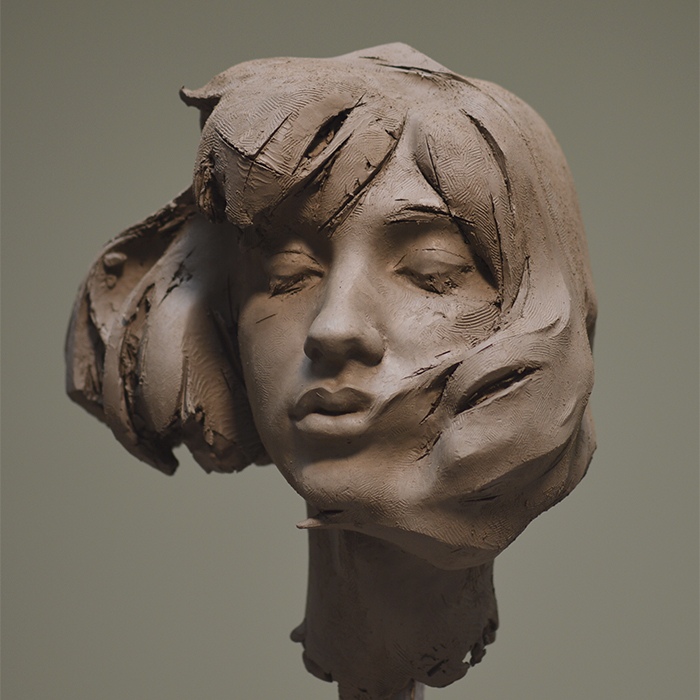
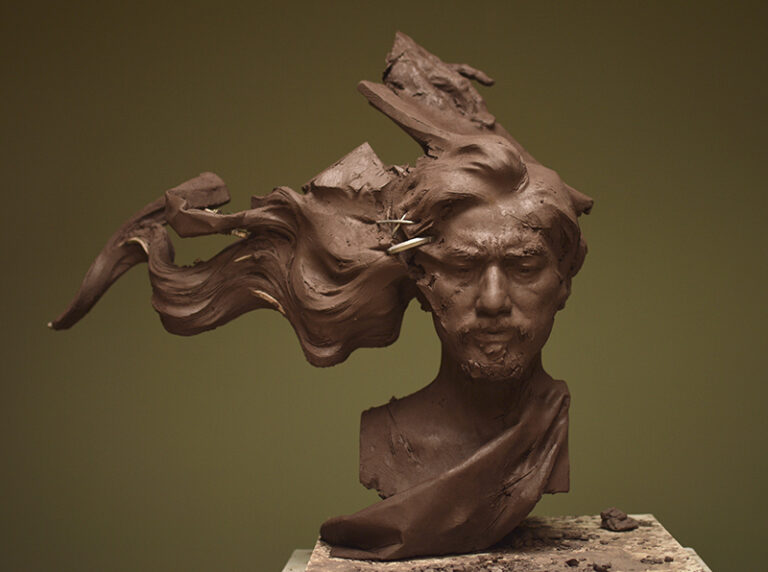
His metaphor of the “eye of the hurricane” captures this strategy perfectly: calm, detailed areas contrasted with dynamic, gestural passages that seem to capture motion and energy. A face rendered with quiet precision might be surrounded by hair that appears to move with geometric wind patterns, creating a visual tension that animates the entire composition.
Lau from Sons of the Neon Night, Image credit: Eudald De Juana Gorriz
Public Engagement and Universal Appeal
The recent installation of De Juana Gorriz’s work in Hong Kong’s harbor district represents more than exhibition strategy. It embodies his philosophy of art’s democratic potential. His belief that sculpture should speak to “all type of people, people who is educated in art, people who is not educated in art” reflects a commitment to accessibility without simplification.
This public engagement has validated his approach, generating responses from viewers who might never enter a traditional gallery. The works’ success in this context suggests that his synthesis of classical technique and contemporary sensibility creates a visual language that transcends cultural and educational boundaries.
Big Composition from Sons of the Neon Night, Image credit: Eudald De Juana Gorriz
The Cinematic Dimension
His work on the “Sons of the Neon Night” film series reveals another facet of De Juana Gorriz’s practice: the ability to translate character psychology into sculptural form. Working with filmmakers to create portraits of morally complex characters, he discovered new ways to embed narrative contradiction within his sculptural language.
These works, created for characters existing in a “really dark world, like post apocalyptic,” required him to find sculptural equivalents for psychological duality. The resulting pieces demonstrate how his signature contrasts, between soft and hard, calm and dynamic, revealed and concealed, can serve overtly narrative functions while maintaining their essential sculptural integrity.
HOPE, Image credit: Eudald De Juana Gorriz
Future Trajectories
As De Juana Gorriz looks toward future projects, including his upcoming exhibition in Lisbon, his commitment to the fundamentals remains unwavering. “The most important for me is to have time to be in the studio to enjoy sculpting,” he states, emphasizing that technical innovation and conceptual development emerge from sustained engagement with the medium itself.
This dedication to studio practice, combined with his willingness to engage with diverse contexts, from intimate gallery spaces to public harbors to cinematic narratives, suggests an artist at the peak of his creative powers. His work offers a compelling model for how contemporary sculpture might honor its material traditions while speaking to current cultural moments.
DECISIONS GAME, Image credit: Eudald De Juana Gorriz
Conclusion: The Persistence of Touch
In an increasingly digital age, Eudald De Juana Gorriz’s sculptures assert the continued relevance of direct, physical creation. His works function as arguments for the irreplaceable value of the human hand, the encoding of presence through gesture, and the capacity of ancient materials to carry contemporary meanings.
Yet his achievement extends beyond mere advocacy for traditional techniques. By creating works that operate simultaneously as classical sculptures and contemporary art objects, as figurative representations and abstract compositions, as complete statements and mysterious fragments, he demonstrates sculpture’s unique capacity to hold contradictions in productive tension.
His sculptures invite us to consider what it means to leave traces, to speak across time, to create objects that will carry the maker’s presence long after the maker is gone. In this sense, De Juana Gorriz’s work participates in sculpture’s most ancient function: the preservation and transmission of human touch across the centuries, ensuring that something essential about our embodied existence persists in material form.
Through clay and vision, technique and intuition, presence and mystery, Eudald De Juana Gorriz creates sculptures that remind us why, in an age of infinite digital reproducibility, we still need objects that can only be made by human hands touching earth.