
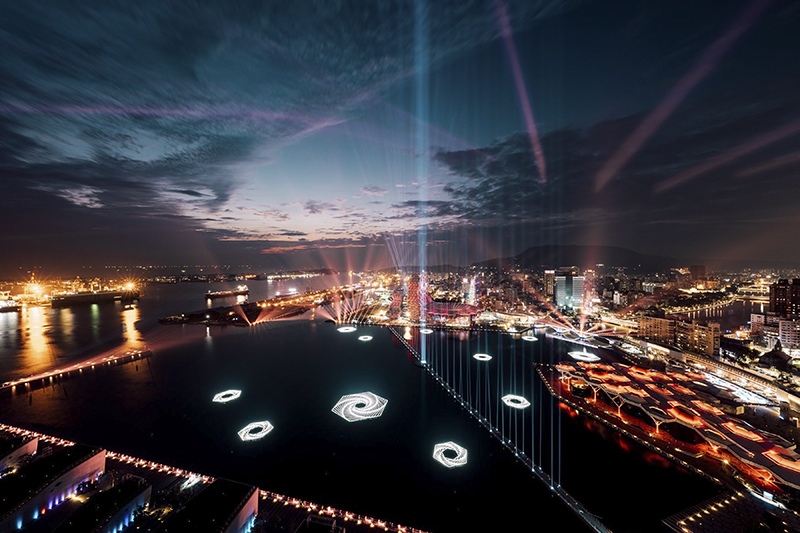
Gravity-defying light installations earn UxU Studio three Amsterdam Light Festival selections
In the dynamic realm of contemporary art, UxU Studio stands as a beacon of boundaryless innovation. This Taiwan-based multi-disciplinary collective, founded in 2013 by Kuan-Hung Chen and Ying-Chu Chen, has emerged as a singular force in the international art scene, demonstrating how local creativity can transcend geographical limitations to illuminate the global stage.
The Philosophy of Making
UxU Studio operates on a deceptively simple yet profound principle: “We often build things by ourselves.” This hands-on approach represents more than mere practicality; it embodies a philosophical commitment to understanding materials, processes, and ideas through direct engagement. The duo’s methodology of “learning by making” has become their signature, enabling them to discover what they call “the essence of things” while stimulating new creative possibilities. As they explain, “We’ve consistently doubted the full reality of designs conceived solely on paper. It’s exclusively through the act of building with our own hands, failing, and then rebuilding that we truly grasp the disposition of materials and their authentic language of possibility.” This conviction shapes their entire design philosophy: “To make is not an endpoint, but an inquiry… thought doesn’t originate solely in the mind, but simultaneously from the hand (praxis) and the tool (experiment).”
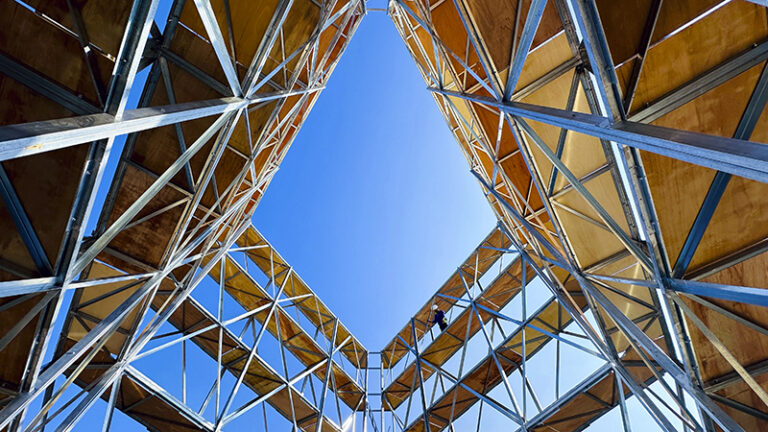
Their practice defies easy categorization, spanning architecture, interior design, retail environments, material exploration, curation, exhibition design, communication design, graphic design, and photography. Yet this breadth never feels scattered; instead, it reflects their core fascination with finding the “unusual” within the “usual”: a perspective that transforms ordinary materials and spaces into extraordinary experiences. They believe “cracks hide unknown doorways,” and the “unusual” is “a quiet call from the everyday—a discord, an instant of insight, or a forgotten trace.” This demands constant observation and engagement of their senses to perceive environmental discrepancies.
“It’s really hard to define UxU Studio,” the founders acknowledge, describing themselves as “people fanatical about creation” who enjoy “doing things without limitation and making things beyond imagination.” Their drive stems from a dedication to imagination and exploring the intricate relationships between space, materials, and craftsmanship. They describe their work as an “ongoing experiment in deconstruction and reconstruction,” openly skeptical of categories, believing that “impactful work transcends boundaries.”
International Recognition and Environmental Consciousness
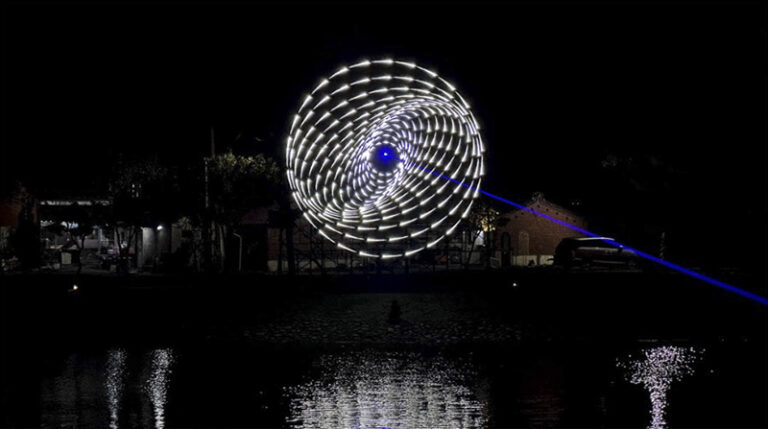
What distinguishes UxU Studio in the crowded field of contemporary art is not merely their creative output but their remarkable international reach. Few Taiwan-based art collectives have garnered such extensive global presence, with exhibitions spanning the Netherlands, United Kingdom, Sweden, Saudi Arabia, Dubai, Australia, Singapore, Japan, and South Korea. Their works—including celebrated pieces like “DESIRE,” “ILLUSION-HOLE,” and “TORNADO”—continue to tour internationally, testament to their enduring appeal and conceptual strength.
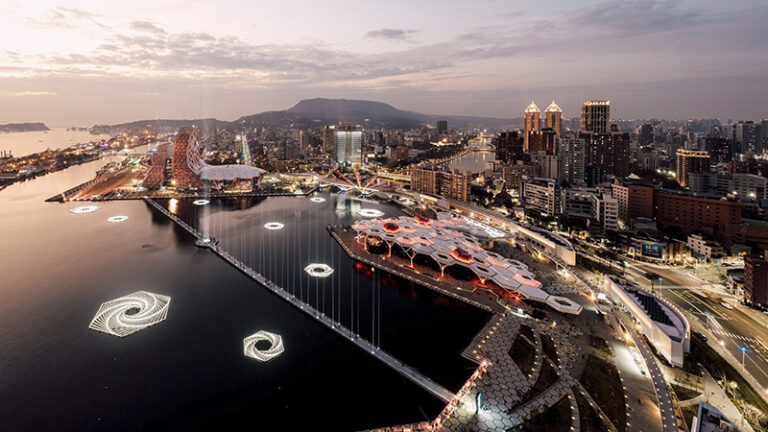
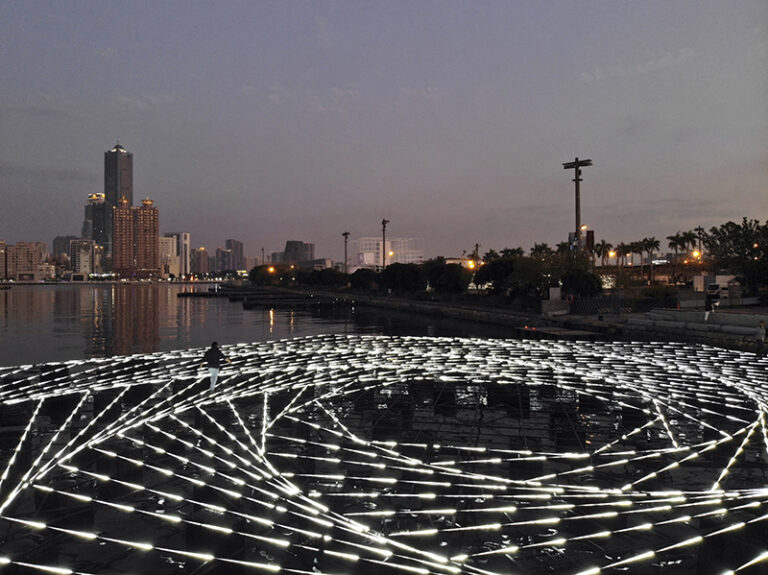
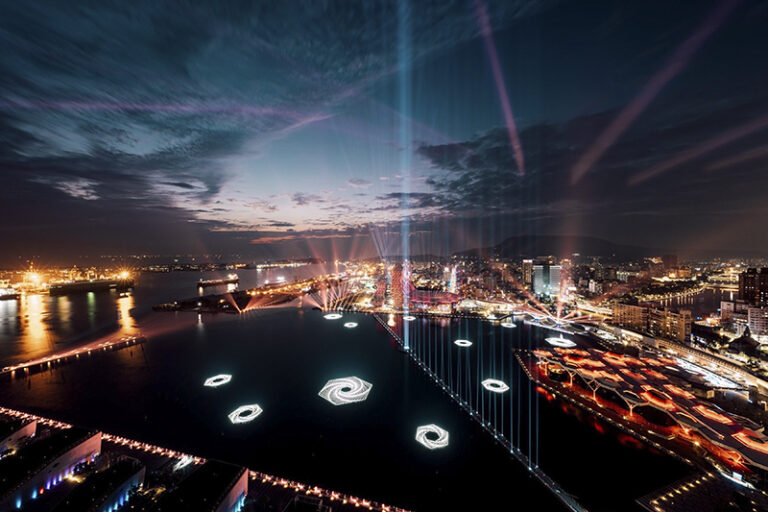
Among their most representative installations are Infinity Cube, Metaflows – Light Islands, and the Light Waterfall Series. Infinity Cube explores perceptual boundaries, built from thousands of semi-reflective mirror panels that create an immersive, fluid landscape, transforming into a dynamic sound and light performance space at night. Metaflows – Light Islands challenged their technical capabilities as it spanned nearly 4000 square meters, with all components floating across the waters of Kaohsiung Harbor, requiring on-site construction at sea and adaptation to marine conditions. The Light Waterfall Series demonstrates their commitment to adaptability, adjusting its size, structure, and display to fit diverse venues, enabling dynamic conversations with natural environments.
Particularly significant is their commitment to environmental responsibility. Through their use of found materials and carbon-footprint-conscious design principles, UxU Studio demonstrates that sustainability and innovation need not be opposing forces. Their practice offers a compelling model for how contemporary art can engage with ecological concerns without sacrificing creative ambition or visual impact.
Diverse Foundations, Unified Vision
The complementary backgrounds of the founding duo create a rich foundation for their collaborative practice. Ying-Chu Chen brings a fine arts undergraduate education and a British master’s degree in design communication, while Kuan-Hung Chen’s path led from vocational advertising design through interior design to graduate studies at Tainan National University of the Arts’ Architecture Institute—specifically he is a member of “Interbreeding Field”, renowned for its emphasis on hands-on construction and building. This combination of theoretical knowledge and practical skill has proven essential to their international success, particularly in challenging outdoor exhibition contexts that demand both creative vision and technical expertise.
Their practice spans vastly different scales, from monumental installations to intimate objects. They explain that the main difference lies in “the interaction distance and perception,” with large works prioritizing structure, views, and flow, while small ones focus on detail, texture, and bodily sensation. They humbly add, “Moving between macro and micro scales is a discipline, a humble reminder that even a screw has its universe.”
In a recent conversation with the founders at their Taiwan studio, we explored their philosophy and international practice.
The Amsterdam Light Festival Journey: A Case Study in Persistence
UxU Studio’s relationship with the Amsterdam Light Festival offers a masterclass in artistic persistence and adaptation. Their journey began in 2017 when friends suggested they submit to Amsterdam’s international call for entries following their work at the Yuejin Lantern Festival.
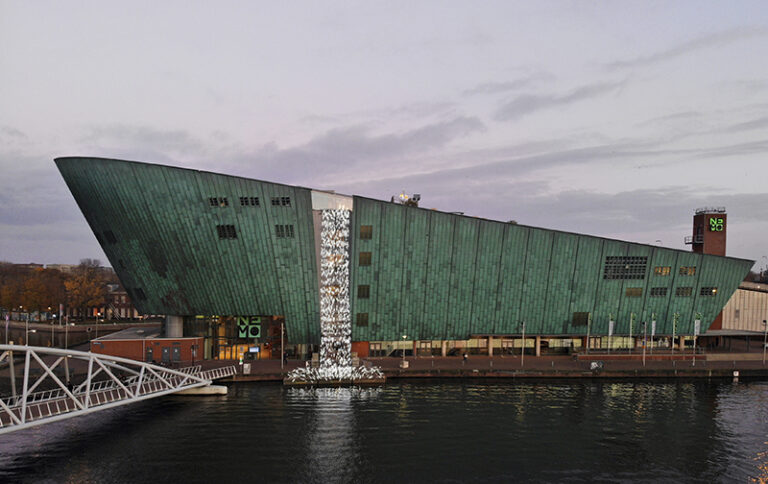
Their initial submission, “Light River,” successfully passed the first selection round but was ultimately rejected when scaled up to 20 meters for the NEMO Science Museum’s facade. This “expected” failure provided crucial insights about the need for structural simplification in large-scale outdoor works.
Armed with refined techniques, UxU Studio achieved a remarkable milestone: three consecutive years of selection from 2018 to 2020, making them the first creators from Taiwan and the broader Chinese-speaking world to achieve this distinction. Their 2020 submission, “Use Your Illusion-Waterfall,” proposed a 15-meter cascade of light bringing apocalyptic surrealism into the urban landscape. Unfortunately, the pandemic forced cancellation of all international works, though they produced a scaled-down version for the 2021 Yuejin Lantern Festival.
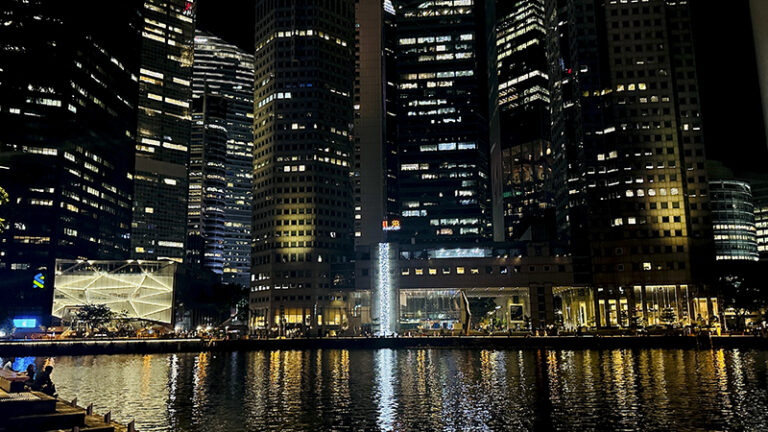
The 2022 Amsterdam Light Festival focused on previously exhibited pieces, perfectly aligning with UxU Studio’s desire to finally realize their waterfall concept in Amsterdam. They made a conceptually elegant adjustment: reversing the light flow direction to create “Inversion Waterfall,” defying gravity’s pull and creating temporal illusions that suggested time flowing backward.
The Poetry of Reversal
“Inversion Waterfall” represents more than technical innovation; it embodies a philosophical statement about possibility and resilience. This upward-flowing cascade of light challenges our fundamental understanding of natural law while creating what the artists describe as “time reverse illusions.”
The initial inspiration for the work came from the artists’ contemplation of “the city’s continuous upward expansion.” They note that this piece, to some extent, “carries a metaphor for climate change and reflects humanity’s collective anxiety about an uncertain future,” challenging “our intuitive dependence on reality” and overturning existing preconceptions. This reversal metaphor resonated particularly deeply with the 2022 Light Festival theme “IMAGINE BEYOND,” while conveying symbolic hope during a period of global uncertainty.
The symbolic meaning of “light flowing against the current” in the work suggests persistence, hope, and the possibility of creating positive change even in difficult circumstances. This multi-layered significance demonstrates the maturity of UxU Studio as artists: their ability to distill complex concepts into powerful visual forms.
Technical Innovation and Artistic Vision
UxU Studio’s international success stems from their unique ability to balance artistic ambition with practical realization. Their commitment to hands-on construction has led to innovative solutions for large-scale outdoor installations that must function reliably across extended exhibition periods. “Materials, to us, are not tools but co-creators,” they reveal. “Physical labor is a dialogue. Through grinding, welding, and assembly, we hear their internal rhythms and resistances, finding form’s logic and poetry in repeated work.” This often means “concepts are overthrown, with materials taking charge,” embracing unpredictability as “beauty is never about control, but the trace of the generative process.”
Their light-based installations represent a sophisticated understanding of how artificial illumination can transform urban spaces and public perception. When integrating technology, they clarify, “We don’t pursue technology; we make it serve emotion and narrative.” For “Inversion Waterfall,” for example, they used standard lights but focused on “the meticulous hand-arrangement of thousands of light tubes” to sketch water flow rhythms and create natural light movements. Their goal is always to see if technology can evoke “emotional resonance” in viewers, beyond just “visual stimulation.” By creating impossible natural phenomena—rivers and waterfalls of light—they blur boundaries between the natural and artificial, the possible and impossible, the temporary and eternal.
Global Impact and Future Directions
UxU Studio’s trajectory from local Taiwanese collective to internationally recognized light artists offers insights into how contemporary art can transcend national boundaries while maintaining cultural specificity. They maintain a coherent creative voice by “enjoying moving between different fields,” which fuels their passion. “Regardless of the project type,” they state, “we always start with the fundamental creative elements of space, material, and craftsmanship. From there, we seek the most impactful tension or gap to amplify.” They consistently “introduce a touch of unfamiliarity into the familiar,” prompting viewers to re examine their habitual understanding of their environment.
Their Taiwanese context has been a profound source of inspiration. Its “intensity, contradictions, and sheer diversity” has accustomed them to creating within multiple linguistic and cultural contexts, cultivating a “hybrid mode of thought.” This empowers them to engage with international audiences from their unique cultural viewpoint. Perhaps, as they suggest, their origin on a peripheral island enables them to “propose alternative perspectives and visions for the future global landscape.”
Their success in repeatedly gaining selection for prestigious international festivals demonstrates that innovative thinking, technical competence, and persistent refinement can overcome geographic and cultural barriers. Their commitment to environmental consciousness also positions them as forward-thinking practitioners whose work addresses contemporary concerns while maintaining aesthetic power.
Conclusion: Illuminating Possibilities
UxU Studio’s journey from that first Amsterdam rejection to international acclaim illustrates the value of treating setbacks as learning opportunities. Their willingness to adapt, refine, and persist has not only brought Taiwanese creativity to global attention but also demonstrated how disciplinary boundaries can be productively dissolved. Through their exploration of light as medium and metaphor, UxU Studio creates moments of urban magic that remind viewers of possibility beyond the everyday. Their “unusual” approach to “usual” materials and spaces continues to generate works that challenge perception while offering hope—proof that imagination, persistence, and skilled hands can indeed create realities beyond our normal expectations.