
A moisture-absorbing composite cools solar panels without electricity, boosting output by 13% and doubling lifespan in desert tests
In the race toward a sustainable energy future, solar power stands out as one of the most widely adopted solutions. Yet it faces a fundamental paradox: the same sunlight that powers solar panels also heats them, reducing their efficiency and lifespan. While solar panels account for more than three quarters of global renewable energy infrastructure, they convert only about 20 percent of incoming sunlight into electricity. The rest becomes heat, which not only lowers immediate output but also accelerates long-term degradation.
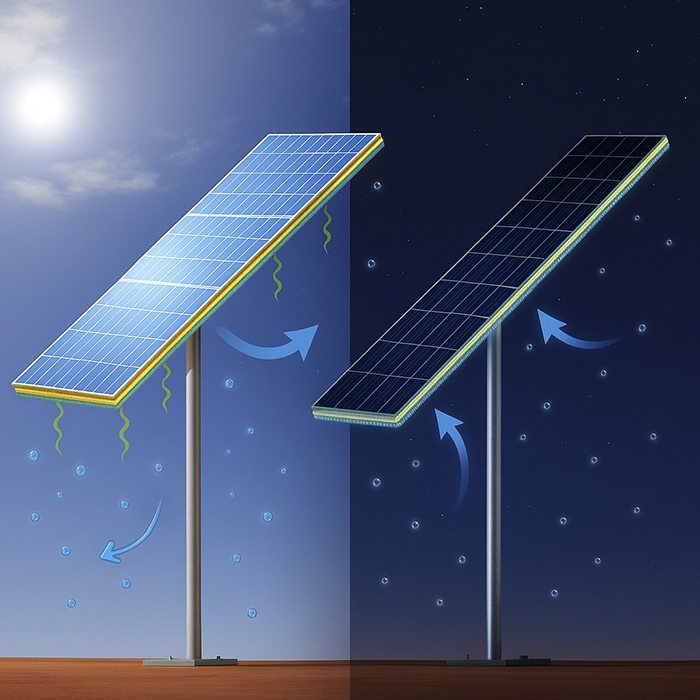
Now, a team of researchers led by King Abdullah University of Science and Technology (KAUST) may have found a transformative answer. Their breakthrough involves a low-cost, passive cooling material that requires no electricity and dramatically improves the performance of photovoltaic systems. Developed from common materials—sodium polyacrylate and lithium chloride—the composite captures moisture from the air at night and releases it during the day through evaporation. This natural process cools solar panels without the need for fans, pumps, or external power.
Tested in the extreme desert climate of Saudi Arabia, the results are striking. Solar panels coated with this composite ran 9.4 degrees Celsius cooler, produced 12.9 percent more electricity, and showed more than twice the expected operational lifespan. The cooling layer reduced electricity generation costs by nearly 20 percent, using only affordable and environmentally safe components. These findings, highlighted in a recent review in Materials Science and Engineering: R: Reports, may mark a new era in solar energy optimization.
To better understand the science and impact of this innovation, we spoke with Dr. Saichao Dang and Dr. Qiaoqiang Gan, two lead researchers on the project. Their insights reveal how this deceptively simple material could reshape the future of clean energy.
Q: What inspired your team to explore passive cooling through moisture-absorbing materials, and how did you arrive at this composite?
We were motivated by the need for low-maintenance cooling in hot climates where active systems are impractical. Early work on hygroscopic polymers showed promising results when we combined sodium polyacrylate with lithium chloride. This combination absorbs moisture overnight and cools effectively through evaporation during the day. After many lab iterations measuring performance, adhesion, and durability, we arrived at a formulation that is simple to produce, inexpensive, and highly effective.
Q: Most cooling systems require electricity. How does your material challenge the idea that cooling needs energy input?
Our material works entirely on its own. It absorbs moisture from the air at night and then cools by releasing it when exposed to sunlight. It needs no power source, no pumps, and no mechanical parts. It shows that cooling can be passive, using only ambient humidity and solar radiation to do the job.
Q: Your composite not only cools panels but increases energy output and prolongs lifespan. Do you see this as part of a new trend in solar technology?
Yes, absolutely. This approach makes solar panels more than just electricity generators. By integrating thermal control directly into the system, we gain better performance and longer durability with no extra components. It is a new way of thinking about multifunctional solar platforms.
Q: The materials you used are widely available. Was scalability a major concern in your design process?
It was one of our top priorities. From the beginning, we wanted to use affordable, safe, and globally accessible materials. Sodium polyacrylate is already used in absorbent products, and lithium chloride is a low-cost desiccant. These choices remove many of the barriers to mass production and deployment.
Q: You tested the material in both Saudi Arabia and the United States. How does it perform under different environmental conditions?
The system adjusts based on humidity. In humid regions, it absorbs more water and provides stronger cooling. In drier climates, it still works but with a smaller effect. We measured cooling of five to eight degrees Celsius even in dry conditions. The only true limitation is the availability of atmospheric moisture, which we are addressing by tuning the lithium chloride content.
Q: Could this cooling mechanism be applied beyond solar energy?
Definitely. Any application that benefits from passive cooling could use a similar structure. Building facades, greenhouse roofs, agricultural shading, even cooling textiles are possible. We are already testing coatings for building walls and exploring materials for breathable garments that stay cool in hot weather.
Q: What technical challenges did you face in developing the material for long-term outdoor use?
We focused heavily on maintaining performance under extreme heat, moisture, and wind. Ensuring that the hydrogel maintained its structure and moisture cycle over months was challenging. Adhesion to the bottom of the panel also required durability in high temperature environments. Fortunately, our year-long field testing confirmed the material holds up under real-world conditions.
Q: This project clearly required collaboration across disciplines. How did that shape your process, and what can other research groups learn from this model?
Our team includes polymer chemists, solar engineers, field testers, and materials scientists. By working together from the start, we moved quickly from concept to practical implementation. KAUST provided the infrastructure and open research culture that made this interdisciplinary approach possible. The key lesson is to involve both theoretical researchers and application engineers from day one.
Q: As demand for solar energy grows, what role do you see passive materials playing in future infrastructure?
They are essential. Passive systems offer reliable performance with no power input. They are easy to scale and can be added to existing solar modules. As more solar farms are built in hot regions, built-in thermal protection will be vital for efficiency, cost control, and long-term system resilience.
Q: What steps are needed for commercial adoption of this technology?
We are looking at pilot programs with utility providers and solar panel manufacturers. The composite can be applied during manufacturing or retrofitted to existing installations. Commercial success will depend on demonstrating return on investment—energy gains and lifespan improvements must outweigh the initial costs. Support from policymakers would also help, especially by updating solar standards to include thermal management and by offering incentives for improved efficiency in hot climate installations.
Conclusion
The KAUST team has introduced a new class of passive materials that do not simply supplement solar energy systems but enhance and protect them from within. This moisture-activated layer improves power generation, extends operational life, and requires no external energy or maintenance. It is a self-regulating, low-cost addition that could significantly improve the performance of solar installations, especially in regions where the need for renewable energy is greatest.
As climate change drives demand for more resilient and efficient infrastructure, innovations like this composite material will be critical. By embedding intelligent cooling directly into solar panels, the research team is helping to create a smarter, more robust solar future. With early results already proving successful across different environments, this technology is well-positioned to move from the lab into the global energy landscape.
Solar power is becoming not just cleaner, but cooler—and more efficient—by design.