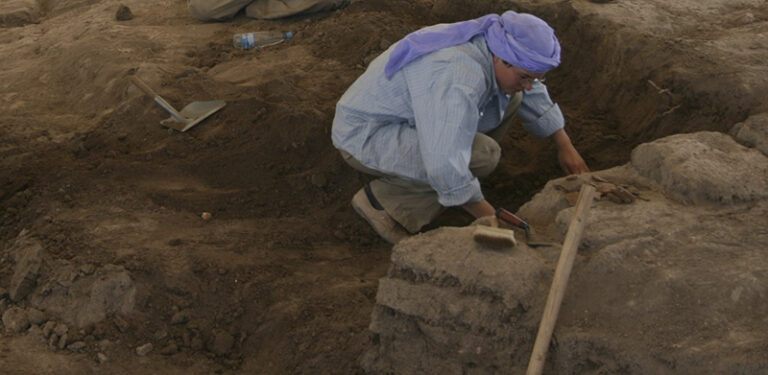
Eva Rosenstock during the excavations at Çatalhöyük West in 2008. In the foreground, we can see a mudbrick wall from the buildings dating from the 6th millennium BCE. Image credit: Çatalhöyük Research Project
New DNA evidence from Çatalhöyük reveals a 9,000-year-old civilization where women may have held the social reins
When archaeologist James Mellaart first excavated the ancient site of Çatalhöyük in the 1960s, he made a bold claim that would haunt his career for decades. Based on the abundance of female figurines and goddess imagery scattered throughout the ruins, he proposed that this Neolithic settlement in central Turkey might have been a female-centered society. The archaeological establishment dismissed his theory as romantic speculation, pointing out that beautiful art depicting women could easily coexist with deeply patriarchal power structures.
More than half a century later, Mellaart’s intuition appears to have been remarkably prescient. A groundbreaking study published in Science has used cutting-edge ancient DNA analysis to peer into the domestic lives of people who lived at Çatalhöyük between 7100 and 5500 BCE. What researchers discovered challenges fundamental assumptions about how early societies organized themselves around gender, kinship, and power.
The DNA Revolution at a 9,000-Year-Old City
Located near modern-day Konya in Turkey, Çatalhöyük was home to thousands of people across more than 1,500 years, making it one of the world’s most significant Neolithic sites. Its dense urban layout and unique burial practices created ideal conditions for preserving both human remains and social patterns across generations.
The breakthrough came from an international team around Prof. Dr. Mehmet Somel based at the Middle East Technical University in Ankara, who extracted DNA from 131 human skeletons buried beneath house floors. This was no easy feat. The harsh continental climate of central Anatolia, with its scorching summers and freezing winters, destroys most genetic material. But scientists discovered that the petrous bone, part of the temporal bone near the ear, preserves DNA remarkably well even under these conditions.
What they found was extraordinary. When genetic relationships existed within households, they were traced primarily through the maternal line. Women appeared to form the stable core of domestic groups, while men likely moved in upon marriage or partnership. Many individuals buried together weren’t genetically related at all, yet isotopic analysis of their bones revealed they shared remarkably similar diets. They were eating together, creating bonds of kinship through commensality rather than blood.
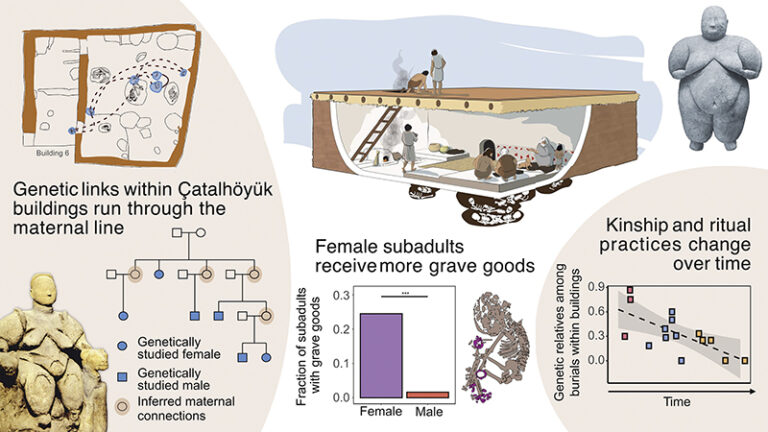
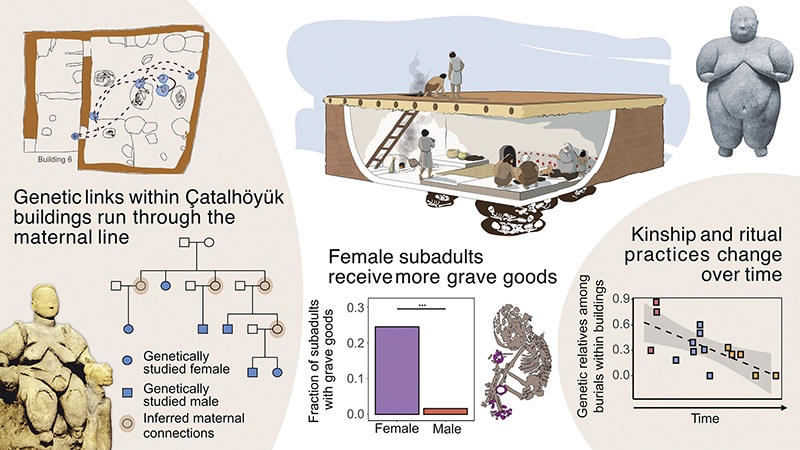
Female-centered practices and changing kinship patterns over time in Çatalhöyük.
Shown are two Çatalhöyük figurines (credit: Mellaart International and the British Institute at Ankara). Centre: reconstruction of a typical Çatalhöyük building (credit: Kathryn Killackey). Left: Building 6 with six genetically studied burials (blue on building map) and their genetic connections (lines), and their inferred pedigree. Centre: Grave good frequencies and a stylized female infant burial with beads shown in purple. Lower right: The frequency of genetic relatives within 15 buildings, spanning about 500 years (bottom right)., Image credits: (BOTTOM LEFT) MELLAART INTERNATIONAL; (TOP CENTER) K. KILLACKEY; (TOP RIGHT) THE BRITISH INSTITUTE AT ANKARA, Source: https://www.science.org/doi/10.1126/science.adr2915
A Society Built on Radical Equality
The genetic data reveals only part of Çatalhöyük’s remarkable social experiment. This was a fiercely egalitarian society that seemed designed to prevent the accumulation of wealth or power by any individual household. Archaeological evidence shows minimal differences in house size, construction quality, or burial goods. There are no elite residences, no obvious temples, no clear evidence of a ruling class.
Perhaps most tellingly, consider how people moved around their city. Houses were built so tightly together that many had no doors or windows. The only way in was through an opening in the roof. To reach your home, you had to walk across your neighbors’ rooftops. “This arrangement requires that they really liked each other,” Dr. Eva Rosenstock, an archaeologist from the Bonn Center for ArchaeoSciences observes. “You wouldn’t do that if you were fighting with your neighbors.”
This architectural choice wasn’t just social. In the harsh climate of central Anatolia, clustering homes provided protection from cold winters while thick mud roofs minimized heat from summer sun. But it also enforced a kind of radical interdependence that made individual wealth accumulation nearly impossible.
The burial evidence adds another intriguing layer. While grave goods were generally modest across the site, girls and women tended to receive more elaborate items than boys and men. This could indicate the special importance placed on female roles, particularly in a society where successful child-rearing required extensive community support and where breastfeeding lasted two to three years.
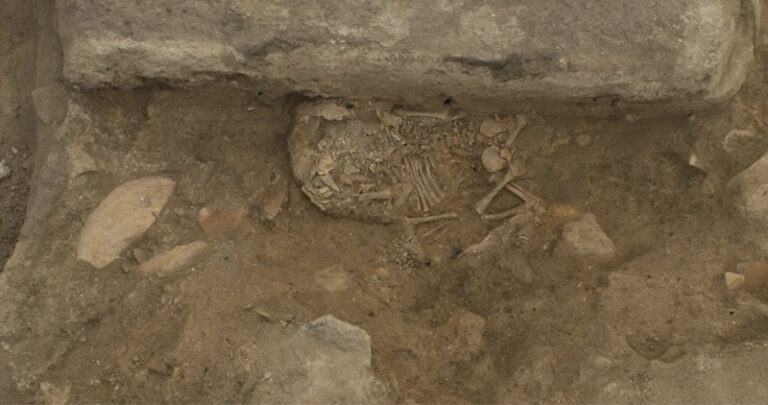
The newborns from the West Mound at Çatalhöyük were buried between 5900 and 5800 BCE, being laid on their stomachs with their head and legs turned to the left. The well-preserved skeleton was dug up by Jana Anvari in 2009. Eva Rosenstock and Peter F. Biehl led the excavations. Both skeletons were subjected to osteological analysis by Jennifer Byrnes. Image credit: Çatalhöyük Research Project/Peter F. Biehl
When Communities Split: Understanding the East and West Mounds
Çatalhöyük consists of two main areas: the earlier East Mound (7100-6000 BCE) and the later West Mound (6000-5500 BCE). For decades, archaeologists debated whether these represented one continuous culture or entirely different populations. Some even proposed violent conquest scenarios to explain the transition.
Between 2006 and 2013, Rosenstock co-directed excavations at the West Mound to settle this question. Using radiocarbon dating and ceramic analysis, her team demonstrated at least 50 to 100 years of overlap between the two settlements. The DNA from two infant burials they recovered confirmed biological continuity as well.
Perhaps, the move from East to West Mound was a consequence of the 8.2-kiloyear climate event, a period of significant cooling that affected much of the Northern Hemisphere. Evidence suggests the community adapted by shifting to more drought-tolerant crops and adjusting their animal husbandry practices. Rather than abandoning their ancestral site entirely, they relocated just across what was probably the Çarşamba River.
The relocation may also have been practical. By its final phase, the East Mound had grown to 20 meters high. “Sometimes I think maybe people were just fed up with crawling up 20 meters several times a day,” Rosenstock admits with a laugh.
Redefining Family in Ancient Times
One of the most profound implications of the Çatalhöyük research concerns how we understand family and household formation. The genetic evidence suggests that people deliberately exchanged children between families, possibly as a way to maintain social bonds and prevent any single household from gaining too much power or resources.
This practice makes sense in a society committed to egalitarian principles. “We see that the site is trying to keep differences between households as low as possible,” Rosenstock explains. “Exchanging children would be a way to establish bonds beyond the genetic family and between households.”
The result was a community where households functioned more like the Roman concept of familia, which included not just blood relatives but also adopted members, and anyone who shared daily life and meals. “They were living in a commensality community because they were eating together,” Rosenstock notes. “I think that’s a pretty charming concept.”
The Great Transformation: From Equality to Hierarchy
As Neolithic cultures spread into Europe, this flexible, community-focused model gave way to more hierarchical systems based on patrilocal residence, where women married into men’s families. What caused this profound social shift?
Rosenstock suggests that migration itself may have been the catalyst. “A communal household model might have been too rigid for groups on the move. It would have been extremely inflexible to move with 100 people as one entity and put them into boats.” Small, maybe household-based units probably proved more practical for the maritime journeys that brought agriculture across the Aegean into Greece and the Balkans.
The demands of mobility may have necessitated more tightly organized kinship-based units, which eventually enabled the more male-centered patterns that dominated later European prehistory. It’s a sobering reminder that even social innovations can be abandoned when circumstances change.
Lessons for Modern Times
The careful distinction between sex and gender runs through all of Rosenstock’s work. “What we can determine with ancient DNA is biological sex, while gender is a role that you assume and can change somewhat independently from your sex,” she emphasizes. This precision matters when interpreting ancient societies and their relevance to contemporary debates.
Rosenstock’s current research explores both sides of this gender equation. While Çatalhöyük appears to have provided an environment favorable to women, her work on early Central European farming communities reveals the opposite pattern. There, females show signs of developmental disadvantage, including stunted growth that the World Health Organization considers a red flag for malnutrition or social neglect.
“So it’s interesting that I have both models in the cultures I study,” she reflects. Understanding why such different systems emerged in neighboring regions could illuminate the conditions that promote gender equality versus those that enable its opposite.
The Enduring Mystery of the Missing Dead
One puzzle that continues to baffle researchers is the fate of most of Çatalhöyük’s deceased. The 400 skeletons recovered from beneath house floors represent only a fraction of the people who must have died during the site’s 1,500-year occupation. There is no cemetery, no evidence of cremation, no obvious alternative burial ground.
“We have absolutely no idea where the other dead were disposed of,” Rosenstock admits. “It’s possible we’re missing some dead who were buried elsewhere or disposed of without formal burial, just put out in nature to decompose naturally.”
This missing majority raises questions about social status, age-based burial practices, or religious beliefs that we may never fully understand. Were subfloor burials reserved for certain individuals? Did most people receive sky burial or other forms of disposal that leave no archaeological trace? The mystery adds another layer to Çatalhöyük’s enigmatic social system.
Validating Archaeological Intuition
Perhaps most remarkably, the new DNA evidence validates the intuitive insights of earlier generations of archaeologists. Mellaart’s theory about female-centered society, dismissed for decades as unscientific speculation, appears to have been largely correct.
“It’s remarkable how often archaeologists of the early 20th century generation were right just based on intuition,” Rosenstock observes. “Now we have the instruments to actually test these hypotheses, and many of them were correct.”
This pattern extends beyond gender relations to other aspects of ancient life. Time and again, careful scientific analysis has confirmed insights that earlier scholars developed through close observation and cultural intuition. It’s a humbling reminder that technological sophistication doesn’t always trump human insight.
Rethinking Human Possibilities
At a time when contemporary societies are questioning traditional assumptions about gender, kinship, and family structure, the example of Çatalhöyük offers both inspiration and perspective. For over a millennium, thousands of people successfully organized their lives around principles of radical equality and flexible kinship. They created a system that minimized economic inequality, prevented the concentration of power, and appears to have valued female roles and contributions.
This wasn’t a perfect society. Life was hard, infant mortality was high, and we know little about how conflicts were resolved or how individual agency was balanced against community needs. But it was undeniably a different kind of human experiment, one that challenges assumptions about the inevitability of hierarchy and male dominance.
The lessons from Çatalhöyük suggest that human societies have always been more diverse and innovative than we typically imagine. Looking to examples like Israeli kibbutzim or contemporary matrilocal societies in Indonesia, we can see that alternative forms of social organization remain not just possible but functional.
As Rosenstock continues her research into how these egalitarian systems gave way to more hierarchical ones, she’s mapping the deep history of human social experimentation. In understanding the diversity of our past, we might discover new possibilities for our future. What if the next great social innovation lies not in inventing something entirely new, but in rediscovering wisdom that worked for our ancestors 9,000 years ago?
The people of Çatalhöyük managed to create a society where cooperation trumped competition, where community bonds transcended blood relations, and where women may have held central roles in organizing social life. Their success suggests that the range of human possibility remains far wider than our current world might lead us to believe.