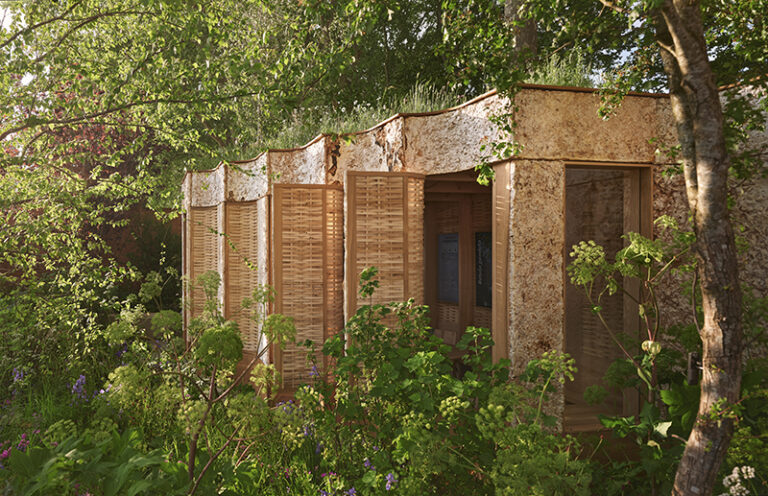
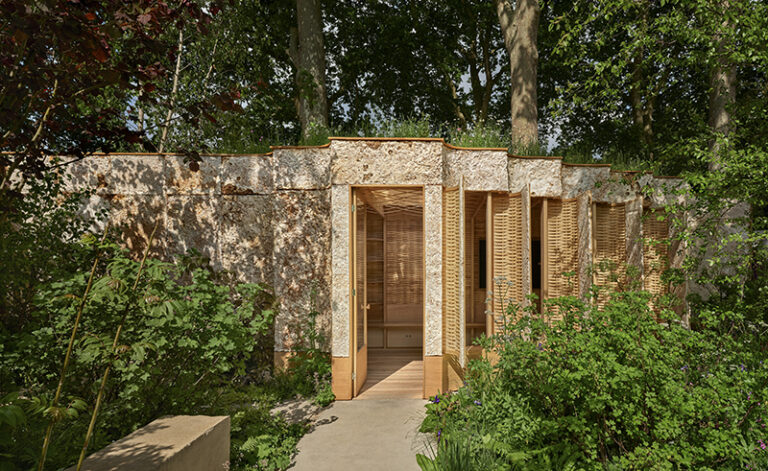
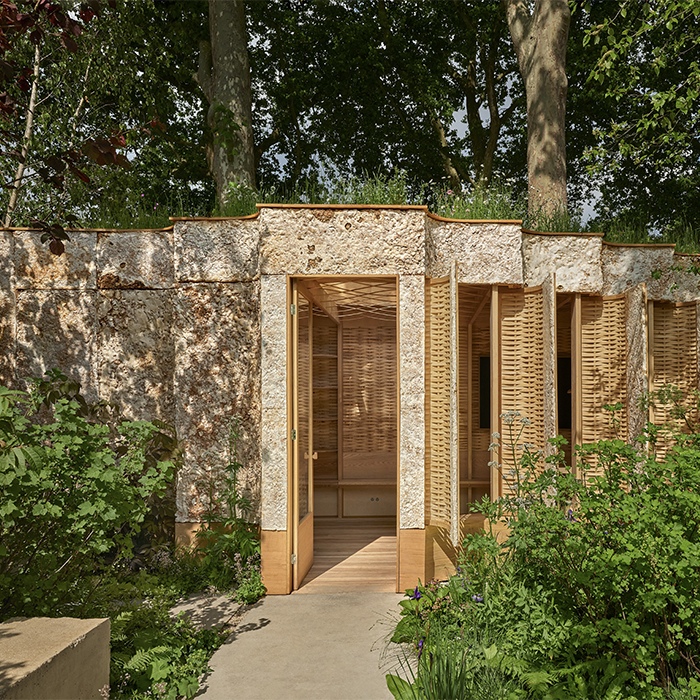
Fluted mycelium facade of Studio Weave's Intelligent Garden pavilion at Chelsea Flower Show 2025. Designed by Studio Weave in collaboration with Tom Massey and Je Ahn. Image credit: Daniel Herendi
How a Revolutionary Garden Is Rethinking the Future of Urban Green Spaces
A revolutionary idea took root among the blossoms at this year’s RHS Chelsea Flower Show in London. It was a garden that thinks. Known as the Avanade Intelligent Garden, the creation was more than just an award winning display; it was a glimpse into the future of our cities. Indeed, the project was so compelling that its creators, a unique partnership of the London architectural practice Studio Weave, landscape designer Tom Massey, and craftsman Sebastian Cox, were crowned with both a Gold Medal and the show’s Best Construction Award.
But what does it mean for a garden to think?
“We wanted to ask a fundamental question,” explains Tom Massey, the project’s landscape designer. “Could we create a space that not only showcases beauty, but actively partners with nature to solve a real urban problem?”
That problem is one of modern cities’ greatest challenges: how to keep trees alive amid the constant stress of climate change, pollution, and poor soil. This project is no ordinary garden installation; it is a living laboratory designed to find a solution. Through an ambitious fusion of artificial intelligence, sustainable materials, and traditional craftsmanship, the Avanade Intelligent Garden points toward a future where cities do not just plant trees, but actively help them thrive.
Locally sourced wood and mycelium construction detail from Studio Weave's Intelligent Garden pavilion, Chelsea Flower Show 2025. Designed by Studio Weave in collaboration with Tom Massey and Je Ahn. Image credit: Daniel Herendi
The Silent Crisis in Our Cities
Urban trees are essential. They cool overheated streets, capture carbon dioxide, reduce the risk of flooding, and support local ecosystems. Yet according to a recent report by the UK’s Forestry Commission, nearly half of all newly planted trees in urban settings do not survive beyond ten years, and up to one third perish within their first year. These losses are not only financial setbacks but also environmental ones.
A newly planted tree typically takes sixteen years to become carbon neutral and may need up to fifty years to reach its full ecological potential. When trees die prematurely, cities lose decades of ecological benefits that are increasingly difficult to replace.
A Garden That Listens and Learns
The Avanade Intelligent Garden responds directly to this issue. Hidden within the landscape are advanced environmental sensors that continuously measure factors such as soil moisture, sunlight, temperature, and nutrient conditions. This information is relayed to artificial intelligence systems that can detect early signs of stress, identify watering needs, and recommend optimal growing conditions.
But the purpose is not to replace human gardeners. “Gardeners will always need a place to care for their plants from, something that technology can never truly replace,” the creators explain. The artificial intelligence serves as a powerful support system, giving gardeners insights that would otherwise be impossible to gather in real time.
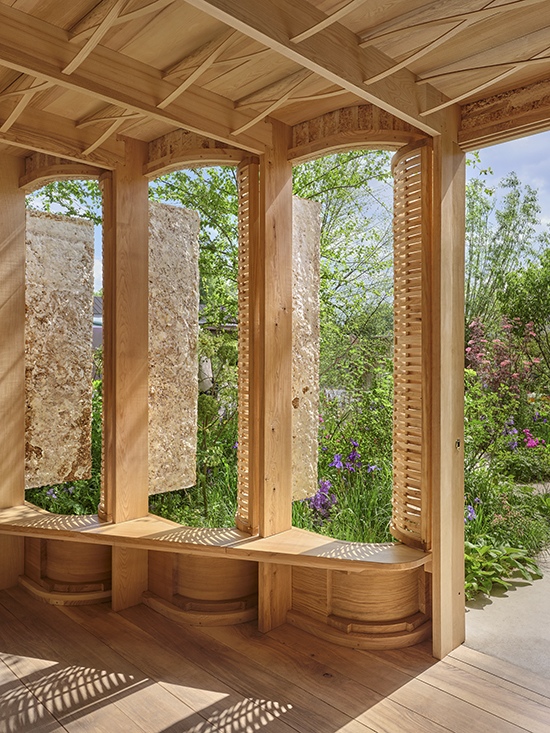
Flexible screening system using ash wood and mycelium at Studio Weave's Intelligent Garden pavilion, Chelsea Flower Show 2025. Designed by Studio Weave in collaboration with Tom Massey and Je Ahn. Image credit: Daniel Herendi
A Pavilion That Breathes
At the center of the garden stands a striking structure that reimagines the very materials we use in construction. Designed by Studio Weave and built by Sebastian Cox, the garden pavilion uses locally sourced ash wood and a remarkable biological material called mycelium, which is the root like network of fungi.
The mycelium components were cultivated in Cox’s Kent workshop using agricultural byproducts. The result is a material with a soft, suede like texture that is fully compostable and even removes carbon dioxide from the atmosphere during its production. When the structure is no longer needed, it can return to the soil without harming the environment.
The ash timber tells a story of recovery and purpose. Taken from trees affected by the ash dieback disease, this wood might normally be discarded. Instead, it is transformed into elegant fluted surfaces that catch light and shadow, still holding the faint, clean scent of cut wood. Smaller pieces, usually seen as waste, are integrated into the intricate woven walls, ensuring that nothing is lost.
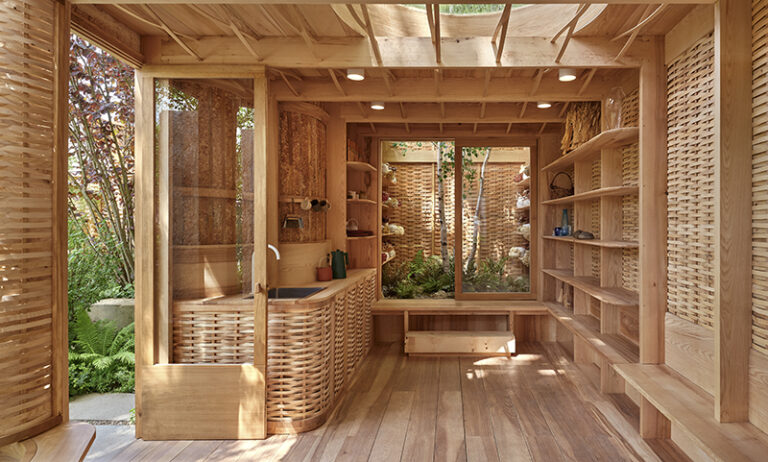
The kitchenette area of Studio Weave's Intelligent Garden pavilion, Chelsea Flower Show 2025. Designed by Studio Weave in collaboration with Tom Massey and Je Ahn. Image credit: Daniel Herendi
Where Craftsmanship Meets Innovation
The building symbolizes the harmony between tradition and technology. Its woven ash structure draws from age old building techniques, while its mycelium cladding represents the forefront of biotechnological innovation. The result feels timeless and forward looking at once.
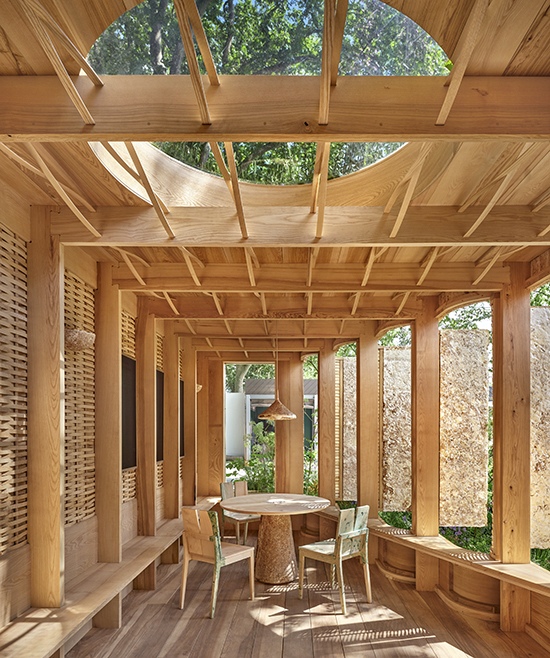
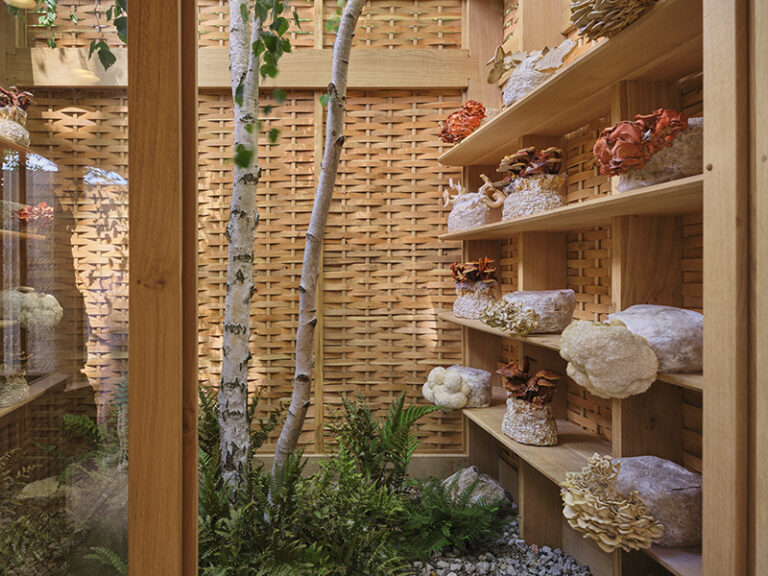
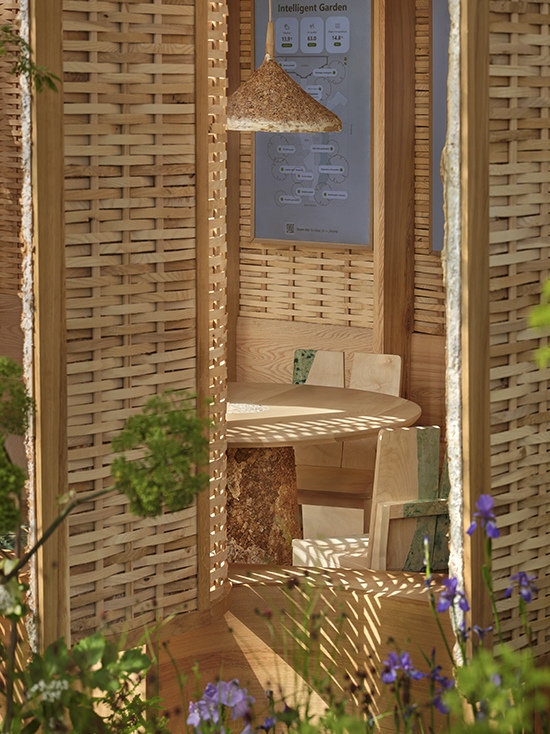
Inside, the structure is designed to serve many functions. There is a table for workshop gatherings where gardeners can study environmental data and make plans. A kitchenette provides space for daily tasks. In the garden courtyard, known as the mushroom room, the darker, cooler environment encourages fungal growth and introduces visitors to the fascinating world of mycelium biology.
Designed for Renewal
Understanding that the Chelsea Flower Show installations are temporary, the design team built this structure with longevity in mind. The entire building is composed of prefabricated modules that can be taken apart and rebuilt elsewhere. Assembly on site took only one week. After the show, the pavilion will move to Manchester Mayfield Park, where it will become part of a long term urban green transformation.
This principle of reuse reflects the team’s broader philosophy: sustainable design must include the entire lifespan of a project, from origin to reinstallation.
Studio Weave's Intelligent Garden pavilion features a dedicated "mycelium parlour" space, Chelsea Flower Show 2025. Designed by Studio Weave in collaboration with Tom Massey and Je Ahn. Image credit: Daniel Herendi
Whispers of Data in the Dirt
One of the garden’s most important achievements is the way it blends technology into the natural world. The sensors and data tools are not intrusive. They are embedded in the design, just like any other gardening implement. Visitors encounter them as naturally as they would a trowel or watering can.
This integration makes emerging technology approachable. Artificial intelligence is not presented as complex or distant but as a helpful tool that gardeners of all experience levels can use to better care for their landscapes.
A Model for Future Cities
The vision presented by the Avanade Intelligent Garden has applications far beyond this single display. Cities everywhere face increasing climate stress, population density, and biodiversity loss. Smarter and more adaptable green spaces are essential. This garden presents a realistic and achievable path forward.
By combining artificial intelligence with locally sourced materials and craft knowledge, the project demonstrates that progress and tradition can work together. Sustainability does not have to mean compromise. With thoughtful design, it can mean enhancement.
Studio Weave's Intelligent Garden pavilion, relocating to Manchester's Mayfield Park after Chelsea Flower Show 2025. Designed by Studio Weave in collaboration with Tom Massey and Je Ahn. Image credit: Daniel Herendi
Looking Beyond the Medals
Winning both a Gold Medal and the Best Construction Award at Chelsea is a major accomplishment. It is also the second year in a row that Studio Weave and Tom Massey have been recognized at this level, solidifying their role as leaders in innovative and ecologically conscious design.
But the true measure of success will be whether these ideas influence how cities are actually built. The combination of living materials, traditional techniques, and artificial intelligence presents a replicable model for greener, more resilient urban infrastructure.
The Avanade Intelligent Garden shows that we do not need to choose between craftsmanship and modernity, or between natural processes and digital tools. Instead, when we bring these strengths together, we create possibilities that go beyond what either could achieve on its own.
As cities around the world search for solutions to environmental and social challenges, this modest garden offers a powerful vision of what is possible when we honor our traditions and embrace our tools.
Studio Weave's Intelligent Garden pavilion, inspired by traditional garden shed architecture, Chelsea Flower Show 2025. Designed by Studio Weave in collaboration with Tom Massey and Je Ahn. Image credit: Daniel Herendi
About Studio Weave
Studio Weave is an architectural practice based in London that specializes in creating meaningful connections between materials, history, and culture. The firm has built an international reputation for delivering extraordinary projects across diverse sectors, including cultural institutions, educational facilities, heritage sites, arts venues, public spaces, and residential developments.
The practice’s approach combines creative interpretation with deep social understanding and technical precision, ensuring that each project is authentically rooted in its specific context. This methodology consistently produces distinctive, high quality architecture that delivers genuine value to the communities and individuals who experience these spaces.
Studio Weave’s work is widely recognized for its joyful and distinctive character, reflecting the firm’s commitment to creating architecture that not only serves functional needs but also enriches the cultural and social fabric of its surroundings. Through this philosophy, a practice continues to push the boundaries of how architecture can meaningfully engage with place, people, and purpose.