

How a creative experiment born behind the camera transformed into a nationwide effort to break down the barriers of math education
For millions of students, the path to higher education ends before it begins, blocked by a single, formidable barrier: mathematics. Yet a revolutionary platform called EdReady is changing that reality for more than two million students each year.
The unlikely story begins not in a classroom but in the world of documentary filmmaking, guided by the vision of media entrepreneur Gary W. Lopez. What started as a digital library of online courses has evolved into a powerful tool that proves the greatest barriers in education are often the ones we cannot see.
From Film to Education: An Unexpected Path
In the early 1980s, Gary Lopez was producing films, not educational platforms. A filmmaker, photographer, and author, he created science and nature documentaries and worked with the legendary ocean explorer Jacques Cousteau and his son Jean Michel. His books and films were widely distributed in schools and libraries.
By 1983, he had founded Archipelago Productions, a multimedia company producing television and educational software. Later, the company was acquired by publishing giant Harcourt, giving Lopez a clear view of the limitations of traditional publishing: expensive, slow, and out of reach for many learners.
When Harcourt itself was sold, Lopez seized the opportunity to rethink education in the digital age. His goal was simple yet ambitious: make high quality education accessible to everyone.
The Rise of Open Educational Resources
Momentum came in the early 2000s when UNESCO recognized the potential of the internet to deliver free, high-quality learning worldwide. The William and Flora Hewlett Foundation, inspired by this idea, began investing in what became known as Open Educational Resources (OER).
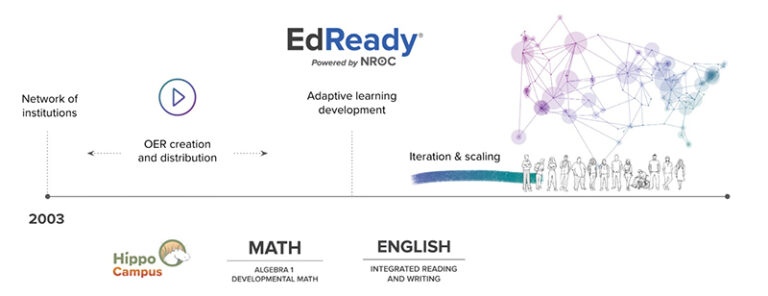
In 2003, Lopez founded the Monterey Institute for Technology and Education (MITE), a nonprofit dedicated to open learning. From MITE emerged projects such as HippoCampus, the International Journal of Media and Learning, and the National Repository of Online Courses (NROC).
Supported by major funders including the Hewlett, Gates, and MacArthur Foundations, NROC curated top quality content, aligned with state standards, and ready to use in classrooms.
But as these resources spread, one truth became clear: mathematics was the greatest barrier.
The Mathematics Crisis
Data from NROC’s partner institutions revealed a sobering reality. Nearly half of students in the United States were being shut out of higher education because they lacked adequate skills in math or English.
The problem was most severe in mathematics. Algebra I became the stumbling block: without proficiency, students could not pursue higher education, particularly in science and technology fields.
The challenge was not simply about curriculum. Some students needed help with fractions learned in middle school, while others were close to college ready but held back by test scores. Traditional remedial programs were slow and ineffective.
Lopez and his team realized students needed something new: personalized learning at scale.
The Birth of EdReady
In 2014, with support from the Hewlett and Gates Foundations, MITE launched EdReady, an adaptive learning platform well ahead of its time.
Unlike closed systems that offered little insight, EdReady was transparent. Its modular design allowed teachers to see exactly what students were working on.
Adaptive assessments diagnosed learning gaps without the stress of high stakes tests.
Students began by setting a goal, such as preparing for college admission, a standardized test, or a professional program. EdReady then created a personal learning pathway. For many, progress accelerated once they mastered a single missing concept. Roughly 15 percent of students discovered that fractions, learned in sixth grade, were their primary obstacle. Once this hurdle was cleared, they advanced quickly.
Montana: A Statewide Breakthrough
Montana was the first state to adopt EdReady across its schools. The pilot program began with just 50 students. The results were extraordinary: every participant successfully transitioned into college level work.
Over the next several years, the state scaled the program across high schools, colleges, adult education centers, and juvenile correctional facilities. More than a decade later, “EdReady Montana” remains one of the state’s most successful educational initiatives.
The success proved systemic change was possible. Yet expanding across the nation would be much more difficult.
A David Versus Goliath Struggle
Despite strong results, EdReady faced serious obstacles. It was competing against publishing giants such as McGraw Hill, corporations with vast resources and political influence. Lopez’s nonprofit had only 24 employees, yet it was battling corporations that dominated the market.
“Our work really makes a difference,” Lopez says, “but it is not a fair fight.”
Major breakthroughs came when EdReady secured statewide partnerships, first in Montana, followed by North Carolina, and then in Texas. Establishing a program in Texas, called Texas College Bridge, was especially historic. A small nonprofit had succeeded in partnering at scale with one of the largest and most complex states in the country.
But adoption was not just about performance. It was also about politics.
The Politics of Adoption
In education, effectiveness alone does not guarantee success. Lobbying, established relationships, and legislative influence often outweigh data. “It is politics,” Lopez observes. “It is a fairy tale to think that just because something works better and costs less it will automatically succeed. That is not how it works.”
Equally important was operational integration. EdReady had to fit seamlessly into classrooms. In Texas, this required partnership with Commit a nonprofit that worked directly school districts across the state. Without this local infrastructure, even the best innovations risk being limited to small pilot projects rather than system-wide solutions.
How Students Experience EdReady
For students, the process is straightforward. They register at their school’s EdReady site (or at get.edready.org), set a goal such as SAT preparation or college readiness, and take a diagnostic assessment.
EdReady then maps their learning path. Some students complete their preparation within days. Others take a semester. Almost all succeed.
The platform is flexible, with hundreds of tailored pathways. Most importantly, it aligns to the readiness expectations of specific colleges, ensuring students are prepared for exactly what will be required.
The Texas College Bridge
The Texas College Bridge program illustrates EdReady’s impact at scale.
Before the program, only about 52 percent of high-school students met college-readiness benchmarks. In districts that utilized Texas College Bridge, that number often rose to more than 80 percent.
When students finish the program, they receive a certificate recognized by colleges across Texas. This certificate allows them to skip remedial classes, which fewer than 20 percent of students ever complete. By removing this barrier, EdReady provides students a genuine path to a college degree or certificate.
Language That Connects
EdReady’s success is not only about technology. It is also about the words and context it uses.
Focus groups with students revealed how quickly learning could stop when content included unfamiliar expressions. Lopez recalls observing a class in South Central Los Angeles where students froze when the teacher used the word “bottleneck” in a mathematical context. None had heard the term before.
“The learning stopped right there,” he says. “Every word matters.”
This insight shaped content development. Lessons are written with accessible language and cultural references that connect with students’ experiences. Clarity of language often proves the difference between frustration and understanding.
A Vision Realized
From its origins as a digital resource repository to today’s platform serving millions, the journey of NROC and EdReady demonstrates how vision, persistence, and innovation can truly transform education.
This is the story of a filmmaker who viewed education through a different lens and created a tool that opens university doors for millions of students.
In a world where opportunity and achievement are often disconnected, EdReady proves that creativity and empathy can enable technology to truly democratize education.
When the spark of transformation ignites from behind the camera, it will ultimately illuminate the future in classrooms.