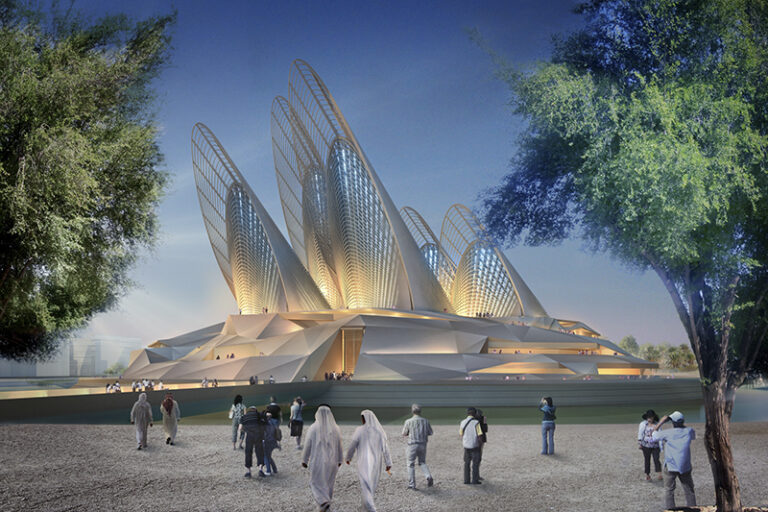
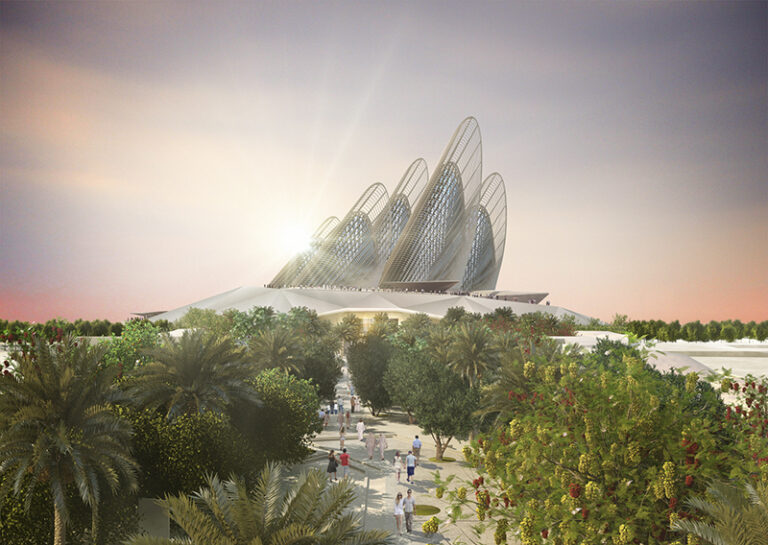
The Zayed National Museum prepares for its December 2025 opening. Image credit: Katy Harris
A cultural landmark on Saadiyat Island that unites memory, sustainability, and innovation in honor of Sheikh Zayed bin Sultan Al Nahyan.
In December this year Abu Dhabi will open the long awaited Zayed National Museum designed by British studio Foster + Partners. Conceived as a monument to the late Sheikh Zayed bin Sultan Al Nahyan, the founding father of the UAE, the museum will serve as the centrepiece of the Saadiyat Island Cultural District and as a living archive of the Emirates’ history, culture, and remarkable transformation in the modern era.
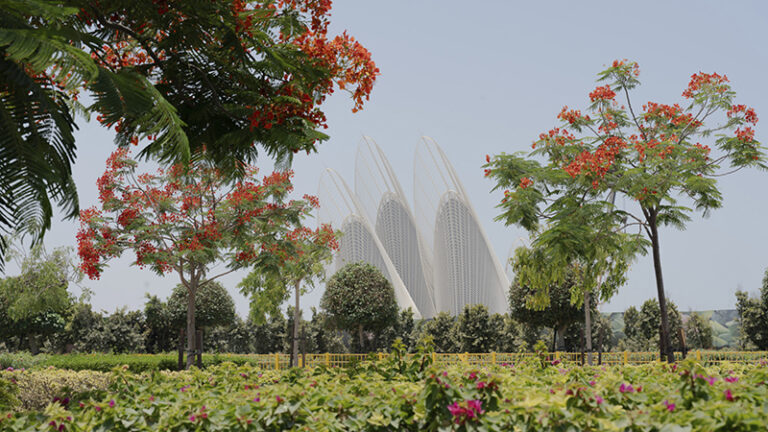
The museum will showcase the rich history and cultural heritage of the United Arab Emirates. Image credit: Katy Harris
Saadiyat Island and a Global Cultural Hub
Unveiled in 2010 and under construction since 2007, the Zayed National Museum has been one of the most anticipated cultural projects in the region. Now nearing completion, it joins an architectural constellation on Saadiyat Island that includes Jean Nouvel’s Louvre Abu Dhabi completed in 2017 and Adjaye Associates’ Abrahamic Family House which opened in 2023. Still to come are Frank Gehry’s Guggenheim Abu Dhabi and TeamLab’s digital art gallery both planned for 2025. The museum anchors this cultural hub not just by scale but by narrative. It tells the story of Sheikh Zayed’s life and vision while situating the UAE’s heritage in global dialogue. Six permanent galleries will display artefacts from the Palaeolithic, Neolithic, Bronze, and Iron Ages alongside sections dedicated to more recent cultural and social developments. A separate space will house temporary exhibitions ensuring the institution remains a dynamic platform for cultural exchange.
A Landscape of Memory
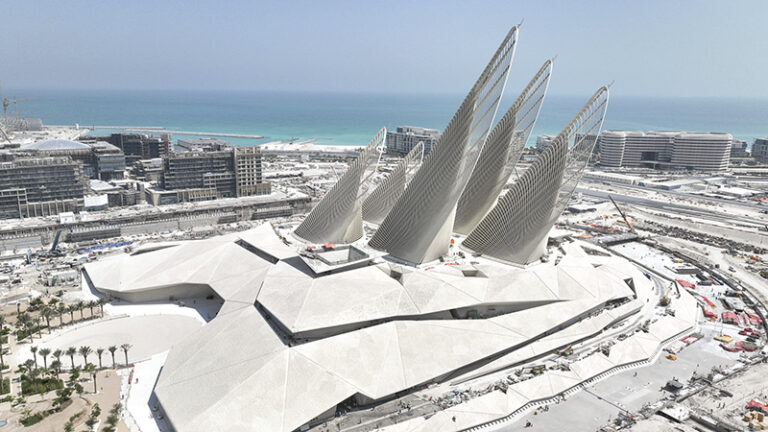
The design draws inspiration from Sheikh Zayed’s biography and the Emirati landscape. The galleries are housed within a multifaceted concrete mound, an abstraction of the topography of Jebel Hafeet in Al Ain where Sheikh Zayed spent much of his early life. A landscaped garden arranged as a timeline of his life links the museum directly to the coast, inviting visitors to walk the story of the man who laid the foundations of the nation.
The museum structure features five distinctive lightweight steel towers rising from its base. Image credit: Katy Harris
Towers of Air and Light
Above the mound rise five striking steel towers aerodynamically sculpted to resemble falcon wings in flight, an homage to Sheikh Zayed’s passion for falconry and a symbol of vision and guardianship. These towers are more than visual icons. Designed as solar thermal chimneys, they draw hot air upward and out of the museum while cooler air, captured at ground level and funneled through buried cooling pipes, circulates through the galleries. This climatically responsive strategy modernises the vernacular wind tower, demonstrating how tradition can inform sustainable design in the twenty first century. Originally envisioned with a green roof, the project has since shifted away from this element, as suggested by recent photographs. Yet the ambition remains consistent, to blend contemporary form with Arabic traditions of hospitality and environmental adaptation.
Spaces of Encounter
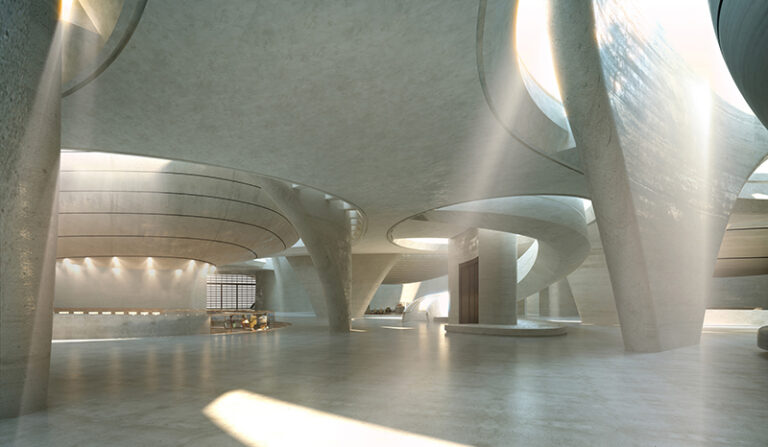
Inside, a dramatic central lobby carved into the earth exploits the cooling properties of the desert ground. Flooded with natural light from above, the space is more than circulation, it is a gathering forum alive with cafés, shops, and stages for poetry and dance. Suspended pod like galleries hover above, their sculptural presence evoking both monumentality and levity. The treatment of light and shade throughout recalls the discreet interplay that characterises traditional Arabic architecture, offering visitors moments of calm, reflection, and discovery.
Cutting-edge architectural design featured within the Zayed National Museum. Image credit: Katy Harris
Tradition Reframed
In the Zayed National Museum, heritage is not frozen in time but translated into a contemporary architectural language. The mound recalls the nation’s geology, the towers reinterpret its climate responsive traditions, and the shifting play of light invokes its cultural symbolism. These elements are not nostalgic reproductions, they are reimaginings that affirm cultural continuity while embracing global relevance.
A Ritual of Memory and Dialogue
When visitors step into the museum this December, they will encounter more than exhibitions. They will enter a space designed as a ritual of remembrance and dialogue between past and future, tradition and innovation, human aspiration and natural environment. As Foster + Partners stated when unveiling the design, “The aim has been to combine a highly efficient, contemporary form with elements of traditional Arabic design and hospitality to create a museum that is sustainable, welcoming, and culturally of its place.” In embodying Sheikh Zayed’s legacy, the museum reminds us that architecture can do more than shelter collections, it can tell stories, shape memory, and point toward new futures.
Foster + Partners unveils Zayed National Museum ahead of December opening. Image credit: Katy Harris
Toward a Cultural Future
The opening of the Zayed National Museum marks not only the culmination of nearly two decades of planning and construction but also the maturing of Saadiyat Island as one of the most ambitious cultural districts in the world. With the Guggenheim Abu Dhabi and other projects soon to follow, Abu Dhabi is positioning itself as a global nexus of art, culture, and dialogue. Sheikh Zayed once said, “He who does not know his past cannot make the best of his present and future.” The museum that now bears his name ensures that the story of the Emirates, its origins, transformations, and aspirations, will be told not only through its collections but through the very structure that houses them.