Animation showing the long-term loss of water in Mars’s Neretva Vallis, the river valley where NASA’s Perseverance rover collected the “Sapphire Canyon” core from the rock “Cheyava Falls” within the Bright Angel formation. Credit: NASA/JPL-Caltech.
A Martian Mystery Invites the World to Solve It
On September 10, 2025, NASA announced that a rock core nicknamed Sapphire Canyon, drilled from Cheyava Falls in Jezero Crater’s ancient river valley, shows intriguing chemical clues. The peer reviewed study, published in Nature and led by Joel Hurowitz of Stony Brook University, doesn’t claim life on Mars. Instead, it presents a compelling puzzle: a mudstone bearing organic carbon and unusual mineral textures that demand explanation.
A Watery Past
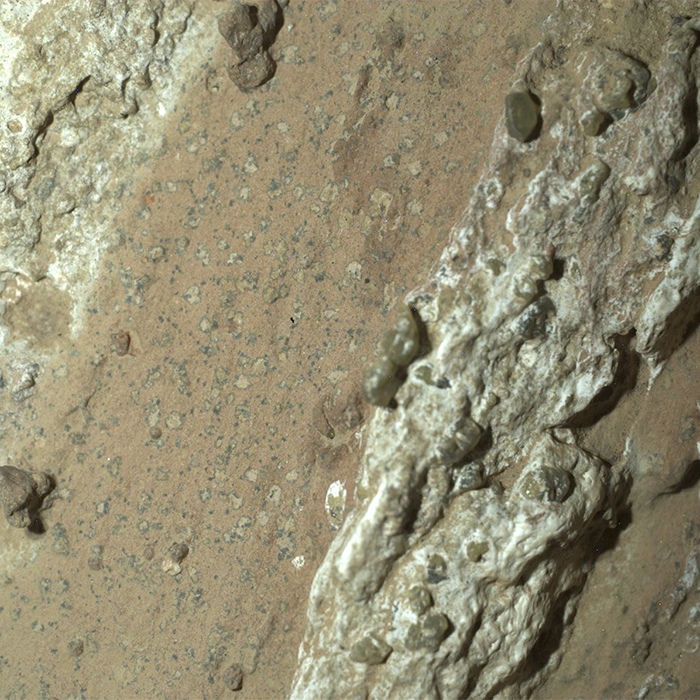
Jezero Crater once held a lake fed by rivers, a history illustrated by NASA animations showing the Neretva Vallis river valley drying out over eons. In July 2024, NASA’s Perseverance rover explored Bright Angel, a region of layered sediments shaped by that ancient water. There, Cheyava Falls stood out with leopard like spots, chemical patterns locked in stone visible in images from the rover’s WATSON camera. This rust colored mudstone sits between bright white layers and displays small, dark blue green to black nodules and ring shaped reaction fronts.
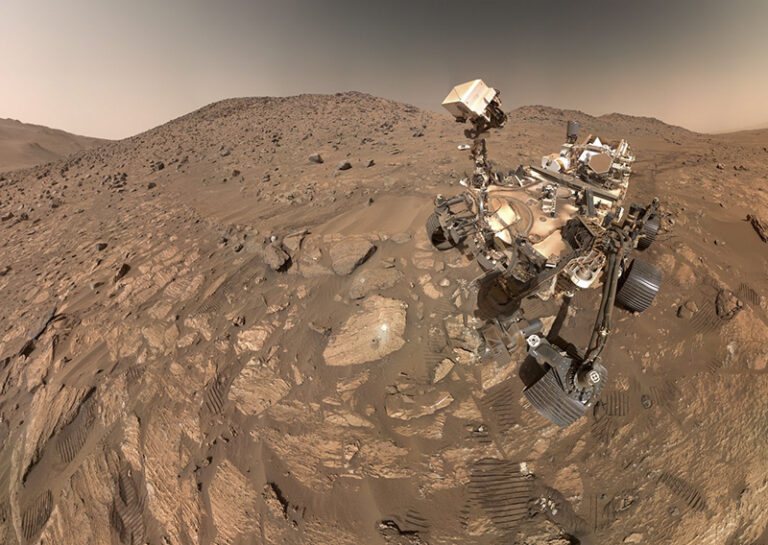
Perseverance captured this selfie on July 23 using a mosaic of 62 images in Jezero Crater. To the left of the rover near the center sits the rock nicknamed Cheyava Falls, whose features may inform the search for ancient microscopic life on Mars. Image credit: NASA/JPL Caltech/MSSS.
Clues in the Chemistry
Two instruments on Perseverance conducted the first detailed look: PIXL (Planetary Instrument for X ray Lithochemistry) mapped elements at millimeter scale, and SHERLOC (Scanning Habitable Environments with Raman and Luminescence for Organics and Chemicals) scanned for organics with ultraviolet light.
The results reveal clay and silt rich in organic carbon, sulfur, oxidized iron, and phosphorus—ingredients that on Earth often accompany microbial life. The spotted areas resolve into reaction fronts (boundaries where chemical change swept through the rock) and include vivianite (a hydrated iron phosphate common around decaying organic matter) and greigite (an iron sulfide associated with some microbial processes). Together, these minerals point to redox reactions, the kind of chemistry microbes use for energy.
“We found a striking chemical combination,” says Hurowitz. “But we had to test whether something else could explain it.”
Untangling Biological and Abiotic Origins
The team thoroughly tested non biological routes. Hot fluids don’t fit, since the rocks show no signs of high heat. Strongly acidic waters don’t match the textures. While organic molecules could in principle catalyze reactions at low temperature without being alive, the specific organic compounds haven’t been identified. Given that low temperature redox reactions in sediments on Earth are often microbially driven, purely abiotic explanations face significant challenges.
For now, these iron, sulfur, and phosphorus bearing nodules and reaction fronts are classified as potential biosignatures—features that might record past biological activity but could also arise without life.
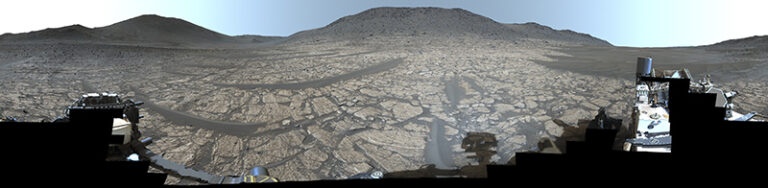
Bright Angel in 360 degrees. Perseverance’s Mastcam Z captured this enhanced color panorama on June 12, 2024, Sol 1178, from 346 stitched images. Cheyava Falls sits slightly right of center about 110 meters from the rover, whose mast appears in silhouette at bottom center. Image credit NASA JPL Caltech ASU MSSS University of Copenhagen.
Why Bright Angel Surprises
Sapphire Canyon’s mudstones are younger than many expected for the best traces of life. Scientists often assume Mars’ most habitable period occurred early, soon after the planet cooled. Bright Angel’s compelling chemistry, formed hundreds of millions of years later, suggests that habitable conditions may have persisted longer or that signs of those conditions can survive much later in the rock record. Hurowitz describes the unit as “a great record of the planetary environment” during that time.
Measuring the Evidence and Next Steps
NASA uses the Confidence of Life Detection, or CoLD, scale to track progress from an initial signal to consensus on a biological origin. The Sapphire Canyon result advances several steps by documenting repeatable, context rich signals that are relevant to life and by addressing contamination controls. As Perseverance scientist Katie Stack Morgan notes, extraordinary claims require extraordinary evidence.
The discovery provides search templates for future work, from orbital scouting to high sensitivity studies. The decisive step, however, awaits the analysis of the Sapphire Canyon core here on Earth, where sophisticated laboratory instruments can definitively determine whether its minerals, organics, and textures record microbial metabolisms or non biological chemistry.
As NASA’s Acting Administrator Sean Duffy called the result a major step in understanding Mars, Sapphire Canyon reminds us that the search for life is a patient, collective inquiry, and one we are better equipped to pursue than ever before. The core is currently one of 27 rock samples Perseverance has collected since its 2021 landing.