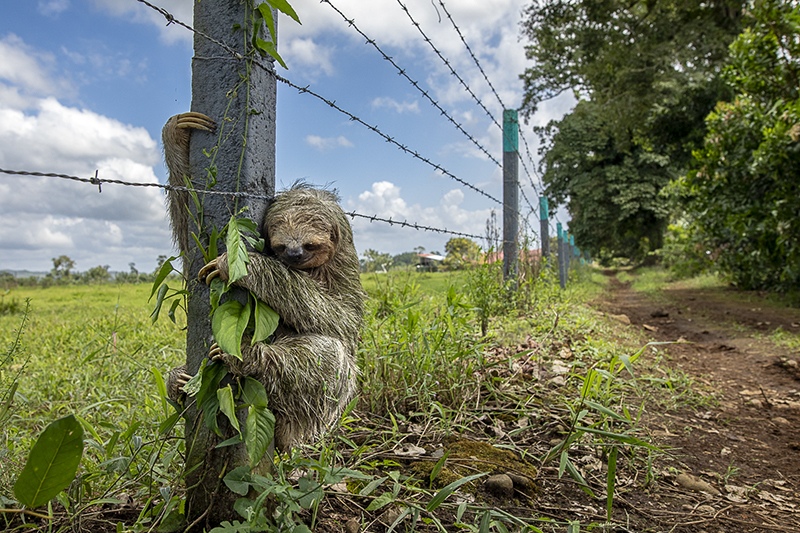
Emmanuel Tardy’s photograph No Place Like Home has been shortlisted for the 2025 Wildlife Photographer of the Year award, with the winner to be announced on October 14, 2025.
Though Tardy grew up in landlocked Burgundy, far from the ocean, images of the sea accompanied his childhood. “As a child, I was obsessed with Jacques Yves Cousteau’s expeditions and never missed a single documentary,” he says. “I dreamed of encountering dolphins and whales; they became protective symbols in my heart.” Years later, a chance encounter with a blue whale specialist opened a door for him. “He invited me to spend a season at his research station in the Mingan Islands of northern Quebec. In that moment, my childhood dream came true.” There, he exchanged ideas with researchers and photographers, learning new ways of seeing. “That was a turning point,” he recalls. “A few years later, it became reality.”
Tardy’s photographic philosophy stems from patience and observation. “I maintain a broad and gentle field of vision, capturing those moments that stand out within the vastness,” he explains. He studies locations more than subjects, focusing on how weather affects animal behavior. The camera became his tool for listening to nature.

The Sloth’s Testimony: The Power of Witnessing
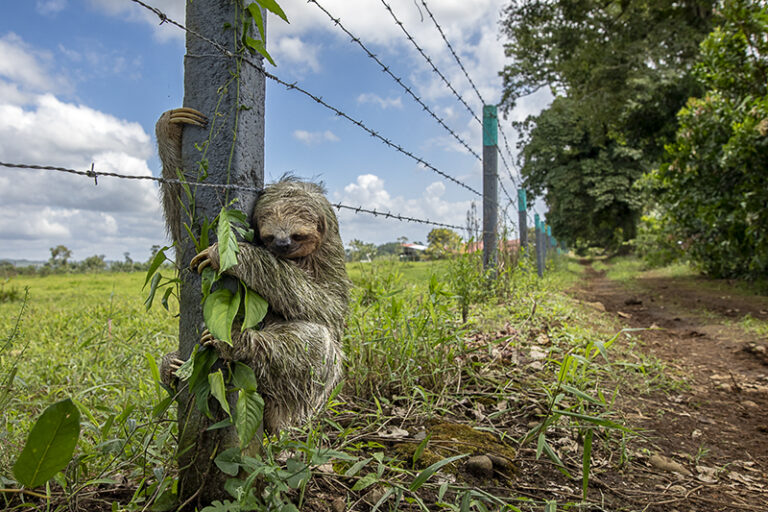
This patient observation shaped Tardy’s approach, leading him to capture the striking moment of No Place Like Home. The photograph, with its ironic nod to ‘home,’ underscores the sloth’s displacement. It was not born from a carefully staged scene but from a traffic jam and a crowd of excited tourists. A weary three toed sloth, soaked by rain and trembling with exhaustion, clung tightly with trembling claws to a fence post along a rural Costa Rican road, supporting its small frame. Its gentle, soulful eyes gazed downward amid the clicks and flashes of dozens of cameras and phones.
For thirty minutes, cars stalled, and tourists spilled out to capture the spectacle. When the clamor faded and the roadside grew quiet, the sloth remained, alone and vulnerable, framed against a dirt path and barbed wire. “That day hit me with immense emotion,” Tardy recalls. As the crowd dispersed, he could finally observe the animal. “During that wait, I composed the image in my mind, adjusted my settings, and ensured the shot was quick to avoid stressing the animal.”
He took only three photos. “As I walked away, its gaze lingered through my entire journey.” No Place Like Home transcends technical skill, carrying a story. “This lone sloth, clinging to human infrastructure, mirrors our collective indifference,” Tardy reflects. “I felt sorrow and responsibility. My role is not just to create beautiful images but to convey the raw emotion of every encounter with wildlife.”
In his lens, the sloth dominates the foreground, its light fur stark against the dark fence post, while the dirt path stretches toward a horizon where forests once thrived. Barbed wire cuts across the frame like a scar, both a boundary drawn by humans and a symbol of hope that can be crossed. “One side is fragile, silent survival; the other is a noisy, bustling world,” Tardy says. “We share one Earth, and I wanted to capture both truths in a single frame.”

From Image to Action
The weight of this photograph is sparking real change. In Costa Rica, conservation groups are building canopy bridges for sloths and other arboreal animals. Tardy hopes images like No Place Like Home will amplify public awareness and support. “We are not alone on this planet,” he says. “Every life deserves respect. By supporting conservation initiatives like wildlife corridors or adopting sustainable practices, we can all help protect wildlife. Protecting biodiversity is defending our own future.”
These beliefs were shaped by countless encounters: a motorboat recklessly charging toward a whale and its calf, tourists disturbing a seal colony, or minor disruptions near his own village. “Each encounter reminds me of the weight of our responsibility,” he says.

The Art of Authentic Advocacy
“Animals must remain free, and my photography never interferes with their behavior or habitat,” Tardy insists. He rejects staged shots, allowing only subtle adjustments to light and color. “The goal is awareness and care, honoring the raw beauty of nature.”
Is he a storyteller or a documentary photographer? “I’m a storyteller first,” he says. “Encounters and emotions drive me. These stories may reflect grand environmental issues, but they’re born from moments that awaken conscience.” His travels span the globe, from Canada’s marine mammals to Costa Rica’s sloths, from Europe to New Zealand. Yet the most vital lessons are close to home. “Daily life shapes my perspective,” he says. “Observing wildlife during walks near my village reminds me that our connection to nature lies in proximity and care.”

Looking Forward
Recognition brings new opportunities and vows. “Nature never ceases to amaze me or push me forward,” Tardy says. He will continue focusing on threatened species while exploring new locations. “In January, I’ll visit Kenya for the first time, refining my approach and sharing the beauty and fragility of life through meaningful images.”
What legacy does he hope to leave? His answer is humble yet grand. “If my work touches even one person, that’s an achievement. Images have the power to raise awareness. Every photograph can awaken a conscience and spark action.”
No Place Like Home embodies this hope, urging us to notice, care, and act—one frame at a time.