
Researchers achieve remote coupling of nuclear spin qubits, laying the foundation for scalable quantum computing.
The race to build a practical quantum computer has produced numerous competing technologies, each with distinct advantages and limitations. Among these approaches, nuclear spin-based quantum computing in silicon stands out for its compatibility with existing semiconductor manufacturing and the exceptional stability of its qubits. However, scaling these systems from proof-of-concept demonstrations to millions of qubits has faced a fundamental challenge: how to connect qubits that are inherently isolated from their environment while maintaining that very isolation.
Recent research from the University of New South Wales, published in Science on September 18, 2025, has demonstrated a promising solution. By using electrons as intermediaries, researchers successfully coupled nuclear spin qubits separated by up to 20 nanometers, a fourfold increase over previous methods. While this distance might seem negligible on human scales, it represents a critical threshold for practical quantum computing architecture.
We recently had the opportunity to speak with Dr. Holly Stemp, the lead author of this groundbreaking study, about the technical achievements and future implications of this work. The detailed conversation that follows provides insight into both the fundamental physics and practical engineering challenges of building scalable quantum computers.
The Isolation Paradox
Nuclear spins of phosphorus atoms implanted in silicon make excellent qubits precisely because they ignore their surroundings. This property, known as coherence, allows these qubits to maintain quantum information for remarkably long periods. In earlier experiments, nuclear spins have preserved their quantum states for up to 30 seconds, an eternity in the quantum realm where most systems lose information within microseconds.
This isolation creates an engineering paradox. To build a functional quantum computer, qubits must communicate with each other to perform computations. Yet the very property that makes nuclear spins attractive as qubits is their reluctance to interact with anything, including neighboring qubits.
Previous solutions involved placing nuclear spins extremely close together, between one and five nanometers apart, allowing a single electron cloud to envelop both nuclei. This shared electron could mediate interactions between the nuclei, enabling the two-qubit operations essential for quantum computing. However, this approach severely limits scalability. Maintaining such precise atomic placement across millions of qubits while leaving room for control electronics presents enormous manufacturing challenges.
Electrons as Quantum Telephones
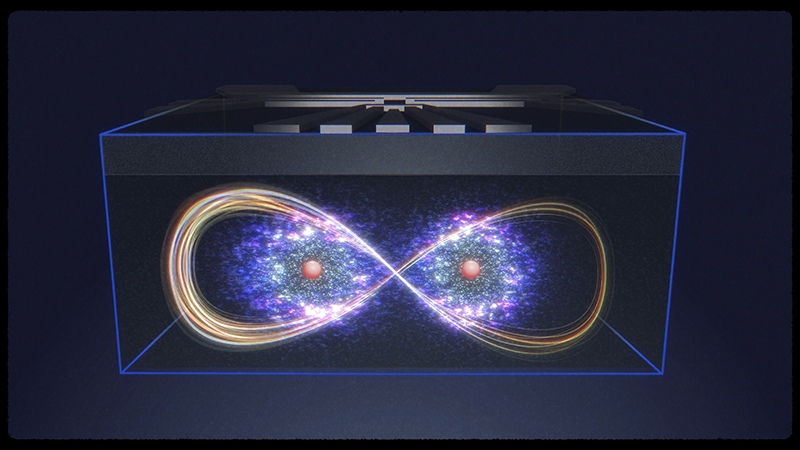
The new coupling scheme takes a different approach. Instead of forcing nuclei to share a single electron, the researchers spaced them further apart, allowing each nucleus its own electron. It is estimated that the distance between the nuclei in this system was up to 20 nanometers. When electrons on adjacent nuclei are added to the system, their quantum mechanical wavefunctions overlap slightly, creating what physicists call an exchange interaction.
This interaction means that the resonance frequency of one electron depends on the quantum states of both nuclei. By carefully timing microwave pulses, researchers can perform two-qubit gate operations between the nuclei, mediated by their respective electrons. Because electrons respond much faster than nuclei, these gate operations complete quickly relative to the nuclear coherence time, preserving the quantum information.
One additional advantage of this scheme is that electrons can be added or removed from the system using local gate voltages, effectively turning the interaction on and off as needed. In the future one could therefore envision deterministically removing the electrons when no computation is required, returning the nuclear qubits to their isolated, high-coherence state. When interaction is needed, the electrons could then be briefly added to facilitate the operation, then removed again.
The Twenty Nanometer Threshold
The 20-nanometer separation achieved in this experiment crosses an important boundary for semiconductor manufacturing. Modern complementary metal-oxide-semiconductor (CMOS) fabrication processes routinely work at this scale, making the approach compatible with existing industrial capabilities. This compatibility could allow quantum computing to leverage the decades of investment and expertise in silicon chip manufacturing.
Furthermore, 20 nanometers provides sufficient space to integrate classical control electronics directly on the quantum chip. Current quantum computing systems require extensive external infrastructure, with control signals routed through carefully shielded cables into ultra-cold environments. On-chip control electronics would reduce this complexity, though it introduces new challenges in managing the heat they generate.
The researchers emphasize that further miniaturization is neither necessary nor desirable. At this density, millions of qubits could fit on a single chip. The manufacturing challenge lies not in packing more qubits into smaller spaces, but in reliably placing them with sufficient precision.
Precision Placement
Deterministic ion implantation, developed in collaboration with the University of Melbourne, addresses the placement challenge. This technique uses an atomic force microscope tip with a tiny aperture to implant individual phosphorus atoms at designated locations. High fidelity single ion detectors verify successful implantation before the system moves to the next site.
Current deterministic implantation achieves position uncertainty of approximately eight nanometers. The coupling gate demonstrated in the recent work functions reliably across a range of 10 to 24 nanometers, comfortably accommodating this uncertainty. This robustness against placement variation is crucial for manufacturing reproducibility.
Performance Metrics
The researchers achieved single-qubit gate fidelities of 99.76 percent, meaning these operations succeed more than 997 times out of 1,000. This exceeds the roughly 99 percent threshold generally considered necessary for quantum error correction, a technique that uses multiple physical qubits to encode a single logical qubit with improved reliability.
The two-qubit gate fidelity in this initial demonstration reached only 76 percent, below the error correction threshold. However, the researchers identified the primary limitation: imperfect initialization of the electron spins due to specific characteristics of the experimental device. Simulations incorporating more typical initialization methods predict two-qubit fidelities above 99.7 percent should be achievable with improved devices.
Operating Conditions
The experiments were conducted at 20 millikelvin, approximately 273 degrees below the freezing point of water, inside a dilution refrigerator. These systems represent the coldest controllable environments in the known universe. A magnetic field of one tesla, roughly 20,000 times Earth’s magnetic field, was also applied.
These extreme conditions were necessary primarily for the readout mechanism used in this experiment. Other research groups working with similar technologies have demonstrated operation above one kelvin and at lower magnetic fields using different readout techniques. Moving to higher operating temperatures will be essential for scaling, as the cooling power required to maintain millikelvin temperatures becomes prohibitive when controlling millions of qubits.
The Path Forward
Demonstrating a more scalable mechanism of electron-mediated nuclear coupling represents one step in a longer journey toward fault-tolerant quantum computing. The next major milestone involves constructing a logical qubit from an array of physical nuclear qubits and demonstrating that adding more physical qubits reduces the logical error rate, the hallmark of successful quantum error correction.
Recent results from Google’s superconducting qubit platform achieved this scaling demonstration, showing that logical qubit performance improves as the number of constituent physical qubits increases. Replicating this achievement with nuclear spin qubits would validate the error correction approach for this platform.
The coupling scheme could potentially extend beyond nearest neighbors. Researchers envision using additional intermediary elements such as large quantum dots or superconducting resonators to bridge even greater distances, in the micrometer scale. This could enable interactions between clusters of qubits, each cluster forming a logical qubit, with longer-range couplings connecting these logical units.
Comparative Landscape
No consensus has emerged about which physical platform will ultimately dominate quantum computing. Superconducting qubits, currently the most mature technology, offer fast operation but require significant physical space and operate at similarly cold temperatures. Ion trap systems provide excellent coherence and gate fidelities but face different scaling challenges related to controlling large numbers of ions. Photonic approaches operate at room temperature but struggle with different aspects of scalability.
Silicon spin qubits occupy a distinctive niche with extremely high density, long coherence times, and CMOS compatibility. Their slower operational speed compared to superconducting qubits represents a tradeoff, though still fast enough to perform many operations within the coherence time. The question remains whether any single platform will dominate or whether hybrid systems combining different qubit types will prove optimal.
Nuclear spins’ extraordinarily long coherence times make them attractive candidates for quantum memory within hybrid architectures. Faster qubit types, such as electron spins in quantum dots or superconducting circuits, could handle active computation while nuclear spins store quantum information between operations. Research groups are actively exploring these hybrid approaches.
Beyond Computing
The same silicon platform could serve functions beyond computation. Quantum networking, which would connect separate quantum processors, requires quantum memories to store photonic quantum states. The long coherence times of nuclear spins position them well for this role, though interfacing nuclear spins with photons presents additional challenges.
The techniques developed for quantum computing also advance fundamental physics research. Coupling small quantum systems to larger objects enables investigation of the boundary between quantum and classical behavior, an area of ongoing theoretical interest. While not directly relevant to quantum computing applications, these experiments contribute to understanding quantum mechanics itself.
Timeline and Accessibility
The path from laboratory demonstrations to practical quantum advantage remains uncertain. Current systems perform specific tasks but lack the scale and error rates needed for problems beyond the reach of classical supercomputers. Achieving fault-tolerant quantum computing will require not only better qubits but also the classical computing infrastructure to perform real-time error correction on millions of physical qubits.
The notion of desktop quantum computers seems unlikely for most qubit platforms that require extreme cooling or other specialized environments. More plausible is a model resembling classical cloud computing, where users access quantum processors remotely. Whether these systems occupy single refrigerators or warehouse-scale facilities depends on the final qubit density, error rates, and classical control overhead.
Silicon-based approaches offer potential advantages in manufacturing scale and cost, inherited from the semiconductor industry’s economies of scale. However, these advantages only matter if the technology can achieve the performance thresholds necessary for useful computation.
The Bigger Picture
Quantum computers will not replace classical computers for most tasks. They offer potential advantages for specific problem classes: simulating quantum systems, certain optimization problems, cryptography, and perhaps machine learning applications. For sending email or word processing, classical computers will likely remain superior.
The significance of demonstrations like electron-mediated coupling lies in addressing specific technical obstacles on the path toward these specialized applications. Each advance either confirms a promising direction or reveals new challenges, gradually mapping the territory between current capabilities and ultimate requirements.
Scalable coupling mechanisms, 99.76 percent single-qubit fidelity, and compatibility with CMOS manufacturing represent meaningful progress. Whether this particular approach will scale to millions of qubits performing error-corrected computations remains to be determined. The answer will emerge from continued experimental work, not theoretical projection.
The researchers themselves maintain appropriate uncertainty about timelines and ultimate outcomes. Their focus remains on the next technical milestone: demonstrating a logical qubit whose performance improves with scale. This achievement would validate the error correction framework for their platform, a necessary but not sufficient condition for practical quantum computing.
The quantum computing field continues its evolution from fundamental physics demonstrations toward engineering reality, one coupling gate and one fabrication improvement at a time. The demonstration of a more scalable coupling scheme between nuclear spin qubits represents another checkpoint on that journey.