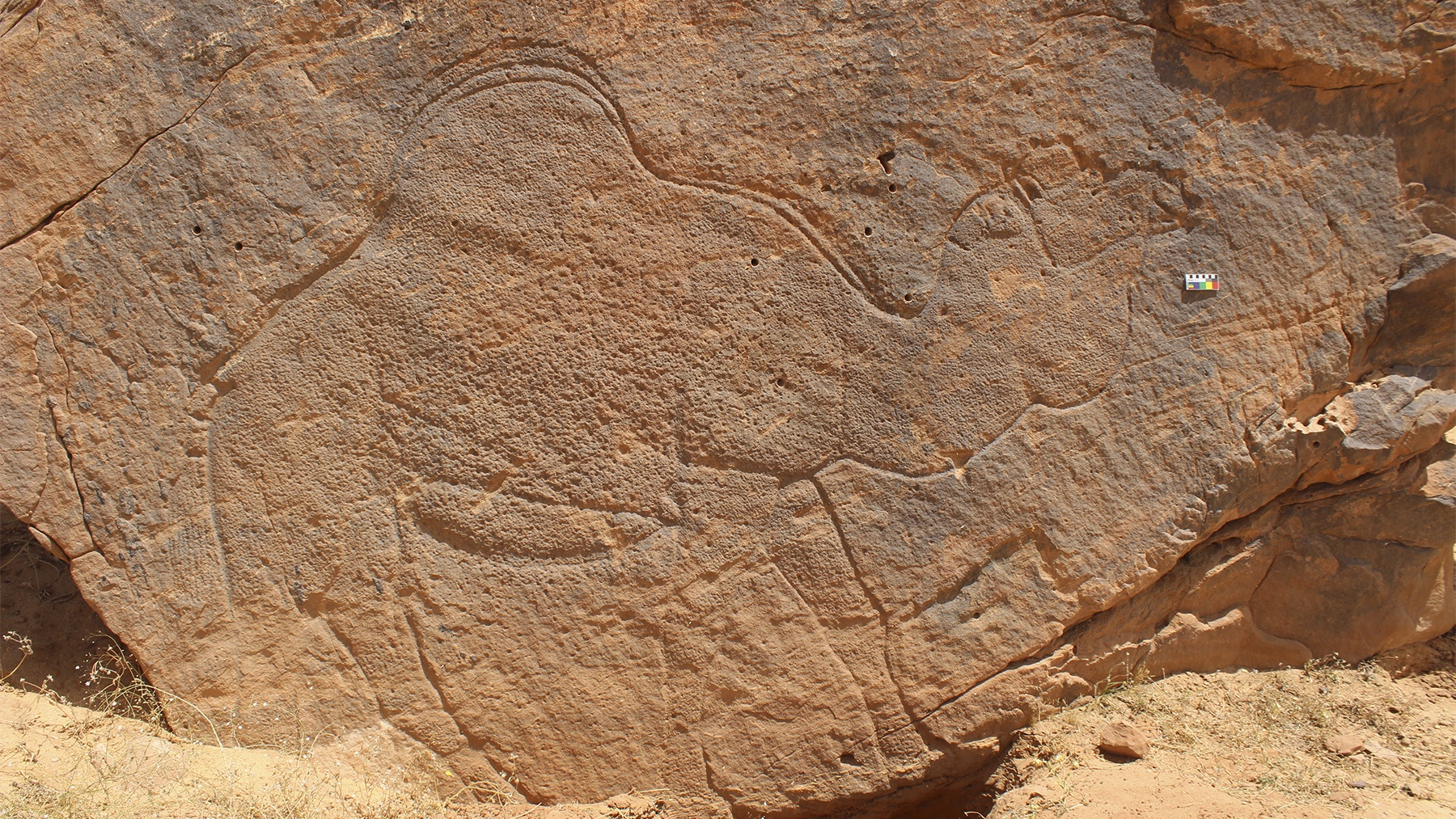
130 Gigantic Rock Carvings from 12,000 Years Ago Unveil Ancient Arabian Routes and the Sources of Life
Along the southern edge of the Nefud Desert in northern Arabia, 130 life-sized rock carvings have emerged from obscurity. Suspended high on cliff faces, some stretching three meters in length, they depict male camels, ibex, African wild asses and aurochs with startling vitality, collectively forming an ancient map embedded in stone, marking the way to waterholes, ancient lakes, and mountain passes.
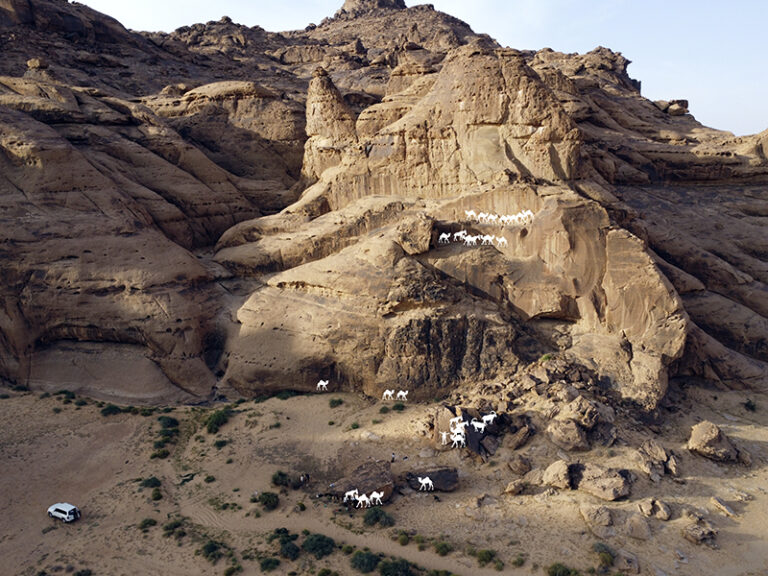
Drone photo of Jebel Misma, with icons indicating the locations of life-sized engravings, Image credit: Dr. Maria Guagnin
Led by Dr. Maria Guagnin as part of the Green Arabia Project, an international team working in collaboration with the Saudi Heritage Commission published their findings in Nature Communications in September 2025. Across three sites—Jebel Arnaan, Jebel Mleiha and Jebel Misma—the team documented 62 rock panels bearing 176 carvings, dating between 12,800 and 11,400 years ago. In a recent conversation, Dr. Guagnin spoke with us about the discovery, bringing both the precision of a scientist and the passion of an explorer to her account of what the carvings reveal about life across millennia and the memories they preserve.
As the aridity of the Last Glacial Period finally receded and seasonal water sources revived, humans were able to venture deeper into this wilderness. Dr. Guagnin points out that these rock carvings are situated in the most prominent locations within the valleys, serving as both a symbol of access rights and a marker of cultural identity. Project co-leader Professor Michael Petraglia believes that this discovery fills an archaeological gap between the post-glacial period and the early Holocene, revealing the extraordinary resilience and creativity of early humans.
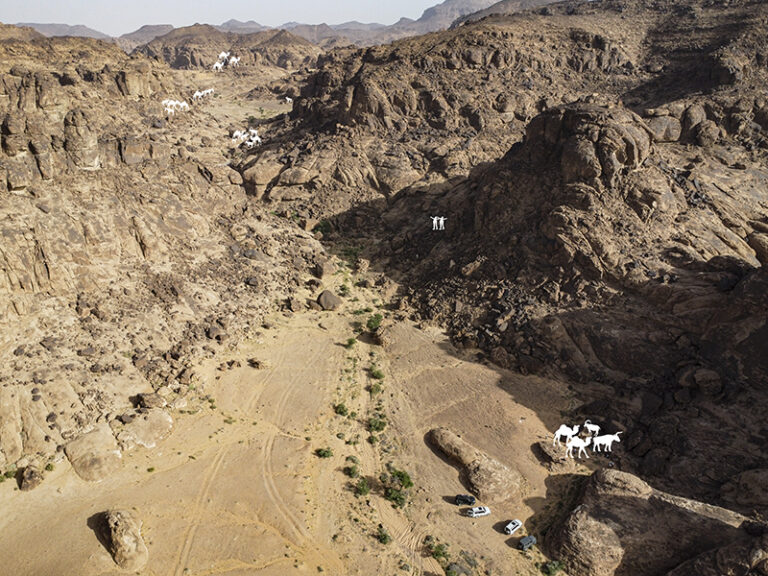
Shows a drone photo of the rock art at Jebel Arnaan, with icons indicating the locations of panels along a path up the mountain, Image credit: Dr. Maria Guagnin
Into Remote Arabia: A Conversation with Dr. Maria Guagnin
In our conversation, Dr. Maria Guagnin recalled the unforgettable days that led to the breakthrough, a discovery that unfolded like both an archaeological excavation and an adventure narrative.
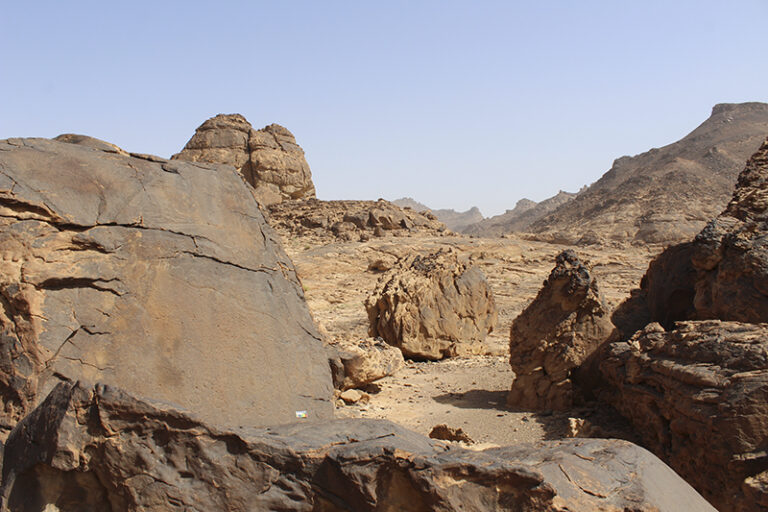
An amateur enthusiast brushed away loose soil at the desert’s edge, revealing half a rock panel. Though this was not a scientific excavation, it unexpectedly opened a portal to the prehistoric world. Following the shadows behind the rock panel, the research team discovered a narrow gorge. The end appeared sealed by massive boulders, yet a glimmer of light still filtered through a crack on one side. A Saudi archaeologist bent down and squeezed through, suddenly finding himself in a deep valley. Along the valley floor wound a silent ancient riverbed, and on the steep cliffs on either side, more than a hundred giant rock carvings stood in quiet formation, like a ceremony frozen in time. The mountain terrain converged into a saddle shape in the distance, gradually extending toward a long-dried ancient lake. In that moment, Dr. Guagnin realized that what lay before her was not merely artistic relics, but a prehistoric water map carved in stone, depicting the eternal connection between humans, water, and life.
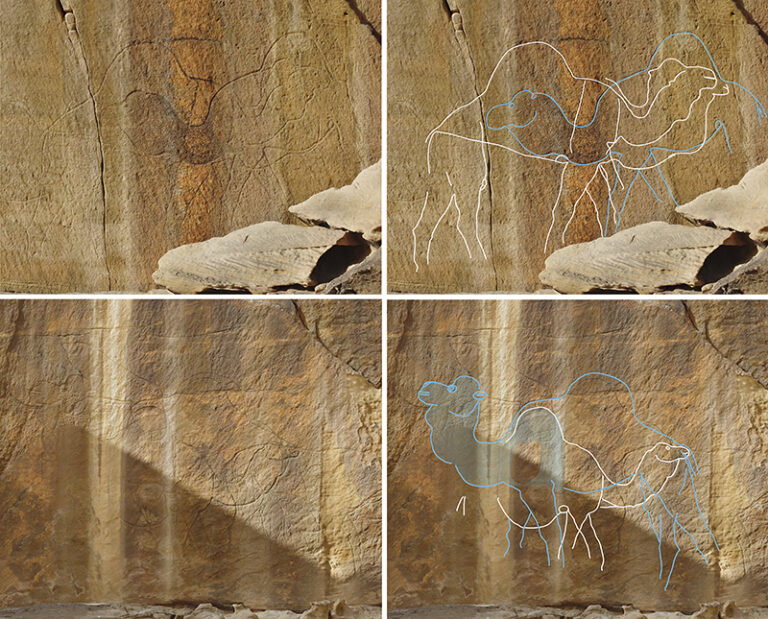
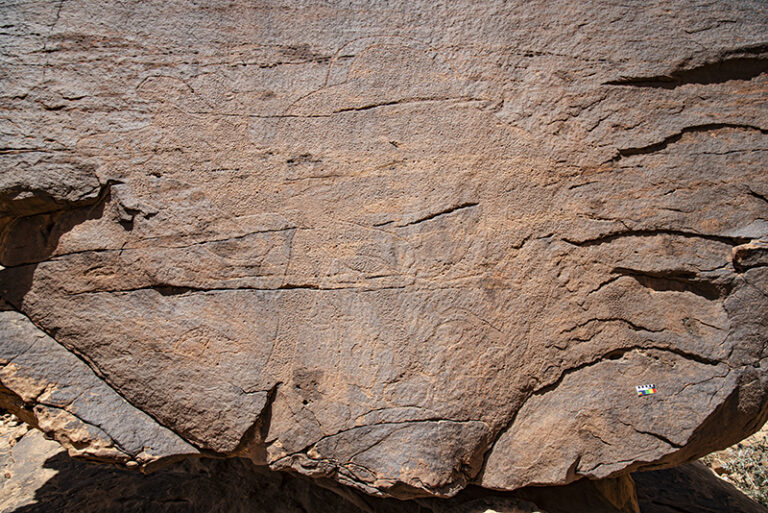
Two close ups of the same panel, with tracings, Image credit: Dr. Maria Guagnin
Images Carved by Time
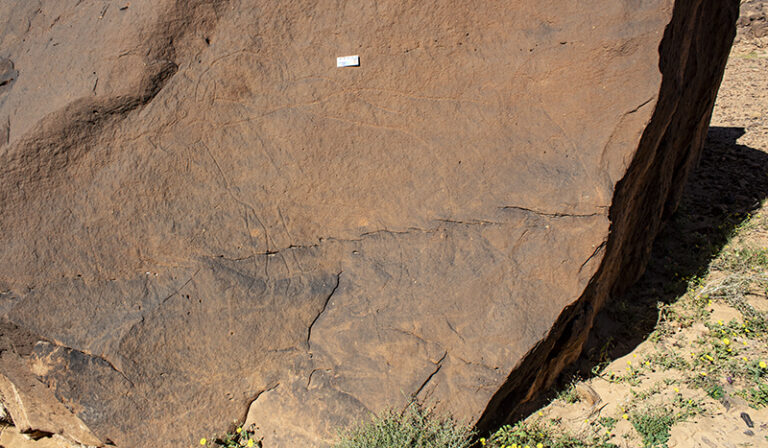
She explained that the carvings are entirely pecked and incised directly into the rock face, with no pigment involved. Because the grooves are extremely shallow, they often prove difficult to discern in photographs. For academic publication, she added tracings to selected images to help readers identify the forms. Across the site, the team found more than sixty rock panels and several hundred carvings, most at human scale. Scattered through the valleys are camel footprints and smaller figures, resembling waymarks left by ancient travelers.
Understanding the environmental context, Dr. Guagnin emphasized, is key to unlocking the meaning of the carvings. Scholars have long been familiar with the Holocene humid period, when the desert bloomed green and lakes filled with water. But the earlier epoch, immediately following glacial retreat, remained shrouded in uncertainty. The research team discovered the engravings beside a datable ancient water source, providing concrete evidence of the brief yet precious surface water that followed the Ice Age. The landscape was no lush oasis but rather a transitional zone between desert and life, where sparse yet reliable water allowed people to linger, migrate and inscribe direction and memory into stone.
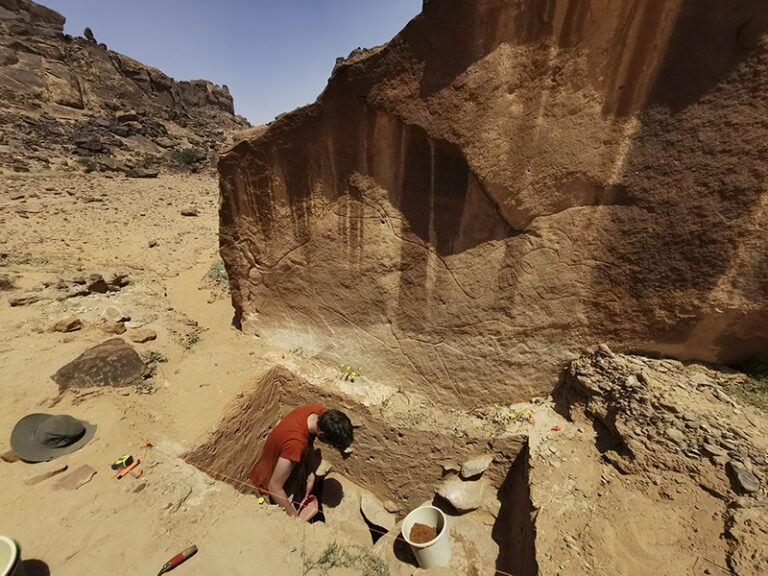
Jebel Arnaan during excavations, Image credit: Dr. Maria Guagnin
Imprints of Water and Life
As research deepened, it became clear that the marks were far from casual traces. Previously, scholars believed the region remained uninhabited during that period, or visited only occasionally by people from the Levant. Current findings reveal that humans lived here continuously for thousands of years, sustaining artistic and cultural traditions. Stone projectile points, green pigments and shell ornaments recovered from the sites confirm exchanges and connections with distant groups.
Dating results further corroborate the finding. The research team employed optically stimulated luminescence to sample sand layers both above and below the excavated carving tools, using the so-called “sandwich dating method” to determine when the sediments were last exposed to sunlight. The lower sand layer dated to approximately 12,800 years ago, the upper layer to around 11,400 years ago, with the carving tools sandwiched between, providing a reliable temporal framework for their use. The results indicate that human activity spanned multiple generations. Far from transient visitors, the artists were residents intimately familiar with the valley.
An untraced image of an engraving showing a wild equid, with the surrounding landscapeI. mage credit: Dr. Maria Guagnin
Society in Stone
Dr. Guagnin believes the carvings on towering cliff faces carry profound social and spiritual significance. Many panels sit more than thirty meters above ground, requiring carvers to work for weeks or even months on narrow ledges. It was arduous and sustained labor—stone chips flying, hammer blows echoing—and in the long repetition, perhaps, a rhythm approaching meditation emerged. She believes the work was not merely artistic creation but ritual, imbued with a sense of dedication.
Such enormous investment suggests not everyone qualified to participate. Dr. Guagnin mentions the nearby “three-dimensional camel relief site,” which similarly required scaffolding and collective cooperation, indicating that a community with clear divisions of labor supported the carvings. The carvers were likely chosen individuals, representing the group in completing tasks of special significance.
Chronologically, the carvings belong to the period between the Late Paleolithic and the early Pre-Pottery Neolithic, before animal husbandry emerged, when humans still lived as mobile hunter-gatherers. The water routes and mountain paths depicted in the carvings functioned both as actual pathways to water and as symbolic spiritual maps. Most camels appear as rutting males, identifiable by their swollen neck ridges and upright postures, symbols of fertility and rainfall. Carving a camel may have been a way to petition or commemorate abundant rain. It served simultaneously as survival guide and prayer.
Life-sized animal images are exceedingly rare in the global rock art record. They assert presence across vast terrain while reinforcing communal belonging at the social level. Some works are so detailed that muscles and hair are distinguishable; others are stark and powerful, inscribed like symbols into stone. Stylistic evolution reveals cultural continuity: early carvings are realistic and specific, while later ones trend toward standardization and abstraction, reflecting maturation in thought and belief.
Close-up view of rock carvings on a panel at Jebel Arnaan, positioned approximately 2 meters above the gulley floor. Image Credit: Dr. Maria Guagnin
The Desert's Silence
In the known archaeological record, no other region has produced rock engravings of comparable scale. Despite geographic proximity between Arabia and the Levant, the latter has yielded remarkably few rock carvings. The research team also sampled sediments from paleolakes near the valleys, finding that the lakes and carvings date to the same period, demonstrating that their co-location was not coincidental but part of a shared ecological and cultural system.
The carvings are not merely records of routes and water sources; they embody ancient people’s understanding of and emotional connection to their environment. They likely served both as markers and symbols, echoing other landscape inscriptions in the prehistoric world. Whether European megaliths or Saharan rock art, humans in the pre-settlement era consistently sought ways to inscribe memory onto the land.
Dr. Guagnin admits that the sites’ remoteness poses challenges for research yet also provides their best protection. Long treks across ridges and dunes keep them distant from development threats. The Saudi Heritage Commission currently monitors the sites to guard against potential damage.
An untraced image of an engraving of an aurochs and an ibex, Image credit: Dr. Maria Guagnin
Looking Ahead
Dr. Guagnin acknowledges that while the team has employed drone photogrammetry and chemical analysis, the carvings’ great age leaves some results uncertain. Smiling, she suggests that the most promising breakthroughs may still lie in traditional archaeology: finding more sites, excavating habitation remains, analyzing bones and pollen, then using technology to breathe new life into ancient evidence. Though human remains have yet to be discovered, small animal tooth fragments may provide fresh leads.
Her voice carries gentle determination as she speaks of tracing the evolution of the artistic tradition. Life-sized wild camel carvings may mark the beginning of a long tradition that later merged with the totemic beliefs of pastoral societies. She plans to pinpoint more precisely when that transformation occurred, marking additional nodes on the timeline to reveal how ancient people continually reshaped relationships between humans and animals, humans and nature, as their environment and way of life changed.