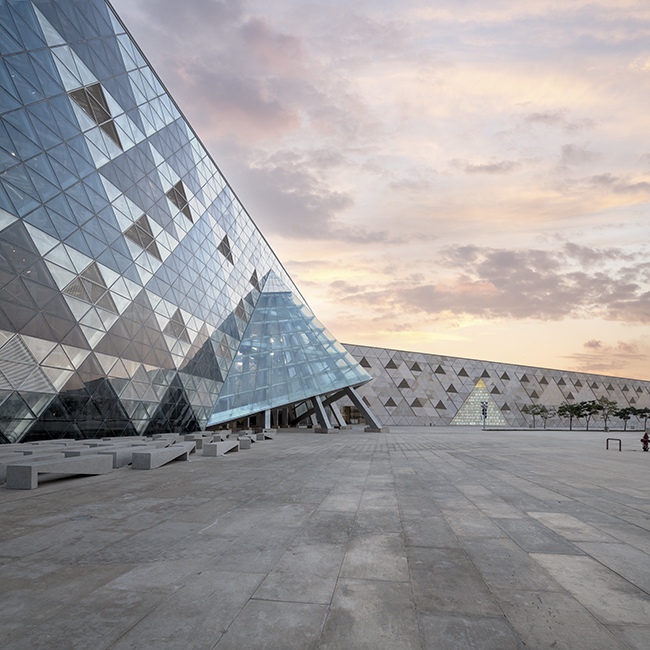
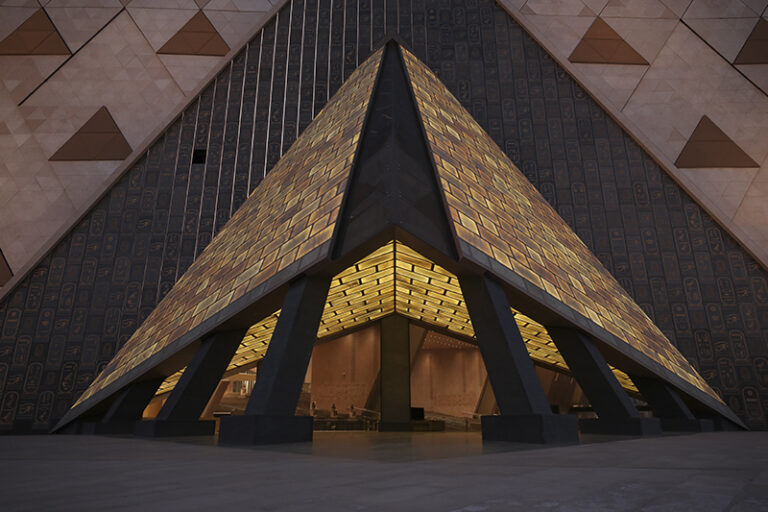
The glazed entrance pyramid aligns the museum to the Giza axis, drawing visitors into the Grand Hall. Credit: Grand Egyptian Museum.
Tutankhamun’s five thousand treasures debut as a complete collection, making this the cultural pilgrimage of the century
After more than two decades of meticulous planning and relentless effort, the Grand Egyptian Museum has opened in the golden light of autumn. This monumental institution, designed by the internationally regarded practice heneghan peng architects, stands a short distance from the Giza Pyramids and welcomes the world to a collection of one hundred thousand artifacts. Together they tell the five millennia long story of ancient Egypt with quiet authority and soaring imagination.
At the heart of the opening is the dazzling unveiling of the Tutankhamun galleries. The most familiar of the pharaohs steps into view through more than five thousand objects presented as a complete ensemble for the first time. The golden mask, the exquisitely crafted throne, the amulets that seem to hum with ceremony. Each work carries the immortal spirit of the Nile. Visitors feel as if time folds, placing them face to face with a boy king from three thousand years ago.
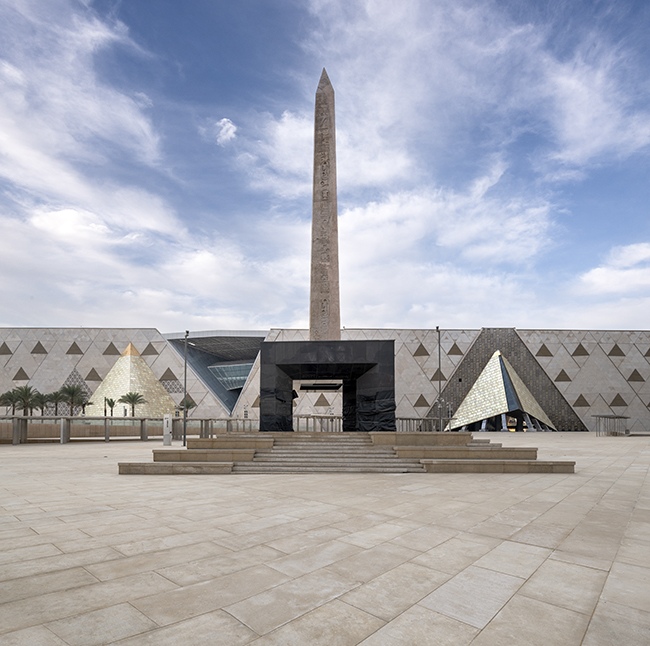
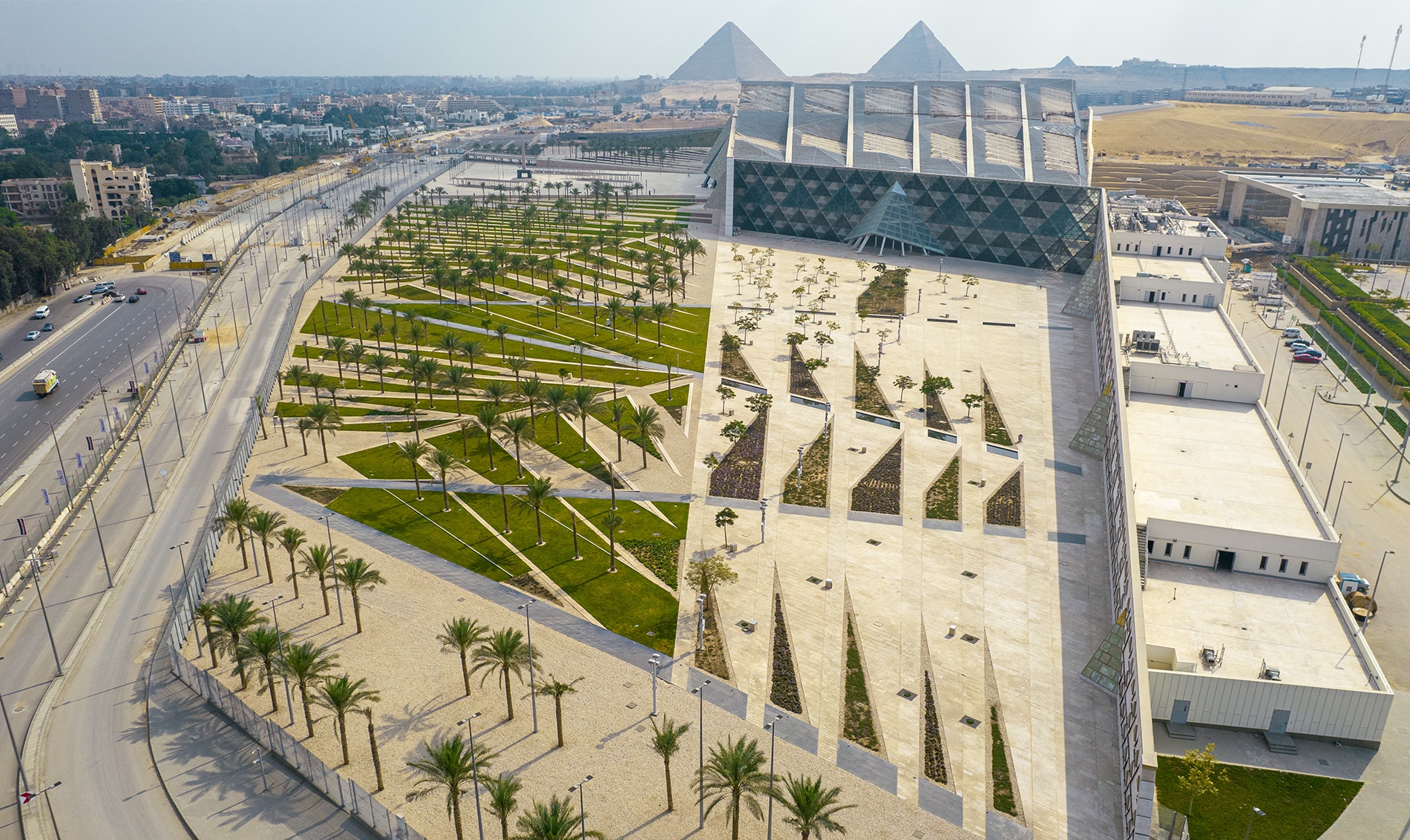
The Hanging Obelisk anchors the five-hectare forecourt, a civic threshold between Cairo and the Giza Plateau. Credit: Grand Egyptian Museum.
The story began in 2003, when the Ministry of Culture launched a design competition of unprecedented scale. One thousand five hundred and fifty-six entries arrived from eighty-two countries. The winning concept came from Ireland. Heneghan peng architects proposed a museum that would speak directly with the pyramids. The commission became both a career summit and a luminous chapter in the exchange between Eastern and Western imagination.
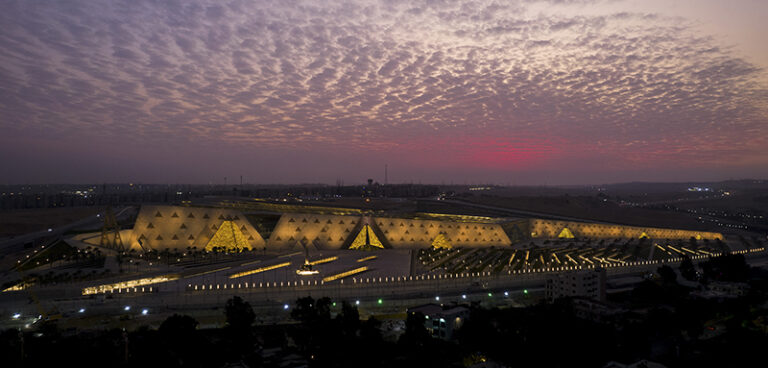
The core idea is disarmingly simple. Build a museum that converses with the geometry of Giza. From afar the porous triangular elevations answer the three giant forms on the horizon. At sunset the glass and stone catch the same golden register as the ancient limestone. Old and new do not compete. They complete the scene.
The Grand Egyptian Museum is more than a national gift to the world. It is a place of pilgrimage for all who love culture. Within these walls there is no boundary of era or language. Bring curiosity. Bring reverence. Walk through a threshold that spans five thousand years. Somewhere between the Nile and distant rivers of memory a shared human story begins to ring clear.
The glowing pyramid canopy marks the main entrance of the Grand Egyptian Museum, echoing the geometry of the Giza pyramids while leading visitors into the Grand Hall. Credit: Grand Egyptian Museum
Design Rooted in Place
“Designing a museum of this caliber, in such close proximity to a landmark as monumental and symbolic as the pyramids, is a once-in-a-lifetime opportunity,” said Róisín Heneghan, Founding Partner at heneghan peng architects. “Our design works to strengthen that connection to history and place, providing a home for some never-before-seen artifacts that rests upon the very land from which they were created. The result is an experience that evokes a sense of awe at the breadth and depth of ancient Egypt’s fascinating history in a way that feels both modern and timeless.”
The site is a desert plateau shaped by the Nile long ago. From a focal point at the entrance, spatial lines radiate toward the exact positions of the three pyramids. Interior walls follow these rays to create a gentle fan. The roof climbs along the same sight lines, rising to meet the height of the pyramids yet never exceeding it. Restraint becomes eloquence. The ancient monument and the contemporary building enter a quiet conversation until the pyramids feel like extensions of the museum itself.
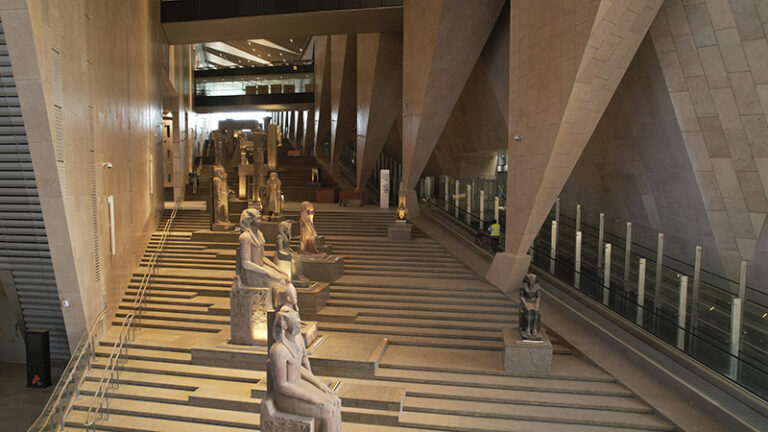
The six-storey Grand Staircase forms a chronological ascent, populated by royal statues that guide the climb. Credit: Grand Egyptian Museum.
A Journey Through Time
The six story Grand Staircase is not only circulation. It is a timeline you can climb. Visitors ascend from the Predynastic period through the Greek and Roman and Coptic eras. The complete Tutankhamun suite waits at the summit so that every guest travels the long arc of civilization before the encounter with gold and legend.
Many of the largest works occupy landings along the stair. Ten seated figures of kings command the space. With every flight the visitor passes another sovereign presence. Transport becomes exhibition. History breathes.
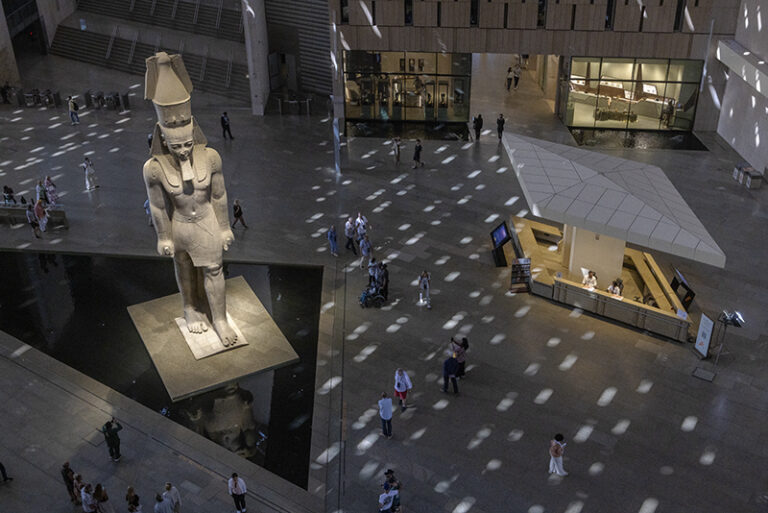
The Grand Hall’s information pavilion and water court under a field of patterned light. Credit: Georges & Samuel / The GS Studio.
Light and Stone
Natural light plays a principled role in the experience. Museums often guard against daylight for conservation. Here the collection is largely stone, weathered by sun for millennia. The architects introduce daylight where possible so that statues regain the vitality they would have held under the Egyptian sky. Faces seem to warm. Inscribed surfaces read as if newly cut.
To temper Cairo’s heat, the structure is heavily concrete. Thermal mass steadies the environment across the eight hundred meter length of the building. Vast volumes remain comfortable with minimal mechanical intervention. The result is a poised balance of environmental responsibility and visitor ease.
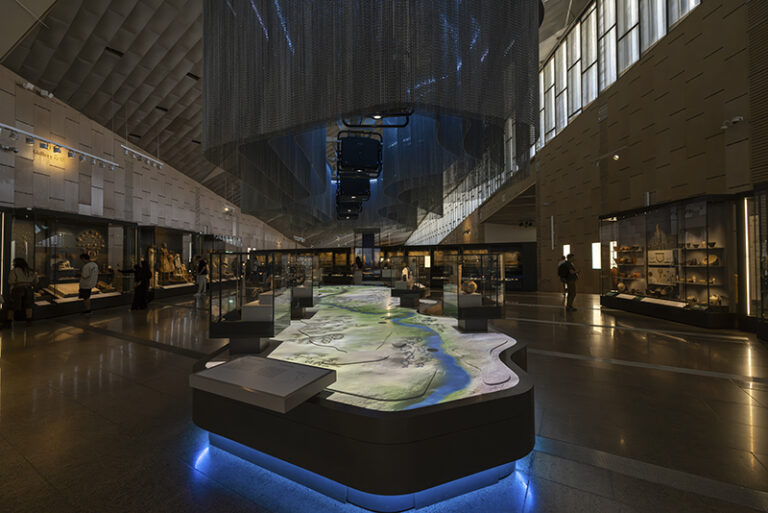
Main galleries with a topographic model of the Nile and a suspended canopy that traces flows of time and geography. Credit: Georges & Samuel / The GS Studio.
Beyond the Galleries
The museum serves Cairo in many ways. A five hectare forecourt designed with West 8 offers a generous public green. Palm groves and water recall the Nile floodplain that once allowed stone blocks to travel by boat to the plateau. Families stroll. Children run. The civic room of the city opens to the desert light.
Behind the scenes is one of the largest conservation centers in the world. Seventeen specialized laboratories connect to the main building through a tunnel network. Papyrus, textiles, pottery, monumental sculpture, human remains. Each material has distinct needs. Each finds a careful response.
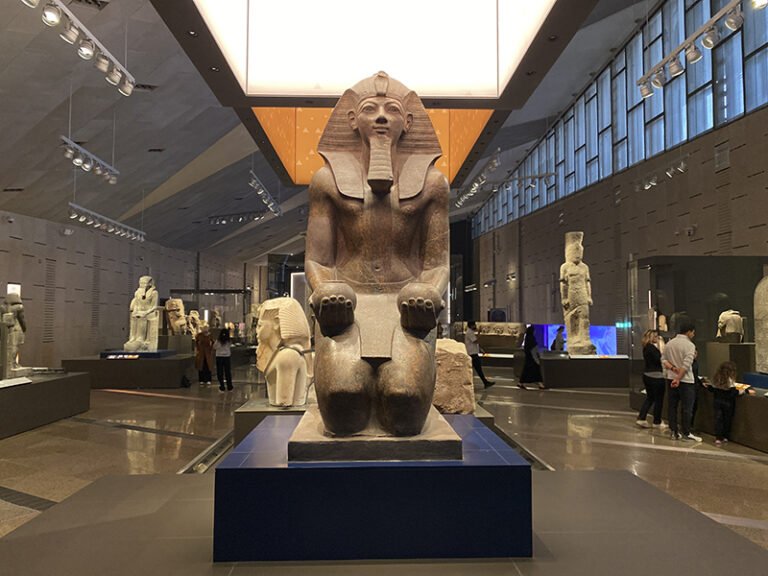
Queen Hatshepsut in the newly curated stone galleries. Credit: Grand Egyptian Museum.
Global Collaboration
The Grand Egyptian Museum is a feat of coordination and shared vision. Heneghan peng architects collaborated with Arup, Buro Happold, Cultural Innovations, Metaphor, West 8, and numerous Egyptian partners. Engineers refined performance and resilience. Exhibition specialists shaped narrative and flow. Landscape designers grounded the campus in its geology and history. The project stands as a model of international collaboration in the service of culture.
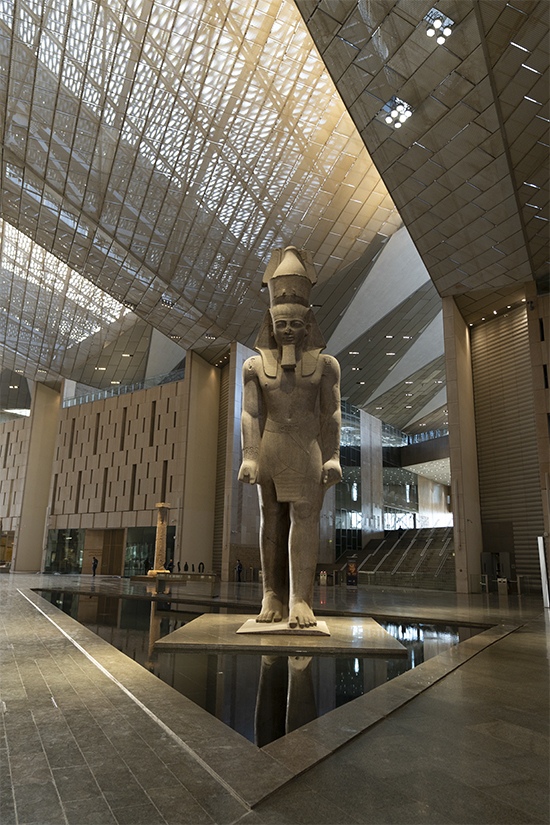
Colossus of Ramesses II installed at the center of the Grand Hall’s reflecting pool. Credit: Grand Egyptian Museum.
A Museum for a New Epoch
Stand at the top of the Grand Staircase. The galleries sweep away to either side. Through the great opening the pyramids hover at arm’s length. In that moment the museum’s deepest accomplishment becomes clear. It does not simply assemble treasures. It places every visitor on level terms with the ancient world.
The Grand Egyptian Museum is a guardian of heritage and also a portrait of modern Egypt. It honors scholarship and welcomes the public. It provides the perfect image for a passport photo one minute and quietly maintains the strictest environmental controls the next.
Opening day is not an ending. It is a beginning. As millions make the journey to Giza, as children gasp before the gold of Tutankhamun, as couples linger in the forecourt at dusk, people will find that this thoroughly contemporary building reveals the enduring warmth of ancient Egypt.
At dusk the museum becomes a band of light along the plateau, its triangular windows glowing like beacons. Credit: Grand Egyptian Museum.
About heneghan peng architects
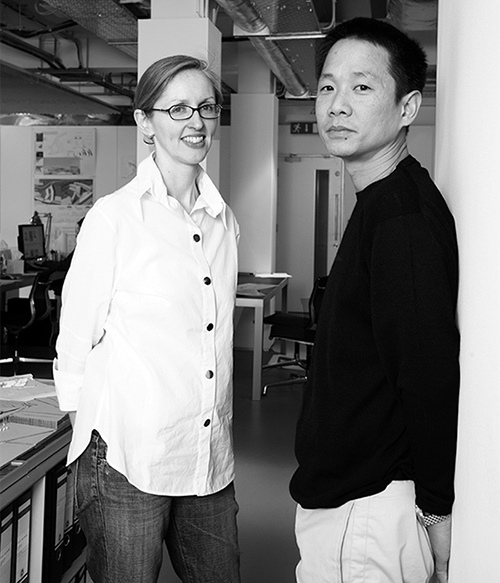
Heneghan peng architects is an international partnership working across architecture, landscape, and urban design. Founded by Shih-Fu Peng and Róisín Heneghan in New York in 1999, the practice moved to Dublin in 2001 and opened a Berlin studio in 2011. Known for interdisciplinary collaboration, the office has delivered the Giant’s Causeway Visitor Centre, the Palestinian Museum, the Arrival and Conservation Buildings at Storm King Art Center, and the refurbishment of the Historic Wing of the National Gallery of Ireland. Current projects include work at Kaiser Wilhelm Memorial Church in Berlin, temporary exhibition pavilions for Trinity College Dublin, the Alte Kaserne at Festung Königstein, and a new children’s museum in Waterford. The Grand Egyptian Museum is the firm’s brightest pinnacle to date, and a work that will endure in the architectural record of the twenty-first century.
(Image on the left: Róisín Heneghan and Shih-Fu Peng, founding partners of heneghan peng architects. Credit: heneghan peng architects.)