

When Technology Meets Tactile Design
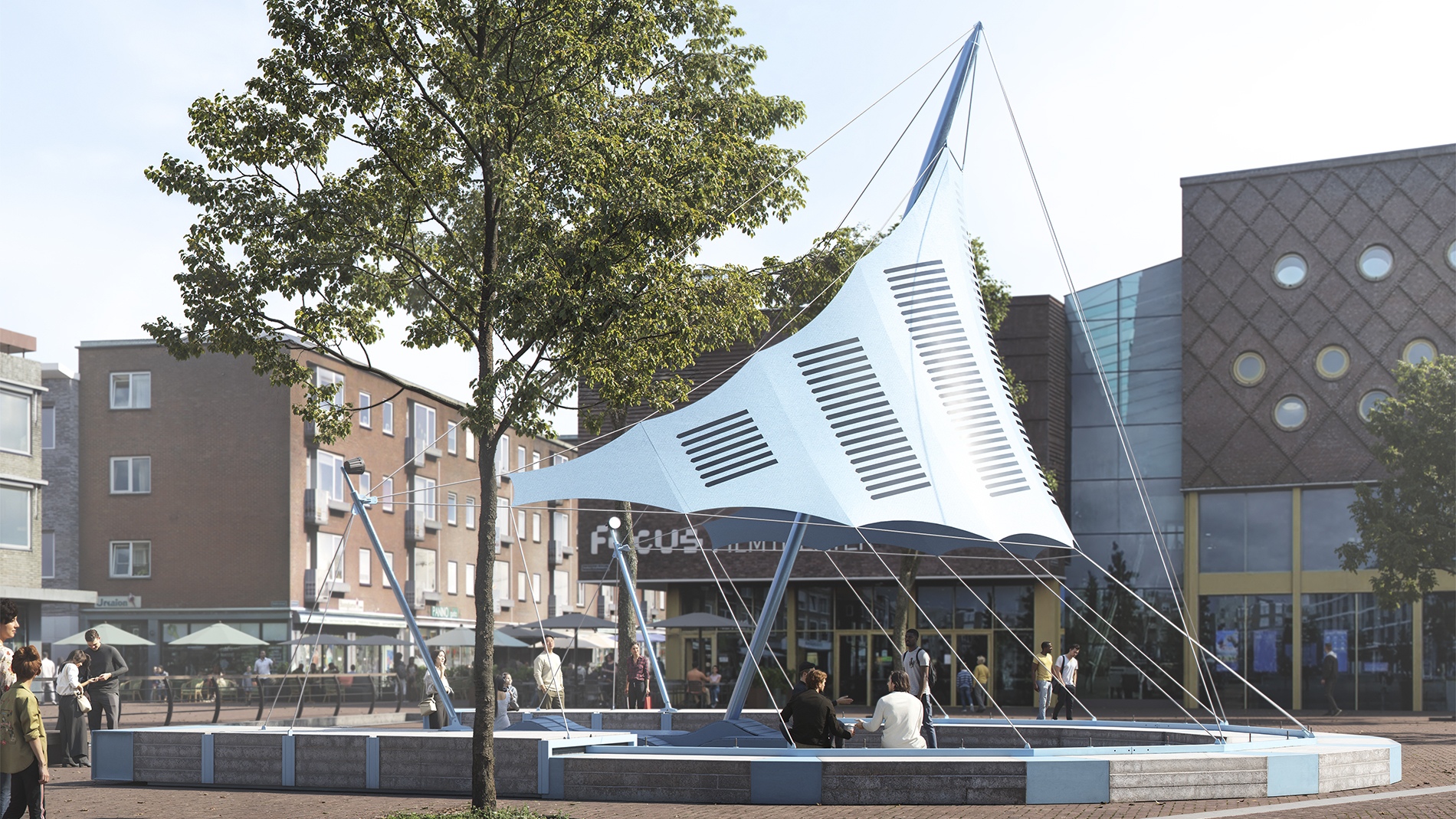
Unveiled at Dutch Design Week 2025, the Umbra Pavilion embodies designer Pauline van Dongen’s core conviction: the energy transition demands more than technical fixes—it requires a cultural revolution that renders renewable energy tangible, inviting, and woven into everyday life. As cities grapple with intensifying heat stress (summer urban temperatures soaring up to 8°C above rural surroundings), van Dongen’s creation delivers practical cooling while forging a new aesthetic vocabulary for solar infrastructure, elevating it beyond mere rooftop panels into an integral thread of our lived environment.
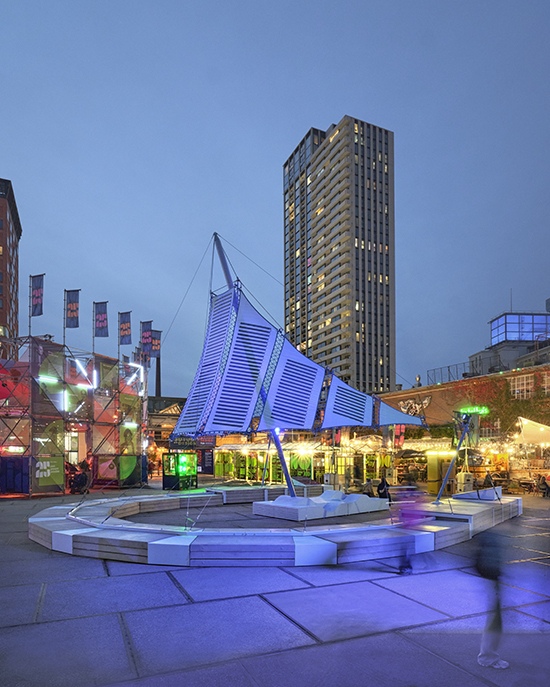
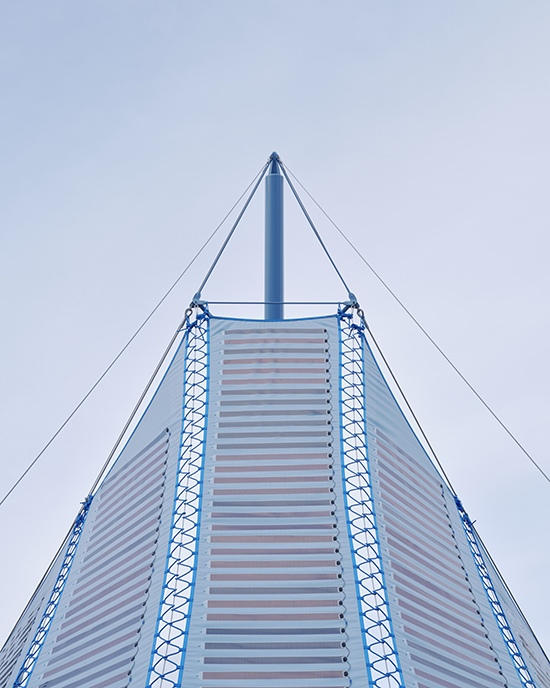
Rising 9.6 meters above ground, the pavilion’s undulating solar-textile canopy drapes dappled light and shadow across 190 square meters of public space. Yet this is no ordinary shade giver. 150 organic photovoltaic modules are seamlessly embedded in the fabric, silently gathering daylight, then—come nightfall—powering four LED spotlights to bathe the structure in a radiant glow, redefining the nocturnal identity of the urban square. Meet heliotex: a revolutionary solar textile marking van Dongen’s bold evolution from wearable tech garments to a visionary reimagination of how cities generate, sense, and connect with renewable energy.
Recently, we sat down with Pauline van Dongen to unpack the pioneering story of the Umbra Pavilion and heliotex—probing how her practice bridges wearable technology and architectural intervention, transforming solar power into something not merely functional, but experiential, beautiful, and profoundly human.
Designing Energy as a Sensory Experience
For van Dongen, solar energy transcends its role as a technical solution. “Solar energy is not just a technical solution, it’s something we live with, something that shapes our habits and perceptions: the way we live and the way we relate to our environment,” she explains. With the Umbra Pavilion, she sought to bring solar energy closer to people through rich material qualities that engage the senses.
“The pavilion doesn’t explain solar power, it lets you experience it: through light, shadow, colour, rhythm and organic form language,” van Dongen says. Rather than presenting energy generation as an abstract concept confined to industrial installations or rooftop arrays, she creates spaces that invite people to pause and discover how solar energy can be gentle, soft, and inviting. “That’s how we move beyond panels on rooftops and in the landscape, by weaving energy into the spaces we inhabit and into our cultural imagination.”
This philosophy marks a fundamental departure from conventional approaches to renewable energy infrastructure, which often prioritize efficiency and output above all else. Van Dongen argues that for the energy transition to succeed, it must become part of our cultural imagination, not just our electrical grid.
The Technology Behind heliotex
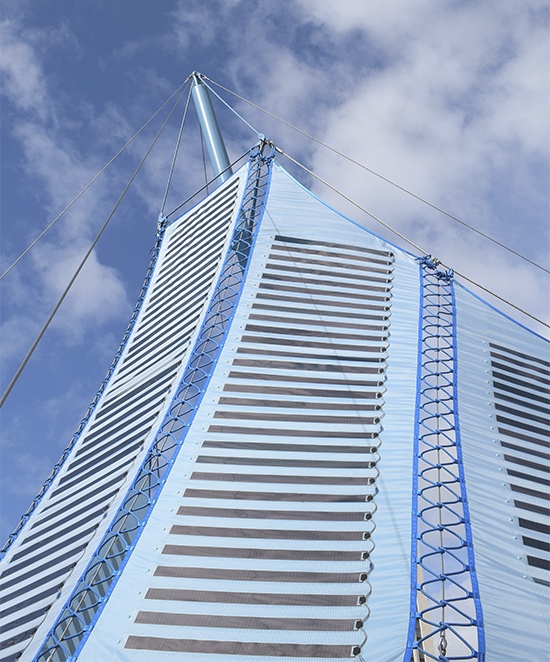
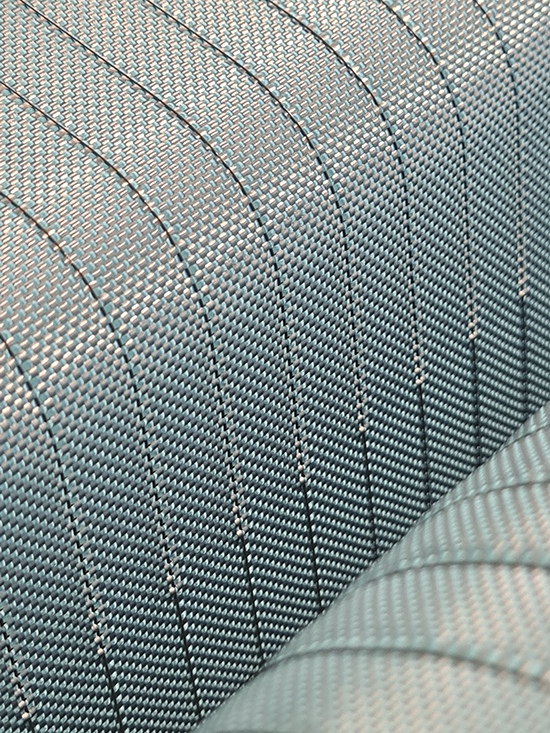
At the heart of the Umbra Pavilion lies heliotex, a technical textile that integrates flexible organic photovoltaic (OPV) solar cells directly into its weave. Unlike rigid silicon panels, OPV technology allows solar energy generation to become flexible, foldable, and adaptable to various shapes, colors, and weave patterns. The current modules deliver an output of 53 watts per square meter, and while this is lower than conventional silicon photovoltaics, van Dongen emphasizes that the comparison misses the point.
“Performance expectations are still shaped by silicon PV, so we have to communicate clearly about the trade offs: flexibility, aesthetics and integrability versus raw efficiency,” she notes. The technology enables entirely new applications where rigid panels would be impossible or aesthetically inappropriate, from undulating architectural canopies to textile façades and festival structures.
The Umbra Pavilion incorporates 40 square meters of heliotex containing 8 square meters of solar cells connected to a 3 kilowatt hour energy storage system. The entire textile structure weighs just 500 grams per square meter, making it remarkably lightweight compared to traditional building materials or conventional solar installations.
Crucially, heliotex has been designed with sustainability and circularity in mind from the beginning. The textile itself is made from mono material recycled polyester (rPET) yarn, and the OPV modules are mechanically integrated rather than glued, allowing them to be easily separated for repair, reuse, or recycling at end of life. “Circularity is part of our development from the start,” van Dongen emphasizes.
The material has been engineered for outdoor architectural applications, with testing confirming it meets necessary standards for tensile strength and fire resistance. It features a water repellent finish that prevents dirt from bonding to the surface, and the team continues to refine UV resistance to extend the material’s lifespan.
Beyond Energy: Measuring Human Experience
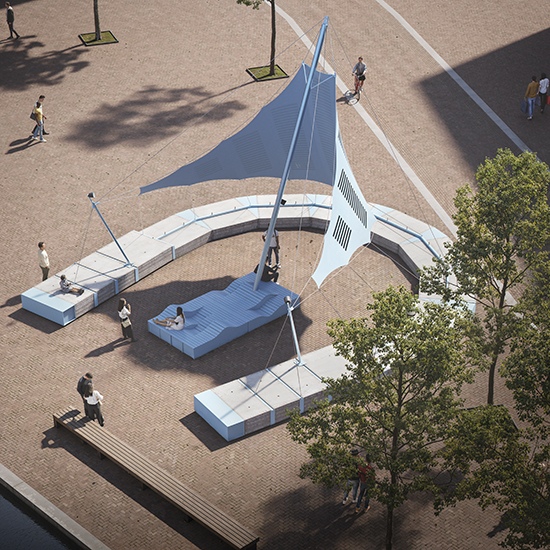
At Dutch Design Week, van Dongen’s goal wasn’t to maximize energy output but to demonstrate how solar energy could be meaningfully integrated into public space, she explains. The pavilion performed reliably, harvesting enough energy during the day to power its nighttime illumination and creating a colorful presence in the square.
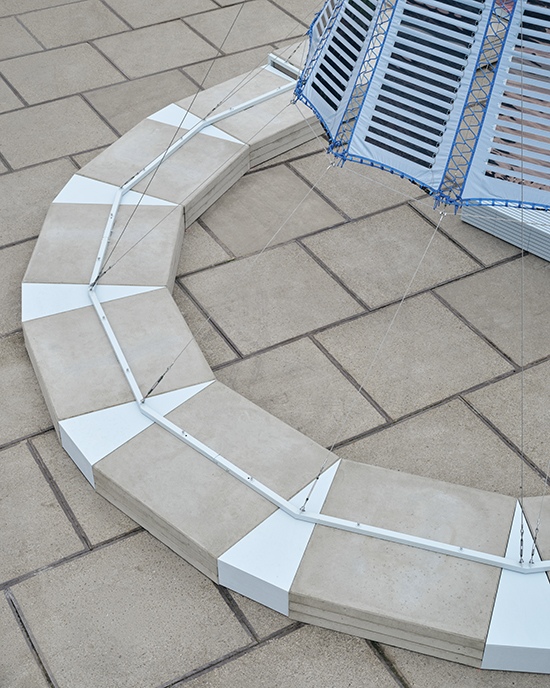
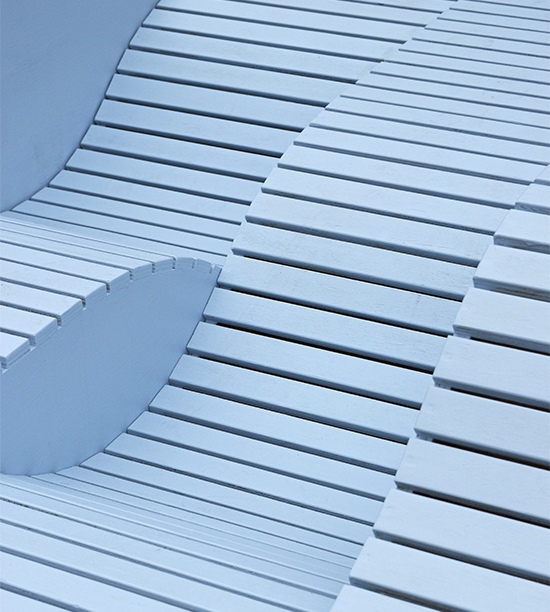
But perhaps more revealing than the technical performance were the human interactions the pavilion sparked. “People stopped, rested, lingered. Some even lay underneath the textile on the wavy furniture we designed for it, while kids turned it into a playground as well,” van Dongen recalls. These observations suggest the pavilion succeeded in its deeper mission: creating a space where renewable energy feels accessible and inviting rather than distant and industrial.
For the 2026 deployment in Arnhem, van Dongen plans to expand these energy interactions. “We’re exploring new ways to make the energy experience tangible, from solar powered phone charging to light projections or even making solar powered ice treats on hot days,” she says, imagining ways to make the energy generation tangible and useful in people’s daily routines.
Tackling Urban Heat in Arnhem
The Umbra Pavilion was developed in close collaboration with the City of Arnhem, a pioneer in climate adaptation, which will host the structure in summer 2026 as an intervention against urban heat stress. This deployment represents a critical test of heliotex’s real world performance in addressing one of cities’ most pressing climate challenges.
Van Dongen’s approach to measuring success goes beyond simple shade provision. “In Arnhem, we’re not just aiming to provide shade, but to actually reduce how people experience heat,” she explains. The team will measure Physiological Equivalent Temperature (PET), which combines solar radiation, humidity, and human physiology to assess thermal comfort. But quantitative data tells only part of the story.
“We’ll also gather stories, through observation, dialogue, and short interviews,” van Dongen says. “We’re working with the city of Arnhem to combine data with lived experience. What does it feel like to spend time in this place?”
For van Dongen, success will be multifaceted: “A measurable drop in perceived temperature, meaningful energy interactions (based on people’s feedback), and perhaps most importantly, a place people seek out on hot days. A space that brings relief and delight.” If the pilot demonstrates clear value, she hopes it will lead to broader implementation of solar textiles for urban cooling, establishing a new category of climate adaptation infrastructure.
Durability and Real World Performance
The Dutch Design Week installation provided crucial insights into heliotex’s durability under real world conditions. “Heliotex held up well during DDW. It resisted wind, rain, and even a storm,” van Dongen reports. While challenges like bird droppings are unavoidable in public spaces, the water repellent finish has proven effective, and the team is now testing various cleaning methods following the exhibition.
UV resistance remains a key focus for ongoing development, as it directly impacts the material’s lifespan. Van Dongen is candid about the work still ahead: “The lifespan of both the textile and the OPV is something we’re actively improving.” This honest acknowledgment of current limitations reflects her commitment to developing a genuinely viable product rather than overpromising on emerging technology.
Navigating Standards and Certification
As an innovative hybrid material, heliotex faces an interesting challenge: it doesn’t fit neatly into existing regulatory categories. “Because heliotex is a hybrid, it doesn’t fit neatly into existing categories, which is both a challenge and an opportunity,” van Dongen observes.
The team is exploring which certifications are most relevant, including EN standards for tensile structures and IEC norms for solar modules. “For municipalities to confidently specify the material, we need to demonstrate performance, fire safety, durability, and reliability over time,” she notes. “That’s exactly what our pilot projects are meant to do.”
This pragmatic approach recognizes that real world demonstrations will prove more persuasive than theoretical specifications, particularly for a material that challenges conventional categories. Each pilot project builds the evidence base that will eventually enable broader adoption.
Overcoming Adoption Barriers
Van Dongen identifies awareness as the biggest current hurdle to adoption. “Most architects and planners simply don’t know that solar textiles like heliotex exist,” she says. Beyond basic awareness, the material faces perception challenges rooted in comparisons to conventional photovoltaics.
“We’re tackling these barriers through storytelling, real world pilots, and by forming strong partnerships with people who are open to new ways of thinking about energy and urban design and healthy living environments,” she explains. This strategy recognizes that emerging materials require not just technical validation but also new frameworks for evaluation and new imaginaries for what energy infrastructure can be.
The next one to two years will focus on further development and industrialization through a Eurostars funded research project with partners in Denmark and Germany. Van Dongen is developing multiple pilot projects, including a solar textile façade and a festival tent, to test the material at different scales and in different contexts.
A Service Based Business Model
Rather than simply selling a product, van Dongen is moving toward a service based model. “We not only supply the material, but also guide the design and implementation,” she explains. “Customisation is key, especially for public space.”
This approach acknowledges that heliotex represents a fundamentally new material category requiring specialized knowledge for successful implementation. At the same time, the studio is developing more standardized modules, such as façade panels, that can be more easily specified and scaled while maintaining design freedom in material qualities like color, weave pattern, and textile density.
Van Dongen aims to be ready for broader commercial deployment within one to two years, “ideally with municipalities, architects, and event organisers who share our vision.” This timeline balances the need for further technical development with the urgency of climate action.
Maintaining Human Centric Design at Scale
As her work scales from wearable garments to city scale architecture, van Dongen remains committed to the sensory, human centric quality that defines her studio’s approach. “Whether I design for the body or for public space, the textile is always a mediator. It connects, communicates and senses,” she explains.
“As we scale from wearable to architectural, I want to preserve that sense of intimacy: of tactility, lightness, and rhythm,” van Dongen says. This commitment distinguishes her work from purely technical approaches to renewable energy infrastructure.
“With heliotex, I’m not just developing an energy material. I’m designing an energy experience. Something that lets people connect with the sun and not just use solar energy.” This philosophy suggests that the true innovation of heliotex may lie not just in its technical capabilities but in its potential to change how we perceive and relate to renewable energy in our daily lives.
Measuring Sustainability Impact
Van Dongen articulates clear sustainability goals for heliotex: “We’re currently focusing on two main sustainability goals: the energy output per square metre per year, and the reusability of the components.” These metrics will provide concrete benchmarks for assessing the material’s environmental performance.
The mono material rPET construction and detachable OPV modules enable repair and recycling, but van Dongen’s approach to sustainability extends beyond material composition to encompass the entire system of energy generation, urban cooling, and public space activation. By providing shade that reduces urban heat stress while generating clean energy, heliotex addresses multiple sustainability challenges simultaneously.
A New Aesthetic for the Energy Transition
The Umbra Pavilion demonstrates that solar energy infrastructure need not be hidden on rooftops or relegated to industrial sites. Instead, it can become part of the public realm, creating spaces that offer both practical benefits (cooling shade, clean energy) and aesthetic pleasure (light, shadow, color, organic form). In doing so, it challenges us to expand our conception of what energy infrastructure can be and how it can contribute to urban life.
As cities worldwide grapple with climate adaptation and the energy transition, van Dongen’s vision of solar textiles that shape new ways of living offers a compelling alternative to conventional approaches. By making solar energy not just visible but experiential, beautiful, and inviting, she points toward a future where renewable energy is interwoven with daily urban life.
The success of the Arnhem deployment in 2026 will provide crucial evidence for this vision’s viability. But perhaps the most important validation has already occurred: in the people who stopped, rested, and lingered beneath the Umbra Pavilion’s glowing canopy, experiencing solar energy not as an abstract technical solution but as a gentle, welcoming presence that enriched their time in public space. That cultural shift, more than any technical specification, may prove the most significant contribution of van Dongen’s work to the energy transition.
*****
The Umbra Pavilion was developed with support from the Municipality of Arnhem, EU projects COOL CITIES and LIFE IP, Creative Industries Fund NL, Dutch Design Foundation, Oost NL, Connectr, Cleantech Park Arnhem, RVO, and the Eurostars Programme. For more information about Studio Pauline van Dongen and heliotex, visit paulinevandongen.nl or heliotexsolar.com.