

Revealing the Emergent Beauty of Nature
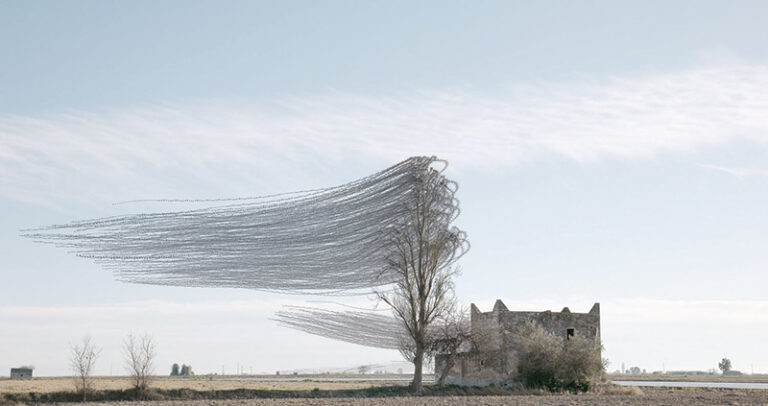
Birds are widely admired for their agility and lightness, yet few people realize that they are even more fundamentally natural scientists. When they rise in flocks and open their wings, they resemble a giant brush drawing across an endless sky. The patterns we see, however, are not created for beauty. They are the incidental outcome of survival strategies. Beneath the flowing arcs and layered trajectories lies no chaos, but the three basic principles that govern flocking behavior: separation, alignment, and cohesion. By avoiding collisions, matching the direction of nearby birds, and moving toward the group’s center, flocks generate emergent structures in the air. Every stroke is the result of countless individual decisions calculated in real time.
Yet these trajectories remain almost invisible to the naked eye. They unfold at a temporal scale far beyond human visual resolution, too fast and too subtle for us to perceive as continuous movement. Air itself is a shaping force, an invisible pool of fluid that wraps around bodies and pulls at their posture, so that flight is always the joint product of forces, density, speed, and the architecture of wind.

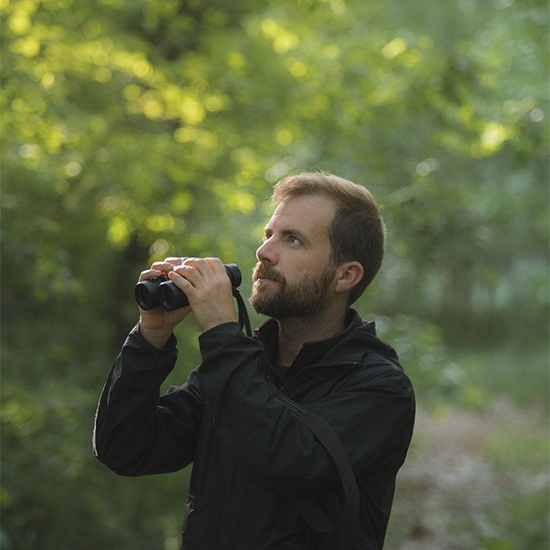
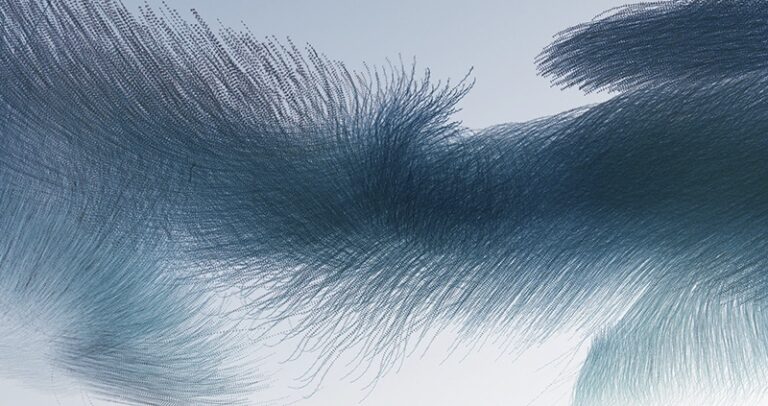
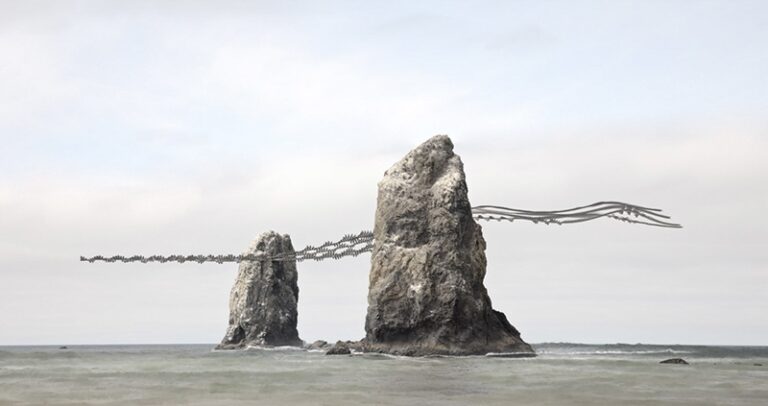
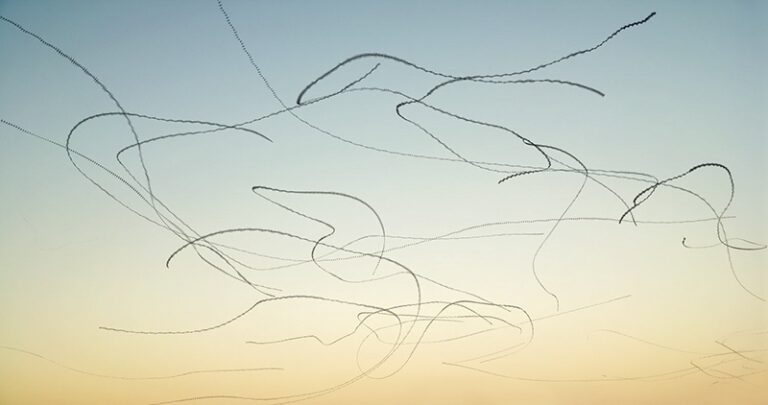
The Catalan photographer Xavi Bou seeks to reveal the structures hidden within the folds of time. In his series Ornithographies and Entomographies, he binds art, science, and nature into a single system through chronophotography, a technique invented in the 1880s by Etienne Jules Marey for the study of animal motion. Bou records birds at sixty frames per second and insects at over one thousand frames per second, compressing hundreds or even thousands of high-speed images into a single picture. The extended time, the shaping force of wind, and the algorithms of movement together become visible. The resulting images resemble flowing ink or wild cursive script, yet they are essentially visual models of collective behavior and flight physics. Art emerges not from intention but as an unbidden gift from physical laws.
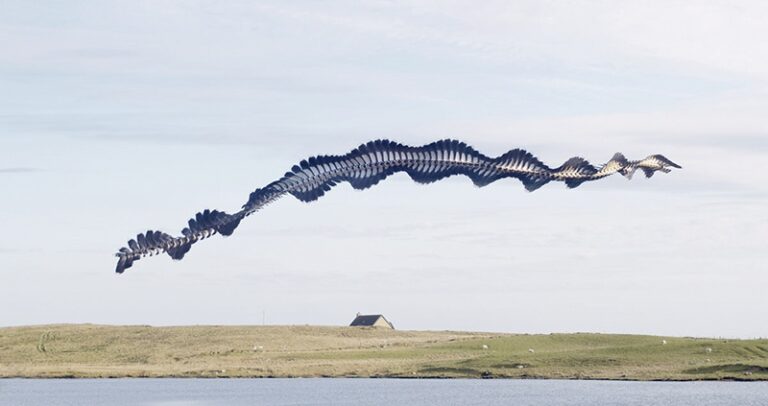
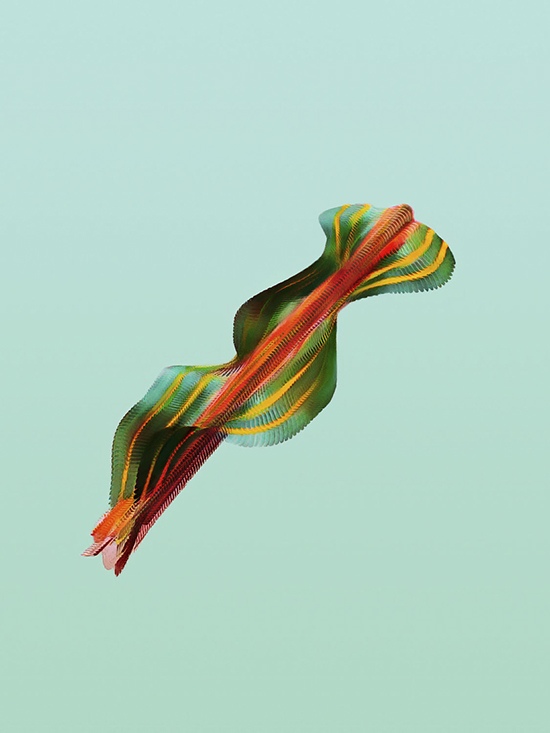
Flocks condense into mountain-like contours that reveal how they navigate three-dimensional space. Insect trajectories form floating ribbons that show how microscopic creatures struggle against the viscosity of air. Patterns that look abstract arise from ancient biological logic and the immediate algorithms shaped by evolution.
Although these works are often mistaken for abstract art, they withstand rigorous scientific examination. This duality is central to Bou’s imagery, drawing viewers between aesthetic perception and analytical understanding. He once studied geology and examined the textures of stone layers before turning to photography. He began Ornithographies in 2012, completed its first works three years later, and soon exhibited them internationally. They appeared in National Geographic, BBC Science Focus, and major events such as the PhotoVogue Festival in Milan. Recently, we spoke with him about how he rebuilds our relationship with nature through images, and how he rekindles the long faded instinct to look up at the sky.
In Conversation with Xavi Bou
Origins and Inspirations
How has your scientific background influenced the way you observe natural movement?
Geology shaped my structural way of thinking and allowed me to understand natural movement from different angles. I wanted to create a body of work that could withstand scientific scrutiny while still carrying artistic resonance. In Ornithographies, the flight paths must be accurate and trustworthy, yet they must also retain poetry. These aims are not contradictory. They nourish each other within the same image.
What first inspired you to record flight trajectories?
I have long wondered how we can truly see the presence of animals. Traditional imagery focuses on external appearance, but I am more interested in what lies beyond the body. For birds, this is especially true. Flight is their essence, yet few people have ever seen a full trajectory. I wanted to make the air’s traces visible so that people would not only see birds but acknowledge the forms of life that often go unnoticed. Homing pigeons, for instance, detect magnetic fields and navigate using landmarks and the sun. When I captured the circular patterns created during their training flights, the elegant ovals were not only beautiful but also clear evidence of their sophisticated navigation.
Collaboration and Practice
How do you balance science and art in your work?
I use rigorous methods to record each sequence, then present it in an open manner so audiences from different backgrounds can resonate with it. For more than ten years, this balance has been the core of the series. I gather the movements of life together like assembling a contemporary cabinet of curiosities. They remind us the world still holds wonder. In an age of information overload, I hope the work becomes a pathway to connecting with nature. Emotional resonance is often the prerequisite for moving toward a more harmonious future.
What role do scientists and ornithologists play in your creative process?
Collaborating with scientists helps avoid misinterpretation and enriches content. They understand migration patterns, foraging behavior, and weather dependencies. They can predict where starlings will murmur at sunset and where swallows will gather before migrating south. Following them into the field allows me to integrate scientific knowledge into images more precisely. Without these collaborations, many of these frames simply would not happen.
What is the creative process for Ornithographies?
The process begins with species selection and conceptual framing. For instance, when to photograph starlings requires understanding migration and foraging seasons, and closely monitoring weather, because temperature, wind speed, and atmospheric pressure all alter flight patterns. After shooting, I select the most ideal sequences and then determine overlay density and color presentation in post-production. The goal is to compress temporal information while preserving the essence of movement, making images both authentic and transcendent of mere documentation.
Methods and Technology: From Field to Studio
How do you realize the technical process behind Ornithographies and Entomographies?
I use cinema cameras and high-speed imaging. Ornithographies is usually recorded at sixty frames per second, while Entomographies requires more than one thousand frames per second. The difference comes from biological scale. Birds move quickly but their bodies are large enough for their trajectories to remain continuous. Insects exist at a low Reynolds number, where inertia is weak and viscosity is strong. To them, air behaves almost like thick liquid, and their wings change direction dozens of times in the blink of an eye. Without high temporal resolution, these micro movements would disappear entirely.
Each final image comes from a sequence of five hundred to two thousand frames. I analyze them one by one, selecting only the sections with coherent and aesthetically resonant paths. If the movement lacks continuity, I abandon the sequence. The frames must be consecutive. I screen the material in DaVinci Resolve, then layer and compose in Photoshop. Choosing frames is both intuitive and rational. I look for emergent patterns, harmonious instants, chaotic rhythms, abrupt turns, or smooth glides.
Each flight is unique, almost like a fingerprint. Different individuals, different species, even the same bird in different states will produce subtle variations in movement. A starling foraging flies completely differently than one evading a predator. A young swallow’s trajectory shows noticeably different fluidity compared to an experienced adult bird. I aim to highlight the individuality of each flight. The final image is a faithful trace of motion, not digitally altered, but composed to highlight elegance already present in nature.
Visual Language and Natural Logic
Why do different species produce such distinct visual patterns?
Movement in nature is inherently rich in form. Starlings create dense, fluid formations due to their tight local interactions. Seagulls form looser shapes. Swallows produce fast, irregular lines when hunting insects. Each species evolves flight strategies suited to its ecological niche, and these strategies generate distinct visual signatures. Scientifically, these are structures shaped by behavior and physics. Artistically, they resemble calligraphy, sculpture, or landscapes. I hope each image can evoke wonder on its own, without relying on narrative.
From Birds to Insects: Expanding the Scale
What does Entomographies mean in your creative work?
After years of recording birds, I wanted to explore more microscopic forms of movement and began Entomographies. Insects operate at a scale completely different from birds. They fly in a low Reynolds number environment, confronting strong viscous resistance.
Their trajectories are sculptural and three dimensional, sometimes defying ordinary visual logic. At first I considered filming outdoors, but soon realized that only ultra high-speed imaging in a controlled studio could capture their complexity. Collaboration with entomologist Adrian Smith was essential. His expertise made the project possible. Presenting these images on pedestals is my way of honoring a world that is often overlooked yet vital to ecological systems. With insect populations declining rapidly, making their motion visible also helps restore awareness of their importance. The series has been exhibited at the PhotoVogue Festival at BASE Milano in 2025.
Impact and Perception
Has visualizing movement for so long changed the way you observe?
More than my sense of time, it changed how I look at the world. I am more attentive and more willing to pause. Birds in the city sky and insects in the garden are lives we share space with, yet rarely notice. Once you begin to study flight patterns, you see differences and understand how weather fronts alter migration timing. Ecologists call this a search image, the ability to perceive what has always been present but unseen.
What do you hope viewers take away from your work?
The most important thing is to rebuild connection and rediscover the world through beauty and creativity. I want attention to return to the everyday nature that surrounds us. If viewers first perceive the image as art and later realize it originates from nature, that is ideal. Aesthetic experience creates emotion, and emotion is often the beginning of care. Once you recognize starling murmurations as flowing calligraphy, you cannot forget them. The next time you encounter them, you carry that appreciation with you, and appreciation often grows into a desire to protect.
Illuminating the Ordinary
Xavi Bou’s work reminds us that the most profound art is not a reproduction of nature but the result of co-creating with it. His images lie at the intersection of science and art, serving as precise records of biomechanics and abstract beauty independent of subject matter. Flight becomes form, time becomes image, the everyday becomes sublime. These trajectories were never created as art, yet they become art the moment they are seen. As biodiversity loss accelerates, making the invisible visible becomes an act of witness. By revealing the mathematical elegance and aesthetic power of collective behavior, Bou presents a visual argument for conservation: what we perceive as beautiful, we are more likely to protect.
For more information, visit xavibou.com or follow @xavibou on Instagram.