Research at The Ohio State University shows shiitake mushrooms can function as organic memory devices
In a laboratory at The Ohio State University, shiitake mushrooms are being conditioned to retain electrical history.
Under carefully controlled stimulation, networks of fungal tissue exhibit measurable and repeatable shifts in conductivity. Their resistance changes depending on prior electrical activity, a defining characteristic of memristors—components whose present state depends on past signals. In experimental configurations, these biological networks function as organic memristive systems.
For research scientist John LaRocco and his collaborators, whose work was published in PLOS One in October 2025, the findings represent more than a technical curiosity. They suggest that information processing may emerge from biological matter itself, shaped by growth, chemistry, and adaptive structure rather than lithography and rigid circuitry.
The work raises a foundational question: if living systems can store and transform electrical information, what other forms of organized matter might serve as computational media in an era increasingly defined by environmental limits and material scarcity?
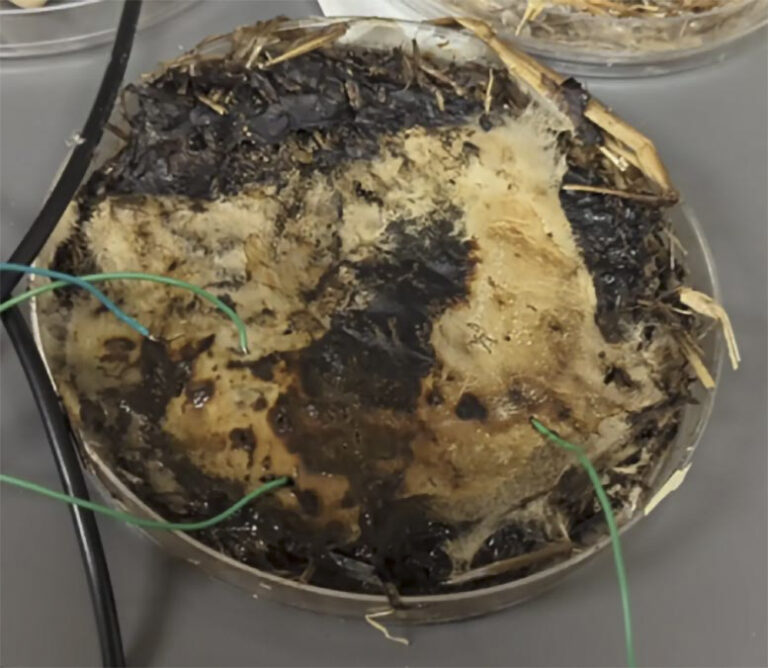
Memristive behavior in fungal substrate. The highlighted region demonstrates sustained conductivity change after electrical stimulation, forming the basis of organic memory storage. Credit: Ohio State University.
Computing Beyond Silicon
Modern digital infrastructure rests on silicon wafers, rare earth elements, and highly specialized fabrication facilities. These systems deliver extraordinary performance but require energy-intensive manufacturing, large volumes of water, and generate persistent electronic waste.
Fungal materials operate according to a different material logic. They are cultivated rather than mined. They grow at ambient temperatures. They are biodegradable. In standby states, individual elements consume microwatt-level power. According to preliminary lifecycle assessments cited by the authors, the embodied energy of fungal substrates may be substantially lower than that of conventional semiconductor fabrication, though direct comparisons remain an active area of investigation.
LaRocco’s research does not propose fungi as replacements for microprocessors. Rather, it questions the assumption that computation must be imposed on inert matter through rigid logical architectures. Biological systems process signals through continuous, adaptive, and context-dependent electrochemical dynamics. The project asks whether those intrinsic dynamics can be harnessed rather than suppressed.
For decades, voltage oscillations observed in fungal networks were treated as metabolic byproducts. More recent investigations suggest these signals possess structure and persistence. What appeared to be noise often reflects underlying biochemical organization.
The inquiry shifted. Instead of asking whether fungi could be forced to behave like computers, researchers began asking whether their natural electrochemical behavior already constitutes a form of computation.
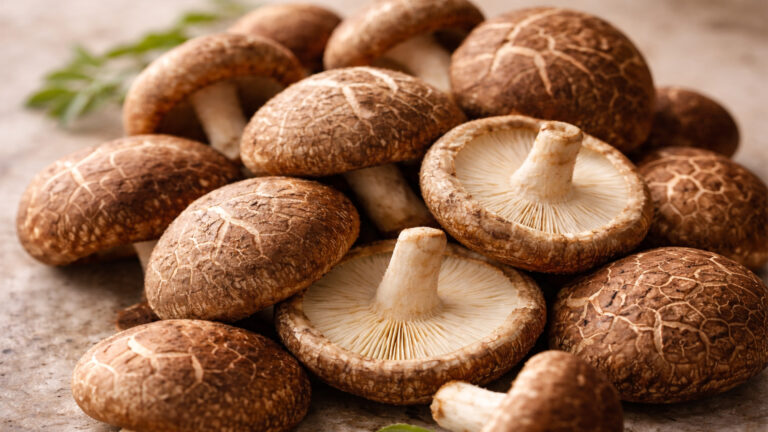
Shiitake mushrooms (Lentinula edodes), whose mycelial networks have been shown to exhibit memristive properties, enabling them to function as organic computing substrates. Photo: Our Narratives
Why Shiitake
Early experiments surveyed multiple fungal species, including varieties with higher intrinsic conductivity. Some proved difficult to cultivate. Others were toxic, unstable, or inconsistent.
LaRocco’s team selected Lentinula edodes, the shiitake mushroom, for practical reasons. It is globally cultivated, biologically robust, and well characterized. Its mycelial networks form dense, relatively consistent structures with comparatively low internal resistance. Established agricultural supply chains and regulatory familiarity further supported the choice.
The decision reflects a broader design philosophy. Scalability, safety, and accessibility were prioritized over maximizing narrow electrical performance metrics. A moderately weaker signal was acceptable if the organism could be reliably grown across diverse settings.
The aim was not to identify the most electrically active fungus. It was to demonstrate that a widely available species could support meaningful memristive behavior.
Dehydrated shiitake specimen with embedded electrodes. The controlled drying process preserves mycelial architecture and redox-active compounds while halting metabolic activity, allowing the fungal tissue to function as a quasi-biological memristor that retains memory without ongoing life processes. Credit: Ohio State University
Training Living Circuits
Biological variability presented an immediate challenge. No two specimens are identical. Hydration levels, microstructure, and chemical composition vary from sample to sample.
To stabilize performance, the researchers developed conditioning protocols combining repeated electrical stimulation, signal averaging, and adaptive filtering. Through patterned inputs over time, certain conductive pathways were reinforced while others weakened.
In laboratory classification tasks under controlled conditions, conditioned fungal networks achieved accuracies approaching ninety percent. These tests involved distinguishing between predefined signal patterns rather than performing general computation. Residual errors were largely associated with moisture drift and structural degradation, phenomena analogous to noise and aging in conventional hardware.
To improve long-term stability, the team implemented controlled dehydration procedures.
Mature specimens were carefully dried to halt metabolic activity while preserving mycelial architecture and redox-active compounds. Cell walls collapsed in ways that maintained conductive pathways while immobilizing internal electrolytes.
The resulting structures retained memory-like hysteresis behavior without ongoing life processes. LaRocco describes these devices as quasi-biological memristors: no longer metabolically active, yet electrically shaped by prior biological growth and conditioning.
They function as material records of biological history.
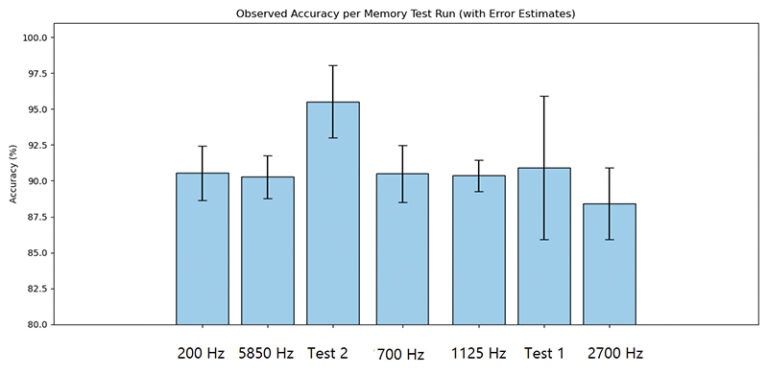
Classification accuracy of conditioned fungal memristors across different operating frequencies (200 Hz to 5850 Hz), demonstrating reproducible performance with accuracy consistently above 88%. Error bars represent standard deviation. Credit: Ohio State University
Distributed Processing
Performance limitations emerged at higher operating frequencies. Biological substrates respond more slowly than semiconductor devices, and signal fidelity declined as input rates increased.
Rather than treating this as a fixed constraint, the researchers explored parallelization. By connecting multiple fungal elements, overall performance improved. Computational load was distributed across networks of substrates.
The architecture resembles redundancy principles seen in neural systems, where distributed processing compensates for local inefficiencies. LaRocco cautions against overextending the analogy. Fungal networks do not exhibit synaptic plasticity or spike-based signaling in the neural sense.
What they share is not cognition but structural principle: adaptive conductivity across interconnected pathways enables distributed information processing.
The fungi do not think. Their electrical behavior reflects chemical dynamics shaped by growth and conditioning.
Practical Directions
Fungal computing systems remain laboratory prototypes. Commercial deployment is not imminent. Nevertheless, potential applications are emerging.
Small-scale substrates embedded with electrodes could serve as ultra-low-energy environmental sensors in agriculture, monitoring humidity, temperature, or soil chemistry while performing simple pattern classification locally. This could reduce transmission requirements in distributed sensing networks.
Wearable devices might integrate fungal elements for limited signal processing, extending battery life in edge-computing contexts. In radiation-heavy environments such as space habitats, fungal composites could potentially function as self-healing sensor arrays where silicon degrades over time.
Architectural materials incorporating mycelial networks might sense and respond to microclimatic changes directly within structural components.
Production would adapt existing cultivation infrastructure, adding electrode integration and controlled dehydration stages. Miniaturization would rely less on photolithography and more on guided biological self-assembly using patterned substrates or microfluidic scaffolds.
Instead of carving circuits from inert matter, engineers would collaborate with growth processes.
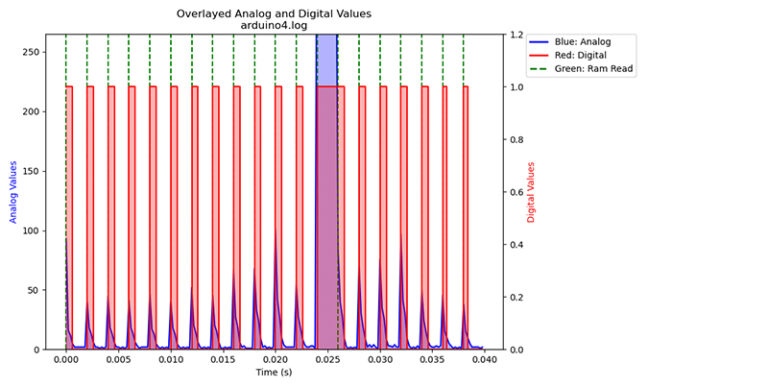
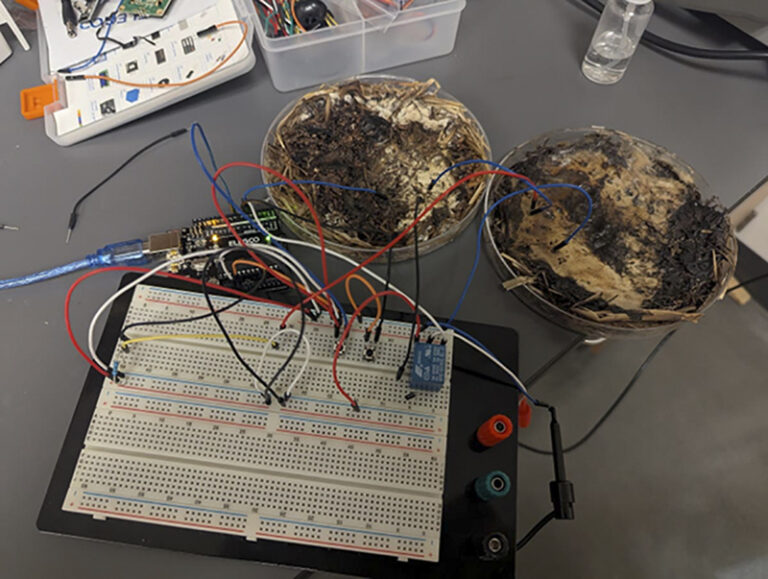
Laboratory setup with conditioned fungal specimens interfaced to Arduino-based measurement system. The breadboard configuration enables precise control of electrical inputs and real-time monitoring of memristive responses in the biological substrates. Credit: Ohio State University
Rethinking Computation
The broader implications are conceptual.
Digital computing is built on discrete states, Boolean logic, and deterministic control. Variability is treated as error. Biological systems operate differently. Signals are continuous. Responses are context-dependent. Adaptation is central.
Fungal memristors occupy an intermediate domain. They are not substitutes for digital processors. They are complementary systems potentially suited to tasks involving pattern recognition, sensory integration, and environmental interaction.
LaRocco situates the research within the longer history of analog computing, which once dominated scientific modeling before digital systems became industrially dominant. Analog machines excelled at continuous system representation. Their decline reflected manufacturing scalability rather than fundamental conceptual limits.
Biological substrates reopen this terrain. They enable analog computation embedded directly in matter and lower experimental barriers for laboratories without access to advanced semiconductor fabrication.
The question is not whether fungi will replace silicon. It is whether hybrid systems can expand the range of computable phenomena.
Limits and Open Questions
Skepticism is warranted.
Engineers question reproducibility across biological batches. Environmental sensitivity remains a constraint. Standardized cultivation protocols are still developing. Interfaces between biological and electronic components require refinement, particularly regarding encapsulation and humidity control.
Long-term durability under field conditions has not yet been fully established. Scaling behavior beyond laboratory arrays remains exploratory.
As LaRocco emphasizes, progress will likely depend on incremental refinement rather than dramatic breakthroughs.
A Material Provocation
Despite these limitations, the research presents a material provocation.
It challenges the assumption that information processing belongs exclusively to engineered machines. It suggests that computation can emerge from organized matter shaped by growth, chemistry, and history.
By demonstrating that a globally cultivated food organism can be conditioned to exhibit stable memristive behavior, the study expands the material imagination of computing. It highlights how current infrastructures reflect historical investment patterns as much as physical necessity.
Whether fungal memristors become commercially viable devices or remain primarily research tools remains uncertain. What is clear is that they open space for rethinking how digital systems might coexist with biological processes in a resource-constrained world.
The mushrooms in LaRocco’s laboratory are not conscious. They do not reason. They do not understand.
They exhibit electrically persistent state.
And in doing so, they suggest that the future of computation may depend not only on faster clocks and denser chips, but also on learning to work with the adaptive properties already present in living matter.
About the Research
Lead Researcher: John LaRocco, Research Scientist in Psychiatry, The Ohio State University
Co-Author: Qudsia Tahmina, Associate Professor, Electrical and Computer Engineering, The Ohio State University
Publication: PLOS One, October 2025
Institution: The Ohio State University
Key Findings:
Shiitake mushrooms conditioned as organic memristors achieved approximately 90% classification accuracy
State transitions reached up to 5,850 signals per second under laboratory conditions
Lifecycle energy use was estimated at roughly one-fiftieth of comparable silicon processing
Performance scaled through parallel connection of multiple fungal elements
Dehydrated specimens retained memory behavior without active metabolism