
The Emergence of Seconds
An experiment suggests that time may not be fundamental, but something that emerges from within
Time is one of the most familiar aspects of human experience and one of the least understood in physics. We feel it passing. We measure it constantly. And yet some of the most rigorous theories of the universe suggest it may not exist at a fundamental level at all.
The Wheeler-DeWitt equation, proposed in the 1960s, describes the universe as a single, static quantum state with no built-in time parameter. In this picture, there is no external clock ticking in the background. The experience of time, including its directionality, flow, and apparent irreversibility, must arise from somewhere else. But where?
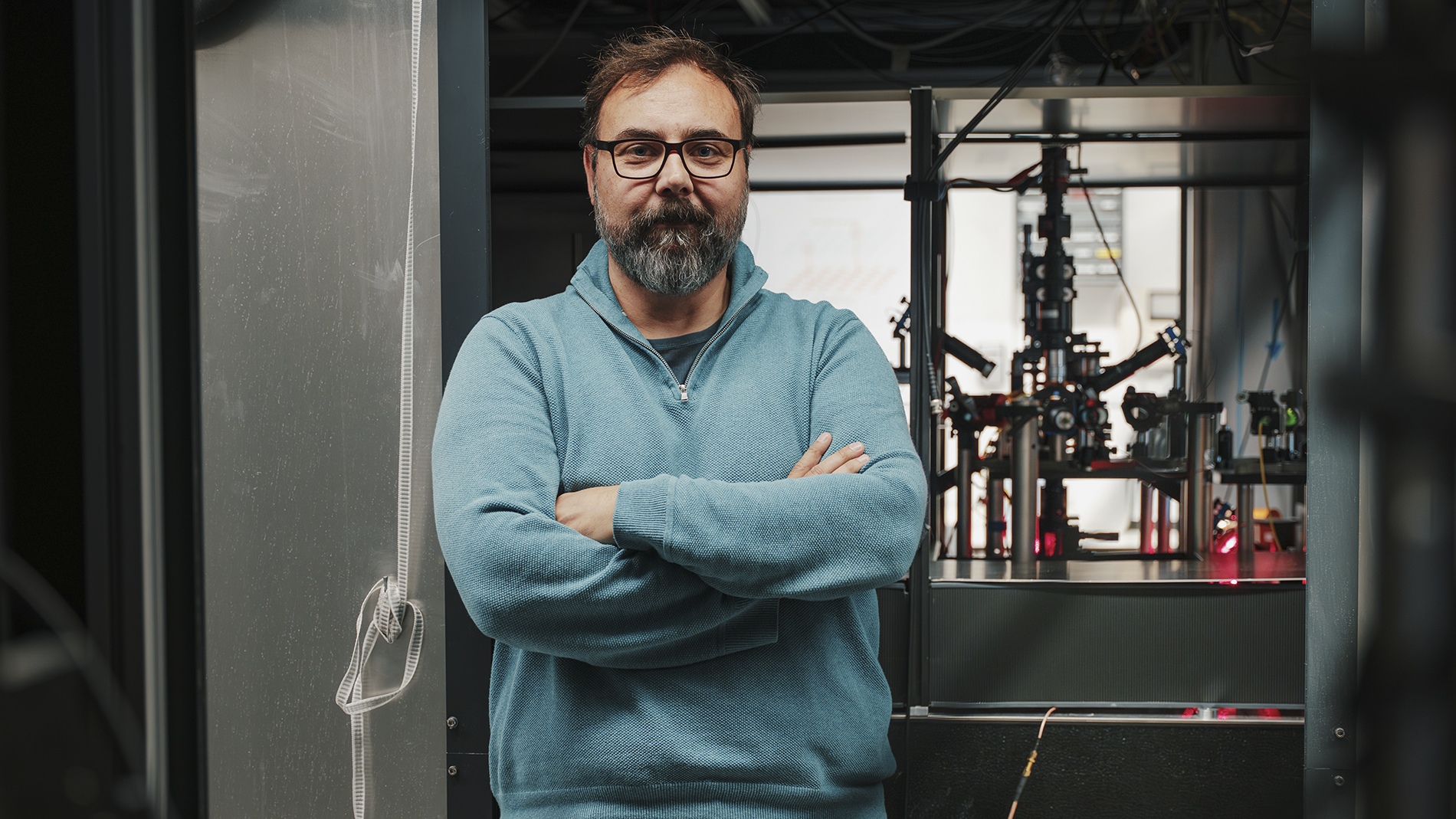
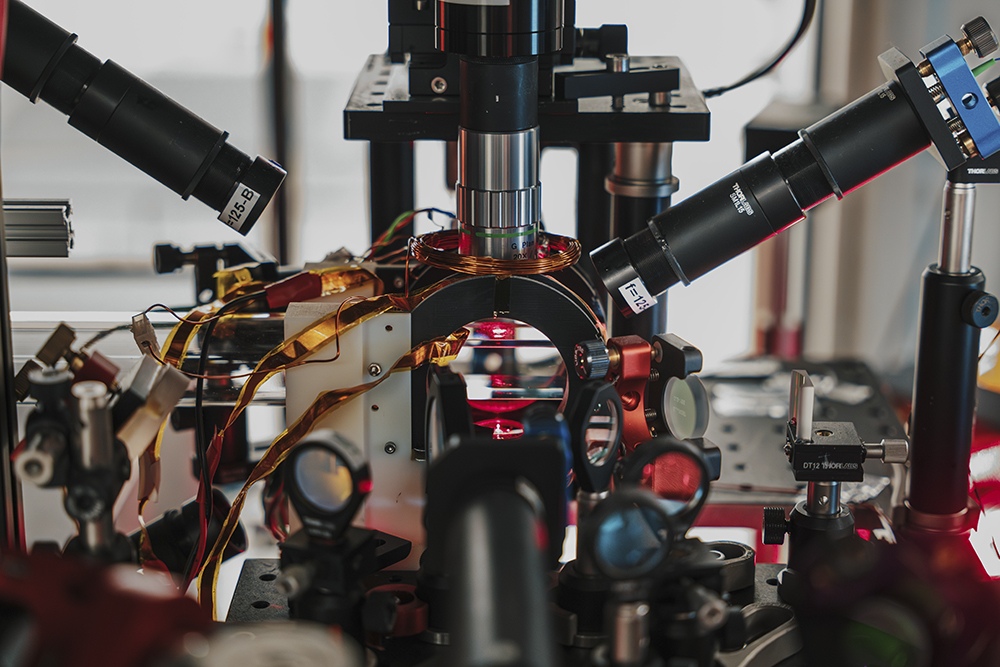
To investigate this question, Professor Giovanni Barontini built a miniature universe in his laboratory at the University of Birmingham. He began with a cloud of 24,000 rubidium atoms, cooled to within a few billionths of a degree above absolute zero, and used them to create a sealed quantum system with no access to an external clock. Inside, a bright region repeatedly expands and contracts, evoking a universe undergoing a Big Bang before collapsing once more into a Big Crunch. It is within this isolated world that a notion of time emerges, not as something imposed from beyond the system, but as a consequence of the system's own redistribution of entropy.
The experiment does not prove that time is emergent in the real universe, and Barontini is careful not to make that claim. What it does show is something more precise: that the idea is physically meaningful, that it can be translated into an experiment, and that it can be tested. We spoke with him about how the experiment came together, what it revealed, and where he believes its conclusions begin and end.

The Conversation
On the Motivation
Giovanni Barontini I think most physicists are drawn to fundamental questions. The difficulty is that, as our careers progress, we often become very specialised. That is necessary because experiments are hard and expertise matters. But it can also make us lose sight of the broader questions that probably attracted many of us to physics in the first place.
In my case I have always tried to keep a broad view. I have worked across several experimental platforms, but the common motivation has always been very simple: I am fascinated by physics and by the possibility of building systems in which abstract ideas become concrete. This experiment is a good example of that. It is curiosity-driven research, but it is also built on a couple of decades of experience with controlled quantum systems. Without that experimental background, the idea would probably have remained only a nice thought.
The origin was much more natural than any grand sense of timing. I was watching my six-year-old son playing and building a little universe, and I thought: in a sense, this is also what we do in cold-atom physics. We build small, highly controlled systems that can be very well isolated from the outside world. For the system itself, there is effectively no external environment, no outside observer, no external clock.
Then the question becomes very direct: if a system has no access to an external clock, how can it know that time is passing? How can it order events from within? That is one version of what is called the problem of time in quantum cosmology. What made the experiment possible is that cold-atom methods allow me to build a simplified analogue of this situation and measure, from inside the system, whether a time variable can emerge from its own internal evolution.
Giovanni Barontini I would be careful with the word "test." The Wheeler-DeWitt equation is a proposal in quantum gravity, and I am not testing quantum gravity directly. What I have done is take one of the conceptual problems it exposes — the absence of an external time variable for a closed system — and build a laboratory system where that question becomes operational.
There have already been important experimental steps in this direction. Several experiments have explored the Page-Wootters mechanism, where time emerges from quantum correlations between a clock subsystem and the rest of the system. That is a beautiful idea, and it shows that a globally stationary quantum state can still contain internal correlations that look like evolution to an observer inside the system.
Our experiment starts from a different physical intuition. As an experimentalist, I find it difficult to believe that fragile quantum entanglement is the only, or even the most robust, ingredient from which the time we experience can emerge. In thermodynamics, the arrow of time appears when we give up complete microscopic information. We coarse-grain. We ignore some degrees of freedom. Entropy then becomes meaningful, and with it comes an ordering of events.
That was the basis of my approach. Instead of asking whether time can emerge from perfect quantum correlations, I asked whether a closed quantum system can build an internal time variable from its own irreversible redistribution of information. In that sense, time emerges from ignorance — not ignorance as a failure, but as the physical coarse-graining that makes thermodynamics possible.
Giovanni Barontini It was not planned in a strategic way, but it was deliberate in a personal sense. As time goes by in an academic career, one has to find new ways to remain challenged. Last year I published a solo theoretical paper, and after that I felt that the next real challenge would be a solo experimental paper.
Working alone changed the way the project developed. It gave me the freedom to let the idea evolve in a rather non-linear way. When one works in a team, one has to explain every step, justify every turn, and keep the reasoning legible to others. That is often very good, and I usually work that way. But it is not always how ideas first form in my head. In this case, being alone allowed me to follow my intuition more directly, make mistakes, change directions, and let the experiment directly talk to me.
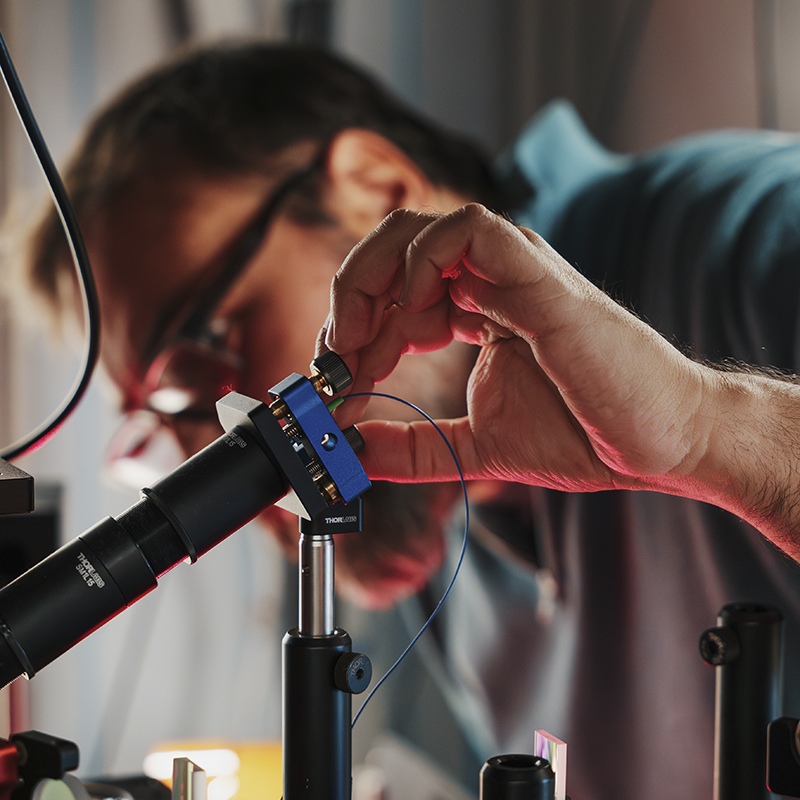
There was also a very simple pleasure in it. I spent time in the lab, with a machine I built, doing the experiment myself. That still gives me real joy. As experimental physicists become more senior, they are often pulled away from the laboratory and towards proposal writing, management, and administration. I understand why that happens, but I have never felt completely at home in that role. I still feel that I have some physics left in the tank, both as a physicist and as an experimentalist.
There is also a broader context. In the UK, the current climate strongly favours applied work — the overhyped quantum technologies. That has made it harder to find people who want to devote themselves to fundamental, curiosity-driven questions. So the solo nature of the work was partly a choice and partly a consequence of the environment. But in the end it became part of the physics: the project was driven by curiosity, built through direct contact with the apparatus, and carried through in a very personal way.
On the Experiment Itself
Giovanni Barontini Rubidium is the workhorse of cold-atom physics. It has very convenient properties for laser cooling, evaporative cooling, and achieving Bose-Einstein condensation. But the atomic species is not the conceptual point. One could in principle use any other atom.
Once the Bose-Einstein condensate is produced, there are two key ingredients. First, the system can be very well isolated. In that sense it resembles a universe: for the universe there is, by definition, nothing outside it. Second, a Bose-Einstein condensate can be described, to a very good approximation, by a single macroscopic wavefunction. That connects naturally to the Wheeler-DeWitt picture, where the universe is described by a wavefunction with no external time parameter.
Once you have these two ingredients — isolation and a single wavefunction — the question becomes very sharp: where is the clock? If there is no outside observer and no external time variable, can the system construct a notion of time from its own internal evolution?
Giovanni Barontini In the laboratory I watch the condensate enter the bright region, expand, reach a maximum size, then contract again and disappear. The Big Bang and Big Crunch language is not a metaphor added afterwards: it is what the density distribution actually does in the images.
Of course, I cannot myself escape laboratory time. Every camera frame has a time stamp. The key point is to ask how that external time is related to a time defined from inside the system. That is the first step of the experiment: understand the relationship between our time and the internal emergent time.
Once this mapping is done, it becomes possible to see when internal time advances and when it stops. It advances when the observed part of the system is exchanging information and entropy with the unobserved part, so that its internal state is changing in a directed way. It stops when that exchange effectively stops. The laboratory time continues, of course, but the internal clock built from the system's own evolution no longer ticks.
Giovanni Barontini It depends on how I set the coupling between the two parts of the system. In some regimes the internal clock keeps ticking during the expansion and contraction cycles, and then pauses between them. In another regime the system evolves into a stationary state. That is where we can say that the internal time has stopped.
What I mean is very simple: nothing happens anymore on the macroscopic scale. The particle distribution stabilizes, the entropy redistribution stops, and the internal time variable no longer increases. The laboratory clock continues to run, of course, but the clock built from the system's own evolution no longer ticks.
There is a point in the data where one can identify this clearly: the observables become stationary and the internal-time curve becomes flat. In cosmological language this resembles heat death. The system may still have microscopic degrees of freedom, but there is no further macroscopic change from which an internal arrow of time can be constructed.
On What the Experiment Does and Does Not Show
The last claim I feel confident making is that I have demonstrated, in a controlled experiment, that a notion of time can be constructed from within an isolated quantum system. The system has no access to an external clock in the way we define its internal description. Nevertheless, by looking at its own redistribution of entropy and information, we can build an internal time variable that advances, pauses, and in some regimes stops.
That is already a strong statement. It shows that the idea of time as an emergent quantity is not only philosophical language. It can be made operational in a laboratory system.
Where I would stop is the next step. I would not say that I have tested quantum gravity, or that I have proved that time in the real universe is emergent. I have not tested the Wheeler-DeWitt equation directly, and I have not recreated the universe. What I have done is isolate one conceptual element of that problem, the absence of an external clock, and show that, in a clean quantum system, an internal clock can be built from the system's own dynamics.
I am not concerned at all, because I think the scope of the experiment is clear. I am not claiming that a cold atom system is the universe, or that this proves a universal theory of time. What I show is more precise: in an isolated quantum system, an internal time variable can be constructed from entropy redistribution, and this time variable orders the evolution correctly even when the observed part of the system contracts.
That last point matters. If time were just being confused with expansion, the construction would fail during contraction. Instead, the entropic time continues to order events according to the internal evolution of the system. So the result is narrow in the good sense: it is a controlled laboratory demonstration of one mechanism by which time can emerge from within. Whether this mechanism is part of the story of time in the real universe is a deeper question that I cannot answer. But the experiment shows that the idea is physically meaningful and operational. It is not only a philosophical statement.
There are two different levels here. The experiment could certainly have falsified the mechanism I was testing. For example, the entropic time could have failed to order the observed evolution; it could have run backwards during contraction; it could have kept ticking when the system had reached a stationary state. Any of these outcomes would have told us that this construction of internal time was not working in my analogue system.
But that would still not have proved that time is fundamental. It would only have shown that this particular analogue, or this particular definition of internal time, did not capture the relevant physics. A negative result would have been interesting, but it would not have settled the nature of time.
What I saw was the opposite. The internal time constructed from entropy redistribution correctly orders the evolution, including the contraction phase, and it stops when the relevant internal redistribution stops. The experiment supports the hypothesis at the level at which it was designed to operate.
The stronger claim, that time in the real universe is therefore definitely emergent, would go far beyond the data. The experiment does not prove that. It only shows that the idea is physically meaningful and experimentally realizable.
On the Deeper Questions
In the Wheeler-DeWitt picture, the universe is described by a global quantum state. If that state is pure, its total entropy is zero and does not change. Similarly, in my experiment the total system is isolated, so the total entropy is constant. Time does not emerge because the whole system is producing entropy in some absolute sense.
The point is more subtle, and more interesting. Time emerges for an internal observer who does not have access to all the degrees of freedom. In my experiment, the observed region has no access to the dark region. Once you describe only part of the system, you have to coarse-grain. You give up information about the hidden degrees of freedom, and then entropy becomes meaningful for the subsystem. It is this internal entropy change that provides an ordering of events and an arrow of time.
So if the observer only has partial information, then an internal time can emerge even though the global state remains stationary. That is the idea I test in the experiment.
In thermodynamics it is already understood that the arrow of time appears only when we use a coarse-grained description. At the microscopic level the dynamics may be reversible, but once we describe only some degrees of freedom and ignore the rest, entropy can increase and an arrow of time appears.
Something very similar happens in quantum cosmology. If the universe as a whole is described by a timeless global wavefunction, then time has to be defined by an internal observer who has access only to part of the full state. That observer necessarily has incomplete information. In that partial description, entropy, change, and an arrow of time can emerge.
So for me these are two faces of the same coin. In thermodynamics, ignorance is what gives the arrow of time. In quantum cosmology, ignorance may also be what gives the existence of time itself. Our experiment tests this idea in a controlled system.
Yes, it does. It makes a clock look less like a fundamental object and more like a physical process that allows one part of the universe to order the changes of another part. When we say that we measure time, we are always comparing the evolution of one system with the evolution of something else. A clock is a reference system whose changes are regular enough that we can use them to label other changes.
What fascinates me is the possibility that time could ultimately be a byproduct of incomplete information. We do not have access to the full state of the universe. We only see part of it, and from that partial description entropy, change, and time may emerge. In that sense, time may be less about an external parameter ticking in the background and more about the structure of what is accessible to an internal observer.
There is also a more speculative thought, which I would present very carefully. We know that much of the universe is hidden from direct access: dark matter and dark energy affect what we observe, but we do not directly see or control them. Perhaps this inaccessible sector is not incidental to the emergence of time, but part of the reason time itself, and an arrow of time, exist at all. That is a very wild speculation, and not something my experiment proves. But the experiment makes such a question feel physically meaningful rather than purely philosophical.
The idea is not to simulate a black hole itself, but to simulate the role that black-hole-like regions may play in the evolution of a universe.
With standard cold-atom methods I can create regions where atoms become trapped and effectively removed from the dynamics accessible to the rest of the system. In that sense they behave like localized inaccessible sectors: they remain part of the total system, but for an internal observer they are no longer available.
The important additional ingredient is irreversibility. In the present experiment, the dark sector is inaccessible, but the dynamics still has a cyclic character in some regimes. A black-hole-like region would act more like a one-way sink: atoms and information enter it and do not return to the accessible dynamics on the timescale of the experiment.
That would allow us to ask a different question about time. How does the internal clock change when part of the system is irreversibly removed from what the internal observer can access? My intuition is that this would slow down the internal time, because the accessible system would have fewer degrees of freedom participating in the entropy redistribution that defines the clock. But that is exactly the kind of question such an experiment could test.
Not really, in the sense of one single concept suddenly changing how I see the world. It is broader than that.
As a physicist, I have spent most of my life being exposed to very big questions and very strange phenomena: quantum mechanics, the structure of matter, the origin of time, dark matter, dark energy. As an experimental quantum physicist, I am incredibly lucky to see every day real wonders that most people do not even know exist. These things inevitably shape the way one thinks, not only in the laboratory but also outside it.
So physics changes me continuously. It defines the questions I ask, the way I look at nature, and even the way I react to ordinary things. This experiment is part of that, but it is not an isolated revelation. It is one expression of a much longer relationship with physics: the sense that the world is much deeper, stranger, and more beautiful than it appears, and that experiments give us a way to touch that directly.
Conclusion
What Barontini's experiment ultimately proposes is not a new theory of time, but a new way of asking about it. Not: what is time made of? But: what kind of system can generate time from within itself, and what does that require?
The answer, in the miniature universe he built in Birmingham, is surprisingly concrete. It requires isolation. It requires a division between what is observed and what is not. And it requires that the unobserved part keep changing in ways the observed part cannot fully track. From that incomplete access — from ignorance, in his word — an arrow of time emerges.
Whether this is the mechanism by which time arises in the real universe, Barontini does not claim to know. The experiment is narrow by design. But it has moved a question that has lived for decades in the space between physics and philosophy into the laboratory — and made it testable. That is not a small thing.
The mechanism Barontini's experiment demonstrates is quantum entanglement, the phenomenon by which two parts of a system become so deeply correlated that neither can be fully described without reference to the other. When the atoms in his miniature universe become entangled, one group effectively becomes a clock for the other. From outside the whole system, nothing moves. But from inside, from the perspective of one entangled part watching another, time flows. What looks static from above looks dynamic from within.
The speculation he offers most carefully — that dark matter and dark energy, the great inaccessible sectors of the universe, may themselves be part of why time exists at all — is not something his experiment proves. But it is something his experiment makes thinkable in a new way. And sometimes that is where the next experiment begins.