
A High-Speed Camera for the Electron
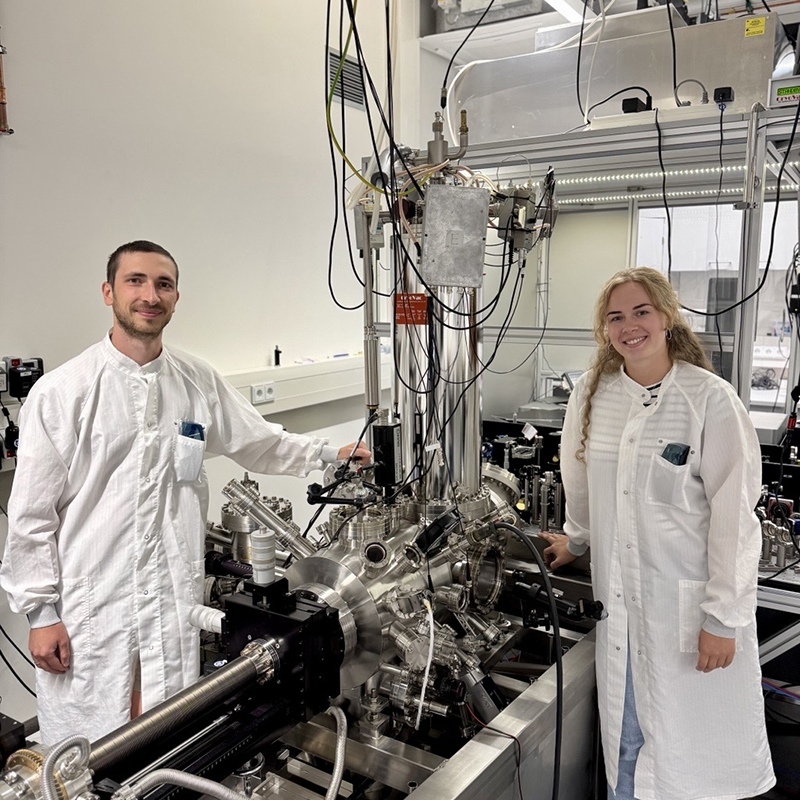
Katharina Glöckl and Raffael Spachtholz on catching an electron in the act
The Conversation
Katharina Glöckl Honestly, at the very beginning you're hesitant. You see a signal that looks like a genuine lightwave-driven current, but the first thing that runs through your head is a whole chain of sanity checks. What did I forget? Did we really think this through? Where could the error be hiding?
Only once you've ruled out every source of artifact for yourself does the excitement set in, and it comes paired with curiosity. From that point on we just wanted to keep measuring and see what else we could find out. Because the truth is, there's still so much we don't know, and that's exactly what makes research so unique.
Katharina Glöckl The laser system came together first. Lead author Simon Maier and my PhD advisor Rupert Huber designed it from home-modified commercial modules. What really took time was everything after that: optimizing the optical waveforms, reaching the stability the measurement needs, and building a suitable STM along the way.
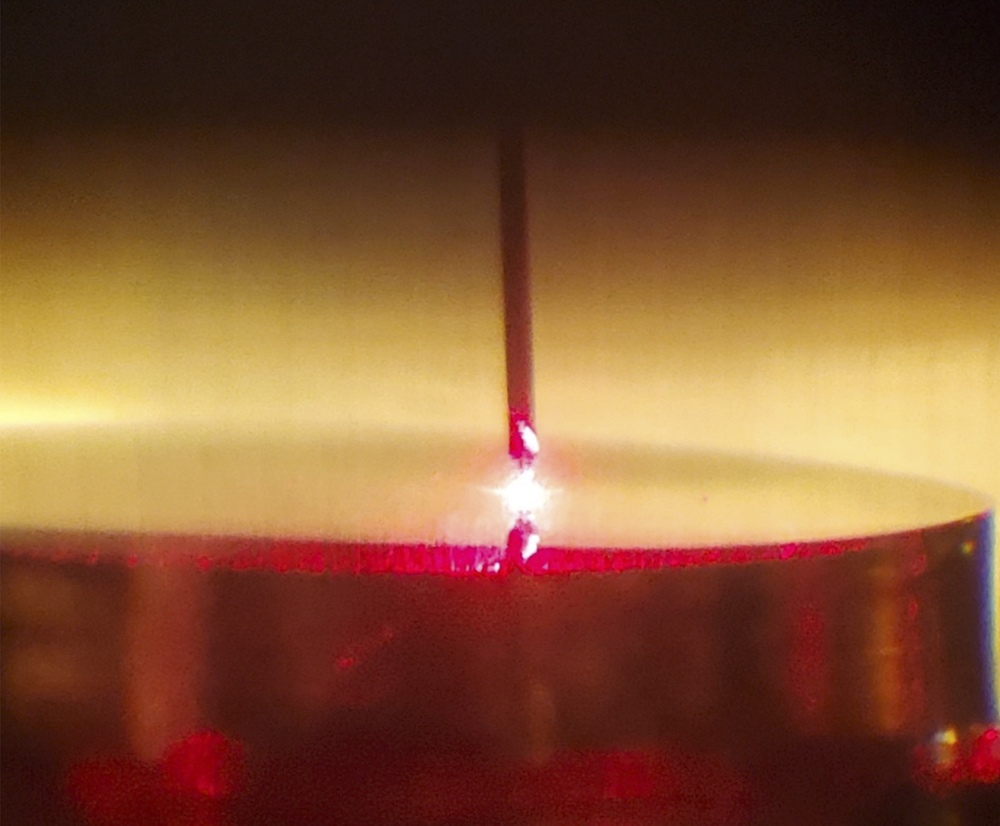
The hardest part was thermal stability during the measurement. The near-infrared light puts quite a thermal load on the tip and sample, and even tiny variations in laser power create current changes that can be far larger than the actual lightwave-driven signal we're after. Normally you would chop the beam to isolate your signal, but here you can't, because chopping introduces thermal artifacts that swamp everything. The key was the idea to instead modulate the carrier-envelope phase of the pulses and lock everything to a common reference.
Raffael Spachtholz It is also worth saying that this experiment required more than a novel laser source. The scanning tunneling microscope itself was custom designed and built specifically for these experiments, while the laser system was developed alongside.
Bringing these two cutting-edge areas together required close collaboration between the groups of Jascha Repp and Rupert Huber, which have established a joint research effort combining expertise in scanning probe microscopy and ultrafast lightwave science. For PhD students, this creates a particularly exciting environment, giving the opportunity to work at the interface of two complementary areas.
Before we trusted anything, we checked a huge number of things. We characterized the thermal stability of the laser and the mechanical stability of the scanning tunneling microscope, and we even created thermal artifacts on purpose, just to see how large the thermal current actually is and how sensitively we had to measure to stay below it.
We had a decent idea of the physics we would like to reveal from the start, but the actual experiments held many surprises in store for us. Understanding the rich details of the signal was the most exciting part of the journey: the oscillating behavior, the dependence on delay time and on the exact waveform. Step by step we built up a consistent picture mostly through a long series of small aha moments, and it came out of a lot of discussion and brainstorming with many people, each of them an expert in their own field.
Katharina Glöckl A delay of 500 attoseconds sounds abstract, but it actually tells us something quite fundamental. We normally think of tunneling as instantaneous, as something that just happens the moment the barrier is low enough. What we see is that this is no longer true on the attosecond timescale. The electron does not follow the light field immediately. Its current response peaks about half a femtosecond after the driving field does.
The reason is that the electron needs a moment to respond. It does not tunnel at the very instant the field is strongest, but slightly later, once it has been driven to a sufficient velocity. In other words, we are starting to resolve the intrinsic response time of the electrons themselves, the time the system needs to react rather than the timescale we impose from the outside with the laser.
And this is exactly why the delay matters for us. It places our experiment right in the crossover regime of light–matter interaction. This intermediate case is set by the so-called Keldysh time, the regime where the light field oscillates on the same timescale as the electron's own response, so that the electron can neither keep up with the field instantaneously nor stay untouched by it.
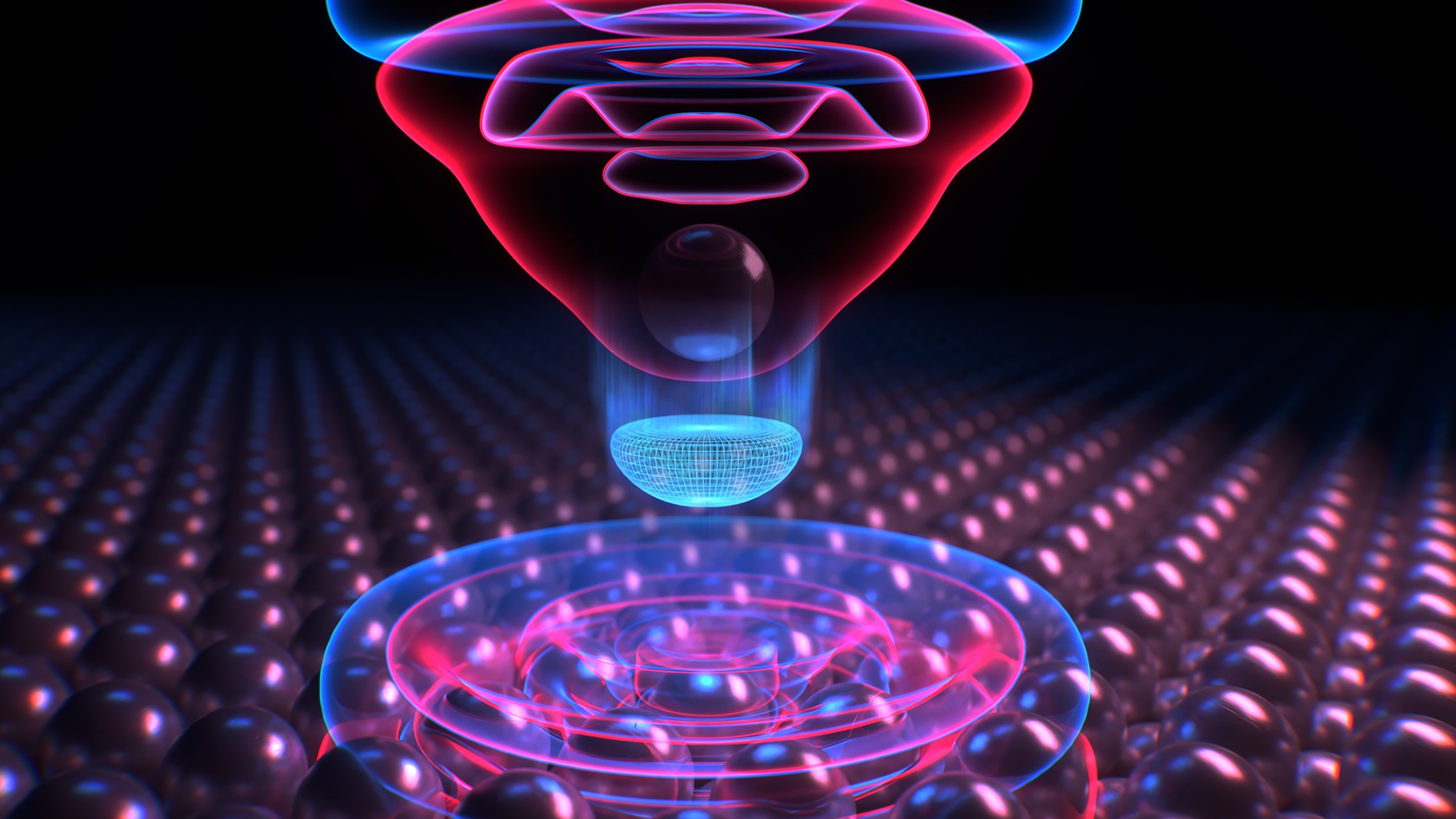
Katharina Glöckl The image comes quite naturally out of how the experiment works. A high-speed camera freezes fast motion by taking many snapshots with an extremely short shutter and then playing them back frame by frame. That is essentially what we do.
Our shutter is a single cycle of light, and instead of a mechanical frame we vary the delay between two laser pulses. Each delay setting is one frame, and because we can tune it with attosecond precision, we can see at which moment in time the electron tunnels through the barrier.
Katharina Glöckl The way we think about it starts with a question that sounds almost trivial: can we watch an electron in space and in time at once? Quantum mechanics seems to permit it. There is an uncertainty relation between energy and time, and one between position and momentum but none between position and time.
So shaping an electron in time should leave its size in space untouched. It does not. An electron sitting in a single sharp energy state, like the 1s orbital of hydrogen, is as localized as it gets, about one ångström, but nothing about it ever changes.
The moment we ask it to move attosecond timescales, we have to superimpose many states, and that superposition makes it spread out. Space and time are not linked by principle, but the dynamics link them anyway. That is the space-time limit.
Raffael Spachtholz Everyone on the team has their own area of expertise and their own particular strengths, so in that sense the work divided quite naturally. That said, it definitely also took a lot of back and forth.
Simon and I in particular had a tendency to drift off into long discussions in the middle of the lab work, really digging into every detail, while Katharina, with her drive to get things done, was usually the one who stepped in and pulled us back to actually taking the next measurement.
Looking back, that mix worked really well. You need both the deep discussions and someone keeping the momentum going, especially on an experiment this precise.
Raffael Spachtholz What excites us most is that combining attosecond timing with sub-ångström spatial precision opens a route that neither technique could reach on its own.
Molecules are the building blocks that life is made of, and chemical reactions happen around us essentially all the time. Chemistry has an enormous catalogue of these reactions, but in almost every case you only ever see the before and the after. You never really see what happens in between.
Being able to watch those in-between steps, to follow how electrons rearrange bit by bit as a bond forms or breaks, would be incredible. Imagine an attosecond molecular movie. By tracking the waveform-driven current with attosecond timing, we could resolve the motion of electrons during a chemical reaction within a single molecule in real time and real space.
Raffael Spachtholz Maybe the most striking thing is how much of our everyday technology already relies on fast electron dynamics in solids, even if we never think about it. A lot of modern electronics and optics ultimately come down to how electrons move in a material.
Katharina Glöckl Yes, we take that completely for granted, but once you have worked at the attosecond scale, you start to notice that hidden layer everywhere, and it changes how you look at the world around you. Matter is never really still. Everything is in constant, ultrafast motion, and we are only now getting the tools to actually watch it happen.
Conclusion
What stays with you from this conversation is not the precision of the instrument, remarkable as it is, but the patience underneath it. A laser system refined over years. A custom-built microscope, developed through a collaboration between two research groups. A signal containing an overwhelming wealth of detail, all of which had to be confirmed by ruling out every possible source of error, one at a time, through what Raffael calls "a long series of small aha moments" rather than a triumphant instant.
What they found, in the end, is a measurement at the space-time limit. Combining sub-ångström spatial precision with attosecond timing, they resolved the half-femtosecond window in which an electron tunnels in response to a pulse of light. A window too small to picture, and yet large enough to reveal something that had never been directly observed: that pinning down when an electron moves means letting go of certainty about where it is. Not a new law of nature, but a limit the dynamics impose: to move quickly, an electron must spread out.
Raffael points to the hidden layer of electron motion beneath our everyday technology. Katharina puts it more simply: once you have worked at this scale, matter is never truly still. Everything is in constant, ultrafast motion. We are only now building the tools to watch it happen.