
Rehearsing the Future Under Glass
John Adams and Laura Condon on how Biosphere 2 became the place where tomorrow's Earth is tested today
The Conversation
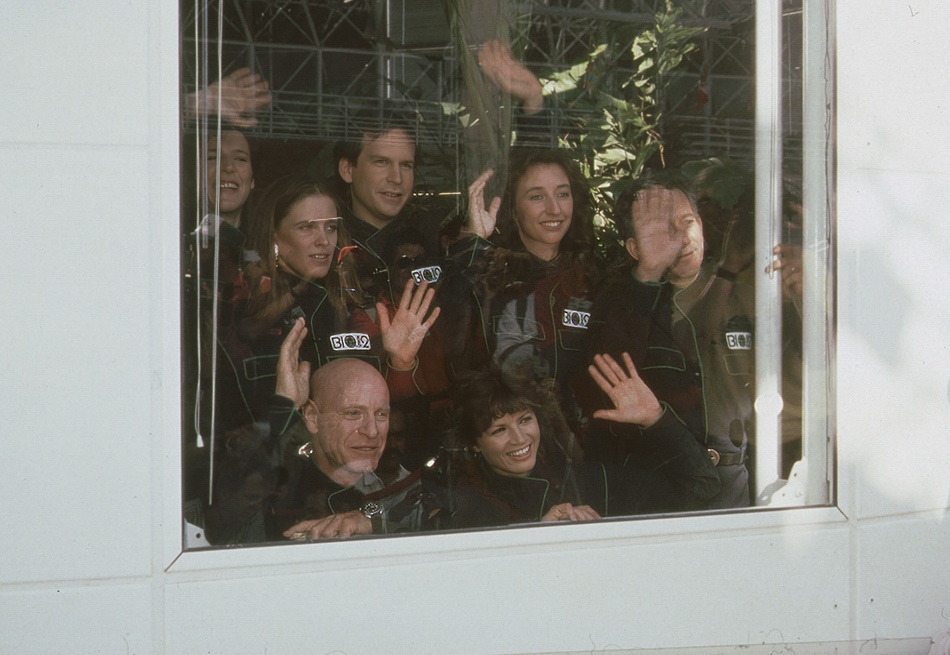
John Adams (Deputy Director and Chief Operations Officer, Biosphere 2) Its start goes back to the early 1980s, when the property was purchased. They broke ground in 1987, and it took four years to build the facility. In September 1991, eight people were sealed inside. That is what made all the headlines. What they hoped to do was capture some of the basic principles that drive Earth's processes, so that those same processes, running inside Biosphere 2, would support everything the eight people needed: recycling their water, recycling their air, producing enough food. As you can imagine, it was a very ambitious project. No one had ever done anything of this size and complexity. There had been sealed experiments before, but all of them were much smaller and much less complex.
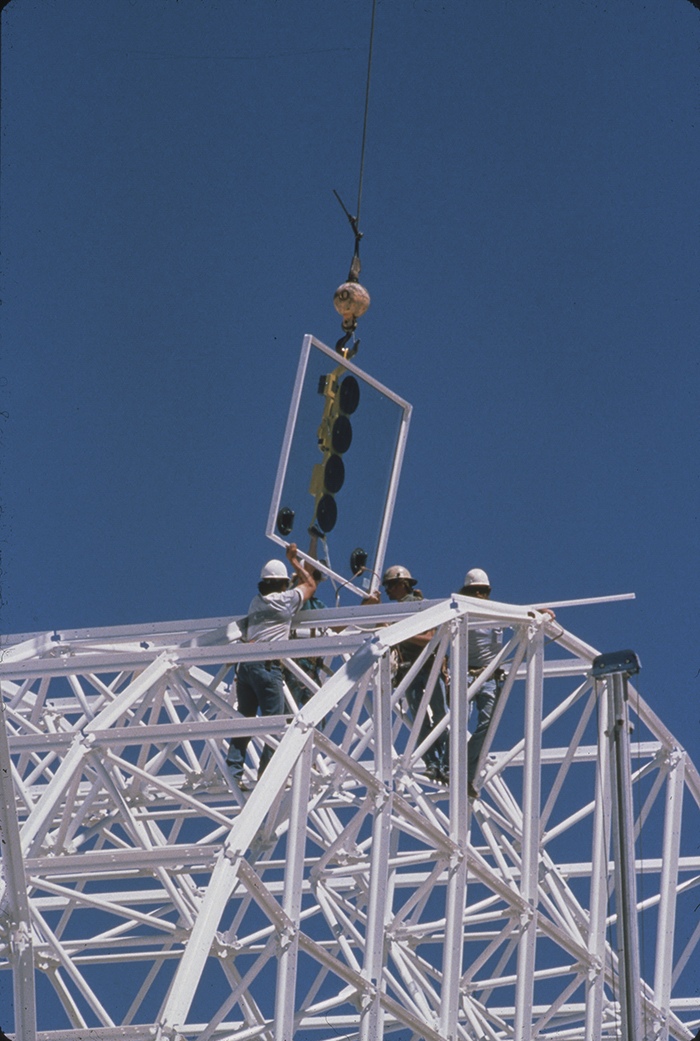
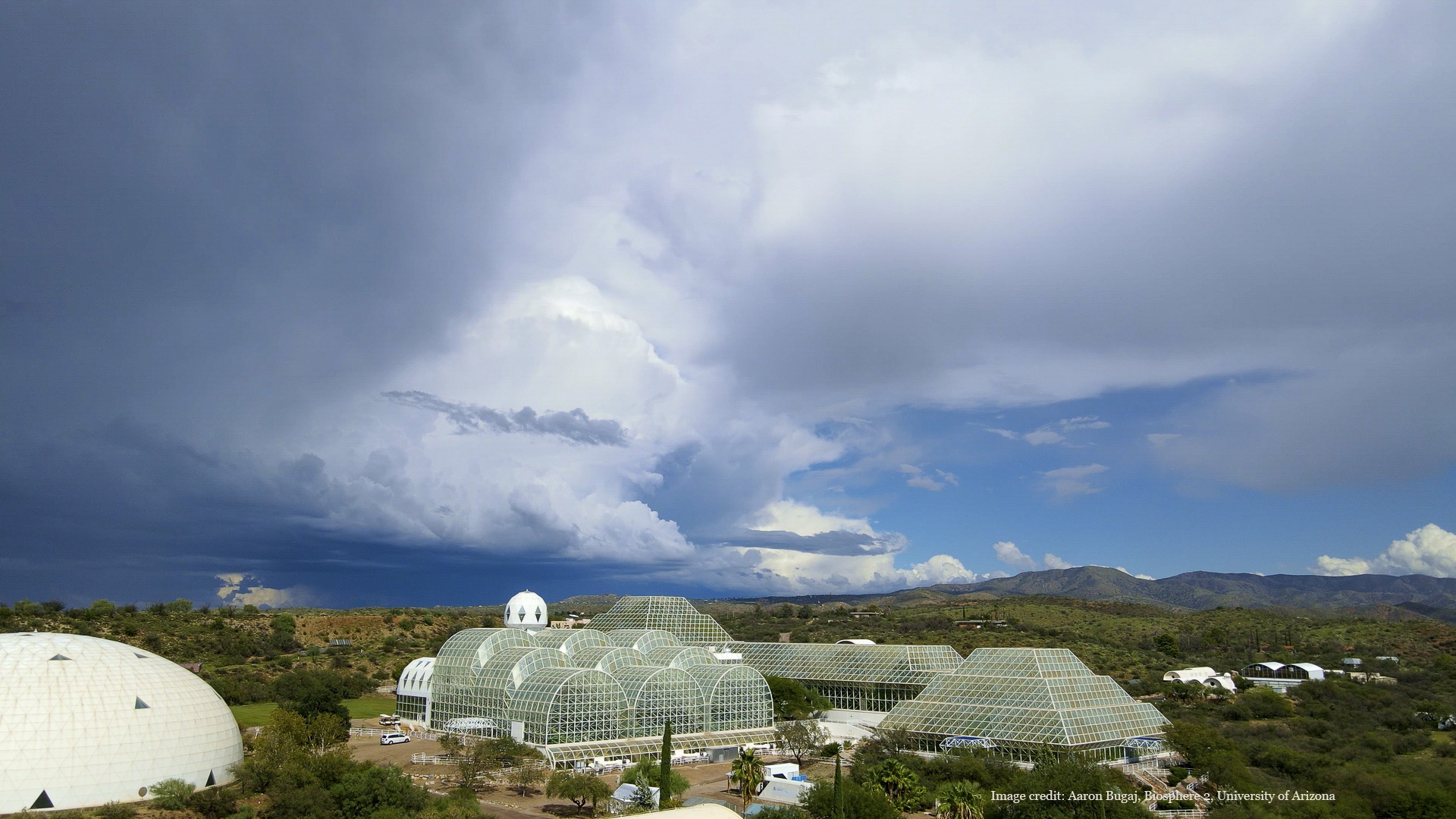
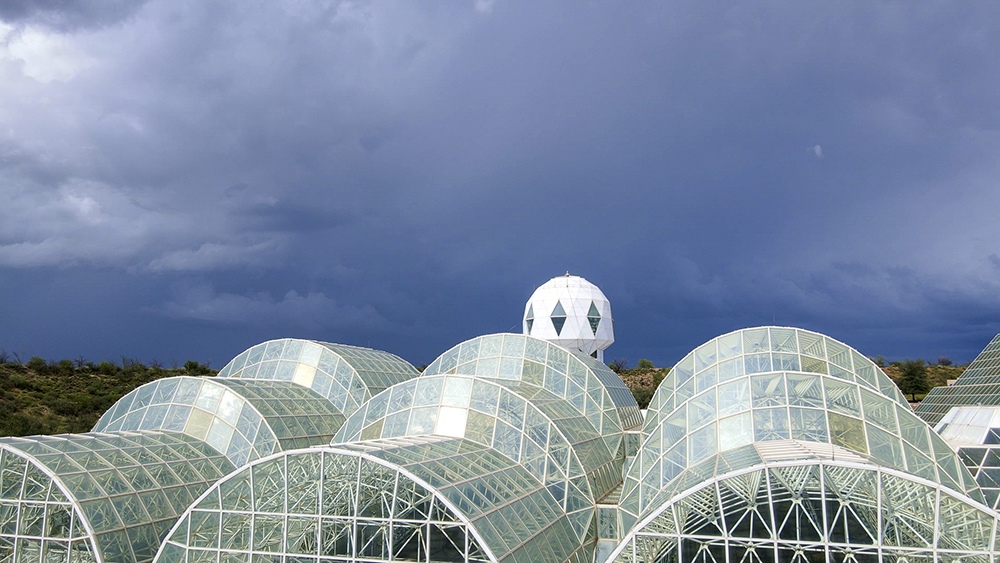
John Adams They designed it to be airtight, hermetically sealed. What you can't see is that underneath Biosphere 2 there is essentially a stainless steel bathtub, a liner that completely isolates it from the desert floor, so that things like radon gas can't get in. We think of concrete as solid, but in reality it is porous. Overhead, the designer Peter Jon Pearce and his California firm, Pearce Structures, came up with a really unique design: interlocking tubular members that we call the space frame. Biosphere 2 is perhaps their best-known project, though they completed many other significant ones. Between the tubular members are window frames that hold the glass, and those frames are sealed from the outside with a caulking made by Dow Corning. Together these elements made Biosphere 2 as airtight as possible. The published data suggest an annual leak rate of around 10 percent, which is very well sealed for a structure with a volume of 7.3 million cubic feet. The analogy I was given is that the leak is equivalent to a hole about the size of three fingers held together.
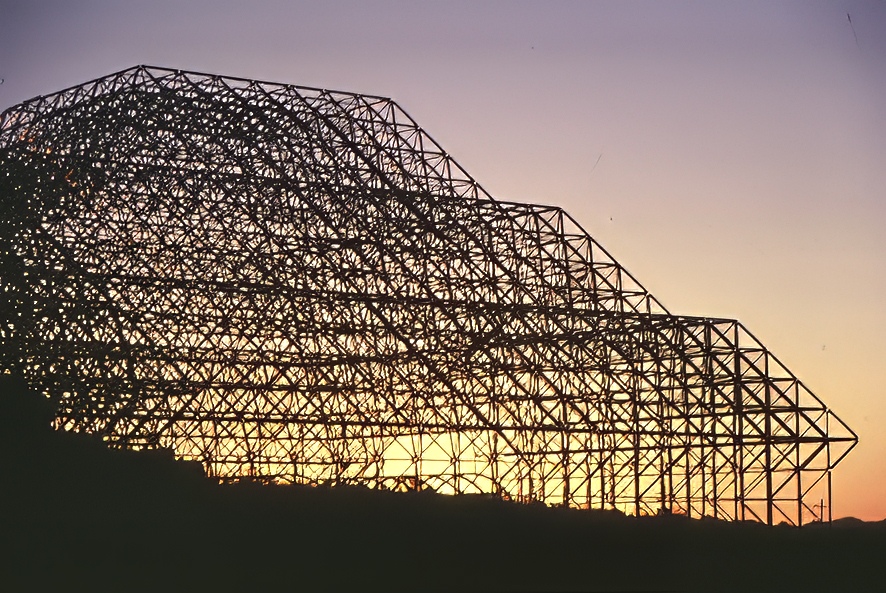
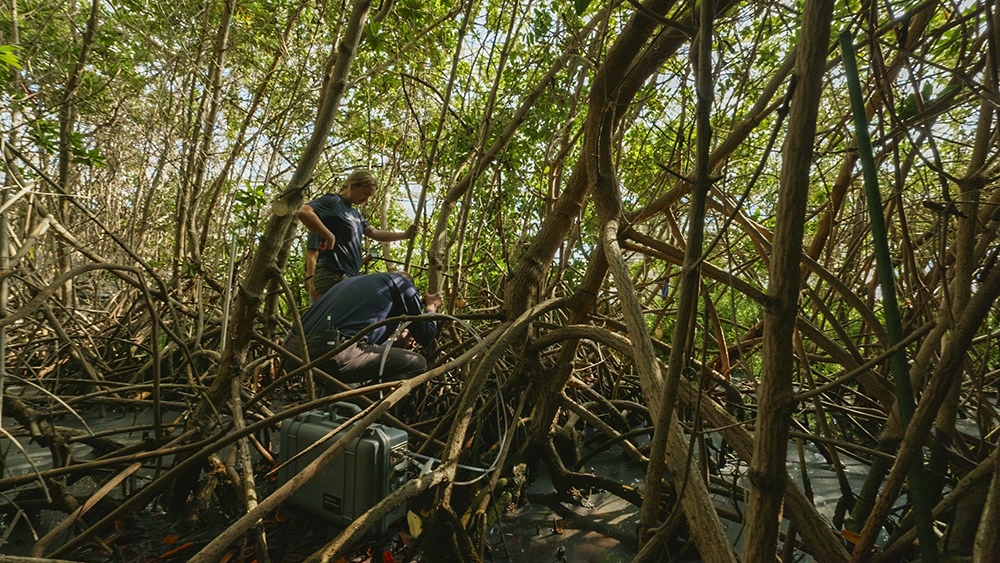
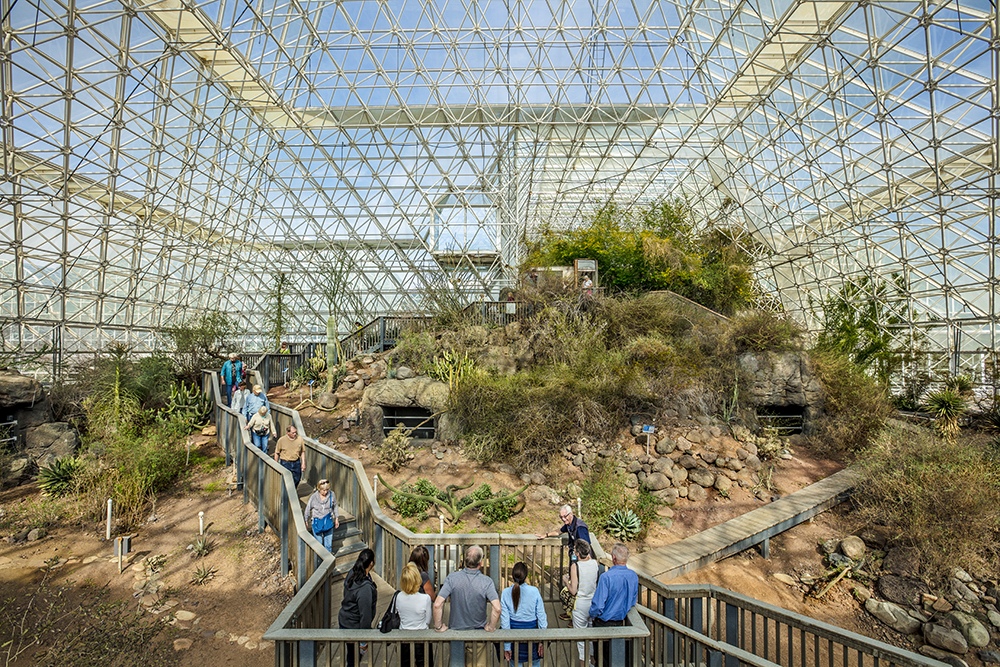
John Adams Inside, they built in all the mechanical systems to circulate and condition the air. That was critical, because they wanted to capture some of Earth's key biological systems, but there were constraints. We're in southern Arizona, and a large glass house here traps a great deal of heat. An Arctic tundra or a conifer forest would have been very difficult and far more energy intensive than the system was designed for. So all the biomes are tropical or subtropical. The rainforest is a tropical rainforest. The ocean is modeled on a Caribbean reef like those off the Yucatán Peninsula. There is a subtropical savanna, a mangrove system like those in southern Florida, and a subtropical thornscrub. Tony Burgess, the ecologist who designed that area, told me you would start to encounter that vegetation two or three days' drive south into northern Mexico. At the far southern end, a smaller pyramid holds the coastal fog desert, modeled on the western side of Baja California. Then there was a separate area, still connected, dedicated to agriculture, and living quarters for the crew.
They hoped the biological systems would balance the air. The people would exhale carbon dioxide, the plants would take it up, split water, give off oxygen, and keep everything stable. But no one had ever done this, and there were going to be things nobody anticipated. That's why we do experiments, and this was a big one.
The most publicized problem was oxygen. Almost from the day they closed the door, if you look at the data, oxygen was decreasing. By about day 500 of the two-year mission it had fallen to about 14.2 percent, and the outside and inside management teams agreed it was critically low and oxygen had to be added. That was not initially disclosed to the public or the scientific community.
Beyond that, when you put eight people together, however carefully you select the team, there will be differences. There were social and psychological challenges from living and working with the same eight people in a confined space. And there was the farm. Biosphere 2's footprint is a little over three acres, and about half an acre was dedicated to agriculture. But it was an El Niño year, with much more cloud cover than usual, and they started in September rather than in spring, when the days are longer. The published data suggest it was probably one of the most productive half acres of farmland anywhere, but it still did not supply enough calories for eight people. Nutritionally they were fine. They were just hungry all the time.
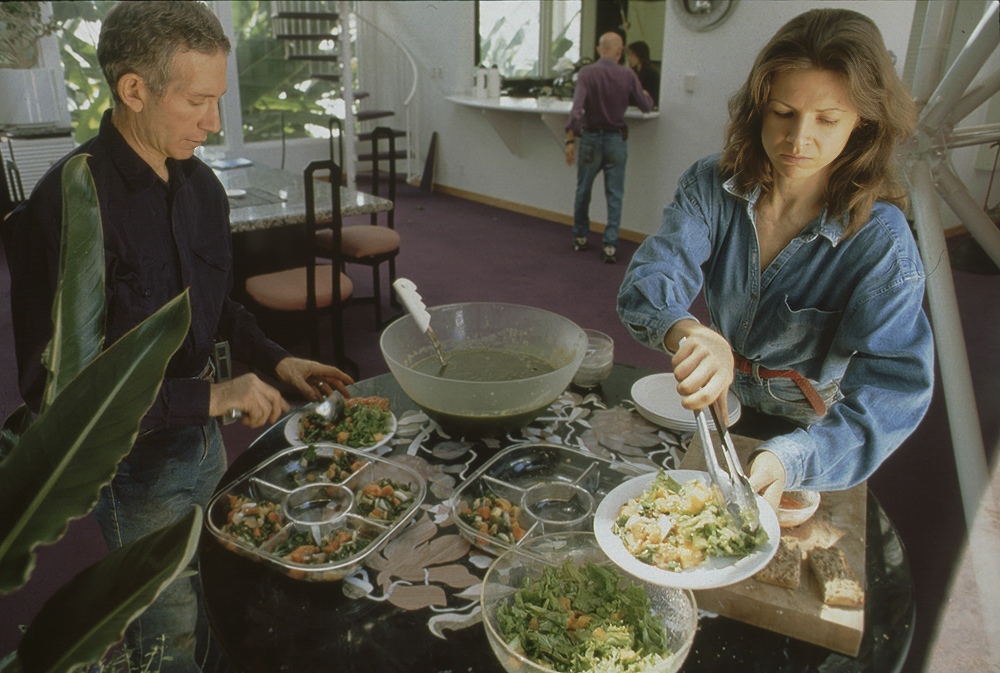
John Adams Those three things weighed on them, but they did complete the two-year mission. They had to break the seal to add oxygen, and one crew member had to come out because she had severely injured her finger and the physician on the inside team didn't feel comfortable reattaching it. She received medical care and came back in. In my opinion, it was a lack of forthcomingness about all this that really cost them their credibility with the press and the scientific community. They adamantly denied that the seal had been broken and then had to retract those statements. Their press secretary had not even been told that oxygen had been added, so when she was asked, of course she said no.
That's a little of Biosphere 2's history. But it is an absolutely remarkable facility, because now, 35 years later, people like Laura, a world-class scientist at the University of Arizona, are here leading work that uses it to address pressing questions we simply can't get at any other way.
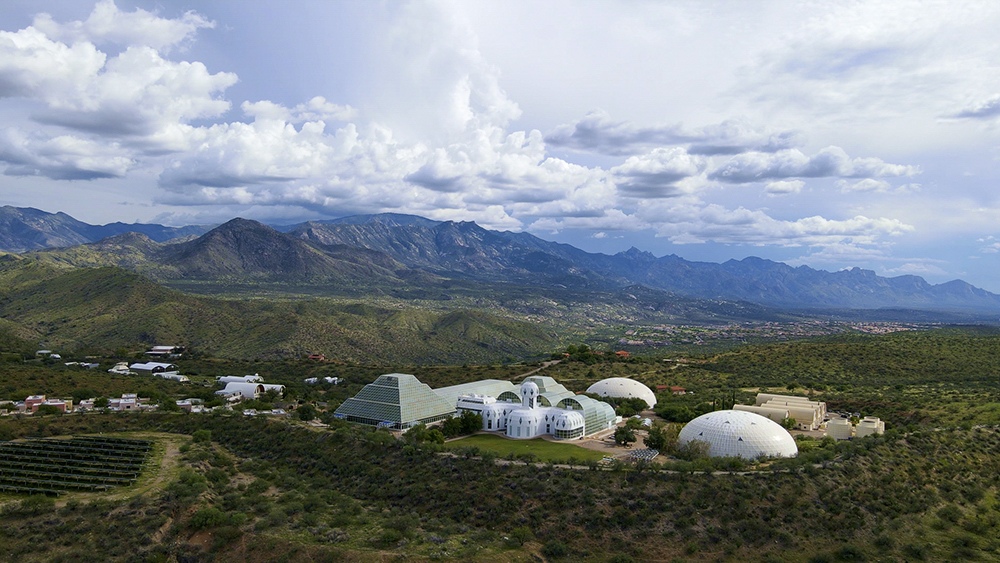
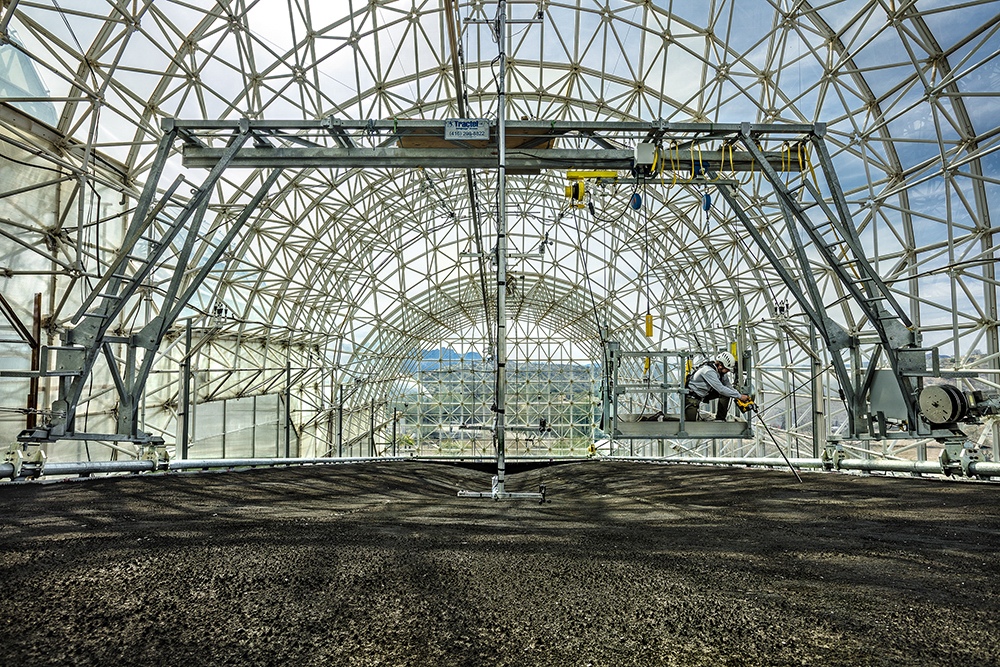
Laura Condon (Interim Director, Biosphere 2; Professor of Hydrology and Atmospheric Sciences, University of Arizona) I'll give you a summary, though I'll let John jump in, because I'm pretty new. Biosphere 2 has long since moved away from its original goals. It has become truly one of a kind, the only facility at this scale in the world for investigating how Earth system processes work and how they might behave as conditions change. Early on, Columbia University used it to understand how ocean chemistry would respond to rising carbon dioxide. Since the University of Arizona took it on, we've done all sorts of research in the rainforest and the ocean. We replaced the area that used to grow crops with a giant experiment called the Landscape Evolution Observatory, or LEO. It is essentially a set of enormous tilted trays, and we are starting from bare rock and watching how you get from rock to soil to being able to grow plants. That matters for understanding how the landscapes we have came to be over Earth's history, and also if you think about something like terraforming, or growing crops on Mars.
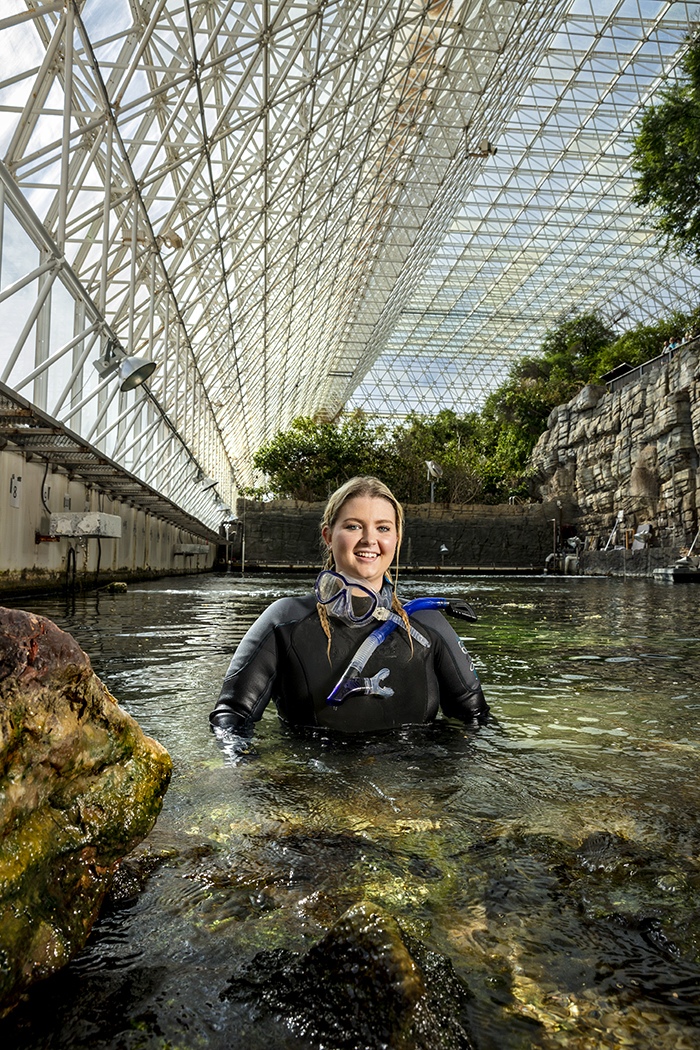
For each of our major ecosystems we have a science director who sets the agenda, with input from leading scientists around the world, and we run experiments that can only be run at Biosphere 2. In the ocean, for example, we are working on the enormous loss of corals happening around the world. We can make our ocean much warmer very easily and control heat stress events, so we can test the approaches people are proposing for growing new corals. The question is not just whether they work today, but whether those corals die off in two years, or whether they could actually last twenty or thirty.
Laura Condon We also have the Space Analog for the Moon and Mars, SAM, which was originally a kind of mini biosphere. Now we use it to research what it would take to live on another planet: how to build habitats with enough oxygen, how to grow plants, and, with medical teams, how you would perform surgery or repair a spacesuit.
Laura Condon We have the largest controlled indoor ecosystem experiments in the world. There are certainly greenhouses where people can do experiments. But we have a whole rainforest that has been growing for decades. It isn't a matter of experimenting on this plant and that plant. We have fully functioning large ecosystems, which simply do not exist anywhere else. We have a whole ocean. You might think of big aquariums, but you can't use those for this kind of research, because there are so many other variables, fish and everything else. Our rainforest, our ocean, the Landscape Evolution Observatory: it's the only place where you can experiment on whole, large-scale ecosystems without going out into the real world, where there are so many other unknowns.
John Adams No, and that is one of the great things about Biosphere 2. To step back a little: Columbia University came in in 1995, but because of a change in administration they didn't continue after, I believe, 2003. The University of Arizona came in in 2007. Before that, Biosphere 2 was managed by different entities on behalf of the founding group, the Bass organization, so it was privately owned. Today it is owned by the University of Arizona, a public land-grant institution.
The other important point is that Biosphere 2 is a tool, and it's configurable. We can manipulate these systems, changing their conditions or even completely changing their composition, if there is a compelling research question. People often ask why no one has built a Biosphere 3, or anything similar. It is no small undertaking. And our rainforest, ocean, desert and mangroves have been in place for decades. Even if you built a new state-of-the-art facility today and put in all the same plants, it would take five or ten years for everything to equilibrate and stabilize. We are already past that point.
So a scientist can come in and say: they say the rainforest is getting warmer and drier, so what will happen? We can do that to our rainforest and compare it with what scientists are observing in the Amazon basin. That's the unique connection. We call Biosphere 2 a scaling tool. In the lab you can run very precisely controlled experiments, but typically with only one or two plants, and often not very big ones. Step outside, and researchers are observing natural systems, but they can't control when it rains, when there's a heat wave, or when it gets cold. We are the middle ground. It's not perfect by any stretch. There's no way to truly replicate all the complexity of Earth's systems. But we've captured enough to understand some of the fundamental mechanisms that tie soil, plant and atmosphere processes together.
Laura Condon John, maybe talk about the WALD experiment [Water, Atmosphere and Life Dynamics] in the rainforest. That's a good example, and I wasn't there for it.
John Adams Think of Biosphere 2's systems as a bank account. When we measure an ecological system, we want to know what is coming into it, how that changes the system, and how fast the system responds. If we also measure what is coming out, we can determine what's called a flux. You put in deposits, you take out withdrawals, and at the end you hope your budget balances. We do exactly that for these ecosystems, except the budget is water, or carbon, or energy.
Recently a European collaborator, Professor Christiane Werner of the University of Freiburg, worked with Laura Meredith here at the University of Arizona to assemble a team. She was in the final year of a five- or six-year grant and wanted a place where she could manipulate the conditions of a tropical rainforest and run very specific experiments. They set up all their instrumentation and measured the rainforest in its normal, unstressed state. Then they cut off the rain for 70 days. They gave it a drought, and measured how it responded as it grew increasingly stressed: how the cycling of carbon, energy and water changed, how the plants partitioned their resources. And because they knew exactly when the rain would return, they could capture its recovery.
We can do really interesting things here. We can label the rain with a heavier isotope, what people call heavy water, and see which plants take it up first, because it carries a unique signature. We can release carbon-13 into the air and see which trees take it up, and where they store it when they are stressed and when they are not. More than 100 researchers from around the world had roles in that experiment. And although the drought itself lasted only 70 days, it took nearly a year to set up and run the pre-experiment, the experiment and the post-experiment.
Laura Condon As a hydrologist I think about the full water cycle: how much water infiltrates underground, how much comes out as streamflow. All of that is closely tied to what is happening with ecosystems, plants and landscapes, to plant water use and interception. I do very large-scale modeling, so I'm constantly bridging between scales. The powerful thing about Biosphere 2 is that it sits at a unique scale, neither the single plant nor a large catchment outdoors. It's the hillslope scale, which we miss a lot in our work.
The other thing I really relate to is that it's very hard to ask questions in the real world about systems that are going to go off the edge of anything we've seen before: temperatures higher than we've ever measured, changes in land cover. We can't run those experiments in the real world. As someone who runs models, I ask myself: can I trust my model out there, where I have no observations to validate it? If I run a long simulation of what climate change will do, how can I trust the results? Biosphere 2 lets us take real systems and stress them far beyond what we've observed, which helps people like me understand whether our far-out simulations are physically reasonable, or whether we're missing processes or feedbacks. That's where Biosphere 2 fits into my research.
Laura Condon LEO does look at how water travels through the subsurface, though it's a very idealized system, a perfect hillslope. What's really valuable, as John was saying, is that it's heavily instrumented, so we can observe subsurface flow and transport in detail. I do a lot of groundwater modeling, and what we are always missing is observations. We usually get a few point measurements. LEO has been very useful for understanding how water moves. It also lets us almost roll back time and think about how landscapes are created, how soil forms, and how we arrive at the land cover we have. I don't personally model anything at LEO, but it is very relevant to hydrogeology and subsurface flow in general.
Laura Condon SAM is actually an existing facility. It was built when Biosphere 2 was built. We use it differently. Biosphere 2 is so big that we feel it's most useful for Earth science experiments, so there we have obviously moved away from the original idea. But with SAM, we feel this is the best use of that facility. John, do you want to say more?
John Adams Laura's right, it's an existing facility. But one key question is how, if we want to be an interplanetary species, we balance the conditions astronauts will need. On the International Space Station they use mechanical systems, what's called physicochemical life support, to maintain conditions. One of SAM's key objectives is not to have a complex assemblage like the one inside Biosphere 2, but to ask whether we can grow food, peas or sweet potatoes or some kind of bean, inside a completely sealed habitat, and while the plants are growing, use them to do what a mechanical device would otherwise do, scrubbing the air. That way we use less energy. Then we harvest the plants and eat what we need, so we're not always eating processed or freeze-dried food, and we start another round of crops. Bioregenerative life support is one of the key things SAM hopes to shed light on. We are still developing the facility. It isn't complete, and we're still putting in place what we'll need for those experiments.
John Adams I'll take a shot, and then Laura. The short sentence I use is that Biosphere 2 is the world's largest controlled environment dedicated to understanding the impacts of change on the systems we depend on.
Laura Condon That was a really solid landing, and I don't think I can improve on it. I'd just say that the history of Earth science is the history of trying to understand pieces of the Earth. We can never recreate the whole Earth. Even if we built something as big as the Earth, it would be different. Our goal as Earth scientists has been to understand pieces in a way that lets us put them together and begin to understand how large, complex, emergent systems behave. What's great about Biosphere 2 is that it bridges from the small building blocks we have as scientists to what we learn about real systems, where there are so many uncertainties. It lets us run controlled experiments at a much larger scale. We're never going to understand the whole. Or maybe we will, but definitely not in my lifetime. This is the next step in our understanding, and that's all we're ever doing as scientists: trying to understand the next thing and build on what we know.
Conclusion
The eight people who walked out of Biosphere 2 in 1993 had demonstrated something, though not what they set out to demonstrate. A world assembled from parts could not simply be assumed to balance itself. Oxygen can drain away in ways no one predicted, a farm under glass in an El Niño year cannot feed its farmers, and a closed community of eight is still a community. Those lessons were real, and some were hard won, but they were not the lessons anyone wanted in 1991.
What Adams and Condon describe is a building that kept its most important property after it lost its original purpose. It can still be closed. The rain can still be switched off and on, isotopically labeled water can still be traced from rainfall into particular plants, and every exchange of water, carbon and energy can still be written into a ledger. That capacity, once meant to keep eight people alive, now lets scientists ask questions the real world cannot answer, because the real world cannot be pushed past its limits on purpose to see what breaks.
Condon's point about models is the heart of it. The futures we most need to understand are the ones we have never observed: hotter, drier, stranger than any record. Models can reach into those futures, but a model is only as trustworthy as the processes it includes, and out there nothing exists to check it against. Biosphere 2 offers a way to carry real ecosystems some of the distance into that unobserved territory, and see whether the predictions hold.
Adams's sentence is modest on purpose, and it is the right one. Biosphere 2 does not stand in for the Earth. It is a middle ground, larger than a laboratory and more controllable than a forest, where pieces of the living world can be studied closely enough to be understood and then put back together. The original experiment asked whether we could build a world. The building now asks a more useful question: how well do we understand the one we have?
About the Interviewees
John Adams
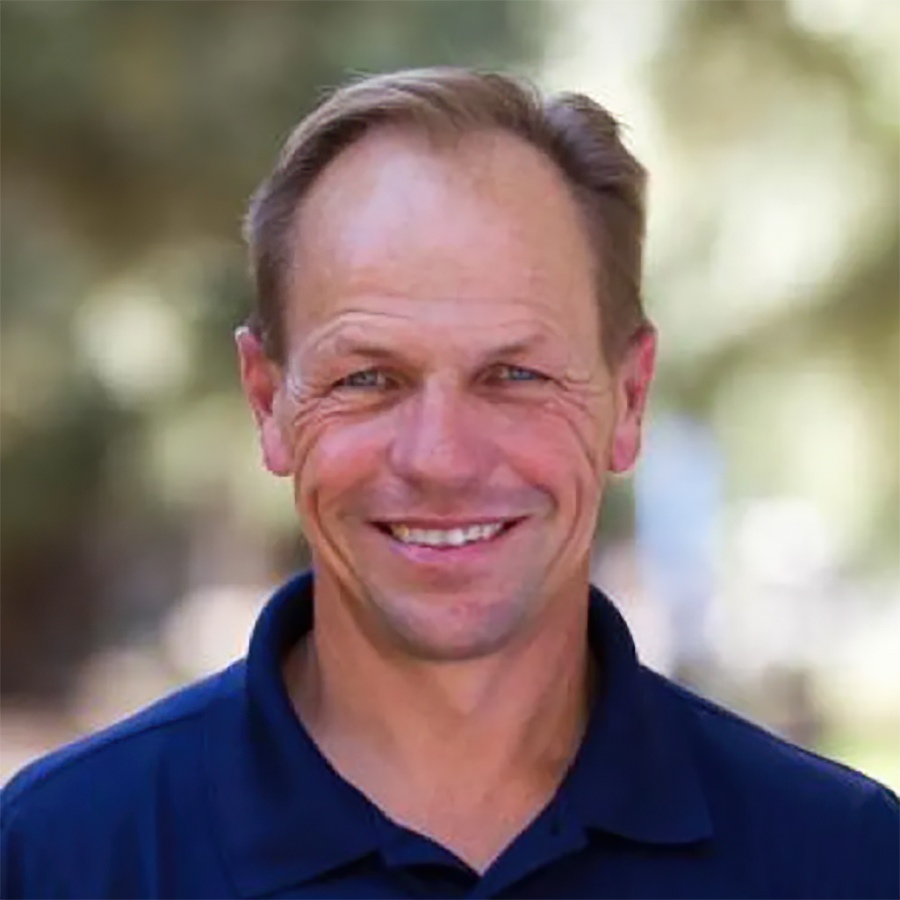
John Adams is Deputy Director and Chief Operations Officer of Biosphere 2. He joined the project in 1995 as a new University of Arizona graduate, leading terrestrial research on the effects of elevated carbon dioxide in Biosphere 2's ecosystems. He became the facility's media coordinator and public spokesperson in 1999, returned in 2004 after a year in the biotech industry to join the team guiding its transition, and served as Assistant Director of Planning and Facilities before becoming Deputy Director in 2014. He oversees site operations, biome and energy management, and public outreach.
Laura Condon
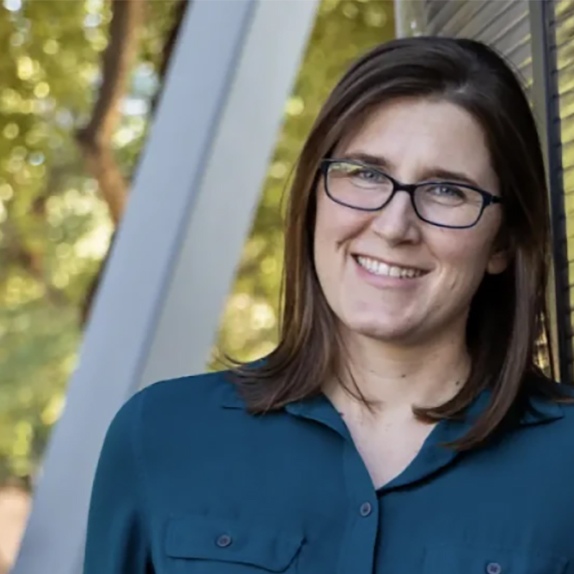
Laura Condon is Professor of Hydrology and Atmospheric Sciences at the University of Arizona, where she has been on the faculty since 2018, and Interim Director of Biosphere 2, appointed in July 2026. Her research focuses on groundwater sustainability and the behavior of large, managed water systems under climate change. She holds a PhD in Hydrologic Science and Engineering from the Colorado School of Mines, has contributed to the U.S. National Climate Assessment, and received the American Geophysical Union's James B. Macelwane Medal in 2025.
About Biosphere 2
Biosphere 2 is the University of Arizona's Earth systems research facility near Oracle, Arizona. Built as a sealed experiment in closed ecosystem living, it now serves as a large-scale laboratory where researchers study how ecosystems respond to a changing planet.