
A Blazar Close Enough to Watch

Inside our own galaxy, a black hole points its jet almost straight at Earth. A phenomenon once known only as distant points of light can now be imaged, and watched changing in hours
The Conversation
Seeing a Blazar Up Close
Benito Marcote At the center of almost all galaxies, there is a black hole with millions to billions of times the mass of the Sun (we call them supermassive black holes). In general these objects accrete the surrounding material and launch part of it as relativistic jets. Across the Universe, each galaxy, and each black hole, will have a random orientation in space. Depending on this orientation and how we see them from the Earth, astronomers call them by different names (quasars, blazars). The latter is when we see the supermassive black hole exactly from the top, from its poles. In these cases, the jets, which always follow these directions, point in the direction of the Earth. And that is a blazar: a supermassive black hole that is observed from the top. Their interest lies in the fact that because of this geometry, we can actually observe much more inside the object than in other configurations, and thus we see the innermost parts of the jets and how the material behaves near the black hole. At other angles, most of this is hidden by the dust and material that orbits around the black hole.
Moving to our galaxy, there are thousands of black holes of the size of a big star, many of them orbiting other stars (in the same way the Earth orbits the Sun). In these systems, the black hole typically accretes material from the star and expels part of it in similar jets. This configuration, observing a black hole from its top with the jet pointing towards us, was expected (as all objects are randomly aligned in space), but never detected until IRAS 18293-0941. The interest is similar to blazars: it allows us to study the inner parts of how the material interacts near the black hole and gets expelled. Additionally, as a microblazar is a billion times smaller than a blazar, everything happens much faster. What in a blazar takes years to evolve, in a microblazar takes only hours. We can thus study the dynamics of these systems in real time, which is not possible in blazars.
Benito Marcote While we know hundreds of blazars, each system has its own particularities. As the systems are much bigger, we only get a snapshot image of them. We cannot really see how they evolve because the timescales are longer than human ones. However, in a microblazar we can see how everything evolves over hours and days. It thus opens a window onto a very detailed study of its evolution. Additionally, the proximity of the system means that we can image it with much higher resolution, revealing details that in blazars may remain hidden because they are too faint to be seen.
Benito Marcote The object was long known but never attracted any interest. We were conducting searches to find potential binary systems consisting of massive stars and black holes in the Galaxy that could accelerate particles to really high energies (moving almost at the speed of light). We recognized this source as a potential accelerator when we started detecting that the object produced significant light at different wavelengths: radio, X-rays and gamma rays. The observations that revealed an extremely obscured star pointed to an object located in a very dense environment that could potentially reveal a unique system, and this raised our interest. And once we detected a one-sided jet, it was clear that we had a jet with such an orientation towards the Earth.
The Jet and the Cloud
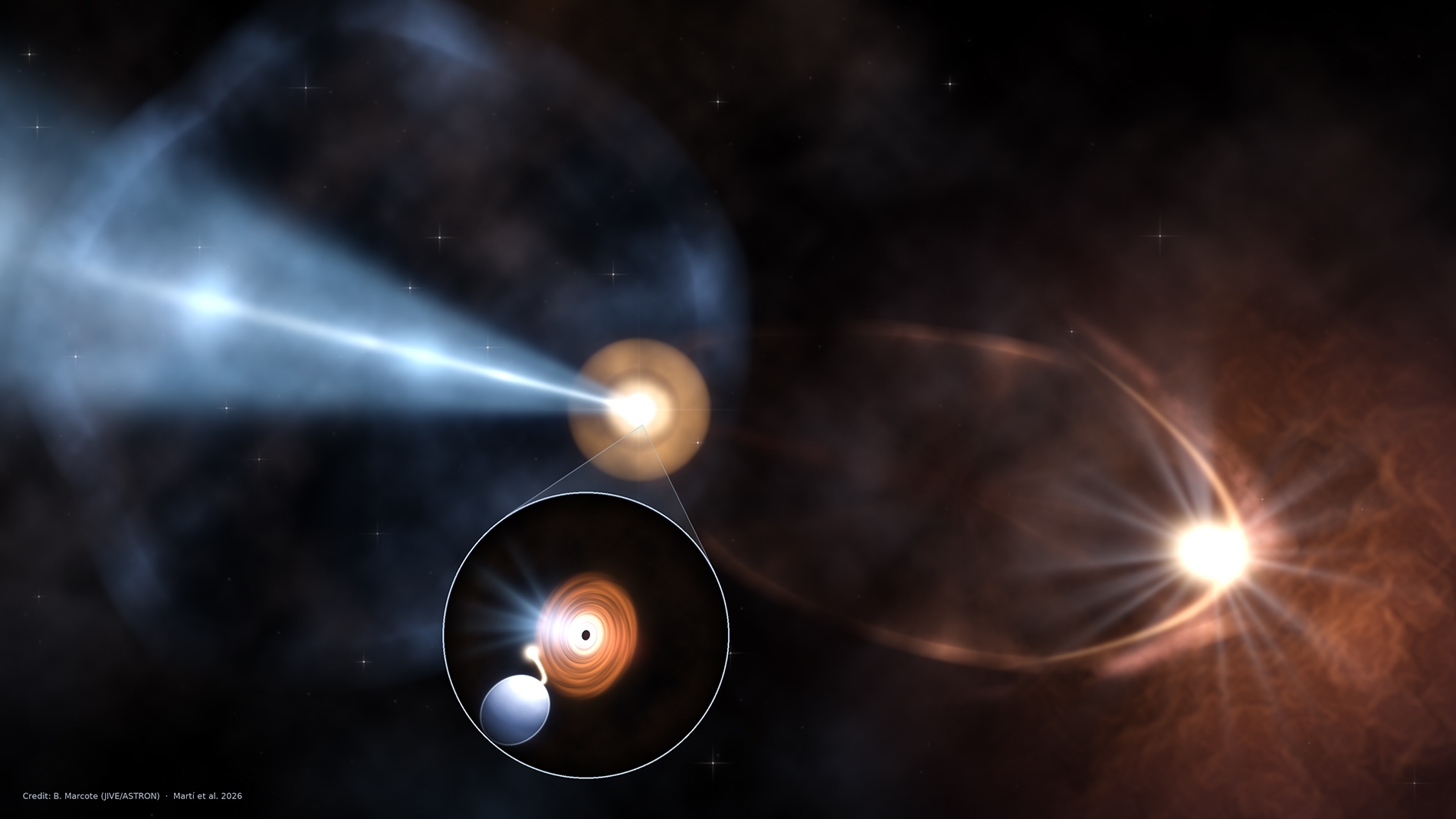
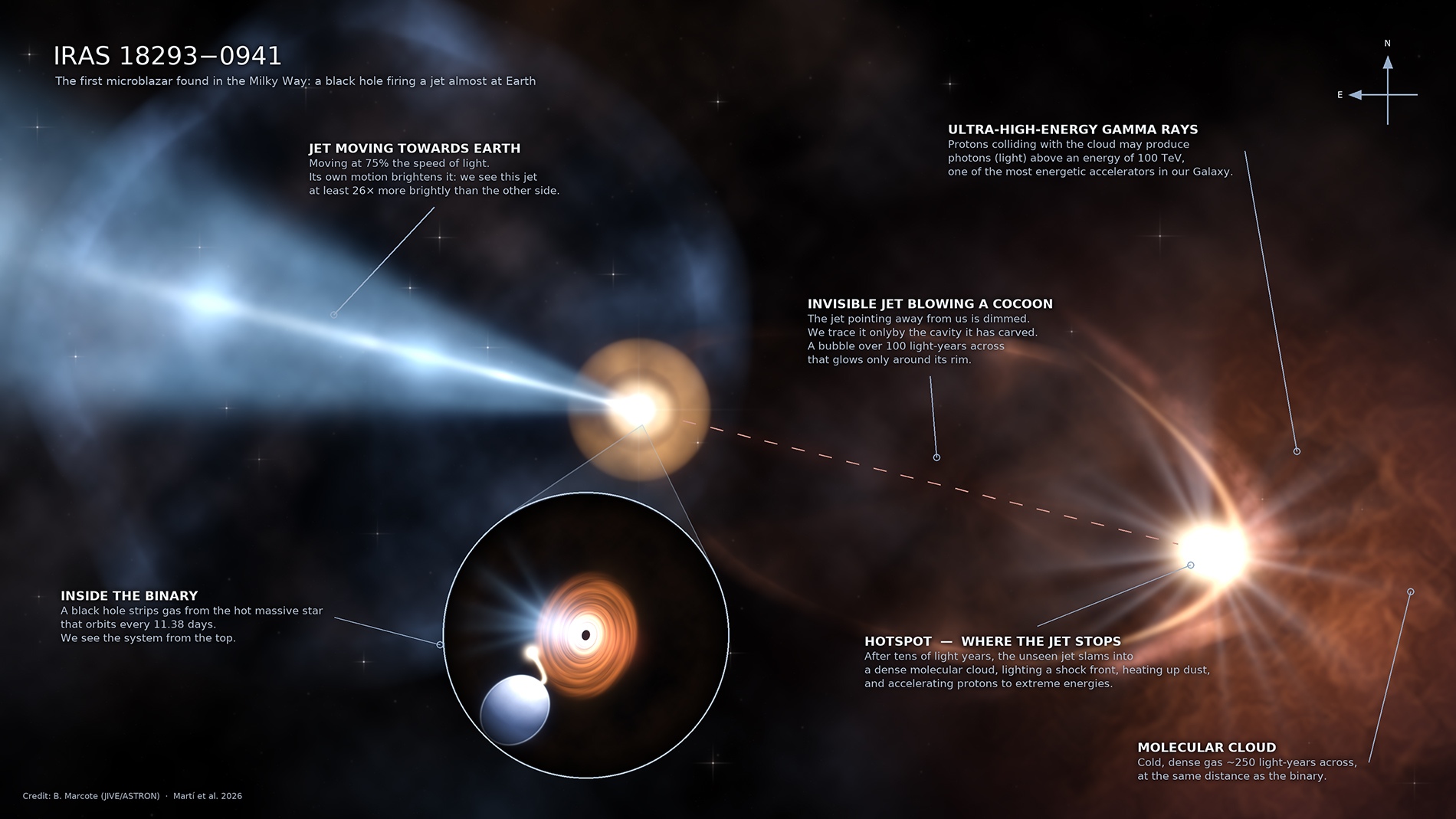
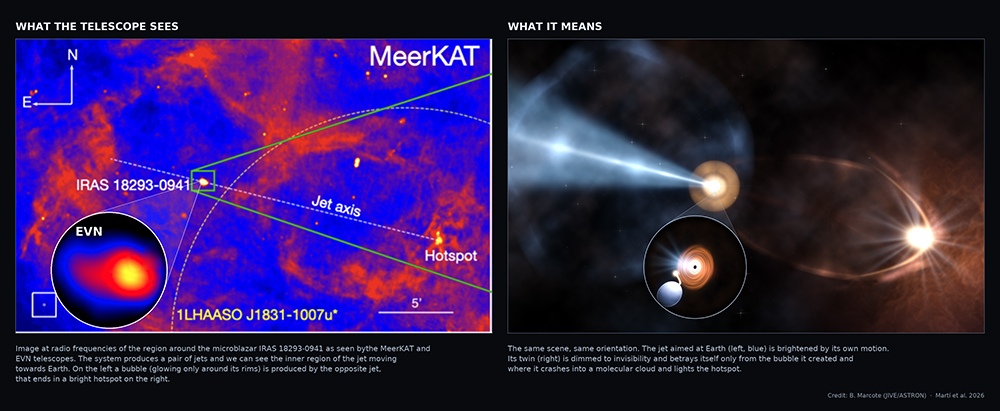
Benito Marcote The jet is a very powerful collimated stream of particles moving at almost the speed of light. It works like a high pressure washer: it cleans up the path it goes through. After years of activity, the existing material in that region was expelled to outer regions, and that is what we now see as an emptier bubble around it. In the same analogy, only when the material piles up and the stream no longer has enough power do we see the limit, in our case the shock between the jet and the denser cloud.
Benito Marcote We would like first to remark that the association between the bright spot and the gamma ray signature is not completely confirmed. There is evidence of its association, and the predictions confirm that such a signature could likely be produced by the hotspot. But we do not have a final, conclusive image that unequivocally confirms it. When we detected the bright spot that far from the object, we could only confirm its association via the detailed measurement of the jet direction. The combination of the jet and the bubble made it statistically improbable that such a spot was produced by anything other than this object. We could not find another explanation for how such a spot could shine without a shock produced by the jet. By following the jet's path, it was clear that it was impacting exactly at that location. Then the second part is the one that remains tentative (but likely): by characterizing the jet, the cloud, and the spot, astronomers have good models of how the material behaves and what kind of emission would be produced. Adapting these models to our object, we noticed that they predict the region to be a really efficient particle accelerator, potentially responsible for the observed ultra high energy particles. These predictions match the gamma ray emission that has been observed. However, as these observatories have very low resolution in their images, we cannot confirm the association as clearly as the one between the jet and the hotspot.
A Century-Old Question
Benito Marcote The "most likely" comes from the association between the petaelectronvolt emission and the IRAS object. We know there is emission at such energies thanks to the observatories scanning the sky at those energies (LHAASO and HAWC). The emission they detected in that area can only be produced by particles that are accelerated to such incredible energies (far beyond what we can accelerate on Earth). And our current scenarios predict that such particles could be accelerated in the observed interaction between the jet and the molecular cloud. However (as mentioned before), the images revealing the petaelectronvolt particles have too low a resolution to clearly reveal that such emission is exactly at the same position as the hotspot. Only once we have better images at those energies (which unfortunately would require new telescopes that we do not have yet) would we be comfortable enough to claim a fully confirmed association. Meanwhile we prefer to just say that it is most likely, or that it seems to have such an association.
Benito Marcote It was expected for decades that we should have many of these sources in our Galaxy. We were just lacking observations revealing them, potentially because they may be in similar environments where it is difficult to spot them. With this confirmation, we know that predictions were likely right. The interactions that we are seeing here with the surrounding medium, and also in a few other binary systems recently, confirm the impact that these objects may have on the Galaxy, and it is something that should be considered in simulations when astronomers try to predict how star formation evolves over time in galaxies.
Benito Marcote The two objects are really close. They are about one third of the distance between the Sun and the Earth apart (roughly the same separation as Mercury from the Sun). At such a distance, the wind of the star, which pushes material in all directions, gets accreted by gravity around the black hole when it passes near it, in the same way as the wind of the Sun falls onto the poles of the Earth, producing aurorae. This material, when moving near the black hole, reaches speeds near the speed of light and gets heated to temperatures of millions of degrees. That is what we can trace, as it produces X-ray light. But before falling into the black hole, part of the material actually gets collimated and expelled in the shape of a jet. In this case, this material produces radio light due to its motion, which is what we see in our images.
Given the small orbit, the black hole always has a source of material falling into it from the star, and that is why we see the jet as quite stable over time.
Many Instruments, One System
Benito Marcote This is a very good example of how, in astronomy, it is rare that a single observation or approach gets the full information; it is only when combining different approaches and different observations that we can really exploit and understand what we see.
Each observation revealed a different part of the system. The optical telescopes showed a star that was extremely absorbed, indicating the existence of a massive star inside or near a dust cloud, and they also revealed the presence of the black hole companion and the orbital period by tracing the variability of the light. The X-ray observations independently revealed the presence of the black hole and put limits on the accretion onto it. The radio emission revealed the existence of the jets, confirming again the presence of such a binary system, and constraining the angle of the jets. With the very high resolution radio images, we could confirm that this was not a distant blazar that just happened to lie in a similar direction in the sky as the star. We could measure its location in the sky with high precision and compare it to the known position of the star, seeing that both matched. And the combination of radio and infrared observations revealed the hotspot, which was at the same place where the gamma ray observations reported the presence of very energetic particles.
Benito Marcote This study revealed that it is not straightforward to unveil these systems in our Galaxy, and that is probably the reason why none was identified until now. We hope that in the coming years more of them will be identified. We hope that this can be used as a Rosetta Stone for blazars, and now our work is to work together with astronomers who have studied blazars for decades, to see what we can learn from each other through these systems, and potentially answer questions that have remained open in the field.
Conclusion
IRAS 18293-0941 sat in a catalogue for more than four decades, hidden behind dust and waiting for someone to ask the right question of it. What finally revealed it was not a single telescope but many, each seeing one part of the system: a buried star, a black hole feeding on its wind, a jet aimed almost at Earth, a cleared bubble, and a bright point where the jet meets a cloud. The link between that point and the most energetic particles in our galaxy remains, in Marcote's careful phrase, most likely, and confirming it will need telescopes that do not yet exist. But the larger shift has already happened. Blazars, once only points of light across vast cosmic distances, now have a small counterpart close enough to image and fast enough to watch. As with the Rosetta Stone, the value lies in having two versions of the same message side by side, one that can finally be read and one that has waited a long time to be understood.
Explore further
A Prediction Made in 1999
Background
The idea that our galaxy should contain small versions of blazars is older than the discovery. Mirabel and Rodríguez proposed in 1999 that when a stellar jet lies within about ten degrees of our line of sight, its variations should speed up and its brightness should be strongly amplified. They also warned that such objects would be hard to find, because few jets happen to align with us and their signals fade quickly.
Mirabel, I. F., and Rodríguez, L. F. "Microquasars as Transient and Persistent Sources of Gamma Rays." NASA/IPAC Extragalactic Database
Where Microquasars Began
Earlier Research
This review introduced microquasars to a wide audience as stellar-mass black holes in our galaxy that reproduce, on a smaller scale, many of the phenomena seen in quasars. It is the conceptual ground on which the microblazar stands.
Mirabel, I. F., and Rodríguez, L. F. "Sources of Relativistic Jets in the Galaxy." Annual Review of Astronomy and Astrophysics 37 (1999). arXiv:astro-ph/9902062
The Search for Galactic PeVatrons
Related Research
The question of which objects in the Milky Way can push particles to petaelectronvolt energies has become more pressing in recent years. The LHAASO collaboration has reported ultra-high-energy gamma rays from six microquasars, five of them beyond 100 TeV, which makes these systems promising candidates. This study examines what might be producing that emission.
Vecchiotti, V., et al. "Constraints on Hadronic Emission from Microquasars Detected by LHAASO." (2026). arXiv:2606.29830
A Microquasar at the Energy Frontier
Related Research
One of the most striking cases is V4641 Sgr. Its gamma-ray spectrum, as measured by LHAASO, shows no sign of a cutoff up to 0.8 PeV. That makes it a useful point of comparison for where IRAS 18293-0941 might sit among the galaxy's most powerful accelerators.
"Microquasar V4641 Sgr and Its Deep Investigation with LACT as a Super-PeVatron of Cosmic Rays." Research (2025). PMC12509212
The Study Discussed in This Article
The Original Research
The paper behind this conversation describes how a dust-shrouded star, catalogued decades ago and then overlooked, turned out to host a black hole whose jet points toward Earth. The team first suspected its microblazar nature from a one-sided radio structure that appeared consistently across years of surveys, which told them this was a lasting feature rather than a brief outburst.
Martí, J., et al. “A Galactic microblazar as a potential accelerator of ultra-high-energy particles.” Astronomy and Astrophysics (2026). arXiv:2609.00990
About the Scientist
Dr. Benito Marcote is a Senior Support Scientist at the Joint Institute for VLBI ERIC (JIVE) and ASTRON in Dwingeloo, the Netherlands, and a guest researcher at the Anton Pannekoek Institute for Astronomy, University of Amsterdam. An observational radio astronomer, he specializes in very long baseline interferometry (VLBI), which links radio telescopes across continents to produce images of extraordinary sharpness. His research focuses on high-energy binary systems, including gamma-ray binaries, high-mass X-ray binaries and colliding-wind binaries, as well as gamma-ray bursts and fast radio bursts. He was a member of the MAGIC gamma-ray telescope collaboration from 2012 to 2015. He also creates illustrations of the systems he studies, including the artist's impression of IRAS 18293-0941.