
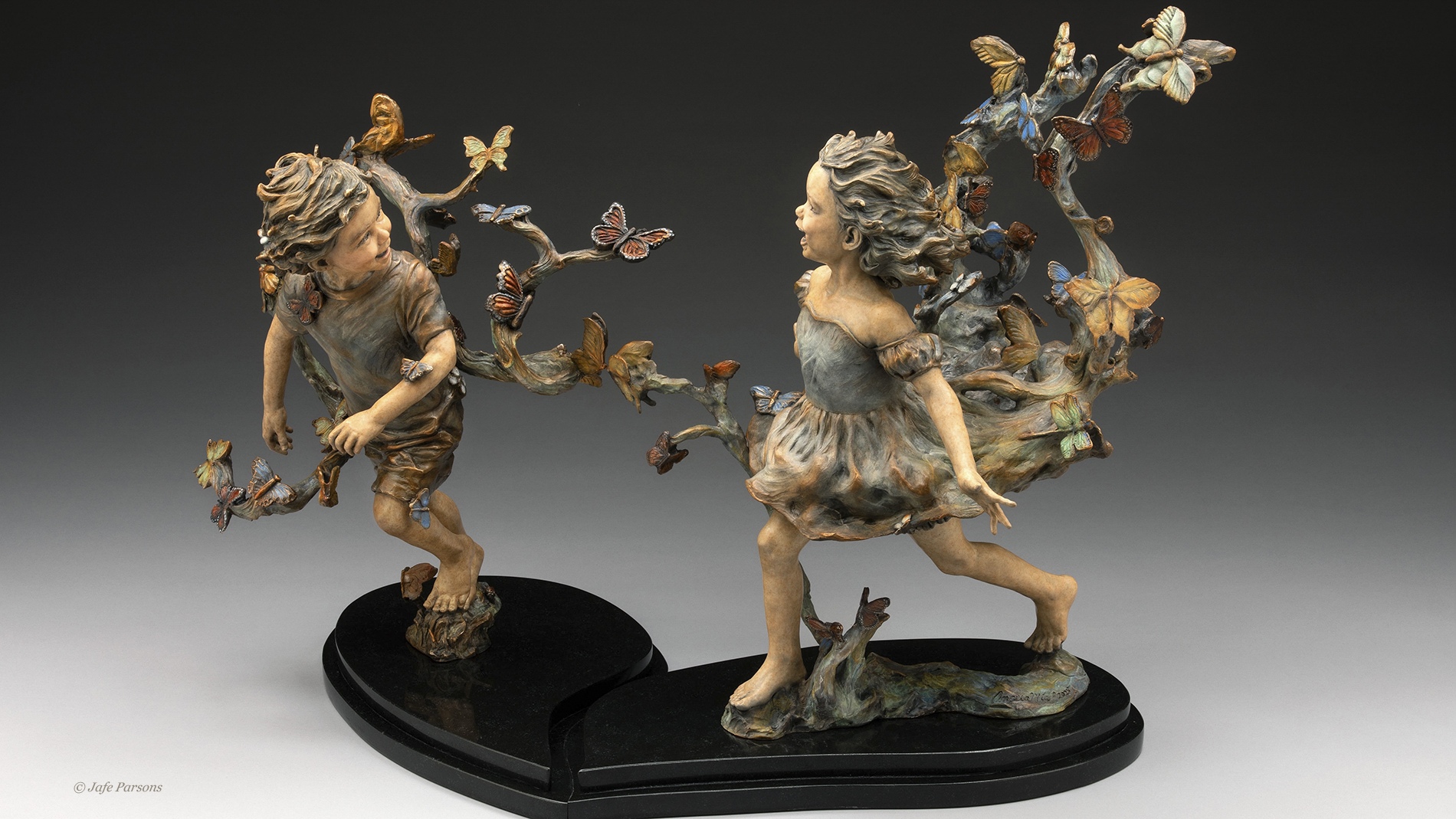
Angela Mia: Oh, There You Are
Angela Mia on clay, love stories, and the courage not to make herself smaller
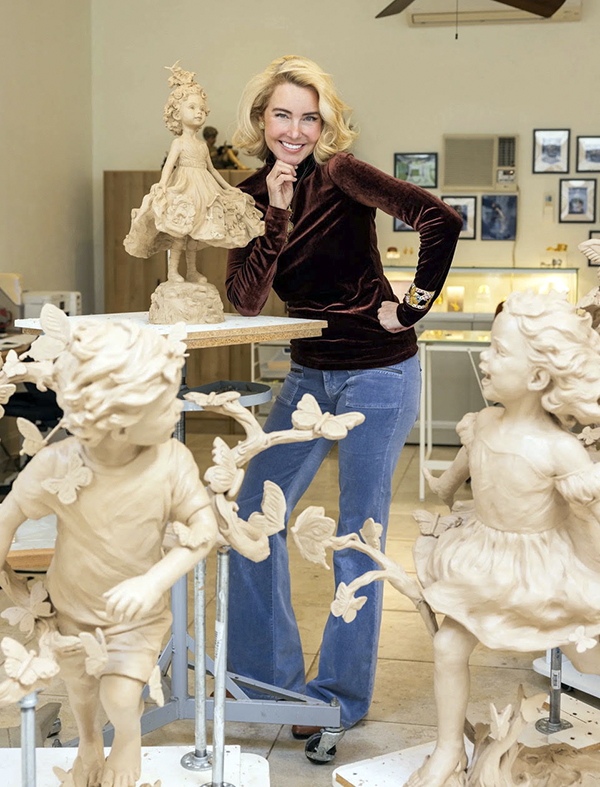
The Conversation
Angela Mia There was a pine tree outside our home in Clarion, Pennsylvania. My mother, a creative educator to her core, removed the branches from the bottom five feet of the trunk so that the many large branches above could still cascade to the ground, forming an evergreen wall that encased a little room within. Inside this magical pine tree studio, I discovered the wonderful clay earth. I would make wee creatures from it, and I became enamored of each one. In my mind, they were alive and very conversational. It was my own safe and happy world inside my pine tree.
Years later, I began making things that would not wash away in the rain. I carved wood and combined fired clay with woven reed and twine. My sculptures were still fantastical, but they had become larger and often eerie: social commentary on issues that troubled me. One piece, for example, was a small, cracked clay corpse of an old woman suspended on a swinging bed inside a woven boat basket. Another was a lanky wooden female figure with oversized hands protecting her round belly, also a basket woven into her abdomen, with a bejeweled egg inside. And another was an enormous wooden arm that hung from the wall. It had a little ladder dangling from a curled finger, an invitation inside the tiny door in the palm of the hand that led to an arched hallway in the triceps and biceps. I chuckle now at my dramatics, but the messages came from a sincere place.
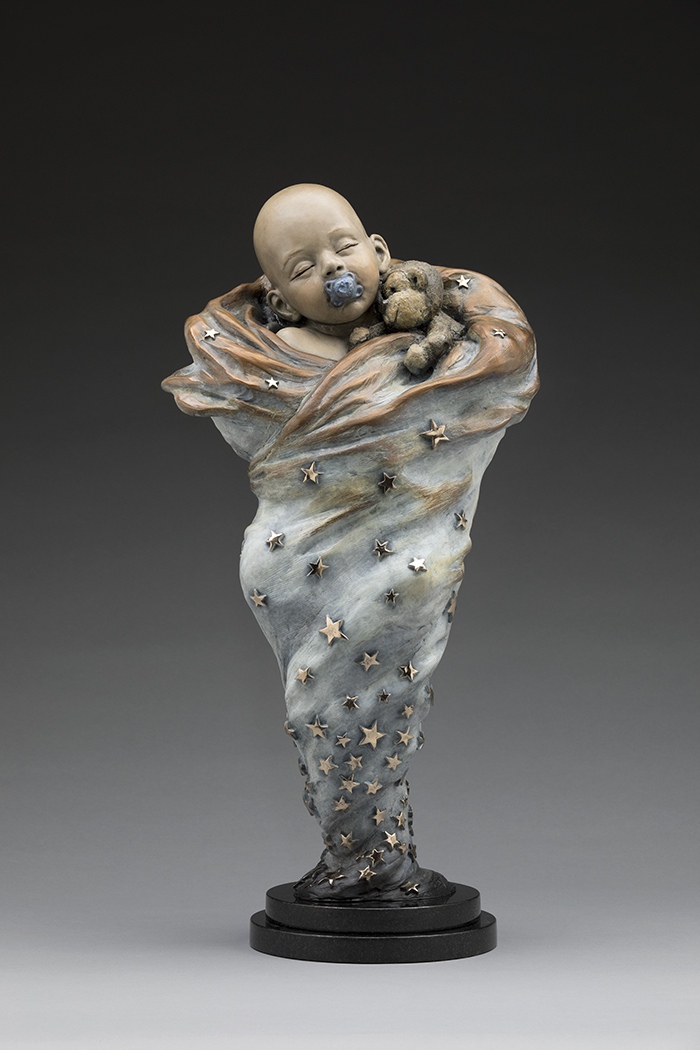
Then, when I was 24, I had my first child, Alexa, and everything changed. I was overwhelmed by her. I'd never known anything so glorious as the love I felt for her. There was so much beauty wrapped up in my new baby daughter that suddenly I didn't want to interpret what I saw or felt. I just wanted my sculpture to honor who she actually was.
When I sculpted her, I realized it was the most honest creation I'd ever made. I was never the same artist after that. I knew that I wanted to sculpt love stories that could move other people as profoundly as discovering mine had moved me.
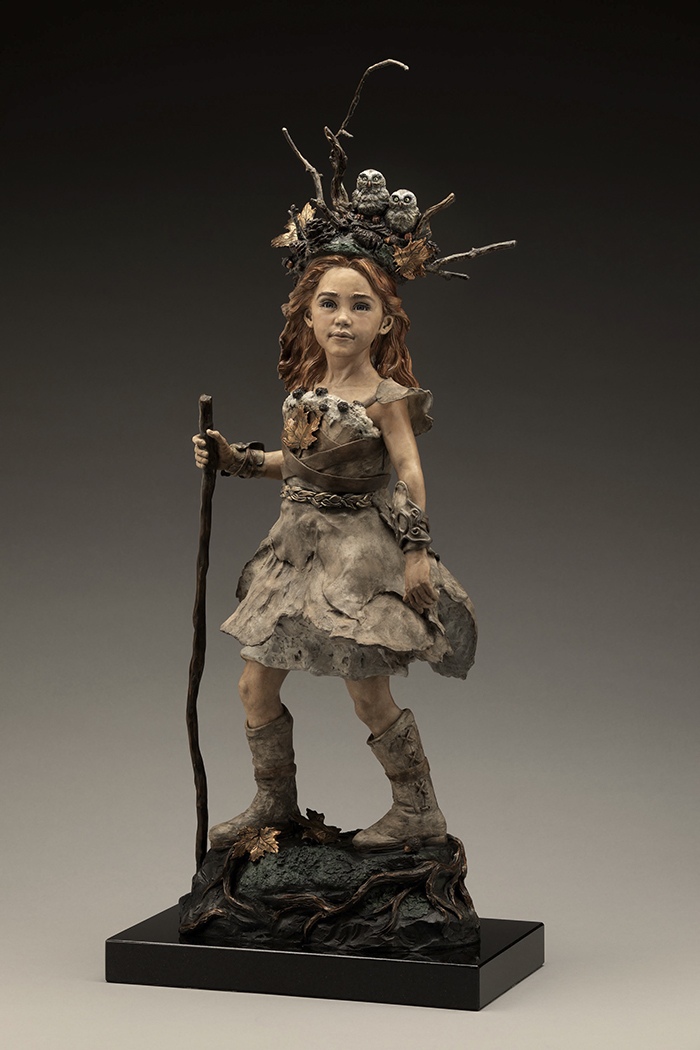
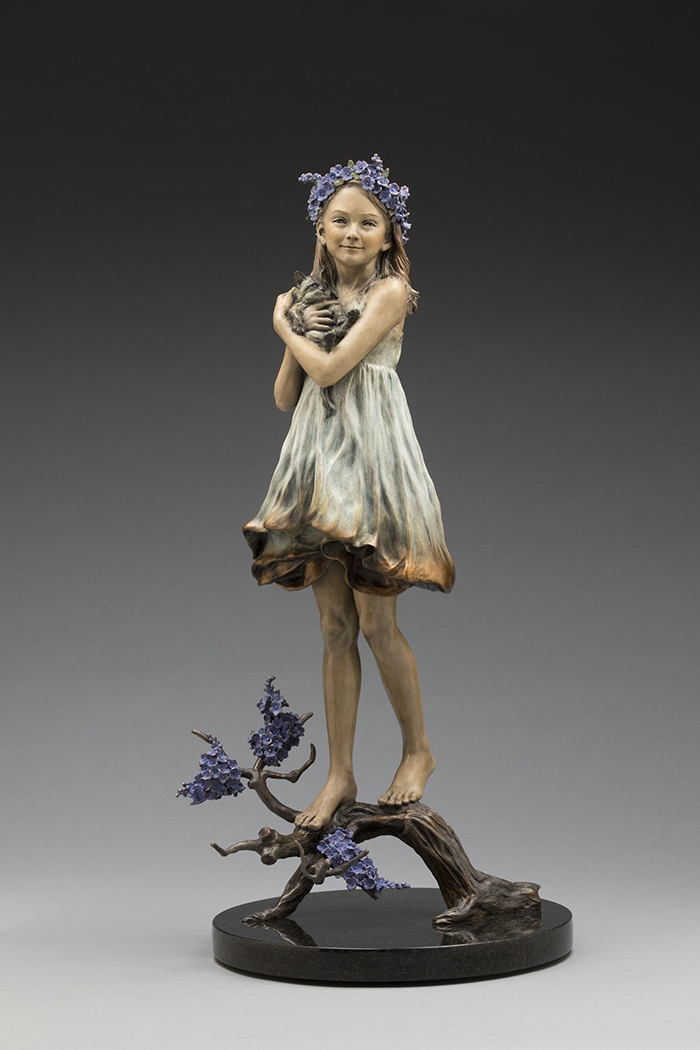
Angela Mia I do sculpt many children, and I understand why people associate my work with childhood, but I don't really think of children as my subject; I sculpt people. Admittedly, however, I am much more selective about the adults I decide to sculpt. There has to be a quality in who they are, or a particular moment in their lives, that makes me feel an urgency to capture them.
Four years ago, my middle daughter, Adiana, was living at home with us after college. She's my beloved wild child, and she had arrived at this wonderful place in her life where her experiences had taught her that she wanted to be healthy, and she truly was. She had also just become engaged, and suddenly it hit me that my precious daughter, who is also one of my very best friends, was going to move away.
I felt a tremendous longing to sculpt her exactly as she was in that moment. I got to sculpt her entirely from life, with no measurements or photos, while she patiently lay on her side for hours on end. It's very hard for anyone to hold the same pose for so long, but she was so giving with me so that I could have all the time I needed. Sculpting her beautiful, thick hair, I'd think back to when I had to chase her with a hairbrush. Sculpting her long, thin feet, I'd remember how my mother used to laugh and say, "Her feet are so narrow! How can she ever hope to stay upright on them?" Sculpting her ankles, I'd think about the times she'd broken them because she's so clumsy. So many emotions poured out of me and into her sculpture. Those sittings became one of the most profoundly emotional and connecting experiences I've ever had, personally and as a sculptor: my beautiful adult daughter sharing this intimate time with me while I studied her humanity with tremendous intention, trying to recreate in clay her extraordinary radiance.
I sculpted her on an exaggerated, wildly overgrown bunch of parsley. Parsley has associations with cleansing and the removal of bitterness, and for me that exuberant growth became symbolic of the health I continue to celebrate in her today and every day.
I've sculpted all five of my children several times: my daughters, Alexa and Adiana; my son, Federico; and my stepchildren, Dominick and Emma. Each time has been a tremendously emotional experience, always an effort to sculpt the enormous love I see in them. This is also how I try to sculpt the children of other mothers and fathers, children of all ages. I try to honor the unique way a person loves, and how they are loved by those who know them best. Sometimes I already know my subject so intimately that the urgency comes from realizing that this particular moment in their life is passing. Sometimes, when I have the large but beautiful task of getting to know my subject, I feel compelled to sculpt and deliver their unique love story to the family it belongs to, so they can have it however and whenever they might need it.
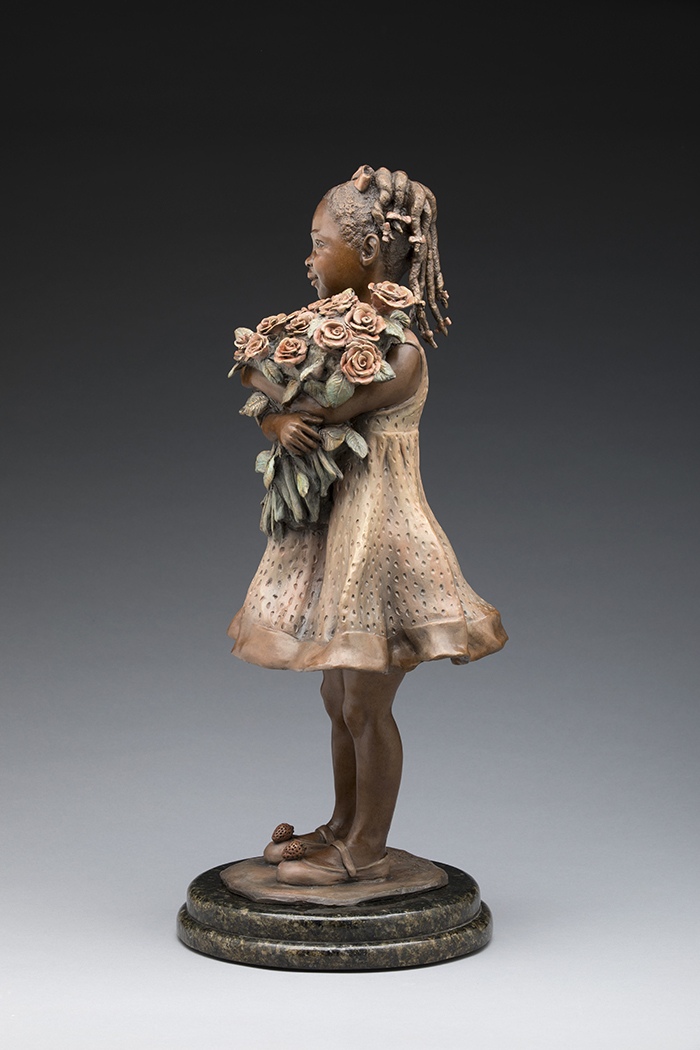
Angela Mia When I was younger, I was much more concerned with how other people perceived me. I think that's an insecurity very strongly linked to youth; at least it was for me. And when you're preoccupied with how someone sees you, that inevitably occupies some of the space between you. As I've gotten older, I've become much less concerned with that, and it has given me a wonderful freedom to experience another person outside of myself. I get to appreciate people more fully now, looking for sweet revelations about them and about the people around them, especially those who love them. Once I understand that, I can build a compositional story around it. I want it to offer a meaningful encounter with humanity as it is lived by someone else.
I experience this even with my husband, whom I love so deeply and whose life is completely intertwined with mine. Every now and then, I deliberately stop and really look at him; I just take him in. His presence suddenly becomes exquisitely vivid to me. This has become a very meaningful way of loving him: taking the time to see him for who he is, outside of myself. I think my sculpture has evolved in much the same way.
With children, I love how quickly they trust and share their hearts. They feel they are as big as the world they live in. So their sculpted stories almost always have a kind of dreamlike wonder or joyful exuberance, and can feel quite magical.
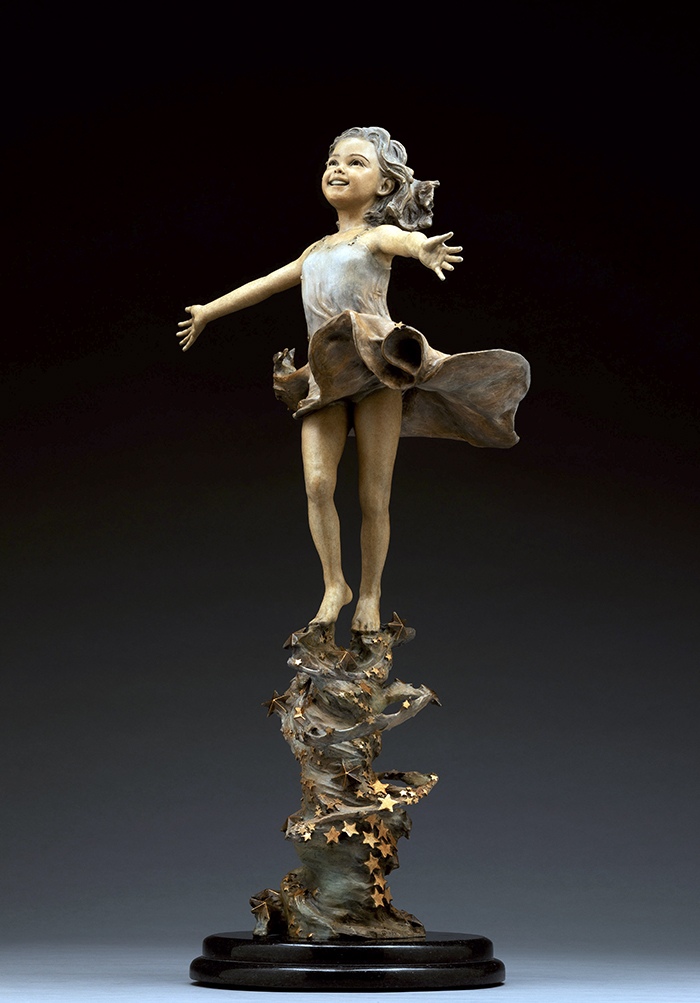
Angela Mia This actually has a rather funny story behind it. When word arrived from the Art Renewal Center in 2012 that I had been named an ARC Living Master, it came as a physical letter. I knew very well what ARC was and what that distinction meant, and my first thought was that they had made a mistake. I imagined some version of one of those pageants where they put the crown on the wrong person and then have the terrible task of taking it back and giving it to the actual winner. I thought perhaps there had been a typo, or something had gone wrong somewhere along the way. I didn't tell anyone, not even my family.
I decided I was just going to be happy with it by myself for a little while. Eventually I told my mother. In her very practical way, she said, "Well, why don't you call them and ask them about it?" I don't remember exactly how I managed to verify it without announcing, "I think you've made a mistake," but somehow I did. And no, the distinction had not been given in error. I really had been named an ARC Living Master.
It was an extraordinary honor, and it propelled me to keep learning and pushing myself, to try to become increasingly worthy of something I still find a little astonishing to have been given.
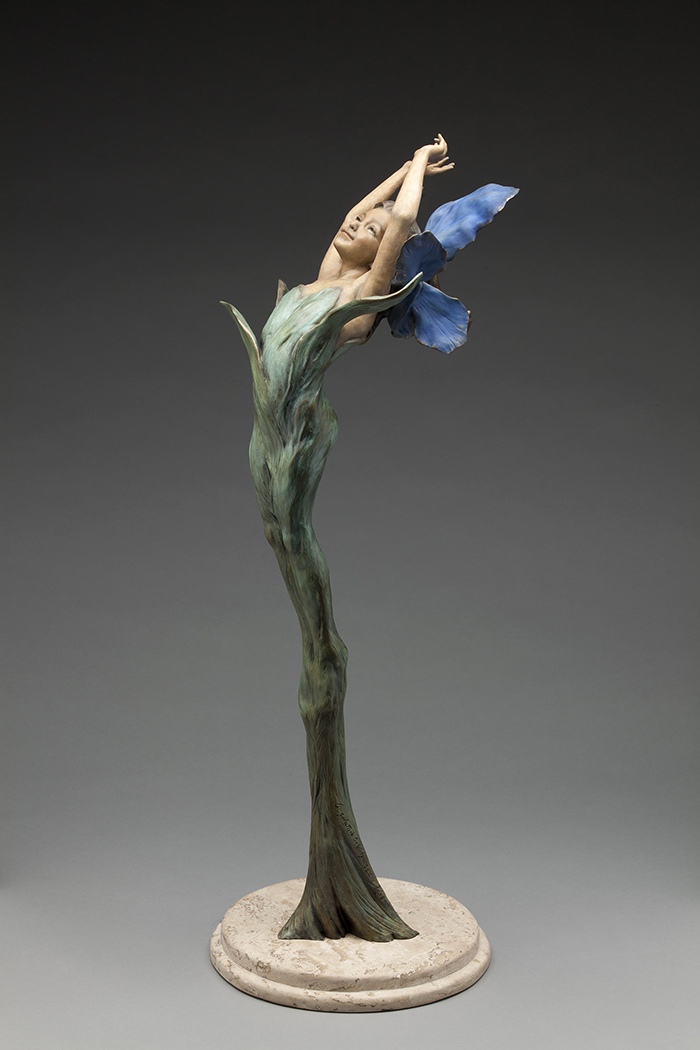
Angela Mia I find that thinking too much about where a sculpture will eventually live can actually confuse the story for me. The figure can begin to feel dependent upon her surroundings rather than independently alive.
Once the sculpture is finished and has a home, I turn my attention to the environment and find a way for the sculpture to become a natural part of that place. I consider how it sits within its surroundings, how people will encounter it, and whether it needs any wayfinding or landscaping to make the setting complete and balanced.
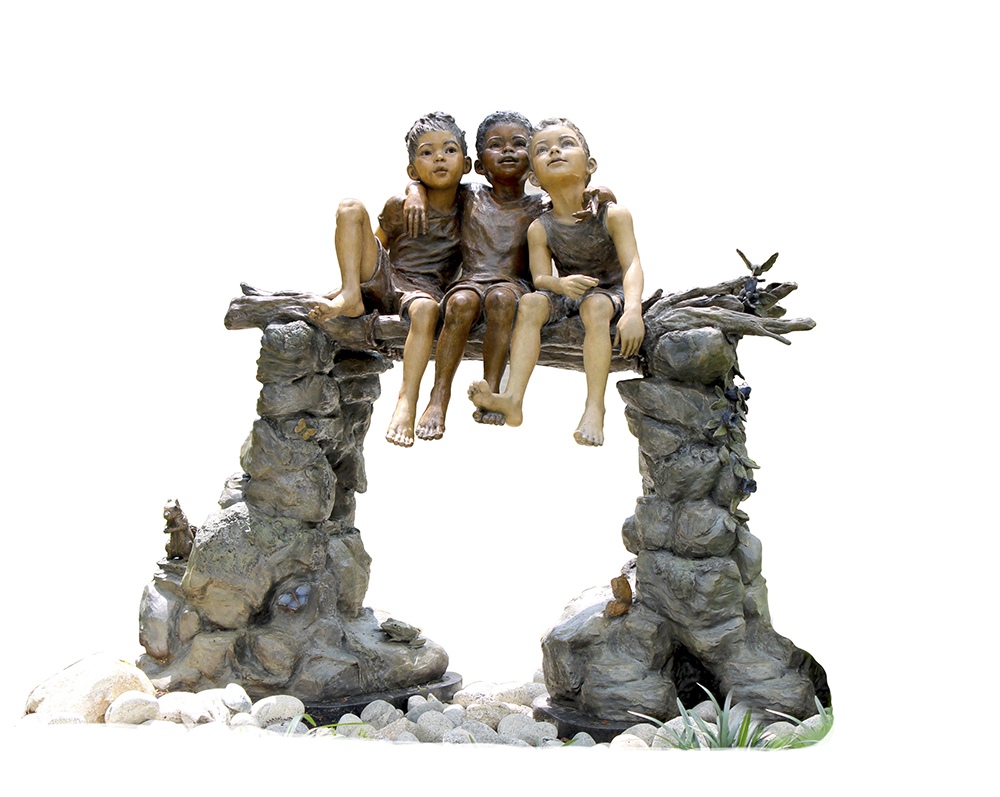
Angela Mia My sculptures have always been about trying to connect with another human being, and I love the possibility that something I create might reach across the differences between me and someone whose life is very different from mine. But jewelry has unexpectedly brought that connection right back to me. The work doesn't simply go out into the world anymore. Sometimes I get to meet the person who carries it there.
I was at an event in a stadium recently and happened to sit in the row directly behind a woman wearing my Tomorrow's Glory earrings. She didn't know I was the person who had designed them. I could hardly concentrate on the event because I was so enthralled watching her. She would turn to talk to the man beside her with these big smiles, and she was sparkling as much as the earrings were. I was so moved! I kept thinking, Wow, she chose earrings I created to wear tonight, and she is glowing.
I felt enormously connected to her, and she didn't even know I was there. I love that! I don't need someone to know me for the connection to happen.
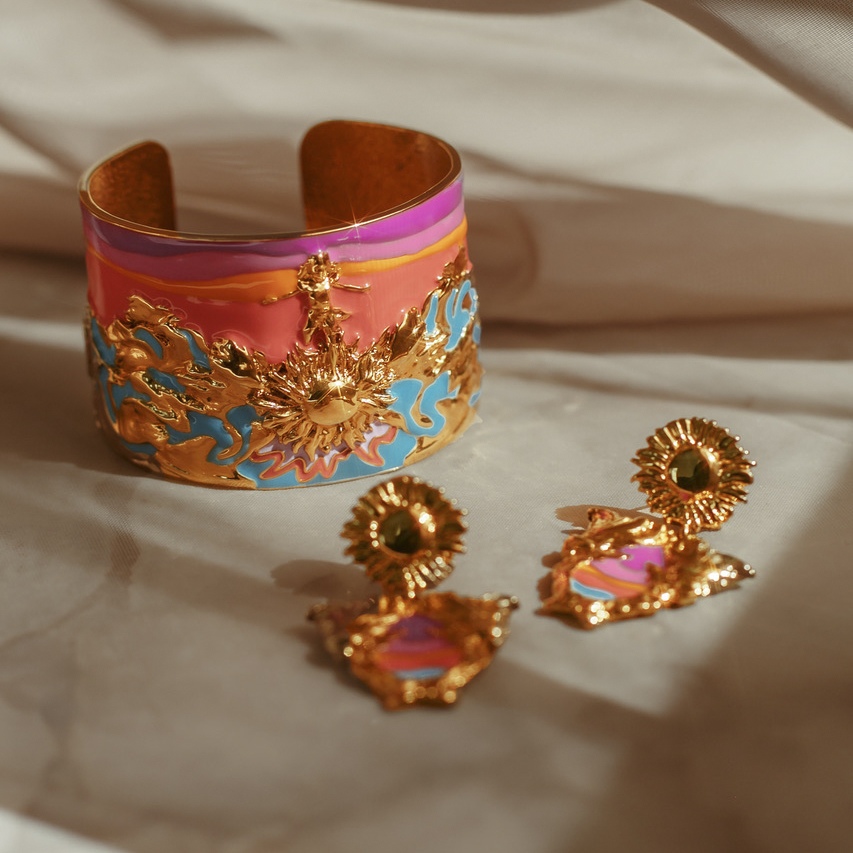
Jewelry has also brought completely unexpected kinds of intimacy. At trunk shows, I'm suddenly in very close proximity to women I've only just met. I'll reach around and clasp a necklace at a woman's neck, or hold a mirror in front of her while she looks at herself wearing something I've made. She'll ask me what I think, and I'll tell her.
It fills me with awe every time, how quickly these encounters can make me a person of trust. Moments earlier she may have been a stranger, and now she's comfortable having me close and genuinely values my opinion about what we're both seeing in the mirror.
Angela Mia Motherhood continues to shape my work, but perhaps now it happens in both directions.
Whenever my children have struggled with insecurity or self-doubt, I've tried to remind them who they are, encourage them, push them a little, and help them believe in their own capabilities. The funny thing is that I wasn't always very good at doing that for myself.
After sculpting Alexa as a baby, I embarked upon a fervor-driven journey to become a masterful figurative sculptor. As I focused on sculpting accurate representations of life, I became increasingly insecure about expressing what was genuinely in my heart through my work. I worried that it might be perceived as silly or cheesy or naïve, or somehow not serious enough. So I would edit myself and pull the work back toward a safer theme, with strict emphasis on its academic nature.
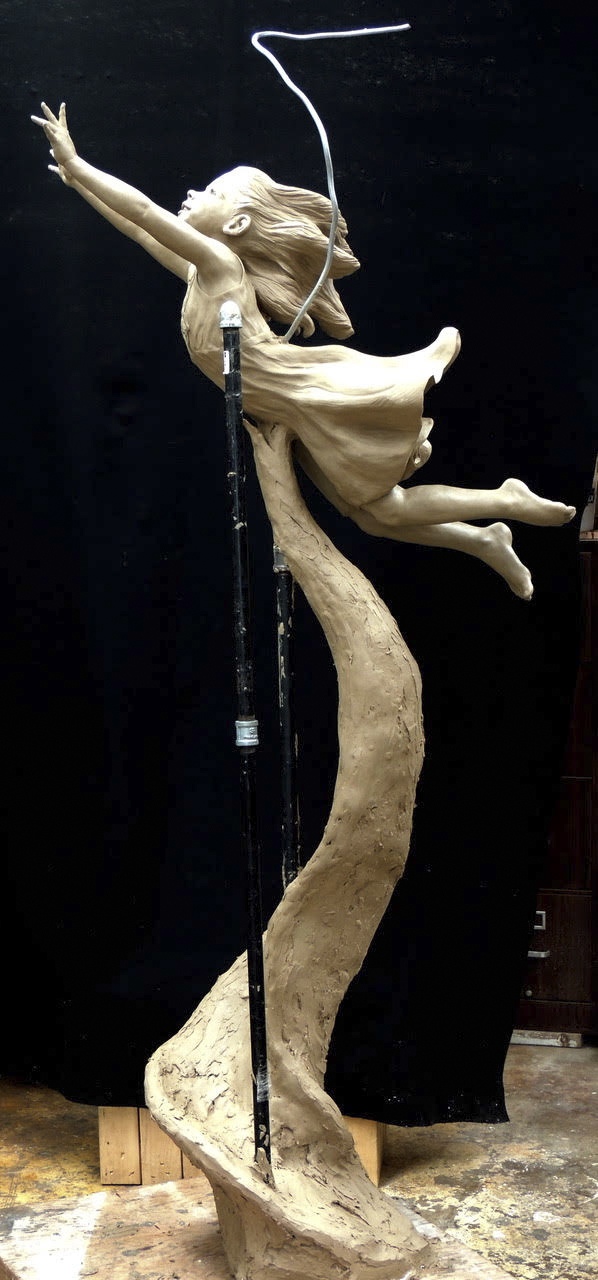
One sculpture in particular changed that for me. About fourteen years ago, I had just left a very difficult marriage and moved into an apartment. On my very first night there, I woke myself up by blurting out loud, "Lift her with butterflies."
I actually started giggling. I had no idea why I'd said it. Eventually I went back to sleep, but when I woke the next morning, I could see her: a little girl being lifted into the air by this wonderful swirling mass of butterflies. I knew I just had to sculpt her.
That very day I went to the studio space I was sharing with another sculptor and began building the armature. I wanted the little girl life-size and high in the air, so I built her above a tall length of plumber's pipe and sculpted her from a ladder. Then I started making butterflies, and more butterflies, and more butterflies! The more I made, the freer and happier and more exhilarated I felt. Eventually there were 276 or 277 of them (I've tried to count them, but I inevitably lose my place), all swirling beneath this little girl in an enormous, uplifting kaleidoscope.
My original intention was for every butterfly to have a full-color patina based on the real species it represented. But more than a year later, when I arrived at the foundry and saw the entire sculpture assembled in bronze for the first time, I was overwhelmed by my own work, and embarrassed. It felt like too much.
I told the patineurs, "No, no, no. Change of plans. We're going to make the whole thing a classic monochromatic bronze. Let's tone this thing down." And they immediately asked me why. Why would I edit myself now, if full color had been the vision all along?
Costel, who is now my husband, was there with me. We had only recently begun dating, and that visit to the foundry in Loveland was actually our first trip together. He said essentially the same thing: Why would you edit yourself? Do what you really envisioned. So, very nervously, I did. Every one of those butterflies received its color.
Since then, Lift Her with Butterflies has resonated with people for deeply personal reasons that are different from my own. They didn't need me to make it safer for them. They received all that color and exuberance and life for exactly what it was. I think the sincerity of the sculpture required me to make it the way my heart had intended, even though doing that frightened me.
This is where motherhood continues to influence me in a way I never anticipated. My children have grown into wonderfully individual people, and their bravery moves me tremendously. They pursue what matters deeply to them, speak honestly when it would be easier not to, and stand behind what they believe is right.
So when I find myself beginning to retreat artistically, wondering whether something is too much, I think of them. I would never advise one of my children to make themselves smaller because someone else might misunderstand them. Why, then, would I ask that of myself?
Angela Mia I can't begin a sculpture until I have a very clear vision of it in my mind. That doesn't mean every detail is resolved; I know the sculpture will continue to reveal things to me as I work, but the vision has to be clear enough to guide me.
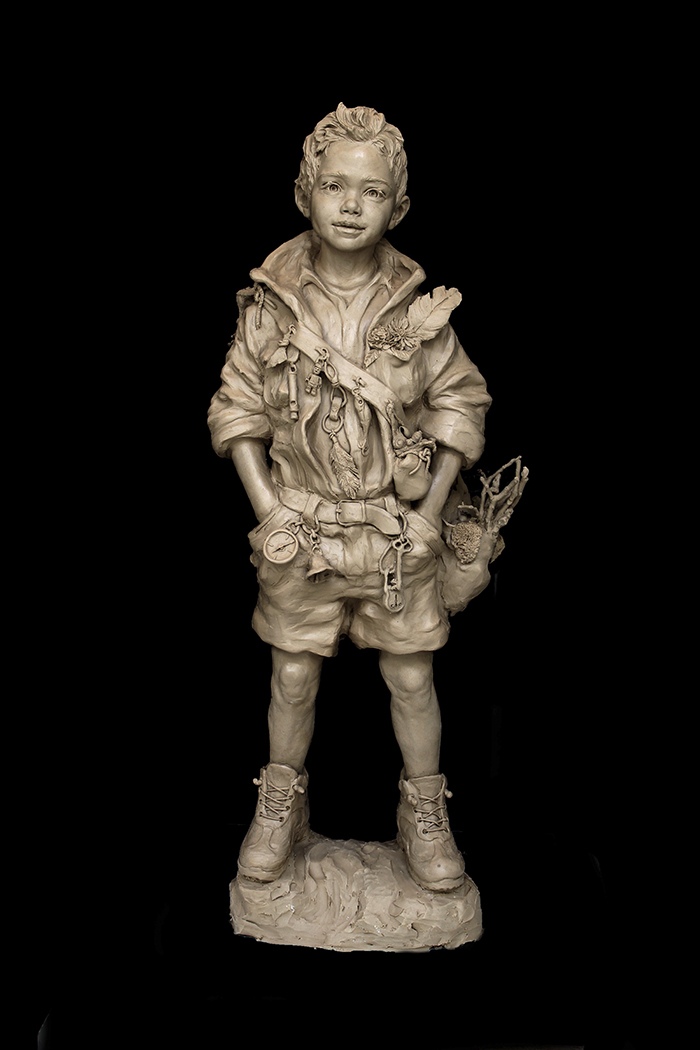
I begin by building an armature from galvanized plumber's pipe and aluminum wire, with aluminum foil to bulk out some of the more voluminous areas. Then I start adding clay, and that part of the process is actually very fast and vigorous.
My clay is warm at this stage, so it's extremely soft, and I can apply a great deal of it very quickly. I work all the way around the sculpture, almost continually encircling it, adding, pushing, building, gesturing. I use the palms of my hands quite a bit and move large amounts of clay around.
I deliberately don't concern myself with specific anatomy yet. If I became too focused on whether a particular muscle or landmark was anatomically correct at that point, I think I would block the fluidity of the sculpture. First, I need the whole figure. I need the gesture and pose to feel right. It has to be balanced and have living movement, and at the same time it has to be structurally secure enough for me to build upon.
Then I begin correcting and modifying the figure. I slow down, bringing the anatomy into greater and greater accuracy. I like to get the sculpture to the point where it feels human in its entirety before I really go into the face.
And when I finally go to the face, my concentration becomes intense. I model and carve simultaneously, adding clay and taking it away, looking and looking again.
As I near a likeness, real life reveals itself in the most delightful way. There isn't even hair yet, just the head and the face, but some inherited combination of features begins to appear. If I'm sculpting a child, I'll often recognize the child's mother or grandmother looking back at me before I see the child. I know then that I'm getting somewhere very real.
I keep working until, little by little, the face becomes this one particular person. I've been searching through the clay for someone I know is there, and when I finally find them, I get to say with delight, "Oh, there you are." It doesn't always happen that way, but I love it when it does.
Angela Mia As a sculptor, I find that I listen to the patterns that occupy an empty space and seem to know instinctively how to reveal them. Listening to patterns and pulling back layers to show how they are interwoven can be a powerful way to uncover hidden depths of inspiration.
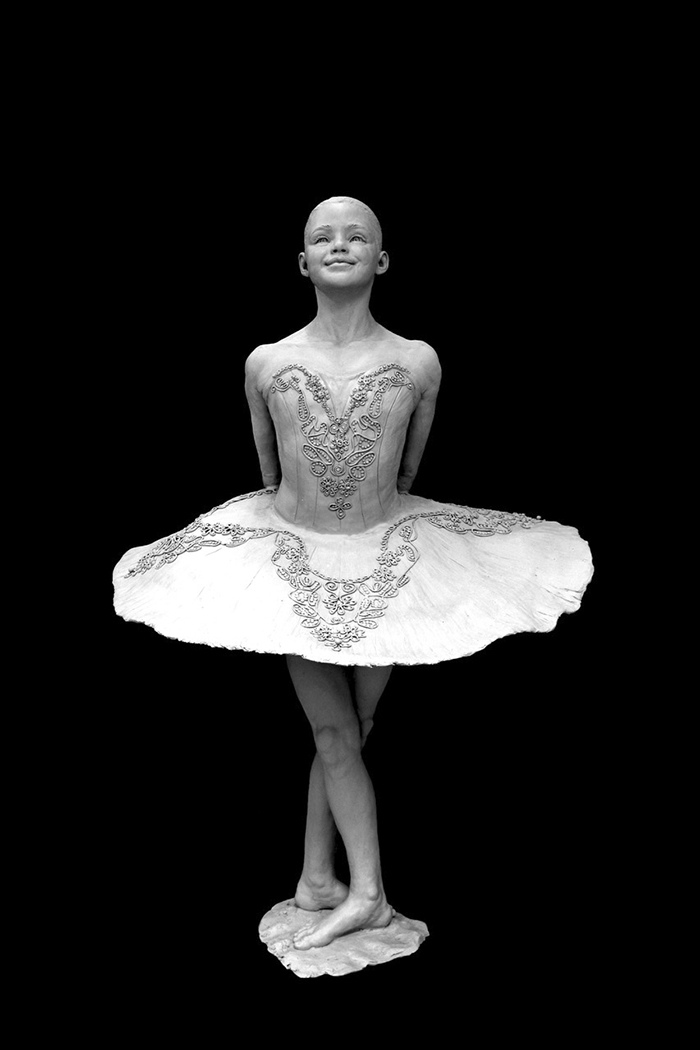
While I was sculpting Izzy Martin, my intuition was repeatedly interrupted by my own emotions. Izzy was a ballerina, an activist, and a warrior against cancer who passed away when she was only 12 years old. Her sculpture would be her memorial.
As I sculpted her, what had been such familiar pathways in anatomy, the fluid connecting layers, were lost to me several times. I had to push myself more than usual to shift my perspective (something sculptors do, for example, by viewing their work in a mirror to see it reversed).
With Izzy, I found that as I built up the layers and the recognizable pathways began to reveal themselves, I would feel a pressing need to peel the layers back again, looking for the beautiful soul of this young crusader. I was covering it up with the layers. I had learned so much about her and had plenty of photos, but I still needed more.
And then I was given the most beautiful gift. Izzy's younger sister, Madelaine, also a dedicated ballerina, came to the studio with their mother, Christine. Maddie got up on the platform next to the clay sculpture of her sister and modeled on her behalf, in her sister's tutu. Christine sat quietly watching.
In life, I occasionally find myself pulling at surface strings that draw me away from depth, from my purpose. Christine, Maddie, and Izzy refocused my center, reminding me of my purpose as a sculptor and as a mother in solidarity with other mothers.
Sculpting Izzy has been the most grounding experience of my career. It reaffirmed my purpose and reminded me to shift my perspective more often.
When I put the finishing touches on Izzy's legs, after hyper-focusing on the details of her knees and feet in ballet's fifth position, I stepped away and walked around her sculpture. Standing at a distance off to her side, I realized the visual weight of her legs was off by about an inch. Had I ignored this slight misalignment, its imbalance would have distracted every viewer. So I took a mallet and knocked the soft clay legs forward, destroying much of my work, which of course I then resculpted.
Only with my purpose and my perspective recentered could I realize Izzy's story.
Sculpting Izzy taught me that I need both knowledge and intuition. Knowledge is what years of training have given me: anatomy, structure, balance. It's what told me her legs were an inch off. Intuition is harder to explain. I think of it as my silent language. It's what kept urging me to peel back the layers until I found her spirit. Knowledge is like rowing your boat, and intuition is like setting your sail to the wind. Now I try to let the two work together on every project. I watch for every glimpse of a person's individual story, her passions and her values, because together they make up the identity that speaks to us through body language.
Conclusion
Mia describes two kinds of looking. One is the knowledge that years of training have given her: anatomy, structure, balance, the eye that sees a pair of clay legs sitting an inch off and reaches for the mallet. The other is harder to name. She calls it her silent language, the intuition that keeps her peeling back layers until a particular person appears. Her best work, she suggests, happens when the two are allowed to work together.
The same balance runs through her life. The pine tree studio, the sittings with Adiana, the moment she simply stops and takes in her husband: each is a way of attending to someone outside of herself, without needing to be seen in return. The woman glowing in the stadium never knew the earrings' maker sat behind her. For Mia, that was enough.
What may stay with readers longest is the foundry in Loveland, and a sculptor about to dim nearly three hundred butterflies because the work felt like too much. The people beside her asked why, and she found the answer in her children: she would never tell them to make themselves smaller. Her sculptures ask the same of us. They are not shy about tenderness, and they trust that tenderness, offered without apology, is something people know how to receive.
About the Artist
Angela Mia is a figurative bronze sculptor based in Dallas, Texas, and the founder of Angela Mia Studios. Named an ARC Living Master by the Art Renewal Center in 2012, she is also a Fellow of the National Sculpture Society. Over more than thirty years, her work has been exhibited and collected widely, and her sculptures stand in children's hospitals, universities, memorial gardens and public plazas around the world. She has recently begun reimagining select sculptures as wearable jewelry.