

How North African mandibles reveal populations near the human-Neanderthal divergence
In the coastal formations of Casablanca, Morocco, where ancient sea levels carved caves into wind hardened dunes, researchers have uncovered fossils that illuminate a pivotal moment in human evolution. Dating to 773,000 years ago, mandibles and associated skeletal remains from Thomas Quarry I document populations living close to the point at which African and Eurasian human lineages began to diverge. These hominins retain ancestral features from which both modern humans and archaic Eurasian populations would later emerge, offering one of the clearest morphological windows yet onto our shared deep ancestry.
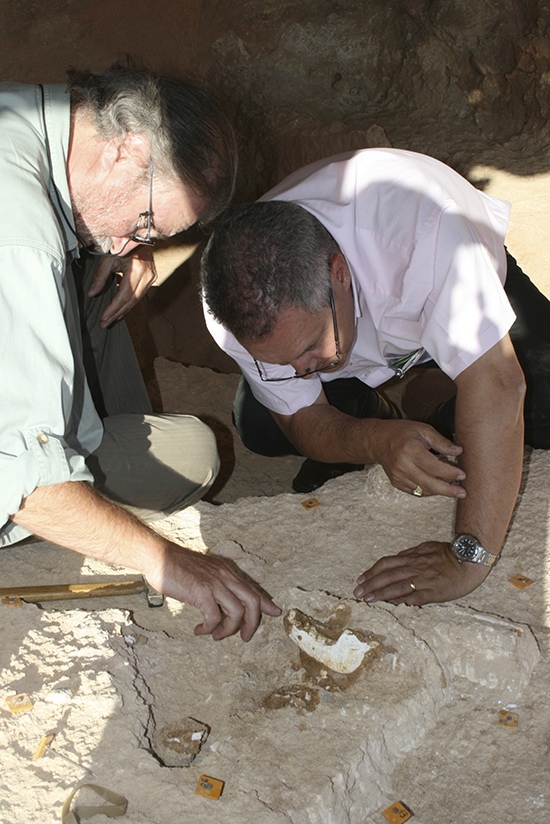
The discovery, published in Nature on January 7, 2026, is the result of more than three decades of continuous Moroccan French collaboration under the Préhistoire de Casablanca program. What sets the Thomas Quarry fossils apart is not only their anatomical significance but the extraordinary precision with which they are dated. The hominin bearing deposits capture the Matuyama Brunhes geomagnetic reversal in exceptional detail, anchored by 180 magnetostratigraphic samples. This globally recognized chronological marker fixes the fossils firmly at 773,000 years ago, providing one of the most secure ages ever established for an African Early to Middle Pleistocene hominin assemblage.
This level of chronological resolution is rare in paleoanthropology, where early and middle Pleistocene sites are often affected by discontinuous stratigraphy and large dating uncertainties. At Thomas Quarry, the combination of an undisturbed geological context and high resolution magnetostratigraphy places the fossils within a narrow temporal window, allowing their morphology to be interpreted against a precisely defined evolutionary backdrop. The remains display a mosaic of archaic and derived traits that situate Northwest Africa as a critical region in early human evolution, challenging overly linear narratives and underscoring the geographically distributed processes that shaped the emergence of our species.
Recently, we spoke with the lead researcher, Dr. Jean Jacques Hublin, Professor at the Collège de France, Emeritus Professor at the Max Planck Institute for Evolutionary Anthropology, and Member of the French Academy of Sciences, who led the study of the hominins. Reflecting on the broader implications of the discovery, he explains, “The fossils from the Grotte aux Hominidés may be the best candidates we currently have for African populations lying near the root of this shared ancestry. This reinforces the view of a deep African origin for our species, but one that is more nuanced and regionally complex than previously understood.”
A Geological Time Capsule on Morocco’s Atlantic Coast
The Thomas Quarry I site lies within the raised coastal formations of the Rabat Casablanca littoral, a region internationally recognized for its exceptional succession of Plio-Pleistocene paleoshorelines, coastal dunes, and cave systems. These formations were shaped by repeated sea level oscillations, alternating aeolian phases, and rapid early cementation of coastal sands, creating unusually favorable conditions for fossil and archaeological preservation.
Within this broader geological complex, the Grotte à Hominidés represents a distinctive cave system formed during a marine highstand and later infilled with sediments that preserved hominin remains in a stable stratigraphic context. David Lefèvre of the Université de Montpellier Paul Valéry describes the site as “a secure, undisturbed and undisputable stratigraphic context,” a characterization that underpins the reliability of the chronological framework.
The cave deposits recorded Earth’s last major geomagnetic reversal with remarkable fidelity. Using 180 magnetostratigraphic samples, the research team identified not only the position of the Matuyama Brunhes transition but also its duration, estimated at between 8,000 and 11,000 years. This represents an unprecedented level of temporal resolution for a Pleistocene hominin site in Africa.
Serena Perini, who conducted the magnetostratigraphic analysis with Giovanni Muttoni of the Università degli Studi di Milano, emphasizes the importance of this result. “Seeing the Matuyama Brunhes transition recorded with such resolution in the ThI GH deposits allows us to anchor the presence of these hominins within an exceptionally precise chronological framework for the African Pleistocene.”
Mosaic Morphology: When Teeth Evolve Faster Than Jaws
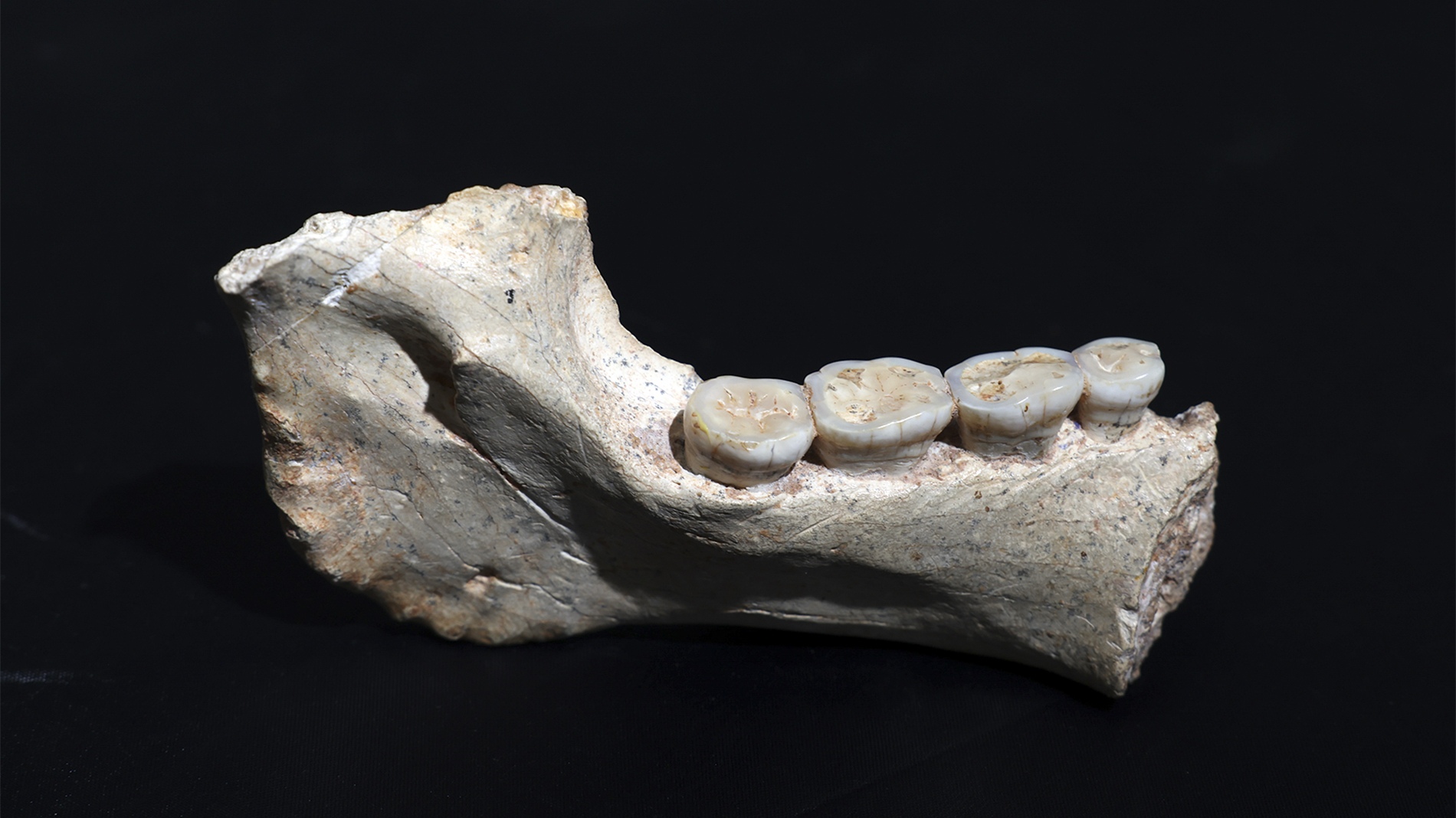
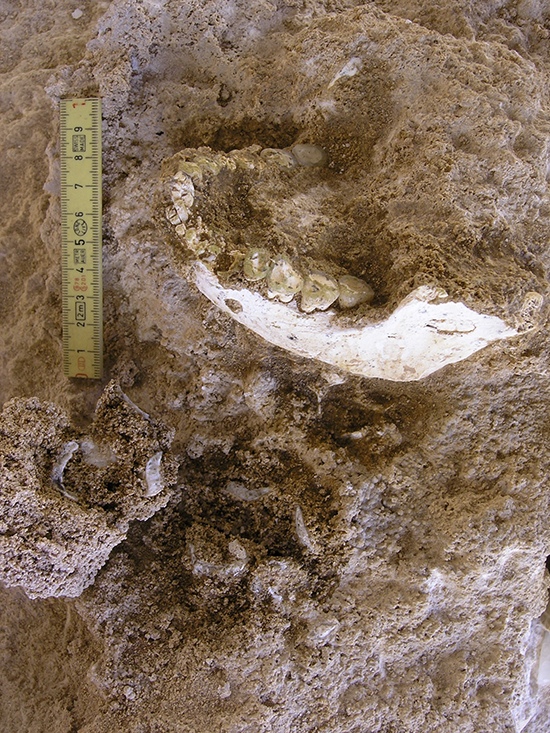
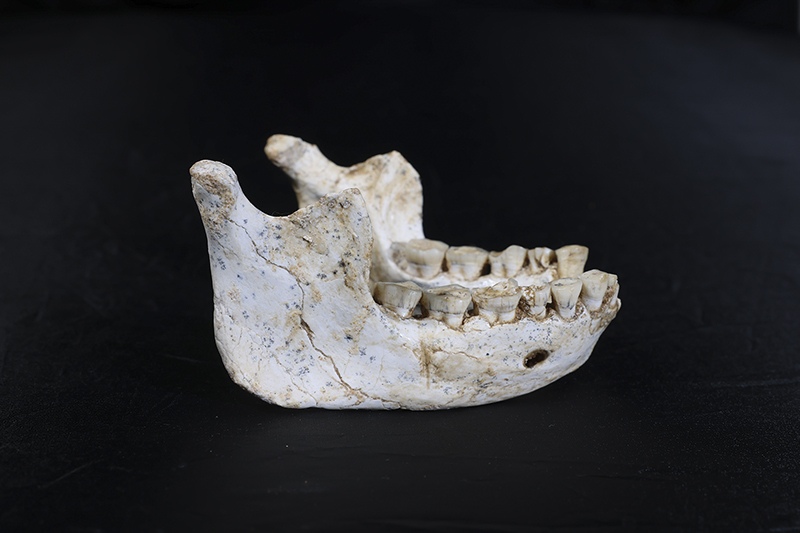
The hominin remains recovered from the carnivore den include a nearly complete adult mandible designated ThI GH 10717, a second adult hemimandible ThI GH 1, a child’s mandible, several vertebrae, a fragmentary femur and isolated teeth. Together, they reveal a striking evolutionary pattern in which dental traits appear to have evolved more rapidly than the architecture of the mandible.
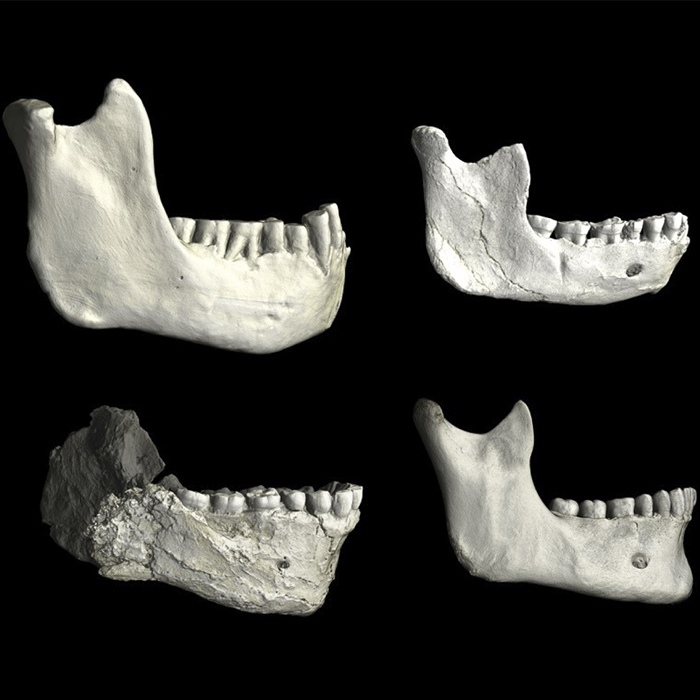
High resolution micro CT imaging, geometric morphometrics, and comparative anatomical analysis show that ThI GH 10717 retains a receding symphysis typical of Homo erectus, while its dentition exhibits derived features such as third molar reduction and root morphology closer to that of Homo sapiens. This decoupling of dental and mandibular evolution reflects a mosaic pattern long recognized in hominin evolution, in which different anatomical systems respond to distinct selective pressures.
Matthew Skinner’s analysis of the enamel dentine junction, a taxonomically informative internal tooth structure, indicates that the Grotte à Hominidés hominins are distinct from both Homo erectus and Homo antecessor. Instead, they appear to represent populations basal to both Homo sapiens and archaic Eurasian lineages.
Shara Bailey’s dental morphological study reinforces this interpretation. She notes that the teeth retain many primitive traits while lacking characteristics associated with Neanderthals. In contrast to Homo antecessor, which already shows early Neanderthal tendencies, the Moroccan fossils suggest that regional differentiation among human populations was already present by the end of the Early Pleistocene.
Variation Within a Population
One of the most intriguing aspects of the assemblage is the contrast between the gracile mandible ThI GH 10717 and the more robust hemimandible ThI GH 1, which exhibits features sometimes associated with Neanderthals, including a retromolar space. Rather than implying taxonomic diversity, this contrast highlights the challenge of interpreting variation in fossil assemblages with small sample sizes.
Morphological traits often scale with body size and allometry, and sexual dimorphism remains a plausible explanation even if it cannot be demonstrated conclusively. The associated vertebrae indicate a relatively small bodied individual with post cranial features broadly consistent with Homo erectus.
This gracility contrasts with the robust Middle Pleistocene African fossils from sites such as Kabwe in Zambia and earlier North African mandibles from Tighennif in Algeria. Rather than reflecting a specific coastal adaptation, the Thomas Quarry morphology is best understood as retained ancestral body proportions combined with normal population level variability.

The Strait of Gibraltar and Early Population Separation
The Thomas Quarry fossils are broadly contemporaneous with Homo antecessor from Gran Dolina at Atapuerca in Spain, yet their anatomical affinities differ in telling ways. While the Spanish material shows dental traits that anticipate later Neanderthal morphology, the Moroccan fossils retain features that align more closely with populations basal to Homo sapiens.
This near simultaneity raises questions about population structure at the western edge of the Mediterranean during the Early Middle Pleistocene. The Strait of Gibraltar, narrow but ecologically complex, appears to have played an important role in shaping divergence between African and Eurasian populations. Rather than acting as a strict barrier, it may have allowed intermittent contact while still permitting long term evolutionary separation.
How this balance between connectivity and isolation operated, and when it became decisive, remains difficult to resolve based on fossil evidence alone. These issues are addressed directly in the interview below.
Biogeography and Ecological Connectivity in Africa
Faunal remains from Thomas Quarry share species with sites in both North Africa and East Africa, indicating periods of broad ecological connectivity across the continent. During humid intervals of the Early Pleistocene, environments now separated by desert were linked by grasslands and savannas, allowing animals and potentially hominin populations to disperse over large distances.
Despite this ecological openness, the hominin remains from Thomas Quarry differ markedly from the robust mandibles known from Tighennif in Algeria. This contrast highlights a central question in African human evolution: whether morphological differences reflect population replacement events or long term regional variation within connected populations.
The Thomas Quarry evidence suggests that ecological connectivity did not necessarily produce morphological uniformity. Instead, populations may have remained distinct while still sharing broader environmental frameworks.
Rethinking Middle Pleistocene Taxonomy
The Thomas Quarry fossils contribute to ongoing debates about how Middle Pleistocene hominins should be classified. For decades, Homo heidelbergensis was used as a broad taxonomic category for fossils thought to be intermediate between Homo erectus and later human forms. Increasingly, this category has proven difficult to sustain biologically.
Comparative analyses show that many Eurasian fossils once assigned to Homo heidelbergensis align more closely with the Neanderthal Denisovan lineage, while African fossils from a similar time range follow different evolutionary trajectories. The Thomas Quarry material documents populations close to the divergence point without fitting comfortably into traditional taxonomic labels, underscoring the importance of population level approaches to human evolution.
Approaching the Ancestral Condition
Genetic studies place the divergence between the Homo sapiens lineage and the Neanderthal Denisovan lineage within a broad window spanning the late Early and early Middle Pleistocene. The age of the Thomas Quarry fossils places them close to this interval, making them especially relevant for understanding the ancestral condition preceding this split.
While no fossil can be identified unequivocally as the last common ancestor, populations living near this time and retaining ancestral morphological features provide critical insight into what that ancestor may have looked like. The Thomas Quarry hominins occupy this threshold position, preserving a combination of traits that illuminate the shared evolutionary background from which later human lineages emerged.
Decades of Patient Fieldwork
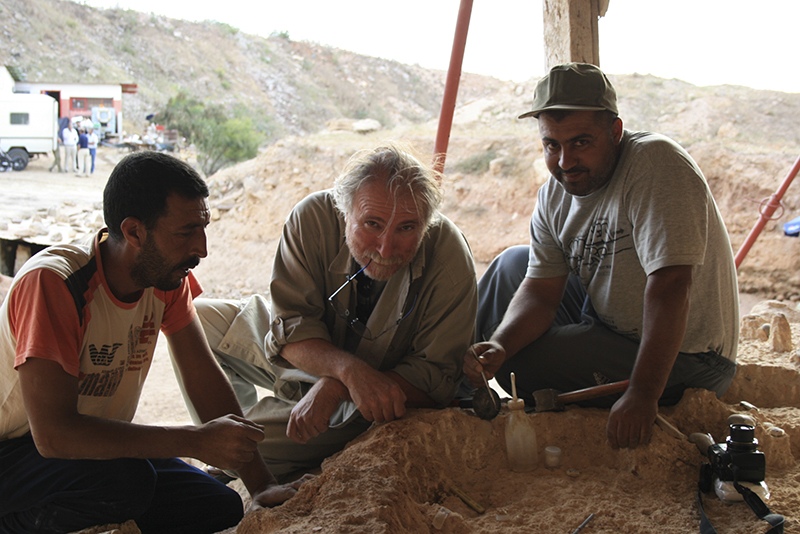
The discovery is the product of more than thirty years of sustained fieldwork conducted through the Moroccan French Préhistoire de Casablanca program. Abderrahim Mohib of INSAP emphasizes the importance of institutional collaboration between Moroccan and French research bodies, while Jean Paul Raynal highlights the unique geological context of the Rabat Casablanca littoral.
Thomas Quarry I is also known for preserving the oldest Acheulean industries in Northwest Africa, dated to around 1.3 million years ago. The addition of precisely dated hominin fossils transforms the site into a cornerstone for understanding both technological and biological evolution across the Early to Middle Pleistocene.
A Conversation with Dr. Jean Jacques Hublin
The Muddle in the Middle and Phylogenetic Position
Redefining the ancestral node
Q: Your paper challenges Homo heidelbergensis as a coherent species, arguing that Eurasian specimens are actually Neanderthal Denisovan precursors. Since ThI GH fossils dated to 773 ka show derived features basal to Homo sapiens, does this make North Africa the primary locus where the modern human clade first diverged?
Our results add to the growing evidence that Homo heidelbergensis, as traditionally defined, does not represent a coherent biological species. Eurasian fossils historically grouped under this label tend to fall on the Neanderthal Denisovan side of the tree, and sometimes are indeed early Neanderthals. The Thomas Quarry GH fossils do not make North Africa the exclusive place where the lineage leading to Homo sapiens emerged, but they strongly suggest that populations close to the divergence between this lineage and Eurasian lineages were already present in Africa around 773 ka.
The Homo antecessor divergence
Q: ThI GH fossils are similar in age to Spanish Homo antecessor yet morphologically distinct. Spanish fossils lean toward Neanderthals while Moroccan ones lean toward Homo sapiens. Was the Strait of Gibraltar already acting as a biological barrier by 773 ka?
The near contemporaneity of Homo antecessor in Spain and the Thomas Quarry fossils is striking, but their morphological affinities differ. When dental features are considered, the Spanish fossils tend to align with later Neanderthal traits, whereas the Moroccan material shows more features basal to Homo sapiens. This does not imply that the Strait of Gibraltar was an absolute biological barrier at that time. Rather, it may have occasionally functioned as a semi permeable boundary, allowing occasional exchanges while still permitting African and Eurasian populations to follow distinct evolutionary trajectories over time. In the absence of a clear cut separation, genomic models are difficult to elaborate in order to estimate precise population separation times.
Mosaic Morphology
The decoupling of jaws and teeth
Q: ThI GH 10717 shows mosaic morphology, an erectus like receding symphysis paired with derived teeth. Does this mean dental modernization preceded mandibular restructuring in our lineage?
Yes, the Thomas Quarry mandibles clearly show that dental evolution and mandibular architecture were not tightly coupled. In this case, derived dental traits such as reduced third molars and Homo sapiens like root morphology appear earlier than major reorganization of the mandibular symphysis. This mosaic pattern is fully consistent with what we consistently observe elsewhere in hominin evolution and cautions against linear or all at once interpretations of anatomical change.
Interpreting intraspecific variation
Q: The gracile mandible contrasts with the more robust hemimandible that shows Neanderthal associated features. Is this sexual dimorphism within one population, or evidence that the Maghreb was a contact zone for diverse hominin groups?
Variation is often largely underestimated in the fossil record because sample sizes are usually extremely small. Sexual dimorphism is a plausible explanation, although it cannot be demonstrated conclusively. It is also important to note that some morphological traits routinely used to assess the taxonomic status of fossil specimens are linked to overall size and allometry, and may therefore be more pronounced in larger individuals. Although this cannot be excluded, there is no compelling evidence that the Maghreb functioned as a contact zone between distinct hominin species at this time.
Post cranial gracility
Q: Associated vertebrae suggest a small bodied individual with Homo erectus like features. How do you reconcile this with the increasing robustness seen in other Middle Pleistocene African fossils such as Kabwe?
The associated vertebrae suggest a relatively small bodied individual with post cranial features broadly consistent with Homo erectus. This contrasts with more robust Middle Pleistocene fossils such as Kabwe, but this variability is not unexpected. In North Africa, older mandibles from Tighennif are very large. Rather than invoking a specific coastal adaptation, I would interpret this gracility as reflecting retained ancestral body proportions combined with normal population level variation. Body size is one of the most plastic traits and can rapidly evolve in response to environmental conditions.
Chronology and Biogeography
The magnetostratigraphic breakthrough
Q: Your study dates these fossils to the Matuyama Brunhes transition, significantly older than previous ESR and U series estimates. Does this require re-evaluation of other North African sites?
Identifying the Matuyama Brunhes transition at Thomas Quarry provides a very strong and globally recognized chronological anchor. Beyond North Africa, this also raises broader questions about the age of other sites that were dated exclusively using methods such as ESR or U series on bone. While this does not automatically invalidate earlier estimates, it strongly suggests that key sites would benefit from renewed and independent chronological investigations.
Biogeography and the Green Sahara
Q: The faunal assemblage shares species with Tighennif and East African sites, yet ThI GH hominins are morphologically distinct. Is this local evolution or population replacement?
Faunal similarities indicate broad ecological connectivity across Africa during humid phases. During the Lower Pleistocene the Sahara was not yet such a strong ecological barrier. Although a population replacement cannot be excluded, I would favor a model of long term regional evolution within Africa, with size and robusticity varying in response to ecological conditions.
Broader Evolutionary Implications
Continuity with Jebel Irhoud
Q: Despite a 400,000 year gap, do specific traits suggest long term continuity in Morocco?
Despite the chronological gap, some anatomical traits, particularly dental features, are consistent with long term evolutionary continuity in the region. While we should avoid claiming direct ancestry, the evidence supports the idea that Morocco repeatedly hosted populations involved in the evolutionary history of Homo sapiens.
The fate of the Asian origin hypothesis
Q: Does the Thomas Quarry discovery undermine models proposing an Asian origin for Homo sapiens through back migration?
All securely dated Homo sapiens fossils older than 90 ka are African. The Thomas Quarry fossils extend sapiens related traits deep into the Early Middle Pleistocene boundary in Africa. The Chinese type specimen of Homo longi, once proposed as close to the ancestry of Homo sapiens, has recently been shown by paleogenetic evidence to be a Denisovan, and therefore a representative of the sister group of Neanderthals. While alternative hypotheses are useful for stimulating debate, the combined fossil archaeological and genetic evidence overwhelmingly supports an African origin for our species followed by dispersals into Eurasia.
Proxy for the last common ancestor
Q: Given the age of ThI GH, can these fossils be considered a proxy for the last common ancestor?
Genetic evidence suggests a divergence between the Homo sapiens lineage and the Neanderthal Denisovan lineage between roughly 765 and 550 ka. The Thomas Quarry fossils fall slightly before this window. They cannot be equated directly with the last common ancestor, but represent populations obviously very close to that ancestral condition. In that sense, they are among the best morphological proxies we currently have for this pivotal stage in human evolution.
Conclusion
The Thomas Quarry fossils capture a rare moment in deep human history, when populations still retained the shared anatomical foundations from which later human lineages would emerge. Precisely dated and exceptionally preserved, they reveal how evolutionary change unfolded unevenly across the body and across geography, shaped by both connectivity and separation within Africa and beyond. In doing so, they bring us closer to understanding not a single origin point, but the complex evolutionary landscape from which all humans ultimately descend.