

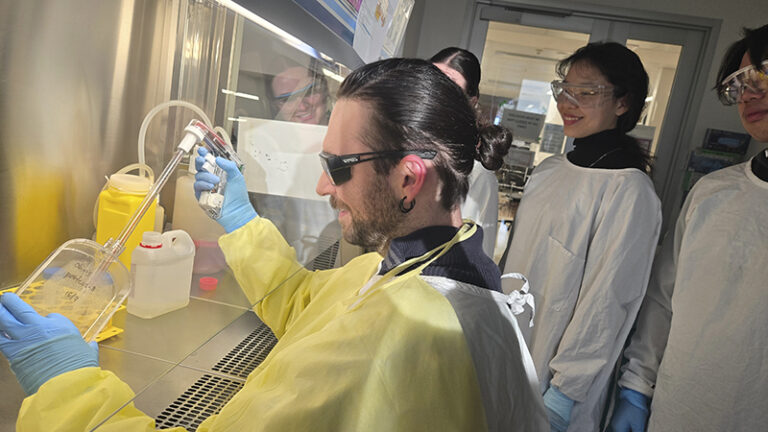
Australian researchers accelerate molecular evolution from years to weeks inside mammalian cells
Technology can be harnessed to design novel and enhanced molecules that address challenges in biotechnology and medicine. Australian researchers at the Charles Perkins Centre, University of Sydney, have created a groundbreaking system that uses what they describe as “biological artificial intelligence” to develop and refine molecules with enhanced or entirely new functions inside mammalian cells. This innovation offers scientists a powerful new way to create more precise research tools and targeted gene therapies.
The system, called PROTEUS (PROTein Evolution Using Selection), builds on a method known as directed evolution, a laboratory process that simulates how natural evolution works. Unlike natural evolution, which can take years or longer, PROTEUS dramatically accelerates this process, enabling the development of novel molecules in just a matter of weeks. This breakthrough represents a significant leap forward from traditional directed evolution methods, which primarily operate in bacterial cells. In contrast, PROTEUS evolves molecules directly in mammalian cells. The findings were published on 7 May 2025 in Nature Communications, marking a major milestone in the field of molecular engineering.
This advancement holds promising potential for improving medical treatments across multiple applications. PROTEUS could be used to enhance the performance of gene editing technologies such as CRISPR, potentially increasing their precision and effectiveness in therapeutic settings. The system could generate new molecules highly tuned to function in the human body, potentially enabling the creation of medicines that would be otherwise difficult or impossible to make with current technologies. By functioning like an artificial intelligence platform that can be given complex biological problems with uncertain solutions, PROTEUS explores millions of possible molecular sequences to find highly adapted answers in a fraction of the time it would take human researchers.
Recently, we had the privilege to interview Dr. Christopher Denes, the lead researcher behind this revolutionary system. The details of our conversation are outlined below.
From Evolution to Engineering
Directed evolution has already transformed biochemistry. How does PROTEUS redefine the boundaries of what is possible now that proteins can evolve inside mammalian cells rather than bacteria?
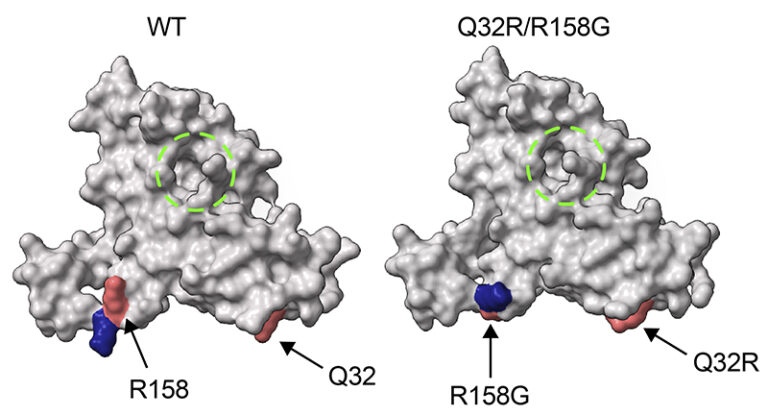
PROTEUS is a new technology that expands the current toolkit of methods for directed evolution in mammalian cells. There are multiple ways we can introduce genetic diversity outside of a cell before testing functionality within mammalian systems. These are discontinuous systems, where the three core steps of directed evolution—diversification, selection, and amplification—are performed separately. Techniques where all steps occur within the same cell are considered continuous, and PROTEUS falls into this category. It takes advantage of the natural biology of viruses, using their inherent efficiency in copying themselves, even under imposed selection pressure.
The strength of PROTEUS lies in its ability to evolve any part of a protein of interest. We are not restricted to specific regions and can instead introduce genetic diversity along the full length of the protein. This allows for the discovery of combinations of mutations that achieve improved function and may never have been found through other approaches. Context also matters—proteins evolved in bacteria or yeast often underperform when tested in other environments. As many enzymes and tools such as CRISPR are now used in human cells for research and therapy, having proteins optimised for the intended cellular environment is increasingly essential.
Biological AI versus Traditional AI
You describe PROTEUS as a form of “biological artificial intelligence.” How do you envision this reshaping our understanding of intelligence, especially in the context of solving complex, embodied biological problems?
PROTEUS is built from synthetic components that form virus-like vesicles. These are not natural viruses, but they carry genetic instructions that make them function in a similar way. The system acts as a biological machine that performs trial-and-error testing inside the cell. We provide selection pressure in the form of a puzzle, and through repeated rounds of evolution, mutant proteins attempt to solve that puzzle. Successful variants multiply, and the process begins again. There can be any number of ways to overcome a challenge, and the system tests many of them in parallel. Because these virus-like machines replicate much faster than mammalian cells, we can observe evolutionary outcomes on an accelerated timescale.
Nature versus Design
By enabling the design of molecules that do not exist in nature, does PROTEUS blur the boundary between what is considered natural and what is engineered? How do you think this will shape future conversations around synthetic biology and bioethics?
Directed evolution has been used for decades, mostly for research purposes. Now, there is growing value in improving proteins for therapeutic use. Everything generated with PROTEUS is engineered, but that is not inherently problematic. Laboratories must still comply with regulations for working with genetically modified organisms and viruses. Medicines developed using this approach are subject to the same rigorous testing and approval processes as any other.
Just as the use of artificial intelligence in other domains requires transparency, engineered proteins should be identified and acknowledged as such. These research tools can significantly expand the range of scientific questions we are able to ask and answer. Their contributions to basic and applied science is substantial.
From Weeks to Minutes?
You have shown that PROTEUS can achieve in weeks what previously took researchers years. As the system evolves, do you foresee it delivering results in days or even in real time?
The virus-like vesicles used in PROTEUS do not evolve themselves, and their natural mutation rate is fixed. However, we are developing strategies to introduce gene sequence diversity more rapidly and on a broader scale. By running larger campaigns that test more variants in parallel, we may be able to observe improved proteins much sooner. A single beneficial mutation can sometimes cause dramatic functional changes, so rapid improvement is certainly possible if such a mutation arises early in the process.
Avoiding the Shortcut Trap
You mentioned one challenge was preventing the system from “cheating.” What does this reveal about the behaviour of evolutionary systems and the kinds of creativity or efficiency we should and should not expect?
Virus genomes are streamlined for survival. They will discard any genetic material that is not essential. Within the context of PROTEUS, a gene introduced into the viral genome will be lost unless selective pressure keeps it in place. Therefore, it is crucial to design puzzles that can only be solved if the virus retains that gene.
These systems can find remarkably creative solutions, often in ways we do not anticipate. Sometimes, combinations of mutations achieve greater improvements than any individual change. This kind of synergy is nearly impossible to predict, highlighting the advantage of biological evolution over algorithmic approaches. These platforms are not perfect, but as the tools mature, they will become increasingly efficient.
Open Source Breakthroughs
By making PROTEUS open source, you are inviting the broader research community to build upon your work. What kinds of unexpected or radical applications would you hope—or fear—to see emerge?
As an early-career researcher, I am excited to see something I helped build adopted across the scientific community. Unexpected applications would be welcome. For example, proteins engineered for zero-gravity conditions in space, where mutations provide advantages in microgravity, could be fascinating. More practically, proteins with agricultural applications that support food production in a changing climate would also be incredibly valuable.
Cellular Evolution at Scale
What are the implications of giving mammalian cells the ability to evolve internally on demand? Could this ever extend to in vivo applications, where evolution occurs directly within a patient’s body?
That is where bioethics will be most important. It is unlikely we would ever perform evolution directly inside a person. However, in personalised medicine, we might take a biopsy or a sample of patient cells and test PROTEUS-evolved proteins in them ex vivo. In this way we might see which evolved variants are most effective for that individual. First, though, we aim to transition PROTEUS from the hamster cells we currently perform experiments in to human cell lines, essentially humanizing the technology.
Machine Learning Meets Molecular Biology
Do you envision PROTEUS being integrated more directly with classical artificial intelligence or machine learning, combining digital and biological evolution to co-design molecules?
Absolutely. The two approaches can complement each other. Data from biological evolution experiments can help train machine learning models. Conversely, machine learning predictions can guide which proteins to test biologically. With PROTEUS, we could take algorithmically predicted proteins and evolve further improvements, combining the best of both methods.
The Future of Drug Discovery
Given PROTEUS’s ability to explore molecular possibilities far beyond human intuition, what role will human researchers play in drug discovery ten or twenty years from now? Will they become more like curators than designers?
Artificial intelligence and machine learning systems, along with tools like PROTEUS, will become essential components of the research process. They will very likely replace slower, less efficient methods, and in some cases already are! However, the creativity and insight of human researchers will remain central to formulating hypotheses, designing experiments, and interpreting data. These new tools simply broaden the range of possibilities we can explore.
Conclusion
PROTEUS represents a transformative step in molecular engineering, bringing the principles of directed evolution into the very cells where therapeutic proteins are needed most. By functioning as a form of biological artificial intelligence, this system offers unprecedented speed, adaptability, and precision in the development of novel molecular solutions.
Its implications stretch far beyond the laboratory. From improving gene editing technologies like CRISPR to enabling personalised medicine, PROTEUS opens new possibilities that were previously out of reach. The open source nature of the platform ensures broad accessibility, allowing researchers around the world to build on its foundation.
As we continue to navigate the intersection of biological and digital intelligence, PROTEUS exemplifies how nature’s own problem-solving processes can be engineered and accelerated by human creativity. While ethical considerations around synthetic biology remain important, the potential to revolutionise drug development and therapeutic innovation offers a compelling vision for the future of medicine.
We are entering an era where biology itself becomes an intelligent system—one that can evolve, adapt, and respond with unprecedented precision. With PROTEUS, the pace of molecular design is no longer bound by the limits of evolution, but guided by ingenuity and accelerated by the very forces that shaped life itself.
Cover image: Conceptual visualization of mRNA structure by artist Nick Hoskin.