

Australian researchers test new protective fabrics against great white and tiger sharks, finding significant reduction in life threatening damage
Shark attacks are rare, but when they do occur, the impact on victims and coastal communities is extremely severe. As more people live near the coast and participate in marine activities like surfing and diving, the frequency of human-shark encounters is rising. In order to significantly reduce life-threatening injuries in these encounters, scientists are gradually shifting from lethal control measures toward innovative technologies that can protect humans without harming sharks. A new generation of bite-resistant wetsuits might become a practical and non-lethal solution.
Researchers at Flinders University’s Southern Shark Ecology Group, led by Professor Charlie Huveneers, have tested four specialized wetsuit materials against two species that account for most fatal shark attacks, the great white and the tiger shark. With support from the New South Wales Department of Primary Industries and Regional Development Shark Management Program, the team found that these advanced fabrics can reduce blood loss, tissue damage, and the risk of limb loss compared to traditional neoprene.

From Chainmail to Modern Fibers
Earlier protective suits used chainmail. They were effective in preventing bites but heavy, stiff, and impractical for recreational use. The new materials incorporate ultra high molecular weight polyethylene, a fiber also found in sailing ropes under brand names such as Dyneema or Spectra. It is lightweight, strong, and can be integrated into neoprene. This creates suits that look and feel like conventional wetsuits but offer additional protection.
Manufacturers strategically place bite resistant panels over vulnerable areas with major blood vessels while leaving joints such as shoulders and knees flexible. This design reduces risk while allowing mobility. The reinforced areas are less flexible than premium neoprene, yet the suits remain far more practical than chainmail.
A Scientist Drawn to Sharks
For Professor Huveneers, the work is part of a lifelong passion. As a child he used a shark book to do a school talk about sharks. He recalls that half the book was filled with “we do not know this, we do not know that.” The gaps in knowledge fascinated him. That early spark became a career devoted to shark ecology. Today he is a leading researcher of great whites, tiger sharks, and many of the more than 500 species of sharks and 1,200 species of cartilaginous fish.
While the large predatory species often attract the most attention, Huveneers reminds the public that many lesser-known species, such as Port Jackson sharks and deep-water sharks, face significant conservation challenges. His research strives to balance human safety with shark protection, avoiding lethal measures whenever possible.
Testing Under Extreme Conditions
The Flinders team tested four specialized fabrics, Aqua Armour, Shark Stop, ActionTX S, and Brewster material, against large great white and tiger sharks. These predators can exceed three meters in length and are capable of delivering catastrophic bites. Smaller reef sharks would not have revealed the limits of the materials.
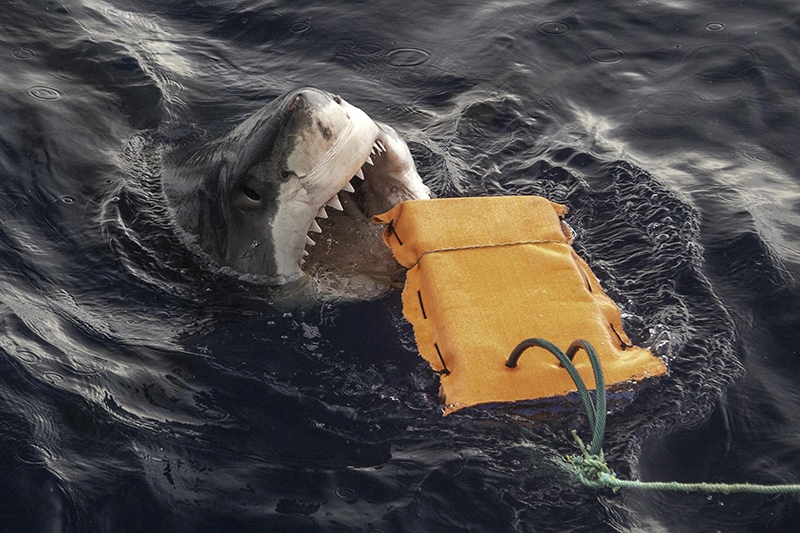
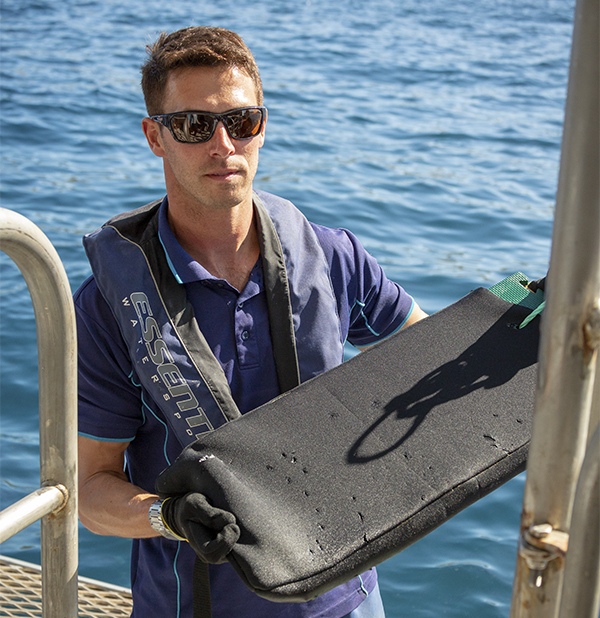
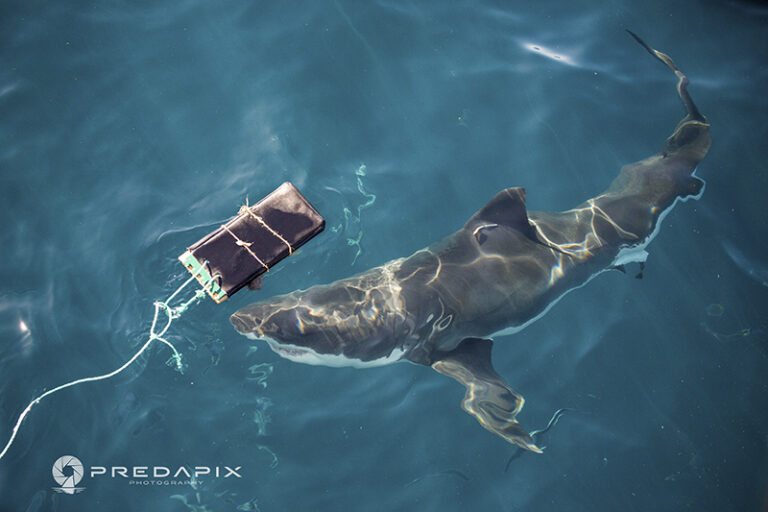
To simulate a human bite scenario, the researchers built pouches made of neoprene or bite resistant fabrics and filled them with foam that mimicked human tissue. A small piece of fish was attached to encourage sharks to bite. Without bait, sharks rarely engage with artificial materials, making it difficult to collect enough data for comparison.
Bite damage was categorized into four levels, superficial, moderate, substantial, and critical. With standard neoprene, bites frequently caused major tears and total destruction of the foam. By contrast, the bite resistant materials prevented critical and substantial damage. Punctures and cuts still occurred, but the foam remained intact. In a real attack, this difference could determine whether a victim suffers catastrophic bleeding or manageable injuries.
Reducing Blood Loss and Saving Lives
The main benefit of these wetsuits is their ability to limit severe lacerations. Medical doctors who treat shark bite victims confirm that the primary cause of death is blood loss rather than crushing injuries. Professor Huveneers explains that with standard neoprene, a bite might require 200 stitches. With the new fabrics, the same bite might require only 20. That difference buys precious time for emergency responders.
The results were striking. In many cases the foam was nearly fully protected, while normal neoprene was torn apart. The protective suits cannot stop crushing injuries, but by reducing severe bleeding or tissue loss, they extend the survival window and increase the chance of recovery.
Long-term durability remains uncertain. The protective properties of the fabrics under repeated stretching, exposure to saltwater, and constant sunlight have not been studied in depth. Manufacturers are now investigating these factors, along with how to improve flexibility without losing protection.
Beyond Protection: Testing Shark Deterrents
Bite resistant wetsuits are only one piece of a larger toolbox. Huveneers’ group has also tested shark deterrents, focusing on three types, magnetic, olfactory, and electric. The clear winner is electric deterrents. They create a small electrical field that interferes with the shark’s sensory system.
Huveneers’ team recorded dramatic footage of sharks launching full speed attacks, only to turn away at the last moment when encountering the electric field. These devices reduced bite risk by about 60 percent even when sharks were in predatory mode. Magnetic and olfactory devices showed far less promise. Electric deterrents are currently considered the most effective option for active deterrence.
A Toolbox for Safety
Professor Huveneers views bite resistant wetsuits as one part of a three-step hierarchy. The first step is reducing encounters by separating people and sharks, through barriers or early warning systems. The second step is deterring bites, with electric deterrents being the best option so far. The third step is reducing injury severity when bites occur, which is where protective suits come in.
“No single measure is foolproof,” Huveneers emphasizes, “but when you combine them you can significantly increase safety.”
Understanding Risk and Exposure
Risk depends on location and frequency. For an occasional beach visitor in a low-risk area, the chance of encountering a shark is already very small. For a surfer or diver in a known shark area, exposure adds up over time. Huveneers explains that even if the probability of a bite is low, repeated exposure increases the overall risk. People who surf every morning are much more likely to eventually encounter a shark than those who enter the water once or twice a year.
This framework applies equally to recreational and occupational users. Lifeguards, researchers, and commercial divers often spend long hours in the water. For them, multiple mitigation measures are worth serious consideration.
The Need for Standards
A key challenge is the lack of independent standards. Many products are marketed as shark safe without rigorous testing. Huveneers argues that this puts lives at risk. He calls for government enforced certifications so consumers can trust that protective devices deliver on their promises. His team’s study, with independent testing of Aqua Armour, Shark Stop, ActionTX S, and Brewster material, provides a model for how products should be evaluated.
Looking Forward
Manufacturers are continuing to refine the fabrics, aiming to balance flexibility with strength. Climate change adds urgency. As oceans warm, temperate waters are becoming home to tropical species. This is already evident in regions like New England. Shifts in shark distribution increase the importance of non lethal strategies that can adapt to new ecological realities.
A Step Toward Safer Oceans
Bite resistant wetsuits cannot eliminate the danger of shark attacks, but they represent an important advance. Combined with deterrents and better risk management, they give ocean users practical ways to reduce injuries and increase survival.
For Professor Huveneers, the work is about coexistence. Humans and sharks share the oceans, and lethal methods undermine both safety and conservation. By developing protective gear and deterrents, researchers are building a future where people can enjoy the sea more safely while sharks remain vital members of marine ecosystems.