
From reclaimed wasteland to living ecosystem, Future Life Village transforms temporary exhibition space into an experimental model for harmonious coexistence.
On Yumeshima, an artificial island born from decades of landfill in Osaka Bay, an unlikely transformation has unfolded. What began as industrial waste deposited into the sea gradually became something unexpected: a thriving wetland ecosystem where diverse species found refuge. Now, as Expo 2025 Osaka takes shape on this reclaimed land, one pavilion asks a provocative question: can architecture honor rather than erase the ecological memory of disturbed ground?
Future Life Village, an official pavilion organized under the Expo’s theme of “Co-Creation and Dialogue,” approaches temporary exhibition design not as placeless spectacle but as environmental restoration in architectural form. The project integrates three exhibition programs—rotating corporate displays, participatory projects, and global best practices—alongside public facilities, into a single complex that functions less like a building and more like a living village.
Ecological Memory as Design Foundation
The design team confronted a fundamental challenge: how to create meaningful architecture on land with no indigenous tradition, where the ground itself is manufactured from refuse. Rather than imposing arbitrary form, they looked to what Yumeshima had become through time and natural colonization. The island’s evolution from sterile landfill to biodiverse wetland suggested a design language rooted in cycles, dispersal, and adaptive growth.
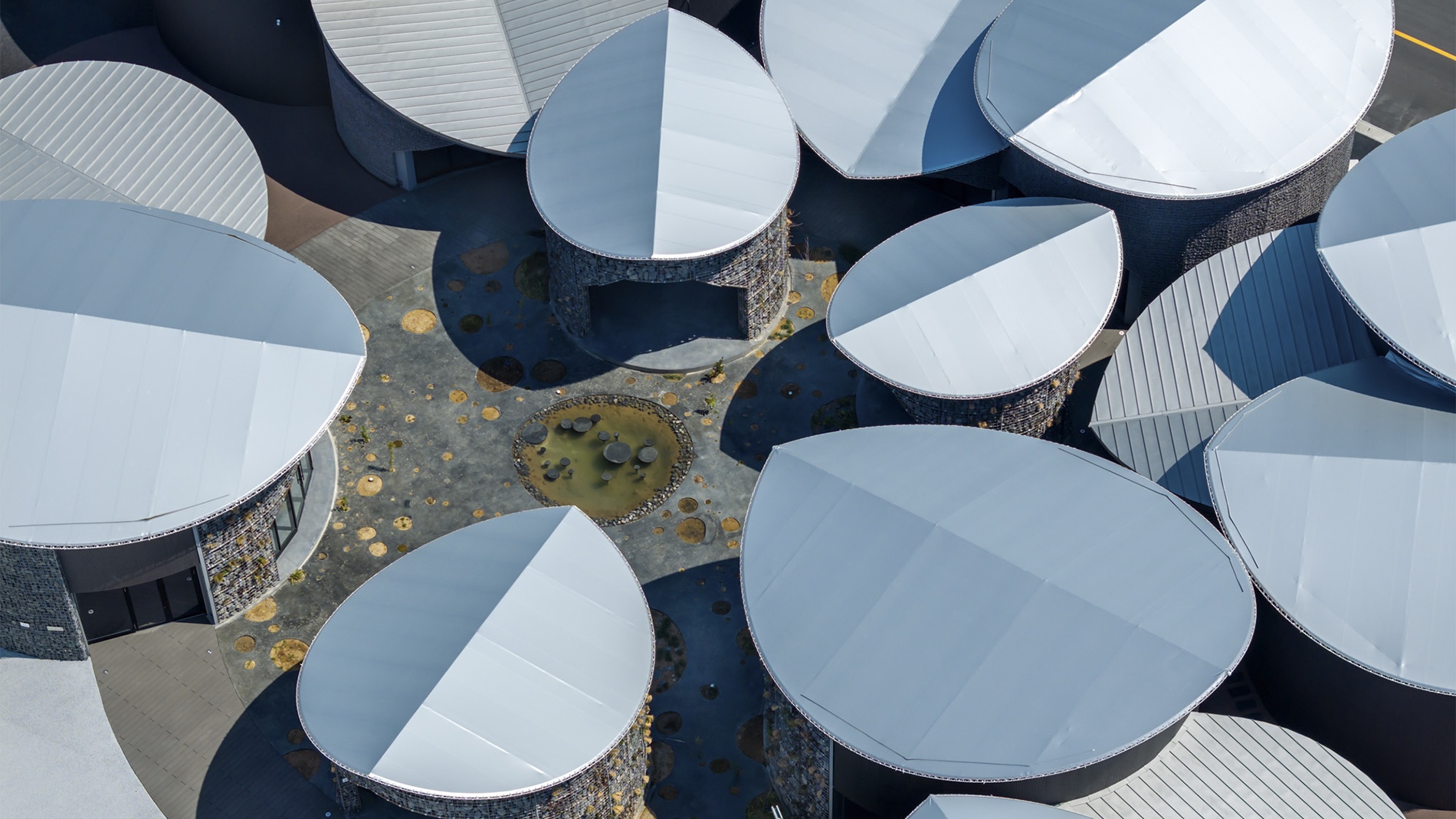
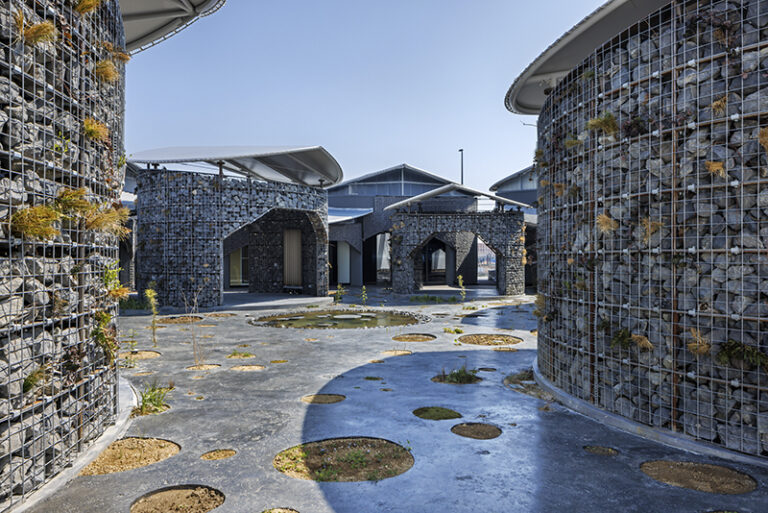
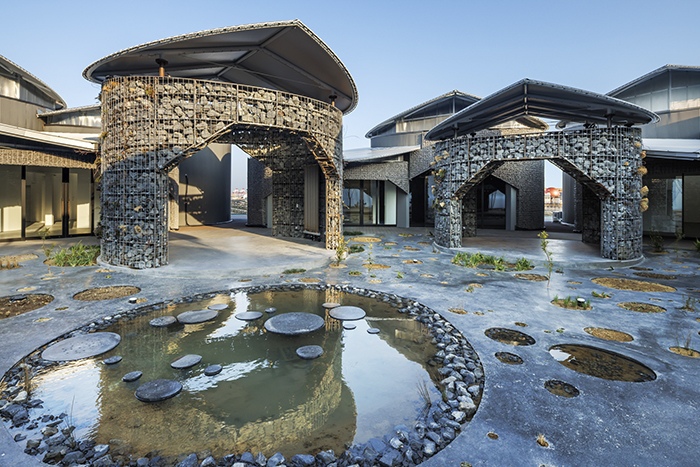
A central courtyard anchors the composition, functioning as living green infrastructure that symbolizes life’s regenerative capacity. Scattered planting beds and ponds highlight individual species rather than homogenized landscaping, creating what the designers call “unity in diversity.” This phrase extends beyond environmental metaphor to describe the pavilion’s social ambition: a space where multiple voices, activities, and perspectives coexist without hierarchy.
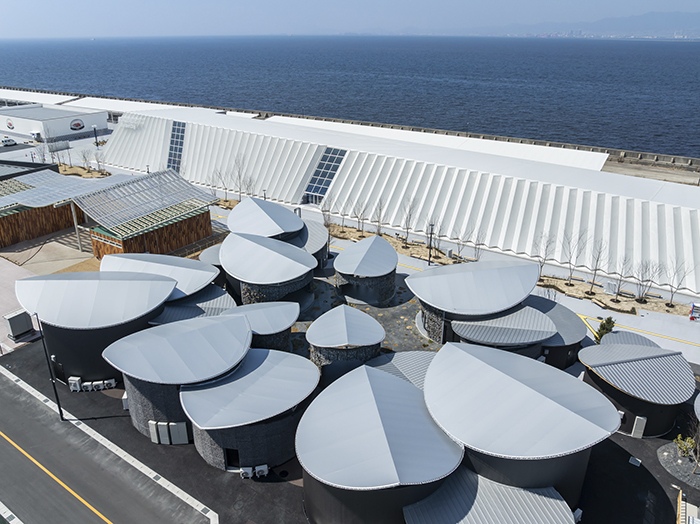
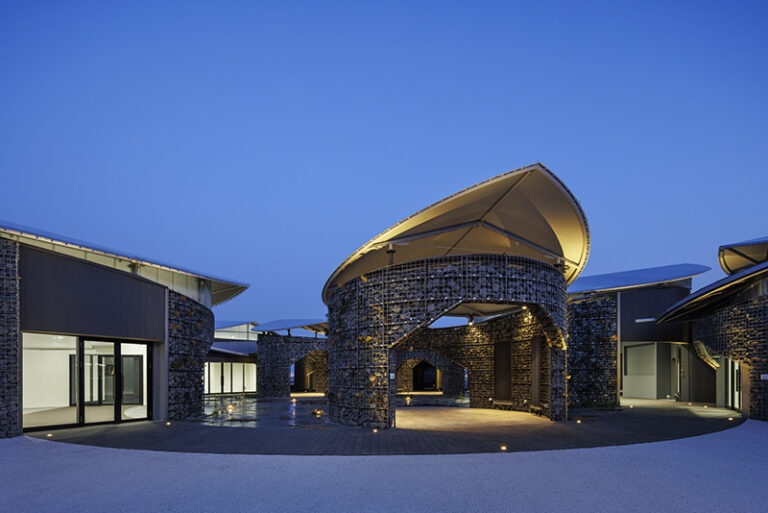
Around this living center, circular exhibition units of varying sizes are distributed like organic growth. A ring-shaped circulation path connects these independent volumes while maintaining their autonomy. This configuration allows diverse activities to proceed simultaneously without interference, while the void of the pathway facilitates natural movement of people, light, and air.
Gabion Walls as Living Structure
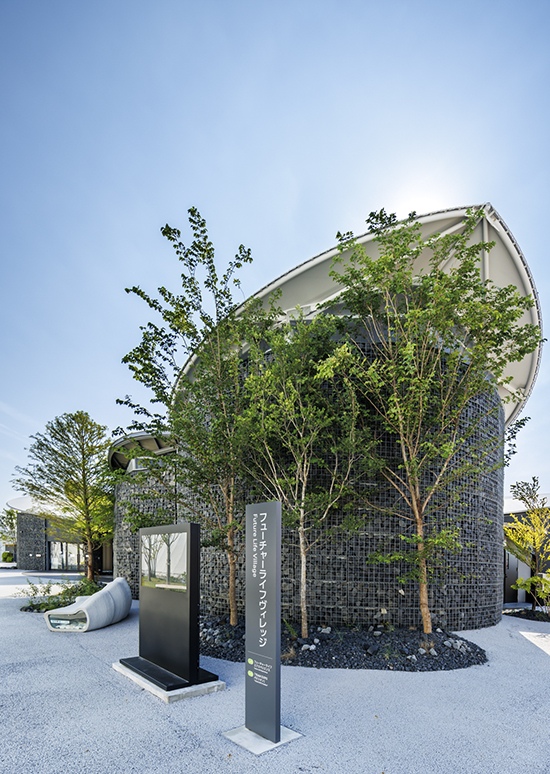
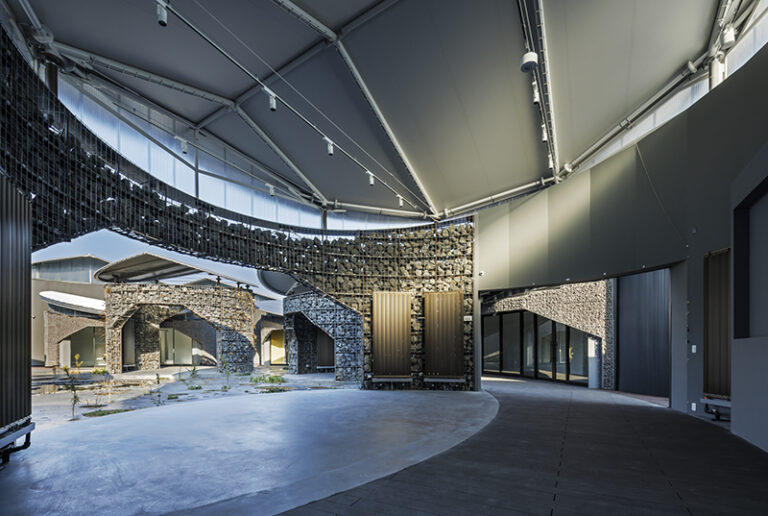
The most striking technical innovation appears in the gabion walls that define exhibition units facing the courtyard. Traditional gabion construction—typically limited to retaining walls and erosion control—here becomes architectural enclosure through a structural system combining steel rebar trusses with welded mesh. This engineered approach creates semi outdoor spaces that merge with the landscape while providing the stability required for public occupation.
The gabion system offers multiple environmental and practical advantages. The permeable walls promote natural ventilation and allow plant growth directly through the structure, blurring boundaries between building and landscape. In summer, water sprinkled over these walls enhances passive cooling through evaporation. The modular nature of gabion construction enables complete disassembly and relocation; infill materials can be removed, repacked, and reused elsewhere when the Expo concludes.
Material selection for the gabion infill reflects site-specific thinking. Rather than conventional stone, the project employs experimental recycled materials, including vitrified slag from incinerated industrial waste and synthetic pumice manufactured from recycled glass. These choices acknowledge Yumeshima’s origin as a repository for urban waste while demonstrating how industrial byproducts can become functional building materials.
Forest Canopy as Organizational Logic
Above the circular units, roofs overlap like tree canopies in a forest, varying in height and geometry to create spatial hierarchy. Roofs gradually rise outward from the courtyard, balancing the intimate scale of the central space with the volumetric requirements of exhibition areas. Three roof forms—gable, inverted gable, and shed—work in combination to direct natural light into all exhibition spaces while channeling rainwater back toward the courtyard.
This rainwater management strategy extends beyond drainage to become an integrated environmental system. Collected precipitation and irrigation runoff from planted walls flow to a central pond, where stored water feeds a heat-exchange system for radiant cooling panels. The result is a closed-loop water cycle that simultaneously manages stormwater, irrigates vegetation, and provides passive cooling for semi outdoor spaces.
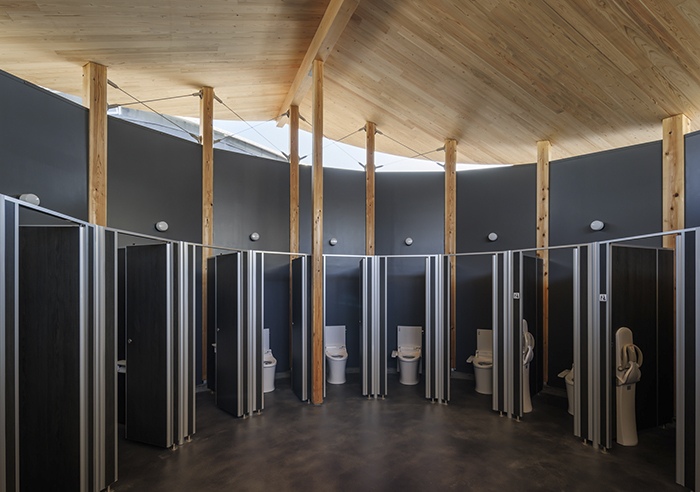
The adjacent public toilet facility demonstrates these principles at reduced scale through timber construction. Cross-laminated timber roofing and timber framing add warmth while offering a spatial experience distinct from the main exhibition area. The circular layout of cubicles supports efficient circulation and enhanced usability, showing that even utilitarian functions can participate in the broader design vision.
Beyond Temporary Architecture
Expo pavilions often embrace ephemerality as design permission. Freed from requirements of durability or permanence, temporary structures can chase spectacle disconnected from context or consequence. Future Life Village resists this convention, proposing instead that temporary construction bears responsibility to place and ecological continuity.
The design integrates architecture, structure, environmental systems, and landscape into what the team describes as an experimental model for sustainable space making. This holism extends to material flows; the gabion system’s capacity for disassembly and reuse suggests afterlife possibilities beyond typical demolition and disposal. Whether the structure actually relocates after Expo 2025 remains uncertain, but the technical capability exists.
More fundamentally, the project argues for temporary architecture that engages rather than exploits its site. By acknowledging Yumeshima’s ecological history and current biodiversity, Future Life Village treats reclaimed land not as blank canvas but as landscape with memory and ongoing natural processes. The courtyard’s scattered plantings and ponds do not merely represent nature; they actively support species colonization and habitat creation during the pavilion’s operational life.
Challenges and Questions
Several aspects of the project warrant scrutiny. The emphasis on passive cooling strategies through gabion walls, water evaporation, and natural ventilation may prove insufficient during Osaka’s humid summer, potentially requiring supplemental mechanical cooling that undermines stated sustainability goals. The comfort and usability of semi outdoor exhibition spaces in extreme weather remain to be demonstrated.
The experimental recycled materials in the gabion infill, while conceptually appealing, raise questions about long-term performance, maintenance requirements, and actual recyclability after expo use. Whether these materials can genuinely enter circular-economy flows or will ultimately require disposal depends on post-event logistics that often receive insufficient planning.
The village metaphor, while evocative, may overstate the project’s social function. Exhibition programming and visitor flow will ultimately determine whether the space truly supports diverse, simultaneous activities or channels people through prescribed sequences. Architecture can enable community gathering but cannot guarantee community formation.
A Model or an Exception
Future Life Village represents a sophisticated attempt to reconcile temporary exhibition architecture with environmental responsibility and contextual awareness. Whether it succeeds depends partly on performance metrics that will not be available until after Expo 2025, and partly on whether its strategies influence subsequent projects.
The real test lies beyond technical performance. Can this approach to temporary construction—one that honors ecological memory, prioritizes material reuse, and integrates passive environmental systems—become a viable model for event architecture in general, or will it remain an exception enabled by unusual site conditions and the visibility of an expo?
As Expo 2025 opens on Yumeshima’s reclaimed ground, Future Life Village asks visitors to see more than exhibitions and displays. It invites recognition of the island’s transformation from waste repository to wetland ecosystem, and proposes that architecture might participate in rather than arrest that ongoing evolution. Whether temporary or permanent, buildings occupy living landscapes. The question is whether we design them to acknowledge that fact.