Through striking imagery and patient observation, Hardik Shelat captures a species rewriting its biological rules to endure a warming world.
In the brutal heat of a summer in Gujarat, where temperatures climb beyond 45 degrees Celsius and the landscape falls into silence beneath a burning sun, something unexpected occurred. In the midst of this intensity, photographer Hardik Shelat captured a moment that challenged centuries of biological behavior. The Indian flying fox, one of the largest bat species in the world, took to the skies not at dusk, but in the full glare of the afternoon sun.
What he witnessed was not just rare behavior. It was evidence of a species adapting in real time to an increasingly unpredictable climate.
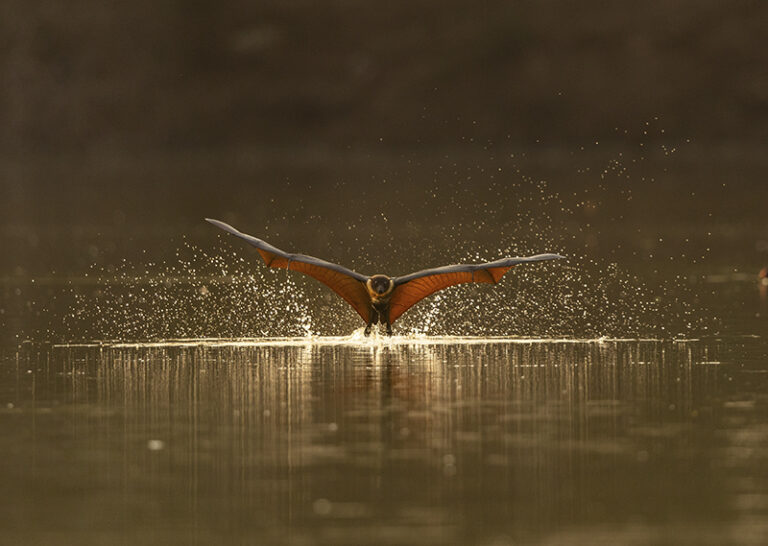
With precision and grace, the bat glides across the water, wings carving through misty gold. These midday dips—once thought to be rare—suggest a striking shift in the species’ daily rhythm as it adapts to rising temperatures., Image credit: Hardik Shelat
Masters of the Night Sky
The Indian flying fox, also known as the greater Indian fruit bat, is a creature of impressive size. With wingspans reaching over four feet, these bats are among the largest in the world. Native to the Indian subcontinent, they have evolved to live by night, emerging shortly after sunset to forage for fruit. Their nightly journeys can span up to 150 kilometers, often in search of mangoes, bananas, guavas, and nectar-rich flowers.
By day, they roost high in communal tree canopies, hanging motionless in large colonies. During hot weather they fan their wings to cool down, while in cloudy conditions they remain still and silent. The rhythm of their lives has long been considered predictable. Flight, feeding, and exploration all belong to the darkness.
That pattern is now beginning to shift.
Challenging the Old Rules
For Shelat, the idea that fruit bats might be active in daylight sparked deep curiosity. He had grown up with the belief that these animals lived only by night. When he heard that it was possible to see them moving in full sun, he knew he needed to investigate further. His search brought him to a remote lake approximately 100 kilometers from Ahmedabad. The setting, lined with trees and removed from human disturbance, provided an ideal location to observe natural behavior without interference.
Shelat and his team arrived in the extreme heat of the afternoon. As they waited, there was little sign of activity. “We waited for more than two hours with nothing to photograph,” he recalls. “It was so hot, we were sweating heavily and trying to stay hydrated.”
Then, just when the heat seemed unbearable, the bats began to move.
Against the glow of early morning light, an Indian flying fox skims the water’s surface, its outstretched wings casting a striking reflection. As India’s largest bat, it uses this rare behavior to cool off—defying the idea that bats are strictly nocturnal., Image credit: Hardik Shelat
Adaptation in Motion
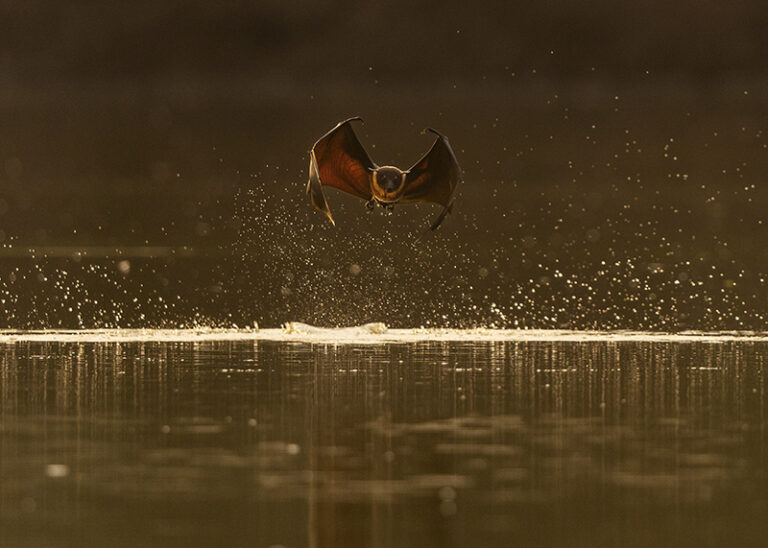
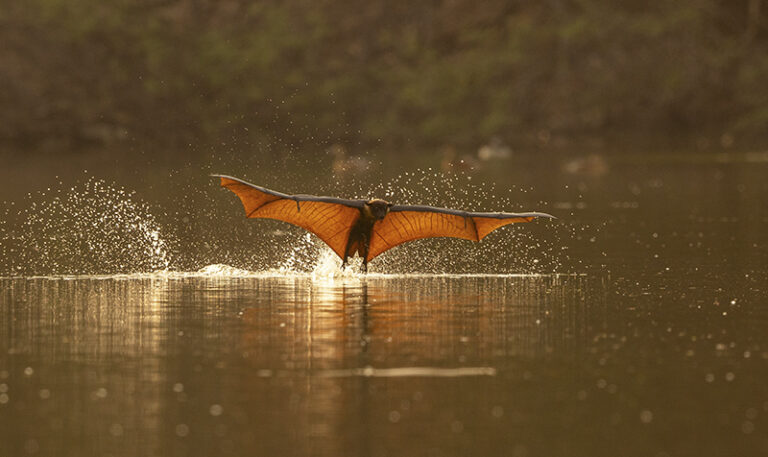
One by one, Indian flying foxes started to leave their roosts, not in the coolness of dusk but under the scorching afternoon sun. They swooped down toward the lake, splashing in the water and drinking repeatedly. This was not idle movement. It was purposeful and deliberate behavior aimed at cooling their bodies.
“They were splashing and drinking to cool themselves,” Shelat says. “This was not something they usually do.”
The behavior he observed was a form of thermoregulation, a survival strategy used to manage body temperature. It was also a remarkable display of behavioral change in response to environmental stress.
A rare sight: one of India’s giant fruit bats flies head-on toward the camera, framed by a shower of golden droplets. This bold behavior, captured mid-flight in daylight, signals how rising temperatures are pushing these nocturnal creatures to cool off by any means necessary—even in full view., Image credit: Hardik Shelat
Intelligence and Survival
Shelat believes this new pattern reflects not just instinct but intelligence. “Of course they are intelligent. That is why they are doing this,” he explains. “They are responding to the extreme heat by trying new behaviors.”
The fact that Indian flying foxes usually respond to cues like ambient temperature and sunset timing makes this change even more significant. To override deeply ingrained nocturnal habits suggests that these animals are capable of adjusting to changing conditions in ways that may prove essential for long-term survival.
Capturing the Unseen
Photographing this behavior was not easy. Using a Canon R5 Mark II and a 500mm lens, Shelat had to overcome the challenges of harsh midday lighting, fast motion, and the physical toll of working in extreme heat. The long lens allowed him to keep a respectful distance while capturing sharp, detailed images of the bats mid-flight and interacting with the water.
The resulting photographs are both artistic and scientific. They document a moment of real-time adaptation and reveal a side of this species that most people have never seen.
A single bat swooping down to the lake, its wingtip creating ripples in the water—captured mid-splash during an unexpected afternoon cooling ritual, Image credit: Hardik Shelat
A Glimpse of a Warming World
Shelat views this behavior as a direct response to global climate change. “Temperatures are rising more each year, and this is how the bats are adapting,” he says.
What he observed is not an isolated phenomenon. Across the world, animals are shifting their behaviors in response to changing environments. Birds are migrating at different times. Plants are flowering earlier. And now, India’s flying foxes are stepping out of the night in search of water and relief.
Vital but Misunderstood
Although often seen as pests by fruit farmers, Indian flying foxes play vital roles in the ecosystem. As pollinators and seed dispersers, they help maintain the health and regeneration of forests across large regions. Their ability to travel vast distances allows them to connect fragmented landscapes and support biodiversity.
Seeing them adapt to extreme heat provides hope that their important ecological roles can continue, even as environmental pressures grow more severe.
Endurance Behind the Image
Shelat’s experience is a reminder that wildlife photography requires more than technical skill. It demands commitment, endurance, and a deep connection to the natural world. “We were happy at the end when we could finally capture those amazing moments,” he says. “People interested in nature and wildlife must have a lot of patience to witness these rare behaviors.”
The Future Takes Flight
At its core, this story is about resilience. The decision by Indian flying foxes to emerge in daylight in order to cool themselves is not simply a break from routine. It is a sign of life adjusting under pressure, an animal rewriting its own playbook to survive.
Shelat reflects on the experience with humility. “Nature will always surprise us,” he says. “Even the creatures we think we know well can show us something new.”
In a time when many stories about wildlife are framed by loss, this one stands out as a glimpse of adaptation. It offers both a warning and a reason for hope.
Nature, when given the space and time, is still capable of writing new stories—stories of survival, transformation, and unexpected resilience.