

Cold Made From Heat
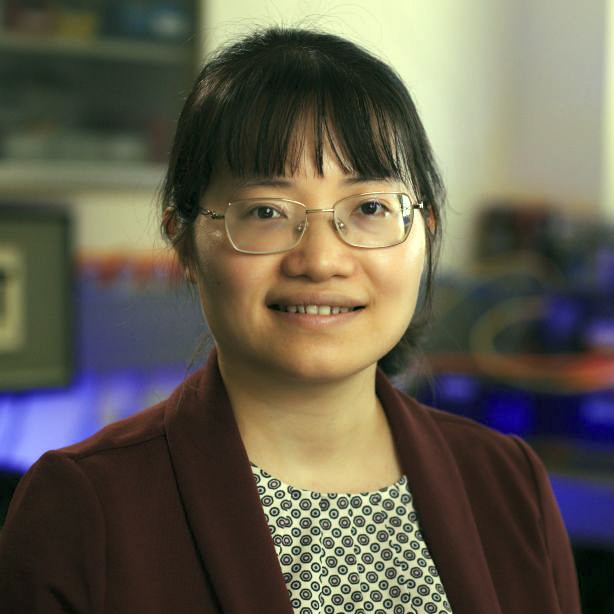
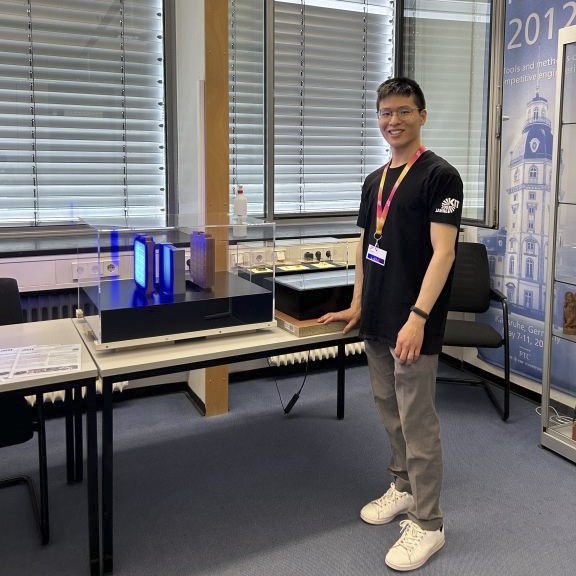
Jingyuan Xu and Yi-Ting Hsiau on a metal that moves when warmed, cools when released, and a refrigerator whose engine is a strip of the same metal
The Conversation
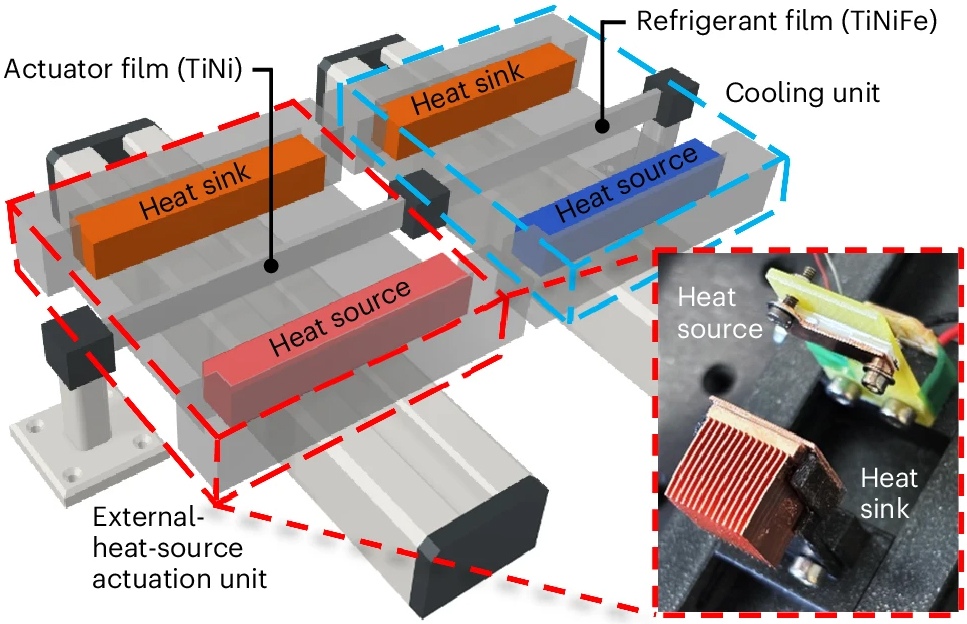
Jingyuan Xu The idea came from thinking about the reversibility of the thermodynamic cycle. Elastocaloric cooling uses mechanical work to drive a reversible phase transformation and produce cooling, and this made me wonder about the complementary process: could we use a temperature difference to drive the transformation and generate mechanical work, essentially creating a solid-state heat engine? That naturally led to the next question: if one cycle converts heat into mechanical work and another converts mechanical work into cooling, why not couple them directly? This became the conceptual origin of our system: one shape-memory film converts heat into motion, and that motion drives a second shape-memory film to produce cooling. So the idea was not simply to replace the electric actuator, but to connect two complementary thermodynamic cycles so that the output of one becomes the input of the other.
Jingyuan Xu Yes, I have always thought of these as two faces of the same underlying material physics. Both the shape-memory effect and the elastocaloric effect originate from reversible martensitic phase transformations in nickel-titanium alloys; what changes is how we drive and use the transformation. In one case, a temperature change can generate mechanical motion, while in the other, mechanical loading and unloading can generate a temperature change. This duality inspired us to bring the two functions together, with the two films tailored for their different roles and transformation temperatures. One acts as a thermal actuator and the other as a refrigerant. To me, the elegance of the system is that these are not separate phenomena artificially combined, but complementary ways of using the same underlying physics.
Jingyuan Xu It may sound paradoxical, but thermodynamically it is similar to other heat-driven refrigeration technologies. The key is that heat at a sufficiently high temperature has the potential to perform useful work because of the temperature difference between the heat source and the surroundings. In our system, heat first drives the phase transformation of the shape-memory actuator, converting part of that thermal energy into mechanical work. This mechanical work is then transferred directly to the elastocaloric film to drive the cooling cycle. So the cooling is certainly not free. The "cost" is paid by the heat supplied to the actuator and ultimately by the available temperature difference. What is unusual in our approach is that we make this conversion directly through two coupled solid-state materials, without first converting the heat into electricity or using an electrically driven motor.
Jingyuan Xu I initially thought of it as a cooling technology, but increasingly I see it also as a way of rethinking what we call waste heat. Enormous amounts of thermal energy from industry, transportation, electronics and even renewable sources such as solar heat are available but often underused because they are difficult to convert efficiently into something useful. Our approach asks whether some of this heat can instead become an energy source for cooling. Of course, not every source of waste heat is suitable, as the temperature and availability of the heat are important. But the broader idea is that heat does not necessarily have to be treated only as something to remove and discard. Under the right conditions, thermal energy that is normally considered a problem can become a resource for providing another useful function.
Jingyuan Xu Solid-state cooling offers the possibility of fundamentally rethinking how refrigeration systems are built. Instead of compressing and expanding gaseous refrigerants, we use reversible transformations within solid materials to generate cooling. This can avoid refrigerant gases and enable much more compact and potentially miniaturized devices, particularly with thin films, where conventional compressors are difficult to scale down. Solid-state materials can also respond very quickly and offer new ways to integrate cooling directly with the component that needs thermal management. However, strong material performance alone does not make a practical cooling system. We still need to improve heat transfer, system efficiency, cooling temperature span, durability, mechanical integration, manufacturing and scaling of cooling power. In my view, the major challenge now is to translate the excellent properties we can demonstrate at the material level into efficient, reliable and scalable cooling systems.
Yi-Ting Hsiau Watching the infrared camera and the monitoring system displaying the temperature change of the prototype was the defining moment. We had been braced for the possibility that the thermal actuator might not generate sufficient force to fully drive the phase transformation of the refrigerant film, or that the temperature change would be too small to be observed. Seeing the refrigerant film successfully unload and cool down to produce a measurable temperature span confirmed that combining the shape-memory effect and superelasticity of these alloys actually works in a coupled, heat-driven system.
Yi-Ting Hsiau Both numbers hold distinct value, but the gap primarily comes down to the operating frequency and heat transfer dynamics. The reduction happens because the lower operating frequency induces thermal loss during the periods when the heat exchangers are not in direct contact with the films. Additionally, the finite heat transfer rate between the refrigerant films and the heat exchangers limits how much of that cooling potential is successfully captured by the overall system. Ultimately, the material-level number demonstrates the intrinsic cooling capability of the alloy film, whereas the device-level result represents the practical system performance we are actively working to optimize.
Yi-Ting Hsiau The hardest part was reaching a fast enough operation speed for the entire system. If the loading and unloading speed is too slow, or the overall cycling frequency is too low, the generated heating and cooling effects are heavily diminished by parasitic heat loss. There was certainly a stage where it looked as though the concept might not work in practice. We struggled significantly during development because the time required for the actuator film to cool down was much longer than we initially expected. Luckily, we overcame this by thinning down the film and reducing its surface roughness. This critical adjustment resulted in much better dynamic behavior, allowing the system to operate fast enough to effectively overcome the heat loss and eventually produce measurable cooling.
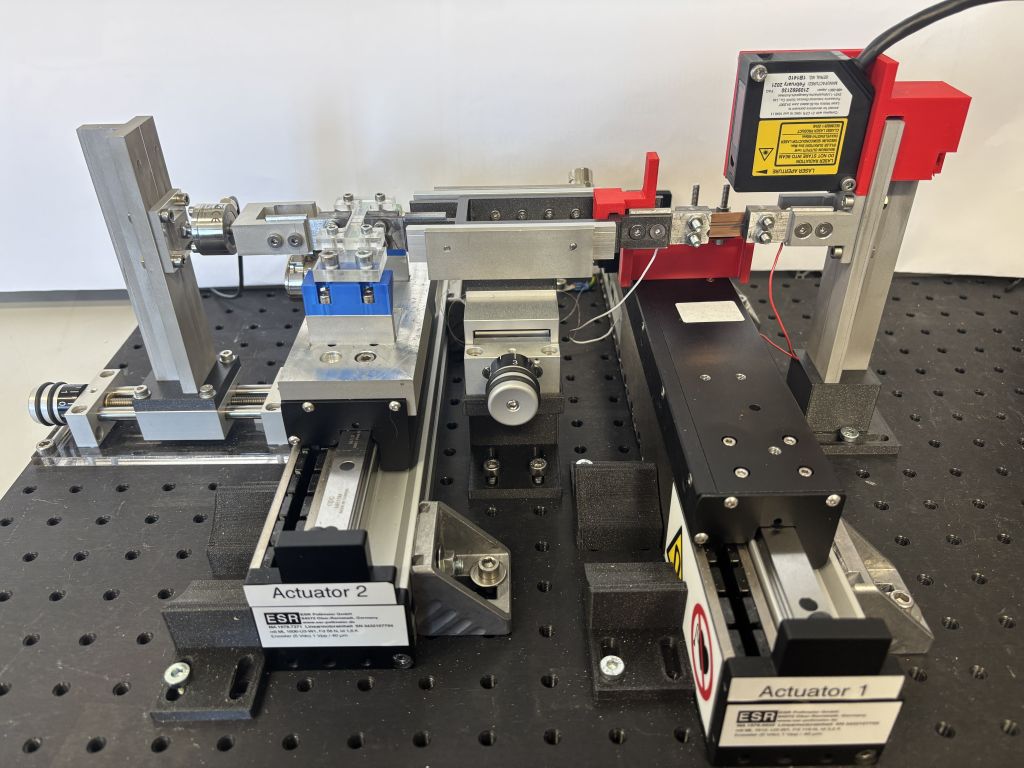
Yi-Ting Hsiau Currently, the 130°C requirement for the external heat source configuration does constrain its immediate application to higher-temperature waste heat sources, such as internal combustion engine exhaust, which easily exceeds this threshold. However, because high-power processors cannot operate at elevated temperatures approaching this range, harvesting computer waste heat requires optimizing the actuator's geometry and transformation temperature to a lower temperature range. Regardless of whether the source is a vehicle engine or household electronics, the design, specifically the film geometry, active mass, and overall size, will change according to the specific application. This customization is necessary to capture enough waste heat energy, deliver sufficient cooling capacity, and adapt the system's form factor for better compatibility and compactness in localized spaces.
Jingyuan Xu The collaboration brought together complementary expertise in shape-memory materials and thermal systems. At KIT, we focus on elastocaloric cooling and device development, while the University of Tsukuba brought strong expertise in shape-memory alloys and their thermomechanical behavior. Combining these perspectives was essential because the actuator, refrigerant and device need to be designed as one coupled system rather than optimized separately.
Jingyuan Xu A processor cooling itself entirely with its own heat would not be possible as a self-sustaining closed loop because of thermodynamic limitations. The cooling process still requires a temperature difference and ultimately needs to reject heat to an external sink. What interests us instead is using waste heat from an independent source, such as industrial processes, engines or solar thermal energy, to provide cooling where it is needed. The broader principle is therefore not that the problem can completely power its own solution, but that thermal energy normally discarded in one part of a system can become a useful resource somewhere else.
Jingyuan Xu Yes, definitely. We usually think of materials as passive, but shape-memory alloys can actively respond to changes in temperature and mechanical stress. Within the same class of materials, we can tailor their transformation temperatures and properties so that one can act as an actuator, generating motion from heat, while another can act as a refrigerant, generating a temperature change through mechanical loading and unloading. Working with these materials has changed the way I think about engineering: instead of only asking what device we can build from a material, we can also ask what functions the material itself can perform.
Jingyuan Xu Scaling is one of our main priorities now. A single thin film can provide a very fast response and high specific cooling power, but its absolute cooling capacity is limited by its small mass. Connecting multiple films in parallel allows us to increase the cooling power while retaining the advantages of thin films. The key challenges are uniform mechanical loading, efficient heat transfer, low losses and long-term reliability. Ultimately, we envision compact arrays or stacks of thin films integrated close to electronic components, providing localized, high-power-density thermal management for electronics.
Jingyuan Xu If this approach became widely used, I hope we would think of heat less as something to discard and more as an energy resource. Today, enormous amounts of thermal energy from industry, transportation and other processes are simply released into the environment, while we consume additional electricity to provide cooling. In the future, some of this heat could instead be recovered and used to drive cooling where it is needed. More broadly, I hope we can move toward thermal systems in which heat is recovered, reused and redirected more intelligently, rather than simply generated and discarded.
Conclusion
The most instructive moment in this conversation is a correction. Asked whether a processor cooling itself with its own heat represents some deeper principle, a problem supplying its own solution, Xu declines the image. It cannot work that way. Cooling needs a temperature difference and somewhere to put the heat, and a chip cannot be both the source and the sink. The principle she offers instead is smaller and truer: heat thrown away in one place can do work in another. The romance of the closed loop gives way to the plainer economics of moving energy from where it is a nuisance to where it is useful.
That habit of trimming the claim runs through the answers. The cooling is "certainly not free." Not every source of waste heat will do. Strong material performance "alone does not make a practical cooling system," and Hsiau's account of the gap between the refrigerant film's 13°C swing and the prototype's 4°C is a catalogue of everything that leaks: heat lost while exchangers are out of contact, heat that never crosses the boundary between film and sink. The device nearly failed because a film took too long to cool, and was rescued by making it thinner and smoother. This is the language of researchers carefully distinguishing a proof of concept from a practical cooling system. It is the language of people who know exactly how far a result reaches.
And yet the result does reach somewhere new. For a century, mainstream mechanical refrigeration has largely relied on compressors and gaseous refrigerants. The elastocaloric machines of the past decade removed the gaseous refrigerant but still required high-power, bulky mechanical actuators. This one removes the bulky motor for refrigerant loading as well, and does it by noticing that a single metal already contains both halves of a refrigerator: the part that pushes when warmed and the part that chills when released. Xu's remark that the two effects are not separate phenomena artificially combined but two faces of the same physics is the intellectual center of the paper, and her closing thought extends it past the device. We have been trained to ask what we can build from a material. She has started asking what the material can do on its own.
Whether thin films of nickel-titanium end up stacked beside the processors of the future, or remain a laboratory demonstration of an elegant idea, is a question the next years of engineering will settle. The question the paper has already settled is a smaller one about the word "waste." Heat is only wasted if there is nothing nearby that could use it. Here, the team shows a new solid-state route for doing so: directly coupling heat-driven actuation with elastocaloric cooling.
Explore Further
The rubber band, scaled up
The modern elastocaloric field dates from a 2012 demonstration that nickel-titanium wires, cycled between loaded and unloaded states, could produce large elastocaloric temperature changes, establishing an important milestone toward practical solid-state refrigeration.
Earlier research Cui et al., Demonstration of high efficiency elastocaloric cooling with large ΔT using NiTi wires , Applied Physics Letters 101, 073904 (2012)
Why the refrigerant matters
The hydrofluorocarbon gases in most refrigerators and air conditioners trap heat in the atmosphere hundreds to thousands of times more effectively than carbon dioxide. The Kigali Amendment to the Montreal Protocol commits nearly every country to phasing them down, and is one important reason solid-state alternatives are being studied.
Background United Nations Environment Programme, The Kigali Amendment to the Montreal Protocol on Substances that Deplete the Ozone Layer (2016)
The coming demand for cold
The International Energy Agency projects that energy used for space cooling will roughly triple by mid-century as incomes rise in hot countries, making cooling one of the fastest-growing sources of electricity demand in the world. The report is the clearest statement of the problem to which heat-driven cooling is one proposed answer.
Background International Energy Agency, The Future of Cooling: Opportunities for energy-efficient air conditioning (2018)
The study discussed in this article
Yi-Ting Hsiau, Shuichi Miyazaki, Manfred Kohl and Jingyuan Xu, Heat-driven elastocaloric cooling with shape memory films, Nature Energy (2026)
About the Scientists
Jingyuan Xu leads the ZEco Thermal Lab at the Institute of Microstructure Technology, Karlsruhe Institute of Technology, where her group works on elastocaloric cooling and thermal systems. Yi-Ting Hsiau is a doctoral researcher in the same institute and the first author of the study.