
In Aztec mythology, the corn deity Cintéotl, whose name means “ear of corn,” was the son of the gods of fertility and abundance. Rituals in his honor reinforced community bonds and the collective labor that made corn cultivation possible. For the civilizations of Mesoamerica, corn was not merely a crop. It was called tlaolli in Nahuatl, meaning “our sustenance,” and it held the culture’s spiritual, economic, and social fabric together across millennia.
Seven thousand years later, Mexico discards approximately 38 percent of its annual corn production. Nearly 30 percent of that waste, around 2.8 million tortillas every year, simply disappears. The wastewater of corn processing, a calcium-rich liquid called nejayote, is poured away without a second thought, despite containing antioxidants and phenolic compounds with documented anti-inflammatory and anticancer properties. The ancient material knowledge of Sak-Kaab, the Mayan lime tradition known as “White Earth,” has been quietly disappearing under the dominance of Portland cement for decades. Traditionally, this lime was burned at 900°C in open-air conditions, ground with calcium-rich shells, and allowed to mature through its natural cycle.
The story of CORNCRETL begins precisely at this intersection, between what has been discarded and what has been forgotten.
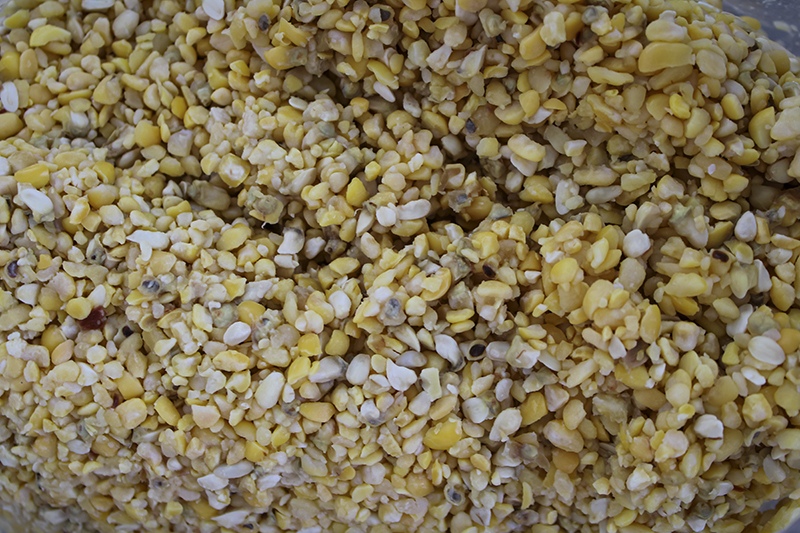
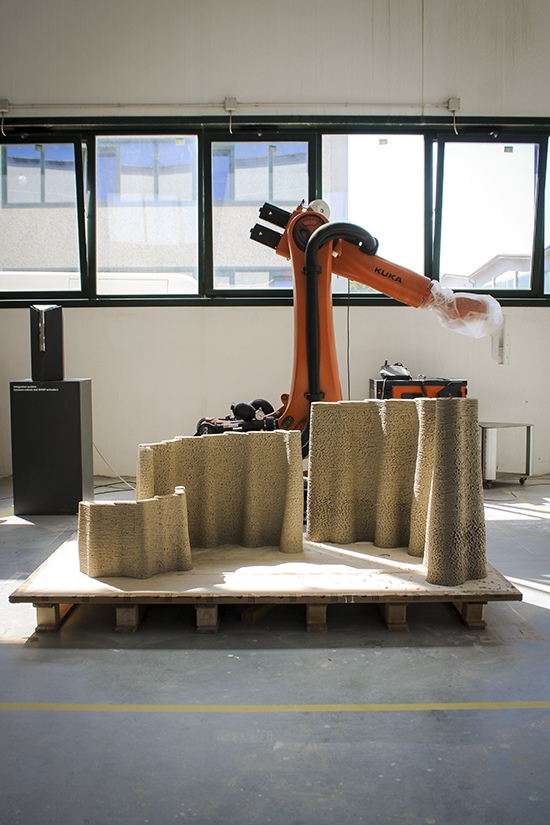
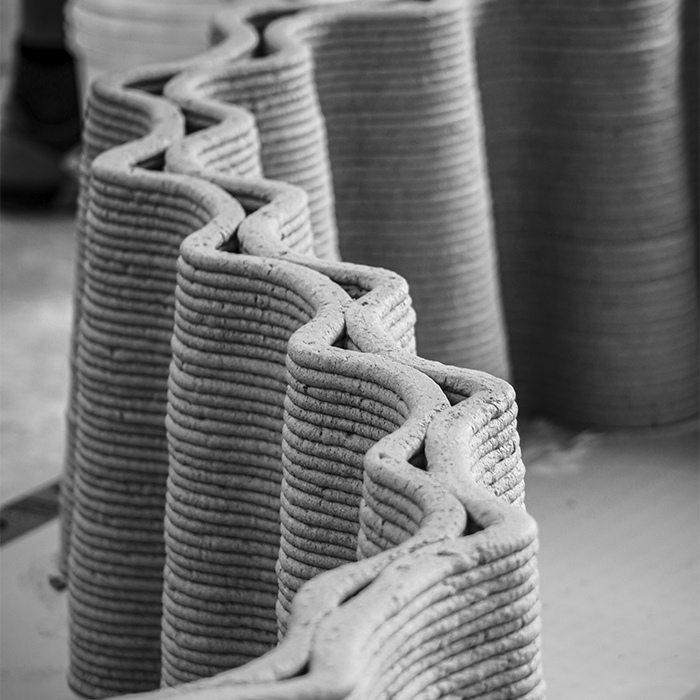
It also begins, more specifically, in a taquería in Berlin. A Mexican migrant chef who had moved to Europe seeking better opportunities, Jorge Armando of TACO KWEEN, was processing approximately 100 kilograms of corn per year in his kitchen. Instead of discarding the lime byproduct, he sent his food waste across an ocean. It arrived in Massa Lombarda, Italy, a small town near Bologna. There, it was blended with Carrara marble powder, river silica, and natural hydraulic lime, then printed by a KUKA robotic arm into modular architectural wall panels whose curved surfaces reference both Mesoamerican heritage and the terrazzo motifs of Rimini.
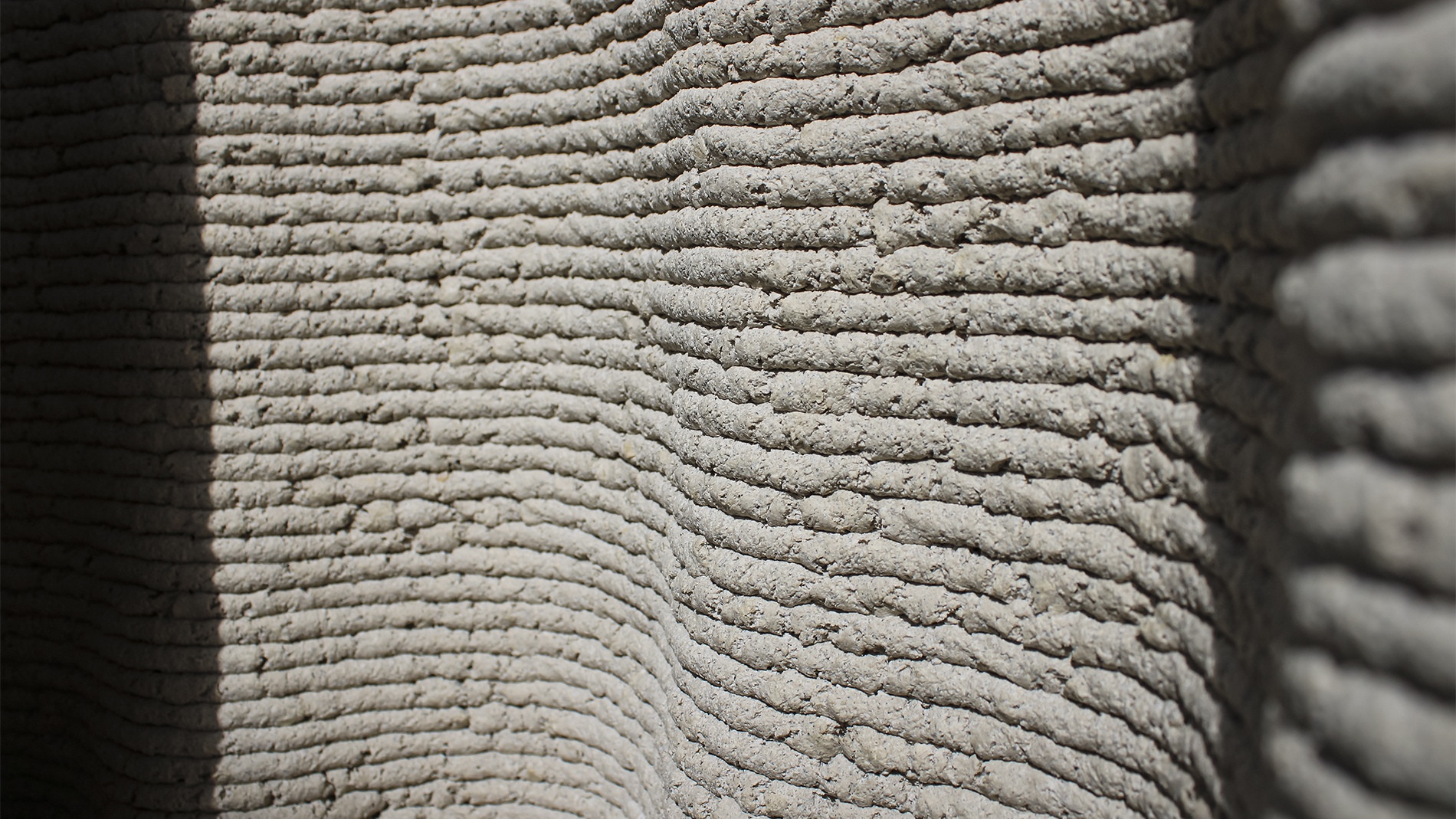
That wall panel is CORNCRETL, a bio-based construction material that achieves up to a 70 percent reduction in carbon emissions compared to conventional concrete. It eliminates the need for formwork through additive manufacturing and carries visible traces of corn grain in its finished surface. It is simultaneously an engineering proposition, a cultural act, and a question addressed to the construction industry: what does it mean to build with memory?
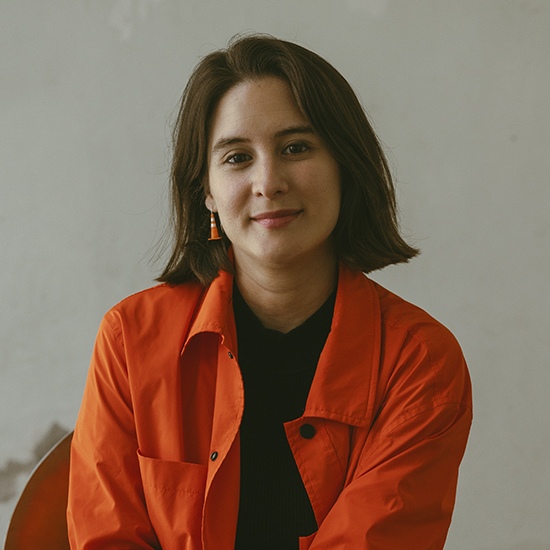
Dinorah Schulte is the lead designer behind CORNCRETL and founder of MANUFACTURA, a Mexico-based design practice working at the intersection of material research, digital fabrication, and cultural continuity. Trained at ETH Zurich and now pursuing a PhD at the University of Florida, she is working with archaeologists to reconstruct the original Mayan lime recipe at a full architectural scale.
What follows is a conversation about corn, lime, robots, failure, and the walls that hold communities together.
Our Narratives: Your work bridges ancestral knowledge, material science, and digital fabrication in ways that feel deeply intentional. Could you tell us about your background and what drew you toward this particular intersection?
Dinorah Schulte: My approach has been shaped by a combination of collaborative practice and advanced training in digital fabrication, where material development is understood as both a technical and cultural process. On a practical level, we materialized these mixtures through close collaborations with experts. I worked alongside Montserrat Ayala and María José Creuheras on biocomposites derived from organic waste, and collaborated with traditional ceramic workshops like Ánfora Studio and Uriarte Talavera. These encounters made it clear that innovation does not replace tradition; rather, it can extend and reactivate it. From an academic standpoint, my formation at ETH Zurich was critical. That environment taught me to see material research not as an isolated experiment, but as something inseparable from fabrication logic, structural performance, and scalability. There was no single moment of discovery, but rather a convergence of places and people that pointed me toward an architecture where cutting-edge robotics coexist with deeply rooted material traditions.
Our Narratives: Corn has been central to Mexican identity for 7,000 years, yet nejayote, the wastewater of corn processing, has historically been treated as a byproduct to be discarded. When did you begin to see this waste as a resource?
Dinorah Schulte: The exact moment was in 2022 during The Eggshell Project. That marked the first time we successfully 3D-printed a biocomposite made from recycled eggshells. That experience fundamentally shifted our understanding of waste, revealing its latent material value. From there, we investigated waste streams in Mexico more systematically. We realized that over 64 percent of the country’s waste is organic, largely from the food industry. These materials currently have no established market value. This condition not only reframes waste as a valuable resource but also substantially reduces production costs, making our system far more viable than those dependent on conventional, market-priced materials.
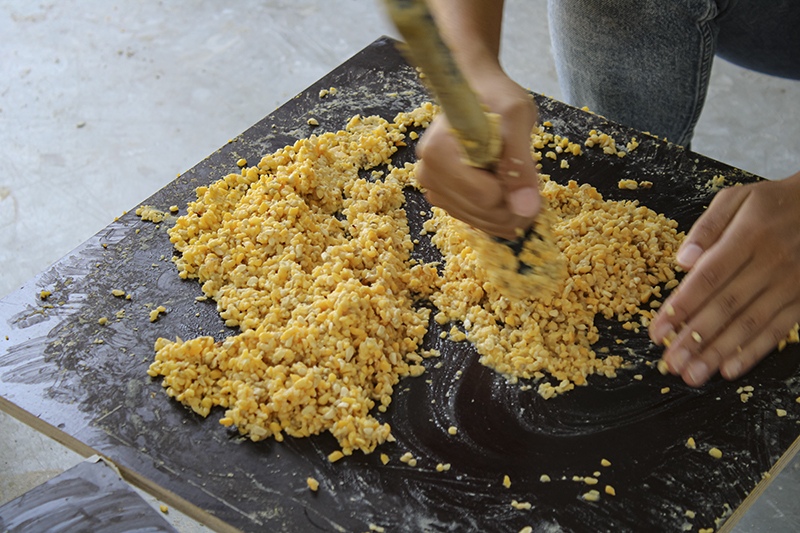
Our Narratives: CORNCRETL synthesizes Sak-Kaab, White Earth, with the precision of a KUKA robotic arm. How do you navigate the relationship between the ancestral and the computational?
Dinorah Schulte: I do not frame this relationship as a conflict, but as a reconciliation. Today, the traditional production of Sak-Kaab is disappearing due to the dominance of Portland cement and chemical additives that artificially accelerate curing times. My goal is to demonstrate that technology is not opposed to tradition. By returning to this pre-Hispanic process, respecting time, climate, and material behavior, and combining it with 3D printing, digital fabrication becomes a strategic ally. Computation amplifies heritage by expanding formal freedom while preserving the cultural memory embedded in the material itself.
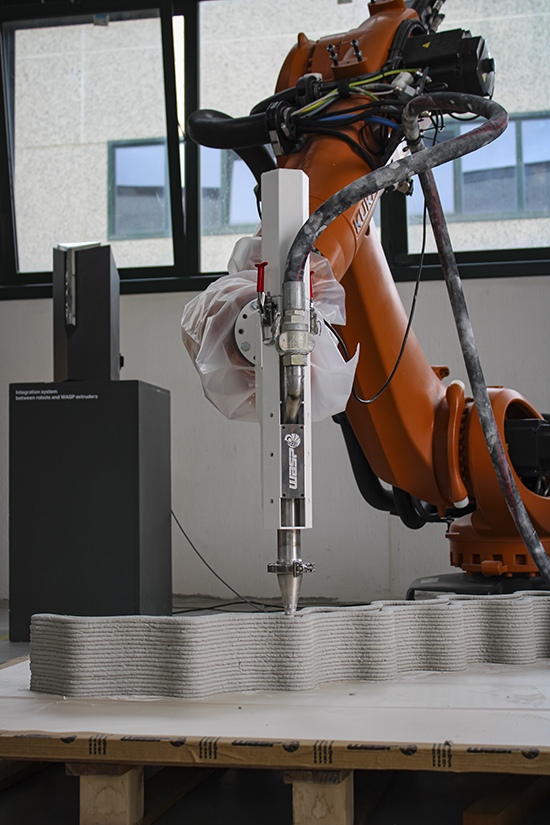
Our Narratives: Lime-based systems possess a capacity to self-heal and regulate humidity that Portland cement cannot match. Has working with CORNCRETL altered your philosophy on what a building material should do?
Dinorah Schulte: It has profoundly shifted my view. Unlike conventional cement, lime-based systems transform architecture from a static shell into an adaptive, living system. Materials become active participants in the performance and longevity of a building. This is not a new idea, but a very old one. Sak-Kaab was valued by Mayan builders precisely because it breathed. CORNCRETL is simply remembering what was already known.
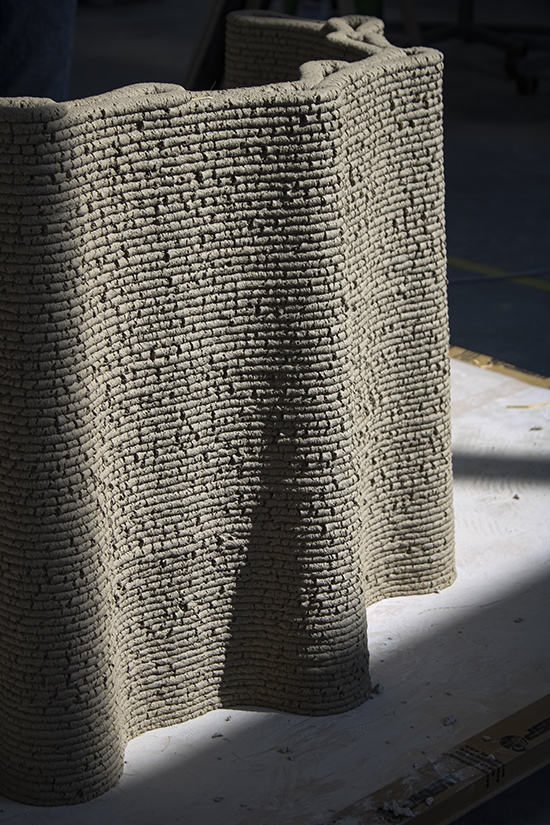
Our Narratives: Your formulation creates a unique chemical hybrid, blending Mexican byproducts with Italian minerals like Carrara marble. What is the significance of this cultural hybridity?
Dinorah Schulte: The project began with a migrant chef in Berlin sending his food waste to be printed in Italy. It was crucial to find a material that could connect these cultures. In Italy, natural pozzolans and limestone have long been used in historic constructions like the Colosseum, which is why we incorporated Italian aggregates alongside Mexican agricultural waste. The resulting material embodies a unique hybridity, combining the histories of both countries. It is a decolonial gesture, transforming a history of cultural erasure into a shared, constructive dialogue.
Our Narratives: With over 60 percent of homes in Mexico being self-built, does CORNCRETL feel like more than just a design project?
Dinorah Schulte: Absolutely. It serves as a critical indicator for scaling sustainable materials to broader applications. The material resonates because it connects to our roots, creating a sense of community around shared heritage. The people constructing their own homes deserve access to materials that are not only affordable and low-carbon, but that carry meaning and belong to the same cultural soil as the communities building with them.
Our Narratives: What did the 3D-printing process reveal about the limits of robotic fabrication? What still demands human touch?
Dinorah Schulte: The limits of digital fabrication in Mexico are not just technical, but social. Labor represents nearly 60 percent of our economy, and many workers are classified as artisans. Replacing them with machines would risk erasing heritage. My research focuses on a balanced approach where manual labor and robotic fabrication collaborate, combining human intuition with machine precision. Too often, 3D printing is introduced as a foreign tool. It is crucial to develop materials that carry identity, working with local knowledge rather than against it.
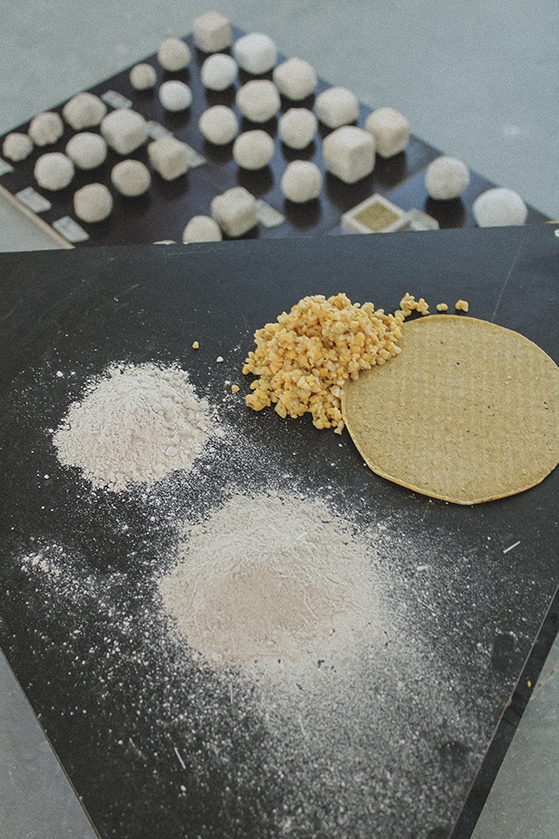
Our Narratives: A specific moment where the material failed?
Dinorah Schulte: We spent two weeks in Italy, and the first week was entirely dedicated to testing formulations. Naturally, there were many failures. These were incredibly instructive, revealing limitations that a successful test could not. It reinforced that material research is a loop where design and prototyping continuously feed into one another.
Our Narratives: What does CORNCRETL actually feel like?
Dinorah Schulte: It feels very similar to a traditional mortar or concrete. It has a hard, stone-like texture and a substantial weight. What makes it unique is its natural appearance. The limestone gives it a beige base, and the corn adds a warm yellow color. In some areas, you can even see traces of the corn grains. This visible presence eliminates the need for paint or coatings; the material is expressive on its own.
There is a word in Spanish, arraigo, that does not translate cleanly into English. It means a deep belonging to a place, a people, and a way of being in the world. It is the feeling of knowing that the ground beneath you is also inside you.
What CORNCRETL proposes is a form of arraigo built into architecture itself. These are walls made not from anonymous industrial materials but from the corn that has fed Mexican communities for seven millennia. The material does not conceal its origins. It carries them visibly, the way memory is carried: not buried, but present, just beneath the surface.
The fact that this material achieves a 70 percent reduction in carbon emissions and eliminates the waste of formwork are not incidental features. They are the result of returning to a material logic that Portland cement spent a century erasing, only to discover that it was already ahead of where we are now.
The wall panel that traveled from a taquería in Berlin to a robotic arm in Italy is a proof of concept for something much larger. The most urgent questions facing the construction industry, how to build with less carbon, with circular flows, and with materials that communities recognize as their own, may find their most compelling answers in the deep past. Dinorah Schulte and MANUFACTURA are building the bridge between those two moments. The material they are using is, in every sense, the bread of life.
Dinorah Schulte is a Mexican architect, professor, and researcher whose work explores cultural exchange through technology, with a particular focus on the impact of digital fabrication in Mexico and Latin America. She is a PhD candidate at the University of Florida’s College of Design, Construction and Planning (2026–2029), where her research bridges material experimentation, technology, and cultural production. She holds a Master of Advanced Studies in Architecture and Digital Fabrication from ETH Zurich and a Bachelor of Architecture from Universidad Iberoamericana, Mexico City. A 2019 fellow of the Norman Foster Foundation’s Robotic Atelier, she has collaborated with MAD Architects and ENSAMBLE Studio.
Schulte is the founder and director of MANUFACTURA and currently teaches at the University of Florida. She has also taught at Universidad Iberoamericana, CENTRO, La Salle, and Anáhuac in Mexico City. In 2023, she joined the editorial board of CEMEX México. In 2024, she received the Young Researcher Award at SIGRADI, was selected for the Haystack Open Studio Residency, and was recognized by Dezeen as one of “Ten Independent Studios Demonstrating the Diversity of Design in Mexico City.” She joined the WASP Residency in 2025. Her work continues to advance the dialogue between tradition and innovation, reimagining materials and methods to shape a more sustainable and culturally grounded built environment.
Name: CORNCRETL
Designer: MANUFACTURA | @manufacturamx
Lead Designer & Project Director: Dinorah Schulte
Senior Computational Designer, 3D Printing Development: Andrea Menardo / Zeitgeistructures
Structural Engineer: Jorge Armando / TAKO KWEEN + TLAXCALLI
Material Donator: WASP 3D Industrial Partners
Photography & Video: Dinorah Schulte, WASP 3D
All images by Dinorah Schulte.