
James Dyson Award Winner Alessandra Galli on Her Journey to Creating Empowering Technology
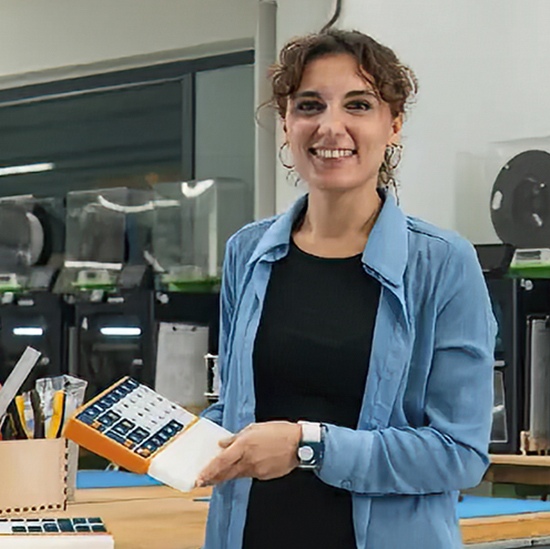
Out of more than 2,100 entries from 28 countries, 29-year-old Italian product designer Alessandra Galli stood out with OnCue, a therapeutic keyboard designed specifically for people with Parkinson’s disease, winning this year’s James Dyson Award gold prize and earning £30,000 to advance her prototype to a market-ready product.
Recently, we had an in-depth conversation with Galli, listening to her story about the design process, her long-term commitment to the Parkinson’s community, and her insistence that assistive technology be “both beautiful and functional.”
“What I really want to change is not how fast they type,” Galli says, “but how they feel when they sit in front of a computer and prepare to press the first key, so they no longer feel frustrated, no longer feel useless.”
From Milan to Delft: A Final Chance to Design Purely for Purpose
Galli’s professional path began in Milan, where she earned her bachelor’s degree in product design and worked for four years. During the COVID pandemic, she moved to the Netherlands to pursue a master’s in Integrated Product Design at TU Delft, where OnCue became her graduation project.
“I knew this was my last chance to learn something on an academic level,” Galli explained. “Because I had work experience before the master’s, I deeply understood how precious student status is: you can temporarily set aside commercial constraints and explore in a completely different way.”
One Sentence That Changed Everything
There was only one sentence in the project brief, yet it stopped her in her tracks: for most people, typing on a keyboard is unconscious; but for people with Parkinson’s disease, every keystroke feels like climbing a wall.
“I myself have never been aware of my fingers moving,” she said. “But they have to bear shame for such an ordinary little action. In that instant, I decided I had to do something.”
How OnCue Works
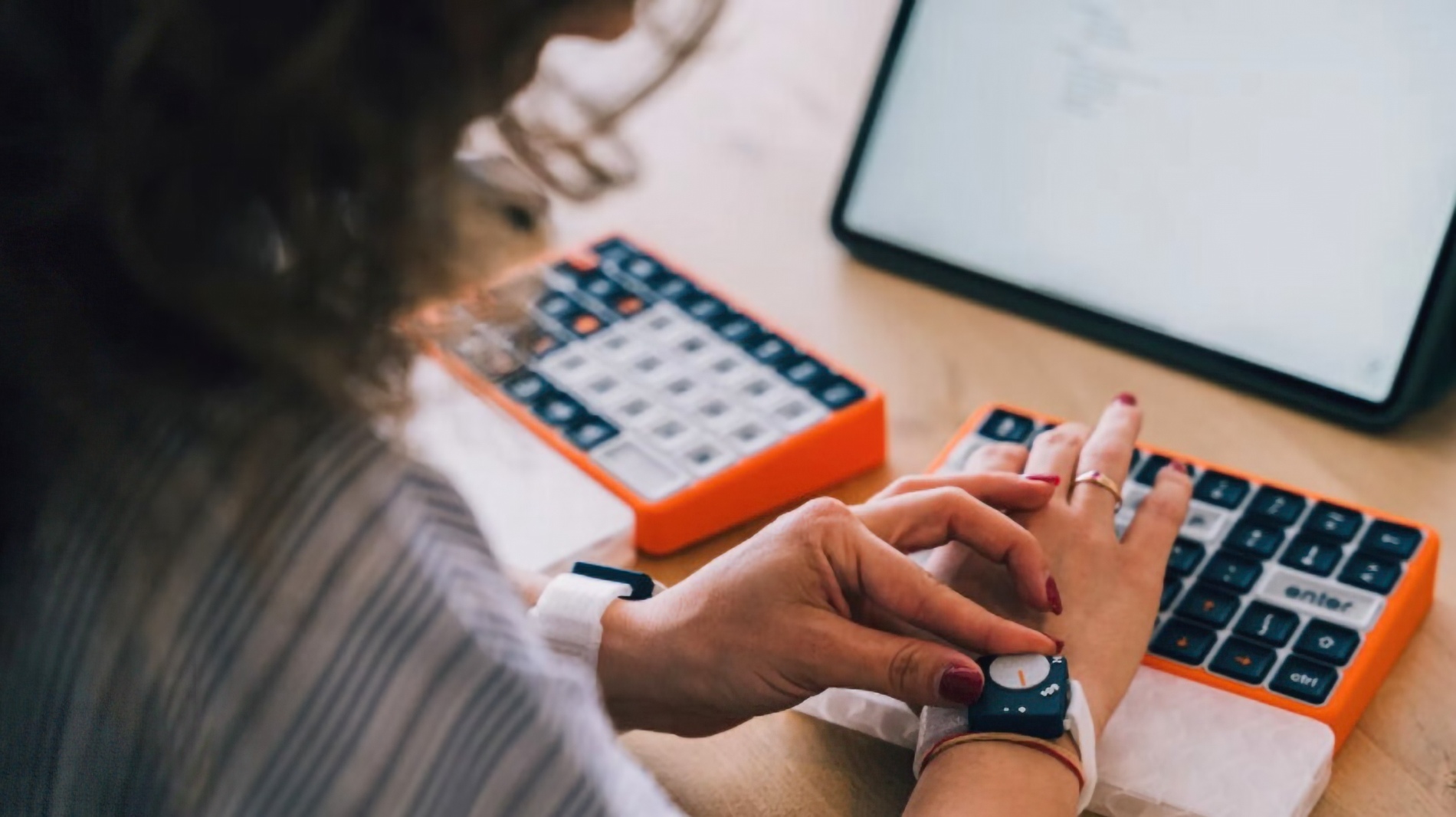
The OnCue keyboard combines artificial intelligence with haptic feedback to help patients manage tremors and rigidity. Main features include:
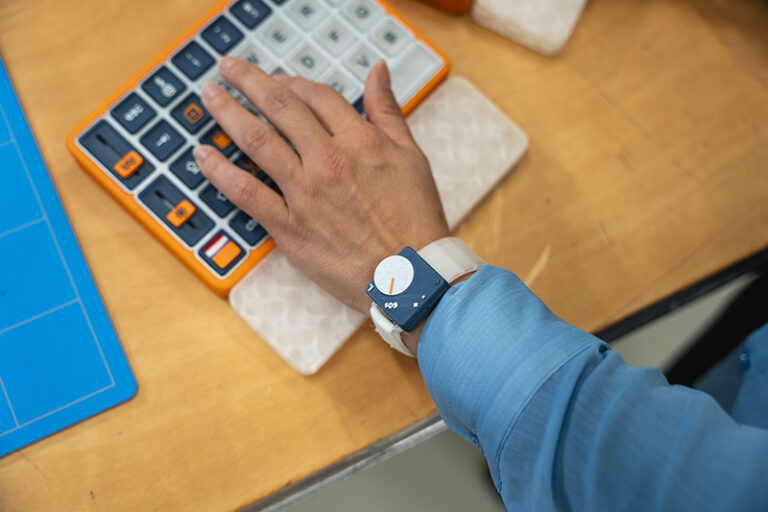
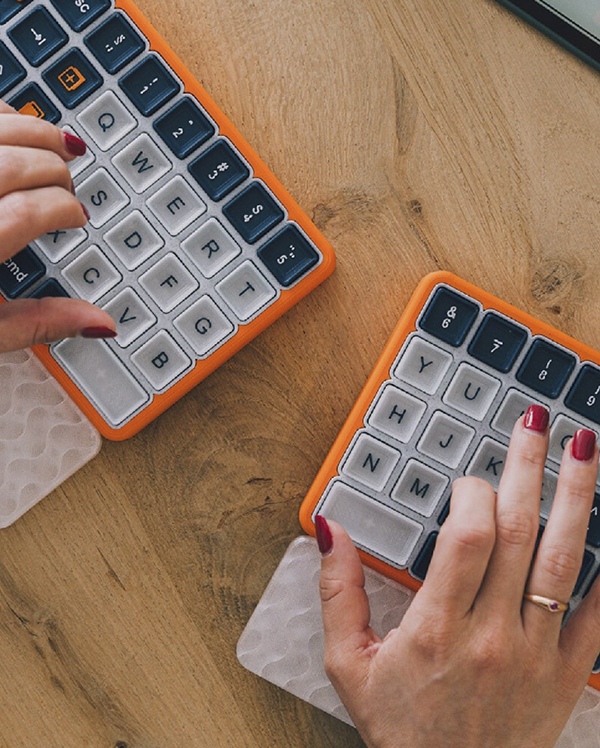
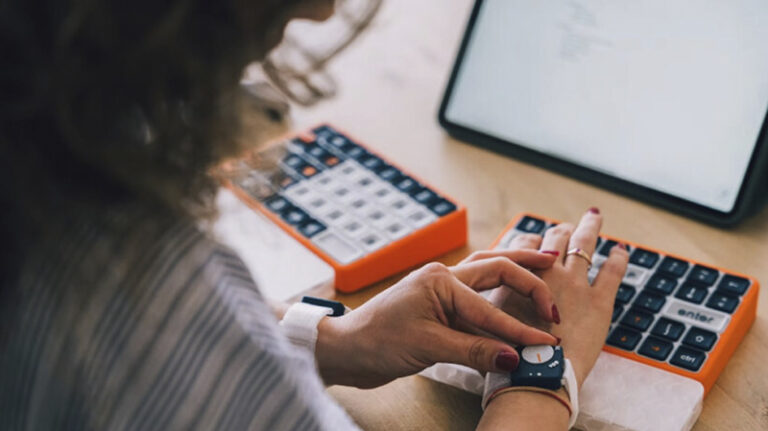
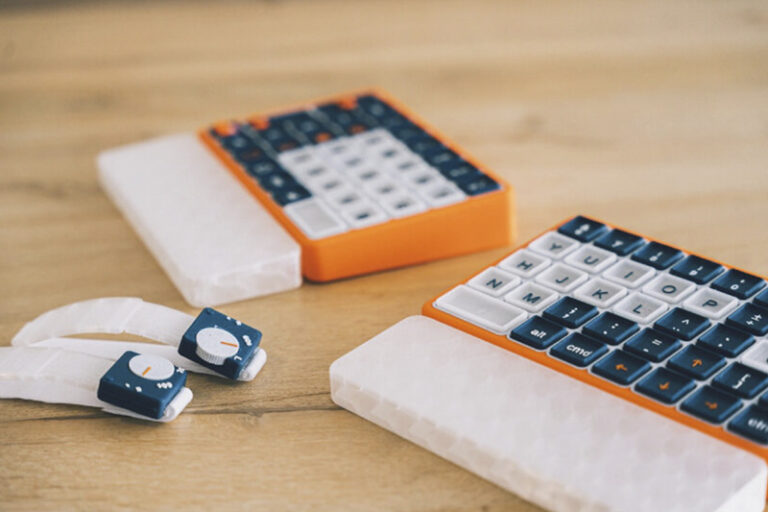
Split Wireless Design: The keyboard divides into two halves, can be placed close to the body, requires no stretching of already aching arms, and achieves the most natural hand positioning.
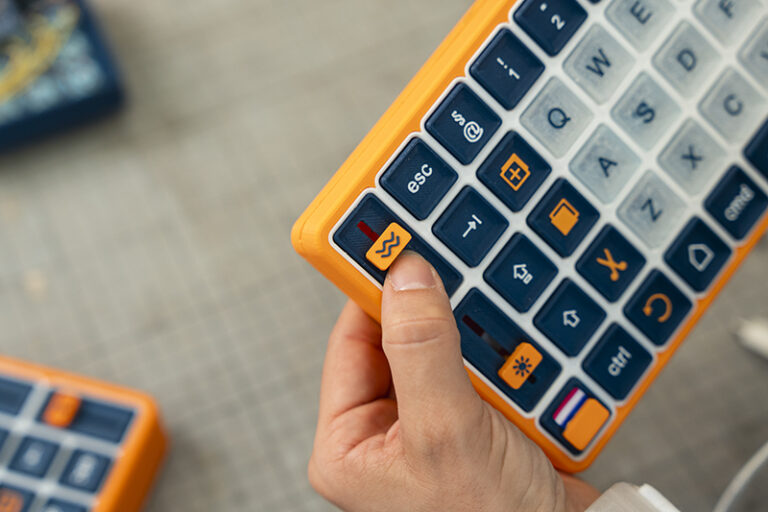
Raised Keycaps and Intelligent Lighting: The edges of the keycaps are slightly raised, making it easier for trembling hands to locate targets; after pressing the current key, it lights up yellow, and the AI-predicted next most likely letter lights up green in advance, serving as an external movement trigger.
Haptic Feedback Wristband: Guides typing rhythm through gentle vibration, like someone gently pushing the fingers to continue.
Adaptive Artificial Intelligence: The system learns personal vocabulary, names, and brands. “It remembers the non-English names or niche brands you repeatedly type and won’t keep correcting them.”
Real-Time Adjustability: A large knob in front allows instant adjustment of cue intensity, turning it up on difficult days, down when symptoms are mild, or off completely; companion software also supports changing light color schemes.
“It looks more like a limited-edition gaming keyboard, nothing like equipment borrowed from a hospital,” Galli says with a laugh.
Designing Through Elimination
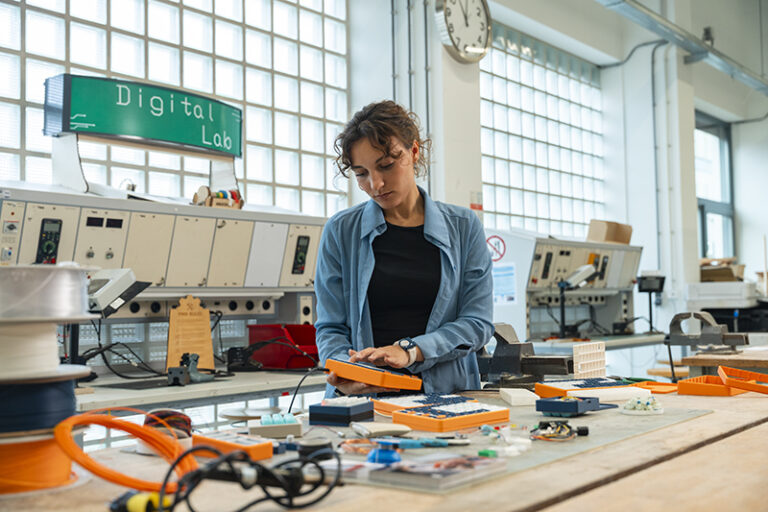
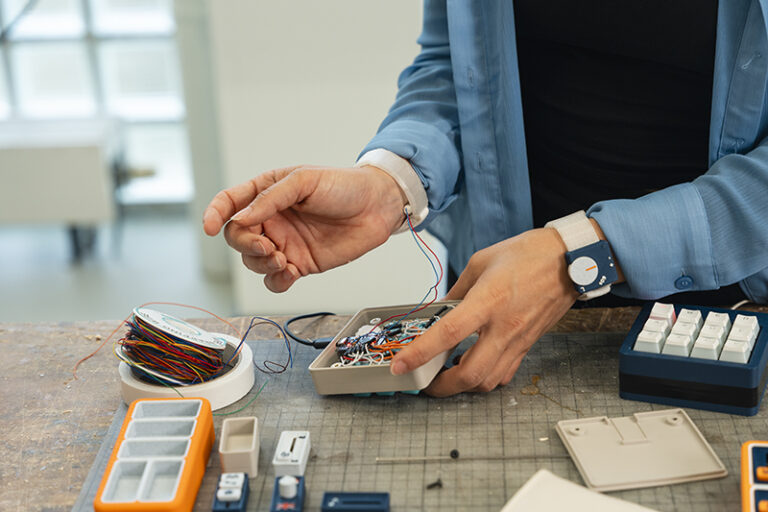
With the assistance of ParkinsonNetherland in the Netherlands, Galli gained access to dozens of patients and one professor who also lives with the disease. She created four prototypes with completely different functions: vibration placed on the palm rest, wrist, fingertips, and even tried audio cues.
She didn’t ask “what do you want” but rather “what do you dislike most.”
“I didn’t ask what they liked, that’s too hard to answer,” she explained. “I asked them to tell me what bothered them most, what could be completely eliminated.”
Through this elimination process, audio cues were rejected first. Palm rest vibration was also quickly abandoned because it forced users to keep their hands in a fixed position. The final winner was the wristband vibration. “It felt like someone was gently pushing me to keep going,” one participant said.
Galli quickly discovered that Parkinson’s is far more complex than she initially anticipated. “Initially I was asked to work only on bradykinesia, which is the slowness of movement, and hypokinesia, which is the reduction of amplitude gestures,” she said. “But after the questionnaire, I realized these people also experience tremors and muscle stiffness with their fingers. I thought, it’s not enough to just work on bradykinesia. I have to work on the full design of the keyboard because if the posture is not right, the symptoms are going to be stronger.”
This realization prompted her to completely redesign the keyboard from scratch. She researched various keyboards and found that mechanical keyboards, popular among gamers, offered unique advantages in durability and ease of use. Crucially, their modular nature, with standard switches and replaceable keycaps, allowed for the customization she knew was essential. “I realized that people’s preferences are highly subjective, so it was important to me to allow for customization.”
The Most Important Discovery: Speed Was Never the Point
“I originally thought everyone would care about speed, but later discovered that speed is almost irrelevant,” Galli said.
During testing, one participant suddenly said, “When I used your prototype, for the first time I felt calm and relaxed.” That moment told Galli she was on the right path.
“They don’t need to be 0.5 seconds faster, but rather to be able to smoothly complete a sentence, not be interrupted, not feel defective because of a keyboard. What they need is to no longer feel frustrated, because frustration was the emotion that came out the most in the questionnaire.”
Refusing the "Medical Look" Is a Choice About Dignity
One of Galli’s core principles was creating a product that people would be proud to use. “Why do assistive products always have to be ugly?” Galli asks. “Knowing that there is so much on the market for gamers, really high-tech keyboards for them, brushed aluminum bodies, rainbow lighting, I feel like there’s a lot for having fun. But I feel like there is little with these technologies for assistive products. Sometimes assistive technologies are kind of ugly.”
This aesthetic consideration was about dignity. “I didn’t want to make an ugly product. I wanted to make a product that you buy and you’re like, ‘This is my new keyboard,’ not ‘I have a problem and I’m using something that’s not aesthetically pleasant.’ I wanted a product with nice aesthetics so that people wouldn’t be ashamed of using it.”
A Companion for a Progressive Journey
One of the most thoughtful aspects of OnCue is its acknowledgment that Parkinson’s is a progressive disease. Symptoms change over time, sometimes even day to day, and the keyboard is designed to adapt accordingly.
“One person told me that in the first years of Parkinson’s, she had tremors,” Galli recalled. “After her neurologist found the correct dosage for her, she’s not having those tremors like before. If she had OnCue during those years when she wasn’t on the right dosage, she would have had a product that would have assisted her.”
The modular design and adjustable features mean that OnCue can serve users at different stages of the disease. To address potential habituation, where users might become so accustomed to the cues that they lose effectiveness, the adjustable intensity allows the device to evolve with changing symptoms. The large physical knob sits front and center: “At any moment you can turn it into a normal keyboard or turn it back into your personal therapeutic device. The choice is yours.”
Recognition and Validation
For Galli, winning the James Dyson Award was both a surprise and a dream come true. “When you are a design student, the James Dyson Award is one of the most important contests out there,” she said. “You see these projects, you see the impact, and when you’re learning you really look up to it. So being part of it really makes me more than happy.”
The recognition from James Dyson himself was particularly meaningful. “James Dyson for me, when you study product design, James Dyson is like one of those heroes. Having the opportunity even to have him know about my project is crazy.”
“It’s a clever and empowering solution, allowing people with Parkinson’s and other motor conditions to stay connected and communicate independently,” praised British inventor James Dyson, who launched the award in 2005.
Beyond the honor, the award provides crucial validation. “When the world’s most critical engineer tells you ‘I see the same value you see,’ it feels unreal.”
From Prototype to Product: Real-Life Testing, Not Lab Data
While OnCue has garnered significant attention and manufacturers have reached out, Galli is cautious about rushing to production. “I think we are a bit far from the manufacturing process. It’s more about launching the pilot and really testing the features,” she said.
The complexity of Parkinson’s, with more than 40 possible symptoms, means thorough testing is essential. “The experience for every person is subjective. I think it’s really important to test it properly with a large number of people with the support of occupational therapists. I don’t want to make assumptions about what works for people.”
Galli recently secured another grant that, combined with the James Dyson Award prize money, will allow her to complete a fully functional prototype and conduct structured testing over three months in collaboration with occupational therapists in both the Netherlands and Italy.
“We’re going to ask participants to indicate the importance for them on different tasks. For example, how important is it for you to write an email?” Galli explained. “The focus is going to be on what they want and how they feel rather than accuracy and speed. We’re not going to measure words per minute. We’re going to ask: ‘How did you feel after writing that email?'”
The testing will be iterative, introducing features one at a time to avoid overwhelming participants. To support this work, Galli has assembled a small team and is completing a validation program at Yes!Delft, bringing on a software engineer to work on both hardware and software components.
Unlike many adaptive technology projects that modify existing products, OnCue was designed entirely from scratch. While Galli uses standard mechanical switches for their proven benefits, everything else is custom, from the 3D-printed enclosure to the keycaps to the internal structure. This approach gives her complete control over every aspect of the user experience.
Collaboration with Healthcare Professionals
Galli understands that developing medical technology requires more than design expertise. She’s working closely with occupational therapists who specialize in Parkinson’s disease to guide the testing and validation process.
“We have one occupational therapist in Italy and another in the Netherlands who are on board for the testing phase,” she said. “We need someone who knows the disease really well and who is able to be a bridge between us and the patients.”
While she’s currently focused on occupational therapists and physiotherapists, Galli hopes to eventually involve neurologists as well. “The different aspects of life, especially work, are essential for us.”
Looking Beyond Parkinson's
While OnCue was designed specifically for people with Parkinson’s, Galli sees potential for it to help with other conditions. The modular nature of OnCue opens doors to dystonia, post-stroke motor issues, and even early-stage Alzheimer’s patients.
“I know that maybe it sounds ambitious because Parkinson’s is really complicated, but I’m okay with taking the risk of trying and seeing what’s going to come out in the future,” Galli said.
The Power of Inclusive Design
OnCue represents a shift in how we think about assistive technology. Rather than creating medical devices that mark users as patients, Galli has created a tool that blends therapeutic function with thoughtful design, allowing people to maintain their connection to the digital world with dignity and style.
By involving people with Parkinson’s at every stage, by prioritizing their emotional experience alongside functional needs, and by refusing to compromise on aesthetics, Galli has demonstrated how inclusive design can transform everyday technology into something that empowers rather than stigmatizes.
Now in its 20th year, the James Dyson Award has supported more than 400 young inventors and awarded over a million pounds in prize money. As Galli moves forward with testing and refinement, OnCue reminds us that the best design solutions come from listening deeply to the people who will use them, understanding that technology should adapt to humans, not the other way around, and recognizing that how something makes people feel is just as important as what it helps them do.
As Galli puts it: “What I really want to change has never been how fast their fingers move, but what happens in their heart the moment they press the first key. Maybe, just maybe, they’ll think: ‘I’m still here. I can still do this.'”
*****
For more information about OnCue and to follow the project’s development, visit Alessandra Galli’s website or the James Dyson Award website.