
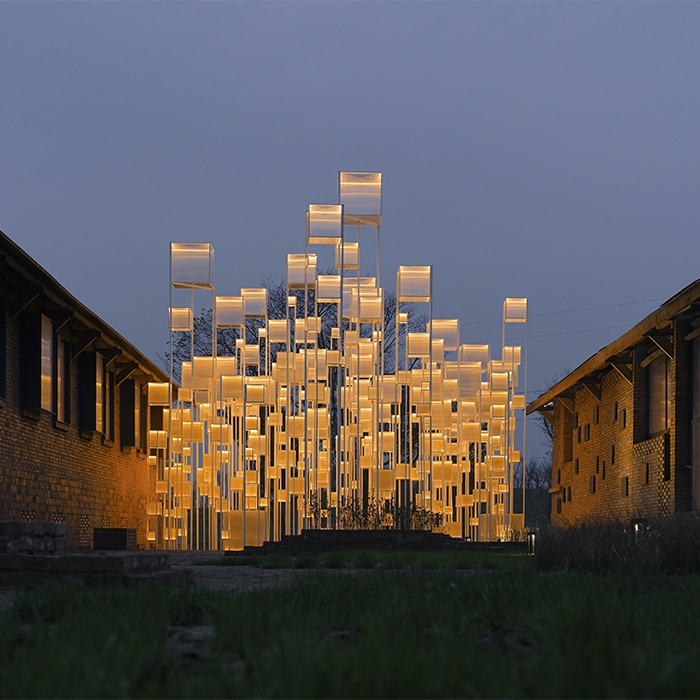
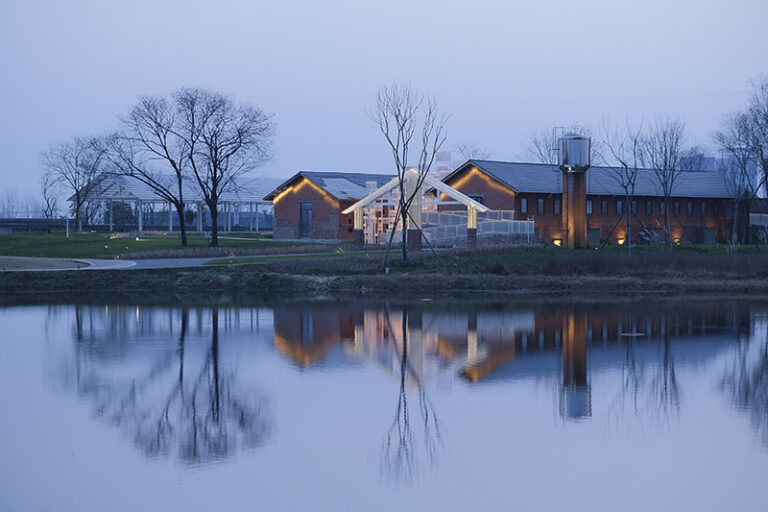
Archermit transforms a defunct school into an agricultural pavilion where polycarbonate cubes float like seeds between preserved brick walls
Time flows like water, and all things drift within it. The traces left by this flow eventually condense into the rings of history. Architecture, as a frozen poem of time, stands quietly in this river of years, silently conveying memory and culture. Each transformation is a renewed inscription of a place’s cultural DNA.
In this passage, architects serve as ferrymen of time, searching for a delicate balance between past and present, delivering a poetic answer to the future through wisdom and creativity.
Origin: Rebirth from Ruins
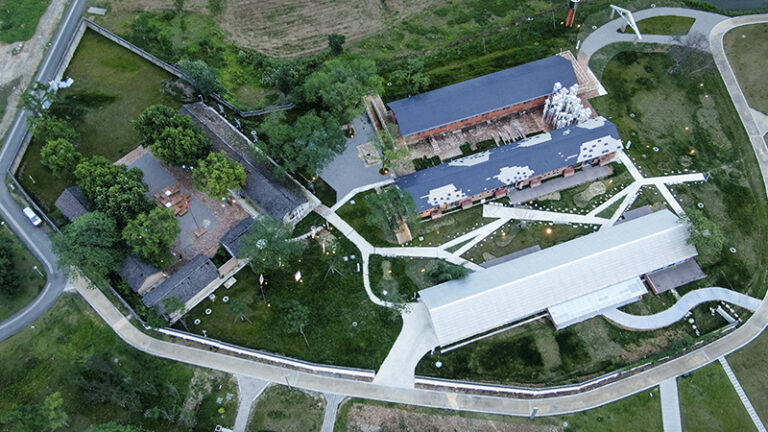
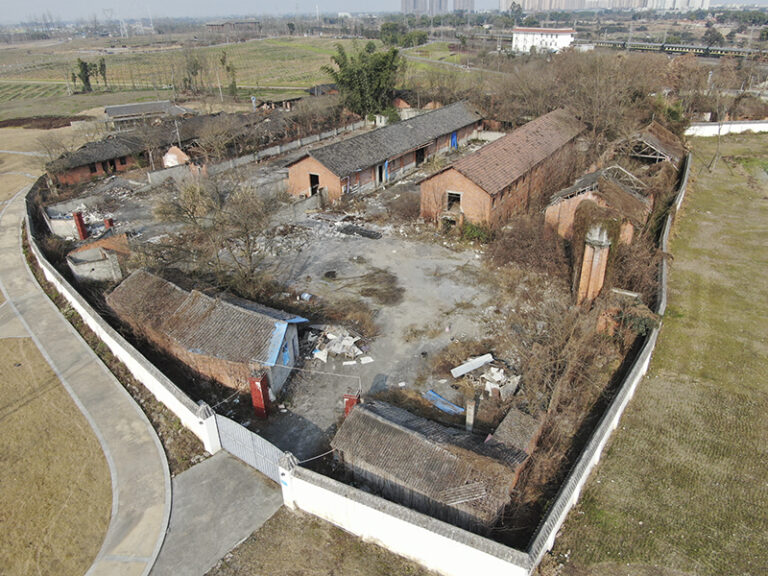
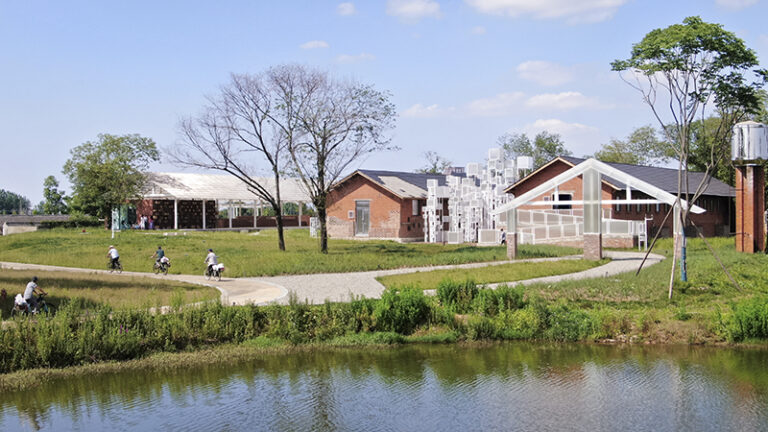
Phase II of the Qinglong Lake Wetland in Chengdu Ring City Ecological Park, China, was once a forgotten plot of land. Here previously stood the now-defunct Qinglong Lake Primary School and a small-scale livestock farm, where rows of red-brick buildings preserved a collective memory of a bygone era. When Archermit received the commission, the site was at a historical turning point: from desolation to vitality, from isolation to openness, from memory to future.
Since Chengdu proposed the forward-looking concept of a “park city” in 2018, the city’s spatial organization has undergone a graceful restructuring. With the ring highway as its skeleton, greenways as veins, and 78 bridges as joints, the city has woven together 121 unique parks into an organic ecological system where humans and nature coexist in harmony. It was within this context that the Floating Seeds project emerged, taking on educational and experiential missions.
Drawing inspiration from the simple yet profound notion of “the cycle of all living things,” the design team translated the growth process of crops—from sprouting to maturity—into architectural form. Using polycarbonate panels, terra-cotta tiles, and red bricks, all materials humble yet warm to the touch, the goal was to create a poetic space where time, memory, and the breath of life could intertwine.
The Question: Balancing Preservation and Transformation
Every urban renewal project begins with a philosophical question of what to preserve and what to change. It is a test of both professional judgment and cultural sensitivity.
The site’s condition resembled a fragmented jigsaw puzzle. Some buildings, though aged, remained structurally sound and could be revitalized. Others were damaged but repairable. A few, however, had collapsed beyond salvation. The landscape presented its own challenges: rampant overgrowth, crumbling pavement, and a boundary wall that cut the site off from nearby farmland and the surrounding park, forming a cultural island.
Translation: Allowing Time to Flow Through Space
To allow the site to breathe again, openness and permeability became the guiding principles. Unstable structures and enclosing brick walls were dismantled to let the greenery flow into the interior courtyard. The salvaged bricks and concrete blocks were reimagined—red bricks now lay horizontally across walkways, forming a mosaic of time, while the concrete blocks were turned into landscape stepping stones, each echoing a footstep of history.
Throughout the redesign, the architects followed three principles: material and environmental resonance, economic pragmatism, and spatial lightness. Polycarbonate panels, red bricks, and terra-cotta tiles—materials deeply rooted in the site’s memory—became poetic expressions in dialogue with time.
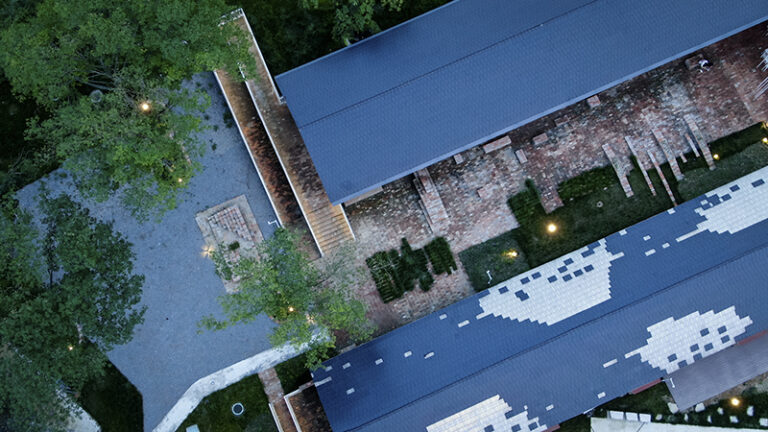
Polycarbonate, a common material in rural buildings, was favored for its transparency, lightness, weather resistance, and accessibility. On the foundations of demolished structures, a new exhibition pavilion for agricultural equipment was built. Its translucent panels and white steel frame created a dreamlike structure that shimmered with morning mist and merged with the horizon.
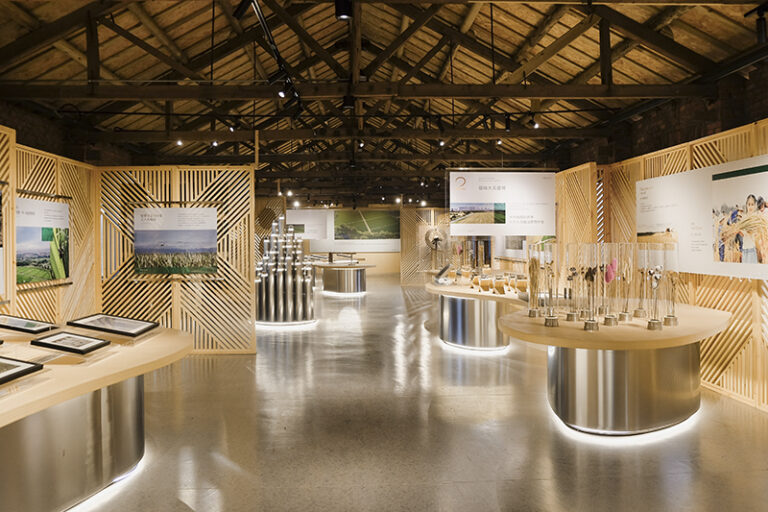
Two other buildings in relatively good condition were respectfully transformed into spaces for displaying agricultural and farming culture. Original brickwork and timber roof trusses were carefully preserved and restored. The roofs were replaced with modest gray tiles. Polycarbonate was used in localized roofs, walls, and windows, introducing a misty lightness that balanced the mass of brick while softly diffusing sunlight into the interiors, forming a rhythm of light and shadow, old and new.
The Climax: Dreams Suspended in Time
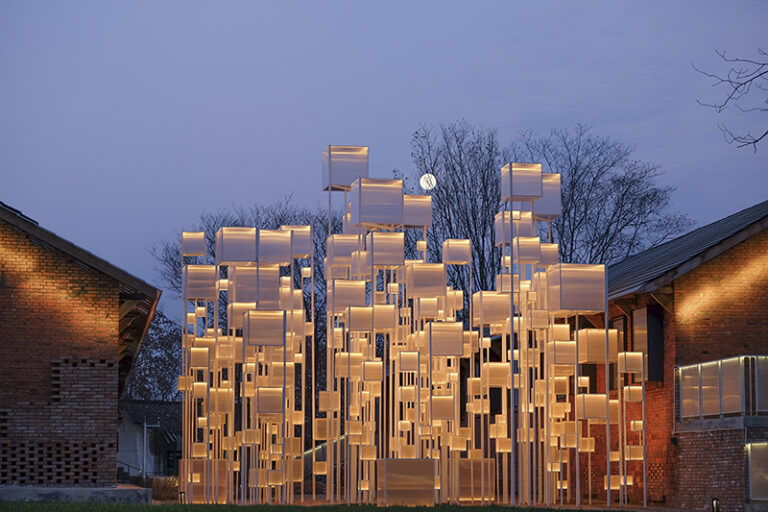
The most lyrical moment in the design lies in the transparent cubes that float between the two preserved buildings. Inspired by the imagery of “seeds” and “sky lanterns,” these structures vary in size and height, becoming the visual focal point of the site. By day, they appear to sprout from the cracks between the bricks, glowing with promise. By night, warm light filters through the polycarbonate, producing a sense of levitation—like lanterns frozen in time, whispering wishes to the night sky.
These cubes not only serve functional exhibition and learning purposes but also act as metaphors for imagination and rebirth, anchoring the entire project in a spirit of poetic futurism.
Conclusion: Planting Seeds of Reflection and Hope
Historian Wang Di once observed that history and culture are the soul of a city. In the face of modernization and commercialization, safeguarding that soul becomes a shared responsibility—not just for planners and scholars, but for architects as cultural stewards.
In the team’s view, it is critical to distinguish between what is “old,” what is “damaged,” and what is truly beyond repair. “Old” represents the irreplaceable patina of time and should be valued. “Damaged” can often be healed while preserving authenticity. “Ruined,” however, signals an end that calls for gentle farewell. Accurately understanding these states allows for tailored design strategies that respect both heritage and practicality.
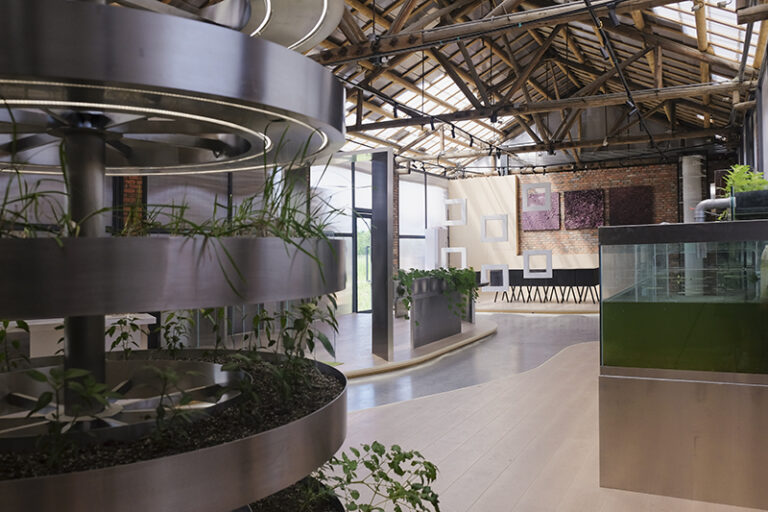
In an age of irreversible urbanization, architecture should never be reduced to mere utility. It is a condensed epic, a space where wisdom, emotion, and memory converge. The Floating Seeds project is one such seed—small, sincere, and full of hope—planted in the soil of a city in transformation.
May this floating seed reflect the team’s vision for urban renewal and spark deeper love and reflection among those who dwell in the city. Let it help preserve fragile memories and ensure that culture continues to bloom in a new historical context.

About Archermit
Archermit was founded in Chengdu, China in April 2015. As the pioneer and practitioner of Imagery Architecture Theory, Archermit represents the avant-garde of the Imagery Architecture movement. The firm’s core philosophy centers on creating entirely new multidimensional spatial experiences and crafting poetic spatial environments imbued with emotion and vitality. Pursuing design that coexists with nature and harmonizes with site conditions, Archermit advocates for refined design and comprehensive design exploration throughout the entire process. The firm emphasizes the integrated exploration of contemporaneity and locality in Chinese architecture, creating spiritual realms that belong to the local context while transcending it. Archermit plants the balance of design in the relationship between traditional culture, modern technology, and social economy and responsibility, striving to become a communicator and creator of Chinese culture and civilization.