Where patience meets purpose in the practice of visual storytelling
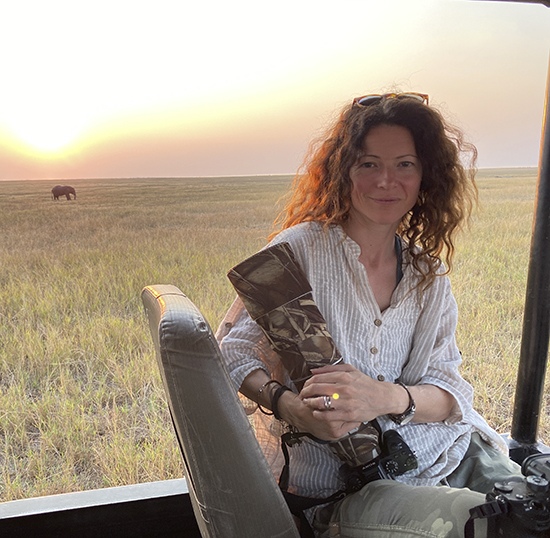
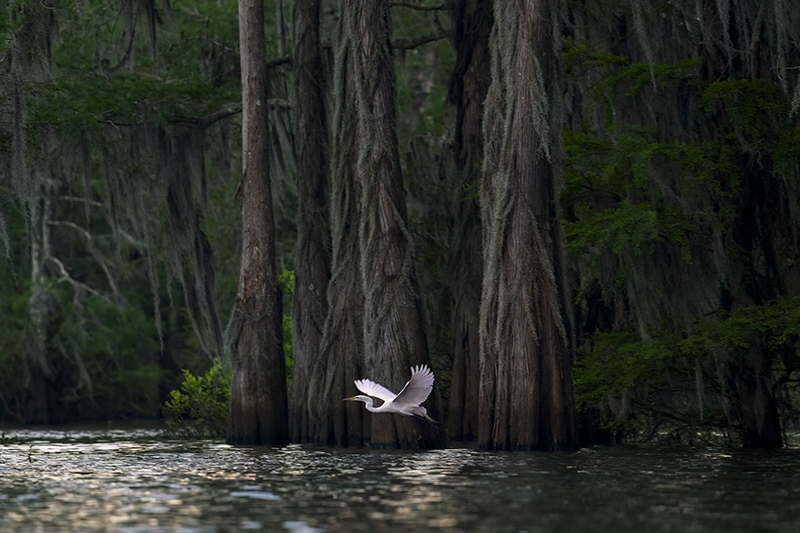
The morning began gray and unremarkable in Louisiana’s Atchafalaya Basin, the kind of overcast dawn that might send lesser photographers back to bed. Yet as British wildlife photographer Irene Amiet lay flat on the bow of a small boat, her husband quietly steering through ancient bald cypress groves, she spotted a sudden flash of white plumage against the dark water.
Above them, the clouds began to part.
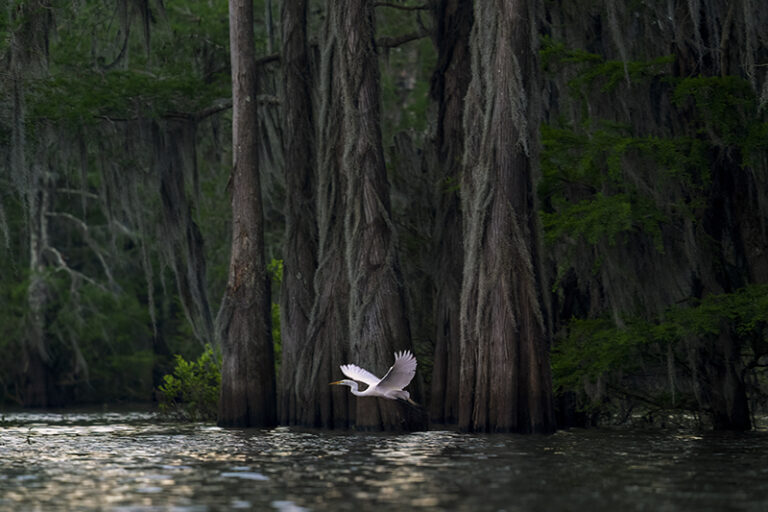
“I saw the white plumage of the bird and, looking up, there was a potential gap in the clouds,” she recalls. “It was just after sunrise and the light that escaped the clouds was still golden.” Moments later, a heron took flight, and Amiet was ready. Her camera captured not only the bird’s movement but also the entire ecosystem in one luminous frame. The image would earn her a silver medal at the 2025 World Nature Photography Awards, proof that even the most common subject can become rare when placed in the right context.
Situated in Southern Louisiana, Atchafalaya is one of the worlds largest remaining wetland swamps. The brackish waters are ideal for bald cypress trees which are habitat for countless birds and an array of amphibians, reptiles and mammals. The trees create different pockets and flooded alleys with full spectrums of green hues and the light often filters through thick canopies sparsley. This great white egret took off into the first light of a morning in spring. Image credit: Irene Amiet
From Childhood Wonder to Conservation Champion
That morning in the Atchafalaya Basin reflects a philosophy shaped over decades. Amiet’s passion began with a Christmas gift when she was six years old: a wildlife photobook from her father. “I could not put it down. Subconsciously, from then on, I knew what was possible to see and photograph in our world.”
Her mother, a historian, nurtured her curiosity and sense of context, grounding her in an understanding of culture and narrative long before she picked up a camera. Years later, while volunteering for Rainforest Concern in Panama, she realized how photography could amplify conservation. “I saw how little material existed to show our project in a compelling way. When fieldcraft and artistry come together, I am in my element.”
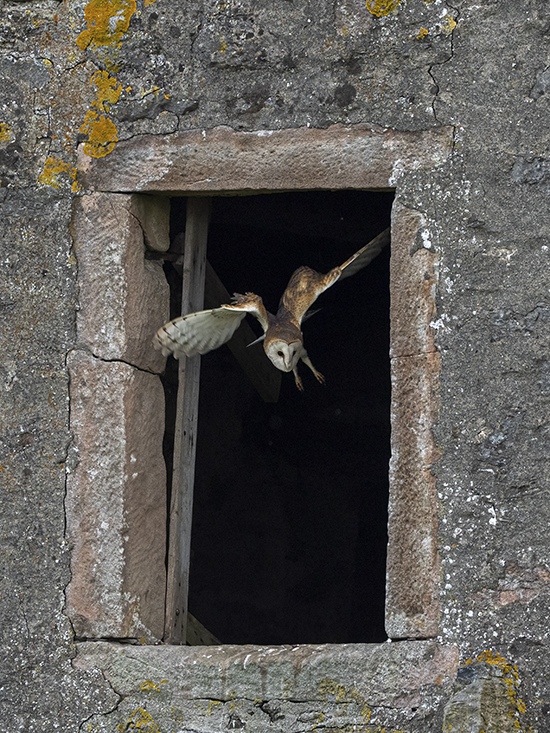
Barn-owl leaving his roost at dusk, Lancashire, UK. Image credit: Irene Amiet
Finding Magic at Home
Now based in Lancashire’s Forest of Bowland National Landscape, Amiet has discovered that powerful stories often emerge close to home. The area’s return to traditional farming practices has created striking contrasts: wildflower meadows alive with insects and birds compared to overgrazed fields that are silent and barren.
Her most intimate collaborators are the owls that hunt at dawn and dusk near her home. “I have started feeling a strange sort of kinship with them,” she admits. “The mystery of them, their calls, their hunting in moonlight, they excite me.”
This familiarity allows for extraordinary preparation. “You may compose an image in your head around a certain perch, or you know when the light hits an area favorably.” By combining local knowledge with artistic vision, she transforms ordinary encounters into images with universal resonance.
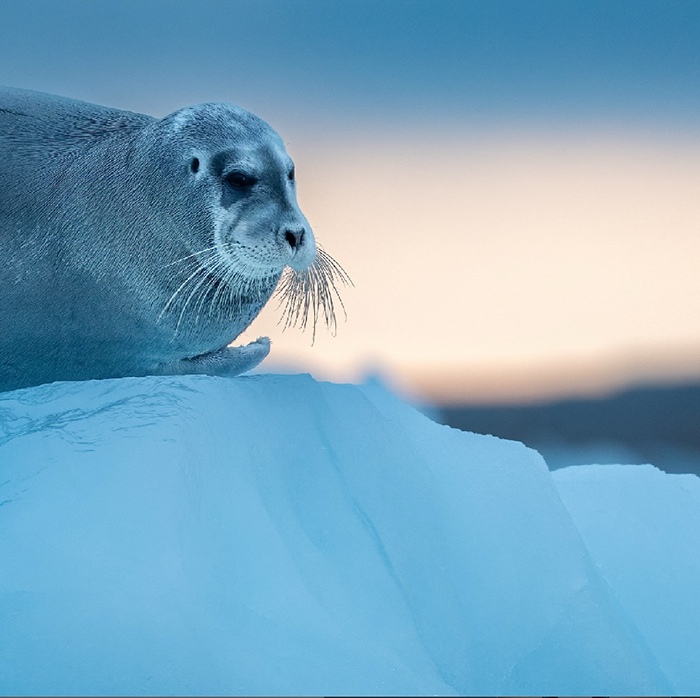
The bearded seal, weighing up to 800 pounds and distinguished by its distinctive curly whiskers, displays fur with a velvety texture and appearance. Image credit: Irene Amiet
The Ethics of Patience
Amiet’s approach rejects shortcuts. Through her book Wilder Britain: Volume I, created without baiting or disturbance and with all revenue directed to rewilding projects, she demonstrates that ethical practice can be both beautiful and effective.
Wilder Britain visual identity, courtesy of Wilder World.
“Many photographers join guided groups where they are placed in advantageous spots to simply press the shutter,” she explains. “There is little wrong with that, but it breaks the journey into connectivity with a landscape.”
For her, the wait is active, her senses heightened, every rustle or shadow charged with potential. “What people confuse with patience is the adrenaline build up. Waiting means being on high alert. In a rich landscape, if you hide in a ditch for a few hours, you will witness an amazing amount of little happenings.”
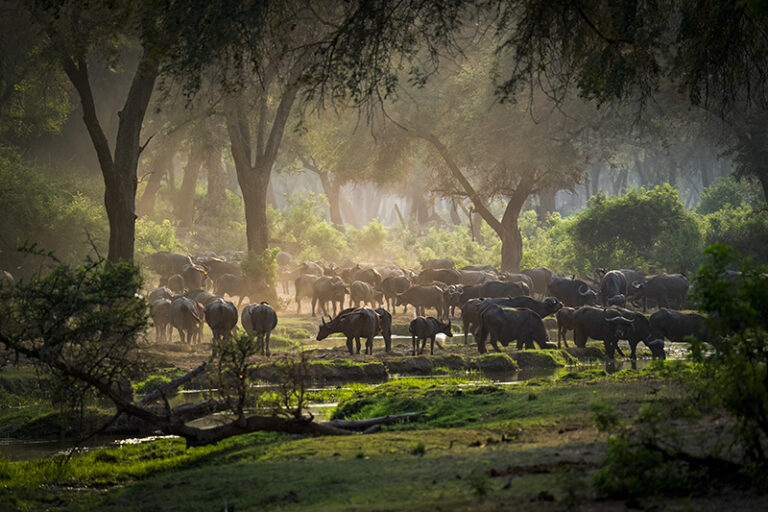
Buffalo in Lower Zambezi National Park, Zambia. Image credit: Irene Amiet
Beyond the Close Up
While social media often celebrates tightly cropped portraits, Amiet insists on keeping animals within their habitats. “Close ups become very similar after a while. Habitat shots, on the other hand, are unique.”
She believes context is essential to conservation. “Habitat and animal are intertwined in one living whole. Wildlife portraits risk marginalizing them into something exotic, as if they belong in a zoo rather than in the landscapes around us.” Her workshops emphasize negative space and storytelling, teaching students that background is as critical as subject.
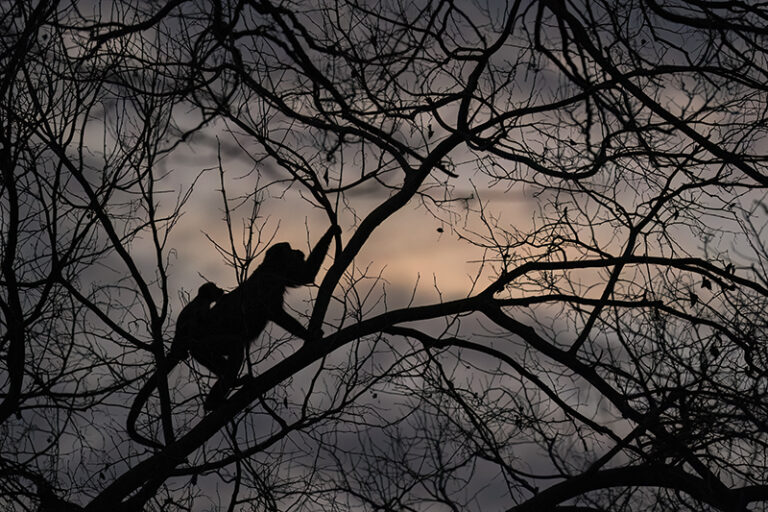
Reaching for the Last Light � howler monkeys at dusk, Pantanal, Brazil. Image credit: Irene Amiet
The Power of Beauty
Having faced threats for previous environmental work, Amiet has come to value beauty over confrontation. “To reach people, beauty is often more conducive. I am drawn to the beautiful to show what still exists, what needs our efforts, and what could be again.”
Her photographs are both art and education, rekindling curiosity at a time when, as she notes, “fewer children can identify our trees, or even tell our owls apart. You only care for what you know.”
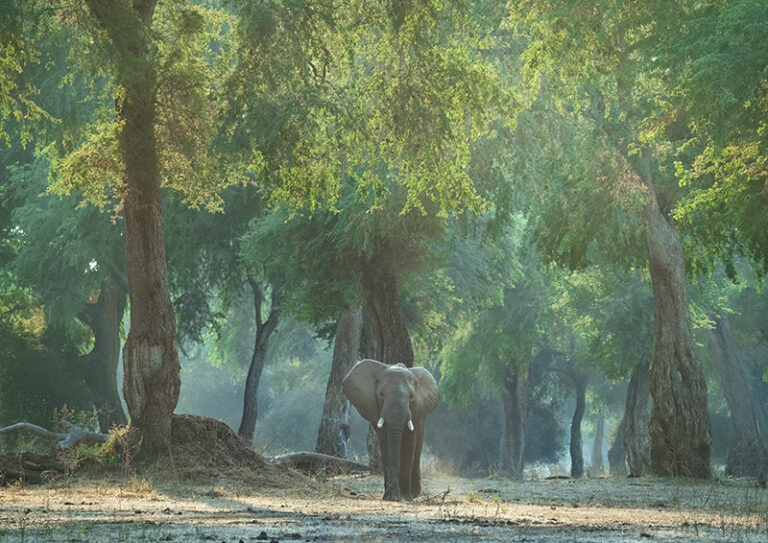
Elephant in Mana Pools, Zimbabwe. Image credit: Irene Amiet
Dreams of Lynx and Corridors
Looking forward, Amiet’s work bridges local and global conservation. In Britain, she documents biodiversity gains in rewilded landscapes. Abroad, she photographs Zambia’s Lower Zambezi Valley, where efforts to create wildlife corridors offer new hope for cohabitation.
Her boldest dream is closer to home: the careful reintroduction of lynx into the British landscape. “It is a dream, but a possible one, if we are willing to think ecologically and socially.”
The award winning image Amiet captured in Louisiana holds a significance that has long surpassed the award itself. It is not merely a photograph; it is a profound lesson in perception. Through her lens, the common egret is transformed into the rare, surrounding creatures become neighbors, and familiar landscapes radiate a newfound, mysterious light.
“Searching for animals means opening all of your senses completely,” she says. “And that is the core message I hope to convey through my work: it is an invitation for people to rediscover the instinct to truly see and listen.”
In an age that pursues instant gratification, her photography reminds us that a truly profound experience of nature does not depend on expensive equipment, but on far rarer qualities: time, focus, and the patience to allow the world to reveal itself at its own pace. Her work is both art and a tool for conservation, proving that the most powerful approach is sometimes not a stern warning, but a gentle invitation to rediscover the world’s innate beauty and the deep affection it holds.