

Corrosion-resistant electrodes enable direct hydrogen production from seawater
As the world accelerates its transition to clean energy, hydrogen has emerged as a promising solution for reducing emissions across industries from transportation to manufacturing. Yet one critical barrier remains: traditional hydrogen production methods require vast quantities of purified water. This poses a major obstacle in regions that are rich in renewable energy resources but face severe freshwater scarcity.
The issue is particularly urgent in coastal deserts that receive intense sunlight, where solar energy is abundant but producing desalinated water is costly and requires significant energy. This contradiction, with rich energy resources but limited water supply, has long restricted the expansion of green hydrogen production in precisely the regions where it is most needed.
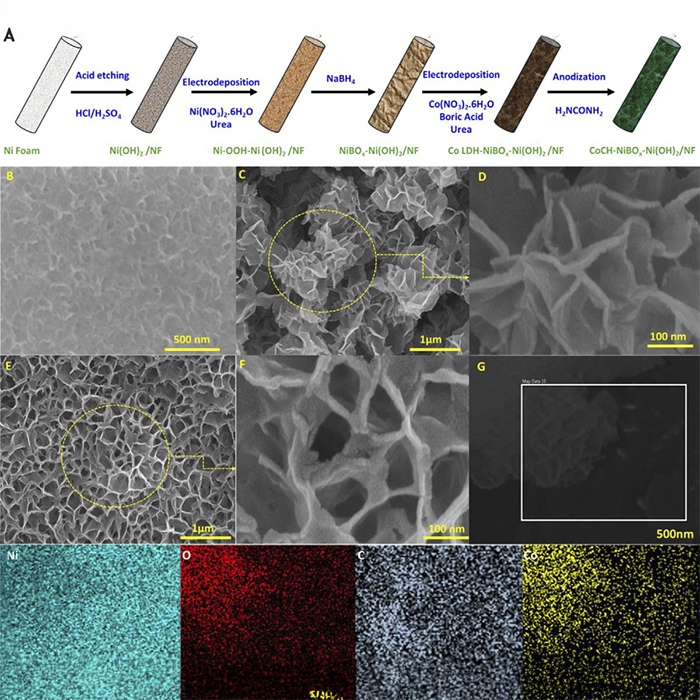
Recently, we had the honor to interview Dr. Yousef Haik, Professor of Mechanical and Nuclear Engineering at the University of Sharjah, who leads a team that may have resolved this long standing paradox. Their innovation enables direct hydrogen production from seawater at industrial scale, eliminating the need for costly water purification. Published in the journal Small, the team’s work demonstrates how a specialized multilayer electrode can resist corrosion from saltwater while maintaining long-term efficiency and reliability.
A Regional Challenge with Global Implications
“The whole world is facing a shortage of clean energy options that can realistically replace fossil fuels,” Dr. Haik says. “Hydrogen is one of the cleanest and most versatile resources we have.”
Hydrogen can be produced from many sources, but water offers the cleanest pathway. However, in the Gulf region and many coastal countries, diverting desalinated water to industrial hydrogen production adds strain to water systems that are already under pressure.
“In our region, most of the clean water is already used for drinking and agriculture,” Dr. Haik explains. “Adding hydrogen production to that would only increase the burden. That is why we turned our attention to seawater as the most logical solution.”
Their idea was straightforward in principle: eliminate the need for water purification by building a system that can split seawater directly. In practice, however, seawater poses a severe challenge because it corrodes standard electrolysis materials and triggers unwanted chemical reactions.
The Science Behind the Solution
The team’s solution involves a three-layer catalyst that creates a protective environment around the reaction site. “We designed a nanostructure that shields the catalyst while promoting the oxygen evolution reaction,” says Dr. Haik. “At the same time, it keeps chloride ions from interfering with the reaction.”
The result is a dual-function system: it resists corrosion while increasing efficiency. Operating in real seawater, the system achieves a current density of one ampere per square centimeter, a level required for commercial viability. Even more impressive, it operates with a Faradaic efficiency of ninety-eight percent and maintains stable performance for over three hundred hours.
This puts it on par with systems that rely on purified water, without the energy and cost penalties associated with desalination.
A Catalyst That Repairs Itself
During development, the researchers discovered something unexpected: a material that regenerates itself during the hydrogen evolution reaction. “It deposits itself back onto the catalyst site,” Dr. Haik explains. “We are in the process of patenting it, but essentially, it eliminates the need for frequent replacement.”
Such durability is a major advance, as catalyst degradation is one of the biggest limitations in electrolysis technologies. A self-regenerating material could extend the life of electrolysis systems by thousands of hours, reducing costs and boosting reliability.
A Complete and Circular System
Beyond the core electrochemical reaction, the Sharjah team has created an entire system that addresses both environmental and economic sustainability.
Pretreatment: Before electrolysis, calcium and magnesium are removed from seawater to prevent buildup on electrodes. This is done using lime, which causes the minerals to settle as solids that can be safely collected and reused.
Posttreatment: After hydrogen and oxygen are extracted, the remaining brine becomes more saline. Instead of discharging this back into the sea, the system uses further precipitation to neutralize chloride concentrations. This closed-loop design protects marine ecosystems and generates valuable coproducts.
“It is a circular approach,” says Dr. Haik. “We eliminate waste and create usable materials, all without harming the ocean.”

Making Solar Energy Work at Scale
Because solar energy is variable, the system includes energy storage components that ensure steady hydrogen output. These include supercapacitors for short-term fluctuations and batteries for longer storage.
“Our system can operate day and night,” Dr. Haik explains. “We are designing a modular generator that can be deployed in coastal regions with abundant sunlight and seawater.”
The team has developed storage solutions tailored to hydrogen production and is actively working on integrating these components into a complete platform for deployment.
From Laboratory to Industry
The project has already attracted interest from government and private stakeholders. With support from the Sharjah Electricity and Water Authority, the researchers are now scaling their system for pilot production.
“We are starting with small-scale systems that produce a few kilograms of hydrogen per day,” says Dr. Haik. “Next we will move to one hundred kilograms, then one thousand. Each stage has unique engineering and safety challenges, but we are ready.”
Importantly, they have created a diverse library of catalyst materials to ensure flexibility at scale. This allows for optimization depending on seawater conditions, available materials, and desired outputs.
Economics That Compete
Using their current materials and energy inputs, the team estimates a hydrogen production cost of two dollars and twenty to two dollars and fifty cents per kilogram at the one megawatt scale. This is competitive with green hydrogen elsewhere and significantly lower than blue hydrogen produced from fossil fuels with carbon capture.
“This system avoids the high costs of desalination and reduces the need for added chemicals,” Dr. Haik explains. “It is especially economical in regions where sunlight and seawater are abundant, like the Gulf.”
These cost savings, along with environmental benefits, make the technology a strong contender for large-scale adoption.
Environmental Integrity and Climate Leadership
Unlike many traditional processes that discharge waste brine back into the ocean, the Sharjah system prevents salinity buildup and chemical leakage. It also avoids the formation of harmful compounds like hypochlorite that threaten marine ecosystems.
The technology operates without direct emissions when powered by renewable energy and supports the UAE’s broader strategy for climate leadership. With a national plan to export clean hydrogen and reduce fossil fuel dependence, the Emirates is poised to benefit directly from this innovation.
“Seawater is everywhere and sunlight is everywhere,” says Dr. Haik. “Together, they give us the tools to create clean fuel without hurting our environment.”
A Vision for Energy Independence
Looking ahead, the team envisions solar-powered hydrogen farms along coastlines, serving as both export facilities and backup power sources for local grids.
“Hydrogen is not just a fuel,” Dr. Haik says. “It is a form of energy storage. During the day, we produce it from solar energy. At night, we convert it back into electricity. This creates clean energy twenty-four hours a day.”
Such systems could help stabilize power supplies in remote or water-scarce regions while reducing the need for fossil fuel infrastructure.
Conclusion
The seawater hydrogen project at the University of Sharjah represents more than a technical achievement. It offers a clear and practical model for the future of clean energy. By addressing both the high cost and the corrosive challenges of seawater electrolysis, the research team has opened a new path toward sustainable hydrogen production.
As the effects of climate change grow more severe and countries look for energy systems that are both reliable and adaptable, this innovation provides a strong and timely answer. With access to both seawater and sunlight, many coastal regions are now positioned to play a leading role in the development of the global hydrogen economy.
In this vision of the future, oceans are no longer seen as obstacles. They are transformed into vital sources of clean energy, connecting regions and enabling a new era of sustainable power for communities around the world.