
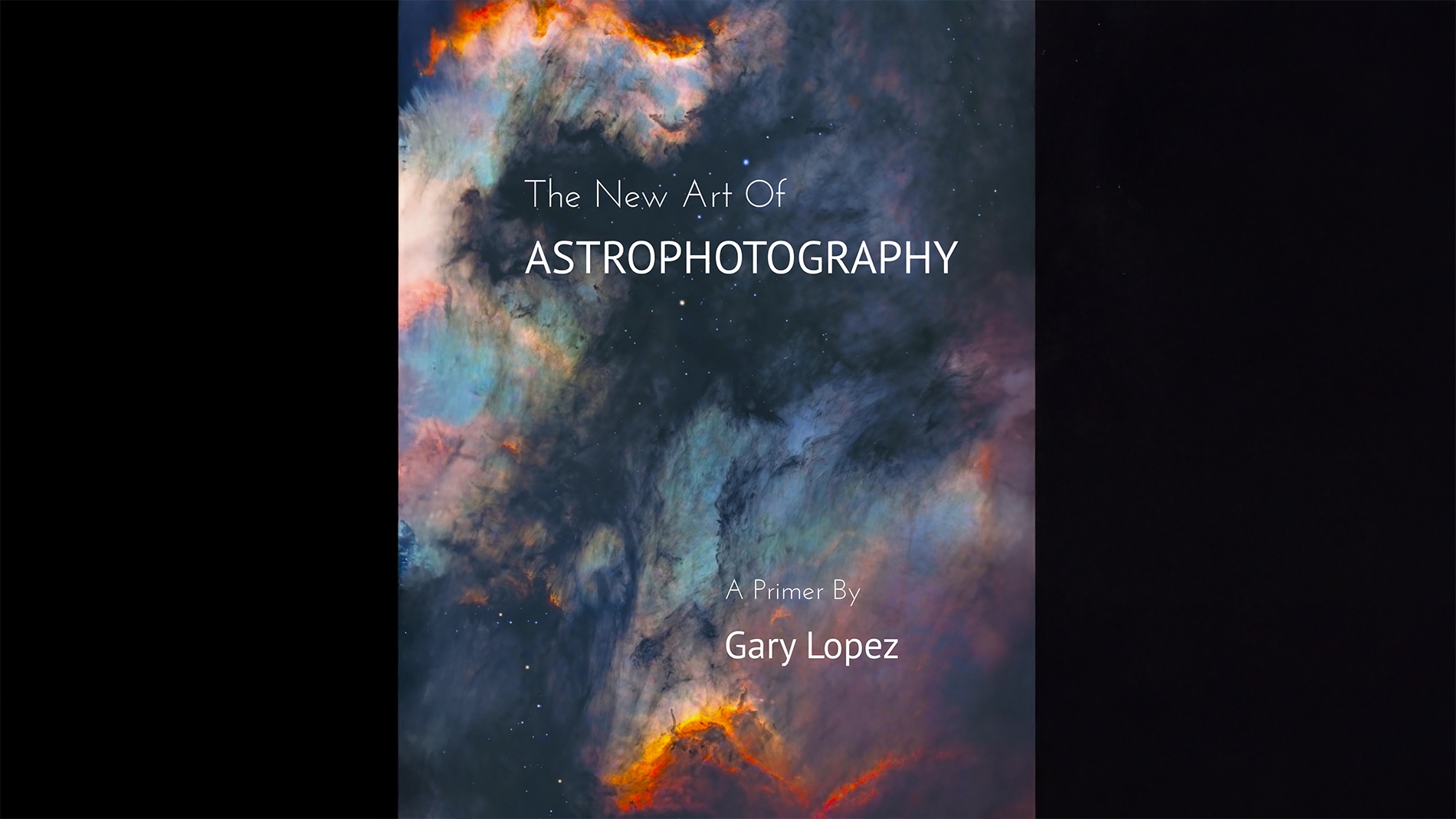
Gary Lopez and his new book, “The New Art of Astrophotography”. Source: https://www.garylopezphotography.com/copy-of-book-tales-told-by-ancient-l
His book, “The New Art of Astrophotography,” is redefining what it means to create art about the universe.
When Gary Lopez began work on The New Art of Astrophotography, he was venturing into largely uncharted space. Eight years of exploring the cosmos as a visual artist (not just a documentarian) had led him to a profound realization: for the first time in history, we have the tools to create true fine art about the universe itself.
As of July 2025, the book he published himself sits at #1 in Amazon’s astrophotography category, proof that there’s a growing audience ready to embrace a bold, imaginative rethinking of how we see the night sky.
A Self-Made Publishing Success
After being told by a traditional publisher that the audience for his work was “too small to justify,” Lopez took matters into his own hands. He designed the book himself using Adobe Acrobat, uploaded it through Kindle Direct Publishing, and relied on Amazon’s print on demand service to deliver globally.
“There are tens of thousands of people doing astrophotography,” Lopez says in a recent interview, “but not many trying to move it into the realm of fine art.” The book’s rapid rise in popularity, however, suggests that more are ready to follow.

From Code to Canvas
What makes The New Art of Astrophotography so distinct is its mission: to serve as a bridge between two creative worlds.
On one side are the astrophotographers, such as engineers, technologists, and scientists, who are deeply skilled in imaging but may lack grounding in visual composition. On the other are artists drawn to cosmic themes but intimidated by the technical learning curve of astronomical equipment.
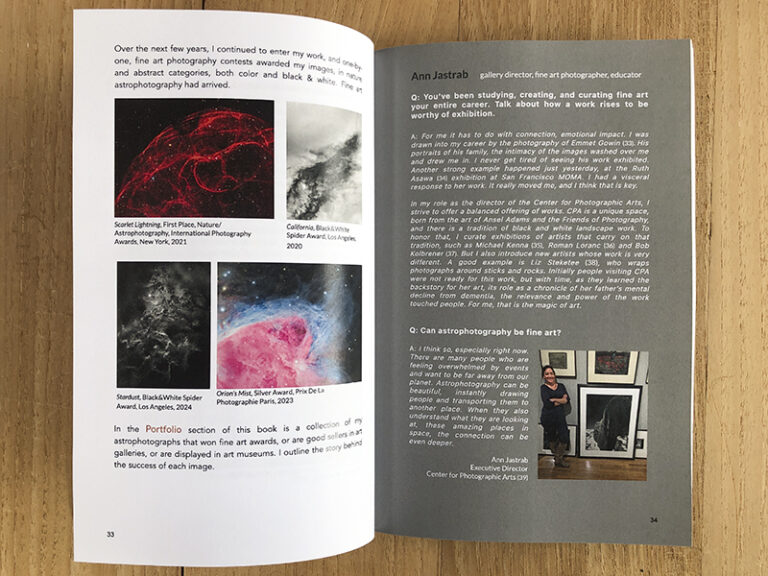
“Most of the people doing this are comfortable with technology,” Lopez explains. “and typically, don’t know anything about art.” His book fills that gap. It offers definitions, practical advice on what makes an image art, and guidance on how to approach galleries and collectors.
It also offers the reverse: technical walkthroughs for fine artists who want to capture the sky in their own visual language.
Science or Art? Yes.
Lopez doesn’t shy away from controversy. The second chapter of his book tackles a question that’s long divided the astrophotography community: Where does science end and art begin?
The difference, he argues, is in the intent.
“Science relies on repeatability. But with astrophotography, two people can process the exact same data and create wildly different results,” he says. “The choices in colorization, framing, contrast… that’s no longer science. That’s art.”
Even NASA images from the Hubble or James Webb Space Telescopes rely on visualizers to interpret raw data, assigning color and light balance to evoke beauty as well as clarity.
“You can do science with astrophotography,” Lopez adds, “but most people out there aren’t. They’re following their instincts. Their taste. Their intentions.”
Painting with Starlight
Recent advancements in imaging filters have made this artistic leap possible. Photographers can now isolate specific wavelengths, like sulfur at 672 nm (deep red), hydrogen at 656 nm, or oxygen at 500 nm (blue green), even in light polluted cities.
“You assign colors to each of these gases, layer them together, and you’re painting with light,” Lopez explains. “By shifting tonal ranges and rebalancing color palettes, you can create a sense of depth, motion, even emotion.”
For the first time, traditional fine art compositional techniques can be applied to the farthest reaches of space, blending craft and cosmos in unprecedented ways.
Composition in the Cosmos
One of the most overlooked elements in amateur astrophotography, Lopez notes, is composition. Too often, celestial objects are simply centered in the frame, like targets. Scientifically useful, yes, but visually static.
“A well composed image draws your eye through it,” Lopez says. “It is a visual narrative. It has rhythm and nuance.”
This is the shift from documentation to art: from recording what’s there to creating an emotional experience.
Astronomers as Unexpected Allies
Surprisingly, many professional scientists have embraced Lopez’s approach. Instead of seeing artistic processing as a distortion, they see it as a new form of outreach and expression.
Dr. Alex Woronow, a Harvard-educated astronomer, credits Lopez’s book and a quote from Edward Weston about daring to experiment with inspiring him to move from representational astrophotography to abstract interpretations of space.
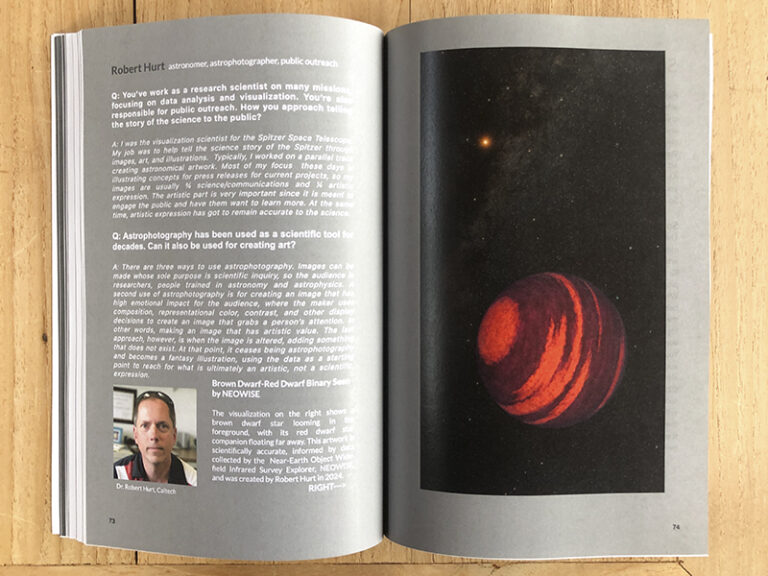
Dr. Robert Hurt, a Caltech astrophysicist and Spitzer Space Telescope visualizer, identifies three types of astro imagery: strict science, aesthetic engagement with scientific accuracy, and pure fantasy. Like Lopez, Hurt champions the second: images that balance truth with awe.
Printing the Universe
Creating these cosmic visuals onscreen is only part of Lopez’s practice. His commitment to fine art extends to physical presentation, where the challenge becomes translating transmitted light into printed form.
“You lose luminosity. Colors shift. It’s not simple,” he admits. “It can take me months to get a piece right.”
He uses a variety of techniques, from optical photographic printing face mounted to acrylic for depth, to textured watercolor paper for warmth and tactile presence. The scale of the work is ambitious. Some pieces stretch to 5 feet by 10 feet and sell for as much as $10,000. Even shipping can cost thousands.
But the effect is immersive. “You feel like you’re surrounded by the scene,” Lopez says.

A Global Lens on Wonder
Perhaps the most moving outcome of Lopez’s journey is the global community it’s connected him to.
“I know of people in 120 or more countries doing this,” he says. “After a while, you realize we’re all looking at the same sky.”
This shared perspective, he believes, dissolves boundaries. “The more we look outward, the clearer things become. Culture, language, religion, politics… they start to melt away.”
Beyond the Book: Immersive Futures
Lopez isn’t stopping at print. He’s working with the Chabot Space and Science Center in Oakland and partners in Melbourne to create immersive dome-based installations: spaces where audiences can step into nebulae, watch stars form, and literally walk through the universe.
His fine art is now represented by Gallery Sur in Carmel, CA on the West Coast and Waterfall Gallery in New York City.

A New Medium Is Born
The New Art of Astrophotography is more than a book: it’s a manifesto for a new kind of visual language.
For Lopez, the moment is historic.
“It’s the first time in human history we can make art about the cosmos in which we live (not just Earth, but the universe). How cool is that?”
For those willing to engage with both the science and the storytelling, he believes the field is wide open.
“If you’ve got the artistic skills and the patience to learn the tech, there’s no limit to what you can do.”
In an era where innovation often feels incremental, Gary Lopez is opening an entirely new frontier: one where science meets soul, and starlight becomes art.