
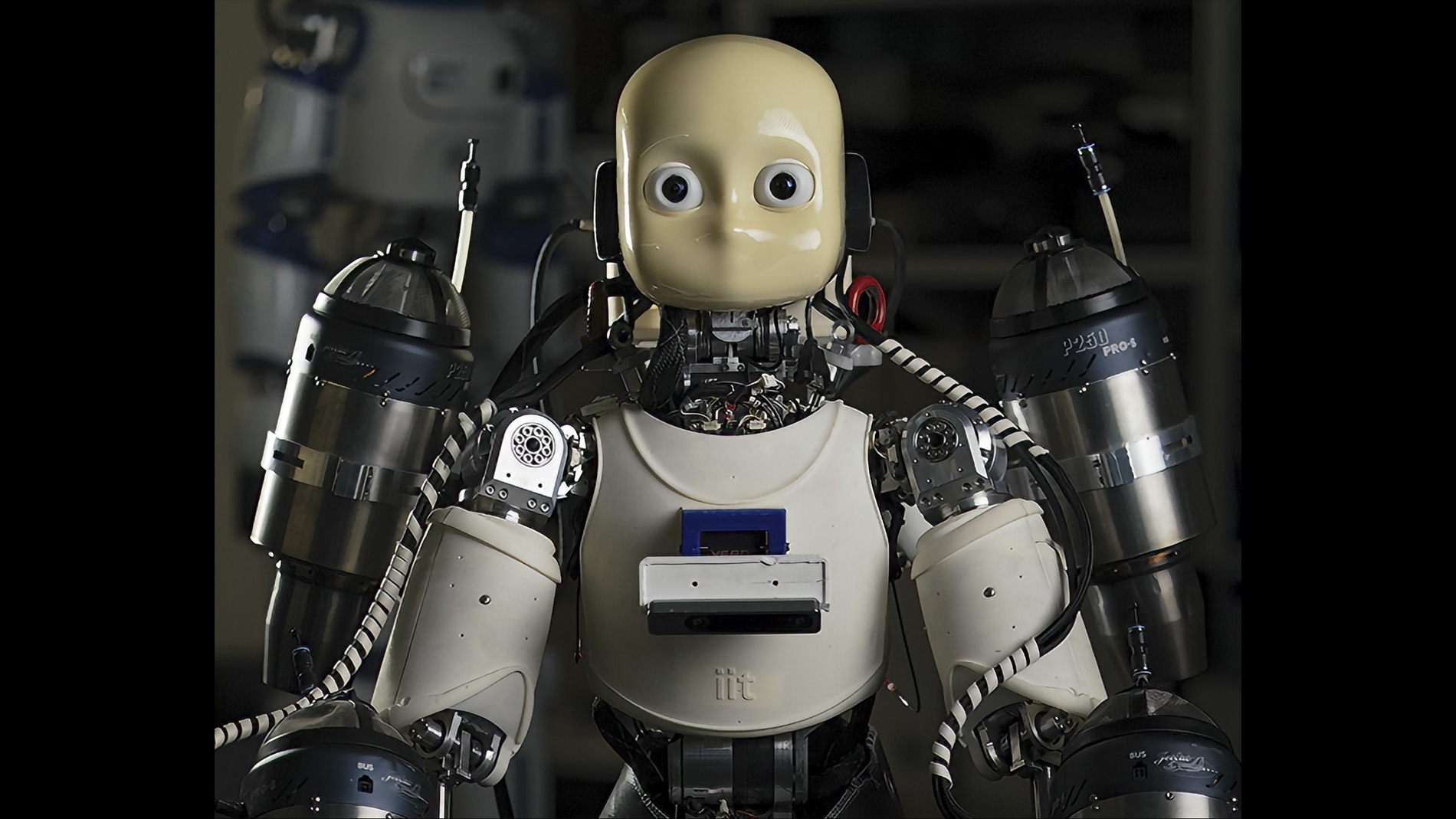

The world's first jet-powered humanoid robot has achieved flight, transforming science fiction into extraordinary reality
For generations, the image of a flying humanoid captured our collective imagination through comic book heroes and blockbuster films. Superman soaring through Metropolis, Iron Man blazing across the sky—these were the dreams that lived safely within the realm of fiction. Until June 18, 2025, when reality caught up with fantasy in a laboratory in Genoa, Italy.
On that historic day, researchers at the Italian Institute of Technology (IIT) achieved what many considered impossible: they launched iRonCub3, a 70-kilogram humanoid robot powered by its own jet propulsion system, into controlled flight. This achievement, with its technical details published in the prestigious journal Nature Communications Engineering, wasn’t a brief hover or unstable wobble. The robot rose a steady 50 centimeters off the ground with remarkable stability and precision, marking the birth of an entirely new category of machine.
Breaking the Laws of Flight
Creating a flying humanoid robot represents one of robotics’ most formidable challenges. Unlike the sleek, symmetrical design of traditional drones, the human form presents a nightmare of aerodynamic complexity. Picture trying to make a scarecrow fly: elongated limbs, an irregular silhouette, and a constantly shifting center of mass create conditions that seem to defy the very principles of stable flight.
“This research is fundamentally different from traditional humanoid robotics, forcing us to achieve a disruptive breakthrough beyond existing technology,” explains Daniele Pucci, Director of the Artificial and Mechanical Intelligence lab at IIT. His team faced a puzzle that required reimagining both the hardware and software foundations of robotics.
The solution came through radical innovation. iRonCub3 carries four micro-jet engines: two mounted on its arms like metallic wings, and two integrated into a sophisticated jetpack on its back. Together, these powerhouses generate over 1,000 Newtons of thrust, propelling superheated gases at nearly the speed of sound and reaching temperatures that would melt ordinary materials at 800 degrees Celsius.
To survive these extreme conditions, the entire robot underwent complete reconstruction. Engineers replaced its original spine with titanium and wrapped the machine in specialized heat-resistant shields. The result is a technological marvel that looks like it stepped out of a futuristic movie set, yet operates in our very real world.
The Mind Behind the Machine
Raw power alone cannot achieve stable flight. What truly sets iRonCub3 apart is its remarkable artificial intelligence, a digital brain capable of split-second decisions in three-dimensional space. Every microsecond, this system must balance thrust generation, position stabilization, and instant adaptation to environmental changes like wind gusts and atmospheric turbulence.
The development of this intelligence required unprecedented international collaboration. Working with teams from Stanford University and the Polytechnic University of Milan, IIT researchers trained advanced neural networks using vast databases of computer simulations and real-world flight data. These digital minds learned to predict and respond to the complex aerodynamic forces that constantly act upon the robot’s unusual form.
“Our model integrates neural networks trained on both simulation and experimental data, embedding them into the robot’s core control architecture to ensure stable flight,” explains Antonello Paolino, the study’s lead author who spent months at Stanford developing these breakthrough algorithms.
The challenge extends beyond simple balance. Every movement of an arm or shift in posture changes the airflow patterns around the robot’s body. iRonCub3’s control system must continuously calculate how each motion affects the physics of flight, transforming it from a simple flying machine into something far more sophisticated: an intelligent aerial being.

From Laboratory to Life-Saving Applications
This successful flight has opened doors to applications that seemed like pure fantasy just years ago. The unique combination of aerial mobility with human-like manipulation capabilities creates possibilities that traditional drones simply cannot match.
Imagine emergency responders deploying iRonCub3 into disaster zones where human access is impossible. The robot could navigate through the twisted wreckage of collapsed buildings, using its flight capabilities to reach survivors trapped in elevated locations while employing its dexterous hands to operate rescue equipment, open blocked passages, or deliver critical supplies.
Nuclear facilities present another compelling application. In the event of accidents or routine inspections in highly radioactive environments, iRonCub3 could fly through contaminated areas while manipulating valves, operating instruments, and performing complex maintenance tasks that would be lethal for human workers.
The robot’s versatility extends to exploration missions in extreme environments. From investigating volcanic craters to inspecting offshore oil platforms during storms, iRonCub3 represents a new class of robotic worker capable of combining the mobility of aircraft with the problem-solving capabilities of humanoid manipulators.
The Science of the Impossible
Behind iRonCub3’s historic flight lies a foundation of rigorous scientific research. The development process required breakthroughs in multiple disciplines: advanced computational fluid dynamics to understand airflow patterns, cutting-edge materials science to handle extreme temperatures, and revolutionary control algorithms to manage the complex interactions between jet propulsion and robotic movement.
A key innovation was the team’s “co-design” approach, where the robot’s physical form and control systems evolved together rather than separately. This holistic methodology allowed engineers to optimize every aspect of the machine simultaneously, considering aerodynamics, thermal management, and coordinated movement as components of a single, integrated system.
The research involved extensive wind tunnel testing, where engineers studied how air flows around the robot’s unusual shape under various flight conditions. Simultaneously, advanced computer simulations modeled the complex interactions between jet thrust, limb movement, and atmospheric forces. These virtual experiments generated the massive datasets needed to train the robot’s neural networks for real-world flight.
A Platform for Tomorrow
The successful development of iRonCub3 represents more than a technological achievement; it establishes a new paradigm for robotics research. This project demonstrates that with sufficient innovation and international collaboration, the boundaries between science fiction and engineering reality continue to blur.
As climate change increases the frequency and severity of natural disasters, and as human activities expand into increasingly hazardous environments, machines like iRonCub3 will play crucial roles in extending our capabilities into places too dangerous for direct human presence.
The robot’s development involved researchers from three countries, combining Italian engineering excellence with American artificial intelligence expertise and collaborative partnerships that span continents. This global approach to innovation suggests a future where the most challenging technological problems require international cooperation and shared knowledge.
Taking Flight into the Future
iRonCub3’s maiden flight lasted only moments, but its implications stretch far into the future. In the coming months, testing will expand to a dedicated facility at Genoa Airport, where the Italian Institute of Technology is establishing a comprehensive flight testing environment with all necessary safety protocols.
As Dr. Pucci notes, “This isn’t just a technological milestone; it’s a platform for the future.” The robot represents the first member of what may become an entire species of flying humanoid machines, each designed for specific applications in our increasingly complex world.
Other research centers worldwide are undoubtedly taking notice. iRonCub3 has proven that controlled humanoid flight is not only possible but practical. The question is no longer whether flying robots will join our workforce, but how quickly we can develop and deploy them to address humanity’s most pressing challenges.
In laboratories across the globe, the next generation of flying robots is already taking shape. iRonCub3 has shown us the way forward, transforming yesterday’s science fiction dreams into tomorrow’s life-saving reality. The age of flying humanoid robots has officially begun, and the sky is no longer the limit—it’s the next frontier.
*****
The research behind iRonCub3 has been published in Nature Communications Engineering, with additional technical details available in preprint on arXiv. The project represents collaboration between the Italian Institute of Technology, Stanford University, and the Polytechnic University of Milan.