
Listening to the Sun

What forty years of solar sound reveal beneath a surface no instrument can reach
Their study, conducted with Rachel Howe, Yvonne Elsworth, Steven J. Hale and Eleanor Murray, appeared in the Monthly Notices of the Royal Astronomical Society in 2026. Bill Chaplin and Sarbani Basu answered our questions together.
The Conversation
Bill Chaplin and Sarbani Basu The Sun resonates just like a musical instrument because of sound waves trapped in its interior. A good starting analogy is a wind instrument, like an oboe or a clarinet. There, one blows over the reed of the instrument. This creates changes in pressure in the air, which are sound waves. Those waves are trapped within the body of the instrument, and the waves with the correct wavelengths reinforce one another to form what we call standing waves. These are the natural resonances of the instrument, and so we hear the instrument produce sound at these natural harmonics.
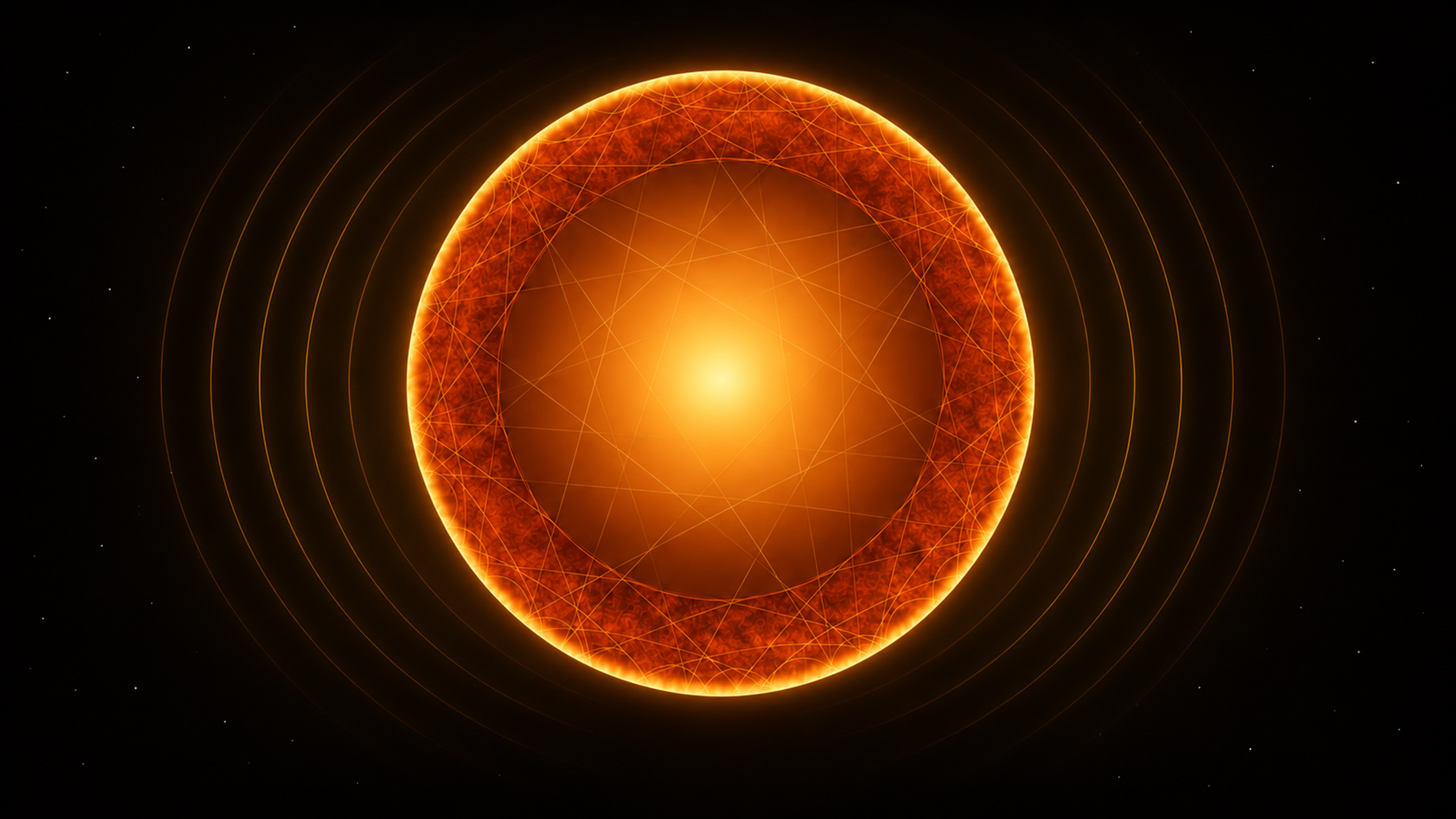
We can carry this analogy to the Sun. There, sound is made naturally just beneath the visible surface, where there is a great deal of turbulence, that is, changes in pressure in the gas. Even though the Sun does not have solid edges (it is a large ball of hot, ionized gas), it nevertheless acts as a natural cavity that traps this sound. Those trapped waves with the correct properties set up standing waves in the solar interior, and so the Sun resonates at its natural harmonics.
We cannot listen to the Sun the way we listen to a musical instrument, but those trapped standing waves make the Sun oscillate, breathing in and out, at the frequencies of its natural resonances. By detecting the Sun’s oscillations, we can obtain the same information we would get by listening to an instrument.
Measuring the resonant frequencies of a wind instrument tells us about its structure, its size and the gas inside it, usually air. A piccolo trumpet, for example, resonates at higher tones than a big tuba. If you flushed the air out of an instrument and replaced it with lighter helium, the instrument would play higher-pitched tones. In the same way, the resonant frequencies of a star tell us about its size and its internal structure.
Bill Chaplin and Sarbani Basu Cycle 24 was weaker in sunspot counts than Cycle 25. But it is true that Cycle 25 has been weaker than Cycles 23, 22 and 21.
The two observables are telling us about related but complementary things. Sunspots are dark regions on the Sun that mark where strong magnetic fields penetrate the visible surface from below. Sunspot numbers therefore tell us how much of that strong field is rising through the outer layers of the interior all the way to the surface and beyond.
The Sun’s oscillations respond to the magnetic field in the interior. We know there is a reservoir of field beneath the surface that the oscillation modes “see,” but not all of that field emerges in the form of spots.
Bill Chaplin and Sarbani Basu That is a very good question, and any answer would be speculative at best. The simple fact is that we do not yet understand how the solar dynamo actually works. There is even disagreement as to where the dynamo is located. Many dynamo models place it deep inside the Sun, where the turbulent convection zone gives way to the placid radiative zone. Another set of models places it in the outer five percent of the Sun, in the so-called near-surface shear layer, where the Sun’s rotation increases inwards. Neither kind of model is yet in a position to give specific answers.
We are, of course, hampered by the fact that our data sets are relatively short: a comprehensive sunspot record of about 400 years, and helioseismic data for only 40 years. If the helioseismic record were as long as the sunspot record, we are sure we would have better answers by now.
Bill Chaplin and Sarbani Basu It is certainly true that we can only make statements about changes on timescales comparable to or shorter than the length of the BiSON dataset. However, that dataset is unprecedentedly long for helioseismology. Moreover, seeing changes that appear to span multiple solar cycles is a potentially significant finding, and it reinforces the point that one solar cycle is not like another.
So here, a “genuine shift” means one on a timescale of several decades. To confirm that this is a systematic change, we need BiSON to continue collecting data so that we can see what happens over the remainder of this cycle and the ones that follow.
Bill Chaplin and Sarbani Basu BiSON was started by Professor George Isaak and colleagues. In the early 1970s, George was developing an instrument to detect planets around other stars using the “Doppler wobble” method, that is, by detecting the motion of a star as it is pulled gravitationally by any planets it might host. He knew that stars are inherently noisy, and that this noise could drown out the signal from a planet. So he decided to test his instrument on the Sun, to measure the levels of noise. Those observations revealed a persistent periodic signal with a period of around five minutes. After several years, George and his colleagues were able to verify that they had discovered oscillations of the Sun as a whole.
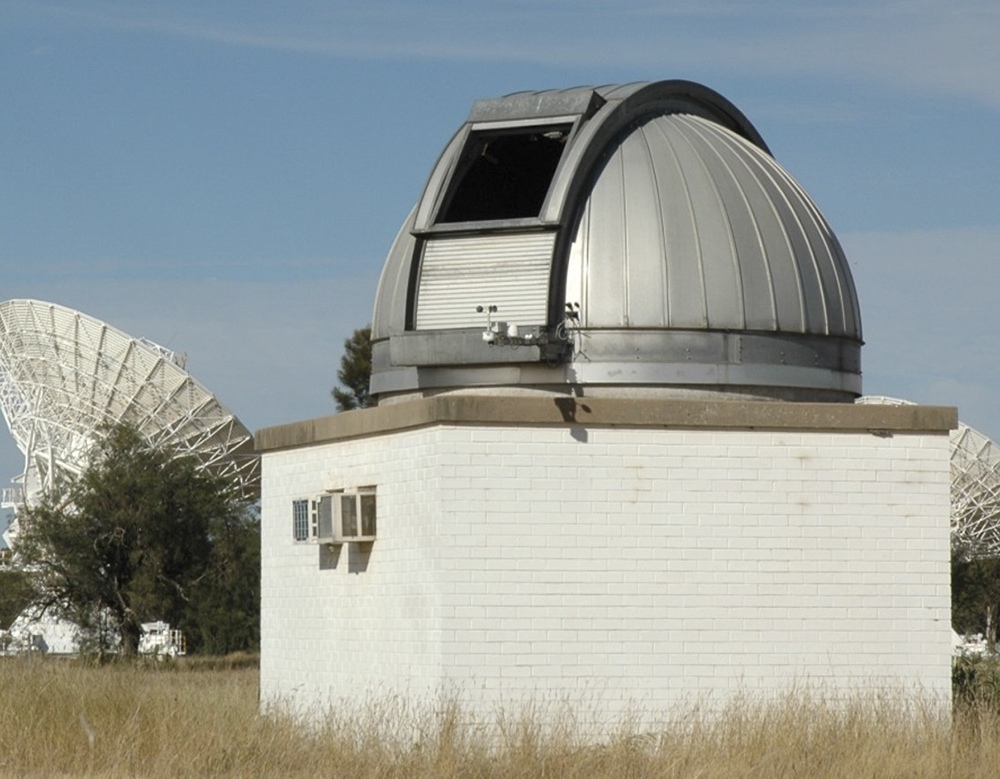
This led George to switch his focus. With colleagues including Yvonne Elsworth, Roger New and Clive McLeod, he set up BiSON to provide continuous observations of the Sun’s “whole Sun” oscillations. It was one of the first robotic, automated telescope networks anywhere, and it has operated as a global network since the early 1990s.
Over the years, and particularly in the past few years, the instruments and systems have been upgraded so that we can continue to collect these valuable, scientifically rich data. The people involved have also changed, and BiSON remains a world-leading project.
Bill Chaplin and Sarbani Basu A long-term record like the one BiSON provides is incredibly valuable, and it opens up science that would not otherwise be possible. It is genuinely a unique record.
Our view of the Sun has been shaped largely by the data available since the development of ground-based telescopes and instruments and the advent of satellite observations. But even over this period, we have seen marked changes in the levels of activity the Sun shows from one cycle to the next.
Helioseismic observations like those of BiSON allow us to see inside the Sun, and continuing them is essential to understanding the changes we are seeing in the Sun’s activity.
Bill Chaplin and Sarbani Basu The Sun is in many respects a Rosetta stone for stellar astrophysics, because of the privileged view we have of it. We can observe and study it to levels of detail that are not possible for other Sun-like stars. Understanding the Sun therefore helps us make sense of what we observe in distant stars, where the data are inevitably more limited. That solar-stellar connection is vital.
The Sun also helps us develop, test and validate analysis tools for asteroseismology, the study of other stars through their oscillations. We do this by applying those tools to helioseismic data collected by observing the Sun as if it were a distant star: without resolving an image of it, treating it simply as a point of light. These “Sun as a star” data are what BiSON collects. BiSON data have therefore played a role in developing the tools we have applied to Sun-like stars observed by NASA’s Kepler and TESS missions, and that we will apply to stars observed by the European Space Agency’s PLATO mission after it launches in 2027.
Bill Chaplin and Sarbani Basu It has certainly made us appreciate the rich information that can be gleaned from measuring the natural resonances of an object. Helioseismology has opened an unprecedented view of the solar interior. While it was previously possible to build reasonable models of stars from what we could observe at their surfaces, those models have since been shown to be inaccurate or lacking in important ways.
Bill Chaplin and Sarbani Basu What we always find surprising is the extent to which helioseismic data provide such an exquisite probe of the Sun’s interior structure and of how it changes over time.
Historically, helioseismology has given us a surprising and unexpected picture of rotation inside the Sun, and it has also made it possible to test fundamental physics.
Bill Chaplin and Sarbani Basu We would ask the Sun: “Please explain how your dynamo mechanism really works.”
Conclusion
For four hundred years, we have read the Sun by its surface. The BiSON record shows how much that reading leaves out. A star can look calmer by one measure while ringing as strongly as ever beneath, and the difference only becomes audible to those who keep “listening” long enough. What the Sun is doing in its thin outer skin, and whether Cycle 26 will confirm it, remains an open question. Answering it will take something science rarely rewards: patience measured in decades.
Explore Further
The Study
The study behind this interview analyses nearly forty years of BiSON’s “Sun as a star” observations, from 1987 to 2025, and finds that the structural changes behind the solar cycle have become increasingly confined near the Sun’s surface since Cycle 22.
The Paper Chaplin, W. J., Basu, S., Howe, R., Elsworth, Y., Hale, S. J., and Murray, E. (2026). “Sub-surface structural changes associated with successive 11-yr solar activity cycles have been progressively more confined near the surface: new helioseismic results on Cycles 22 to 25 from BiSON.” Monthly Notices of the Royal Astronomical Society, 549(2), id.stag847, 5pp. Read the paper
William Chaplin
His University of Birmingham profile, covering his research on the Sun and Sun-like stars, his role with BiSON, and his publications.
The Researcher University of Birmingham profile
The Sun in Transition?
An earlier BiSON study, led by co-author Rachel Howe, first reported that the near-surface changes seen in Cycle 23 persisted into Cycle 24, laying the groundwork for the new findings.
Earlier Research Howe, R., et al. (2017). “The Sun in transition? Persistence of near-surface structural changes through Cycle 24.” Monthly Notices of the Royal Astronomical Society, 470(2), 1935–1942. Read the research
About the Researchers
Bill Chaplin is Professor of Astrophysics at the University of Birmingham. He has been Principal Investigator of the Birmingham Solar-Oscillations Network (BiSON) since 2014, and he has held leadership roles in the asteroseismology programmes of NASA’s Kepler and TESS missions and ESA’s PLATO mission. He received the Institute of Physics Fred Hoyle Medal and Prize in 2020, and the Royal Astronomical Society Harold Jeffreys Lectureship prize in 2012.
Sarbani Basu is the William K. Lanman, Jr. Professor of Astronomy at Yale University, where she has taught since 2000. She has been honoured with the Vainu Bappu Gold Medal of the Astronomical Society of India and the George Ellery Hale Prize of the American Astronomical Society’s Solar Physics Division for her work in helio- and asteroseismology. She is a Fellow of the American Association for the Advancement of Science and of the American Astronomical Society. With Bill Chaplin, she co-authored Asteroseismic Data Analysis: Foundations and Techniques (Princeton University Press, 2017).