
How Lina Ghotmeh filled a Baroque courtyard with memory, movement, and pink
There is a particular challenge in designing for a space that already knows what it is. The Cortile d'Onore of Palazzo Litta in Milan — a Baroque courtyard framed by colonnades, long accustomed to ceremony and civic spectacle — does not yield easily to new interventions. Its symmetry is a kind of argument. Its proportions insist on a certain decorum.
Lina Ghotmeh did not argue back. She filled the courtyard with a labyrinth in multiple shades of pink.
The result — Metamorphosis in Motion, commissioned by MoscaPartners for Milan Design Week 2026 — is Ghotmeh's first site-specific outdoor work in Italy, and one of the most quietly radical installations of this year's fair. It does not compete with Palazzo Litta. It inhabits it, in the way that memory inhabits a place: present, insistent, and impossible to dismiss.
The Work
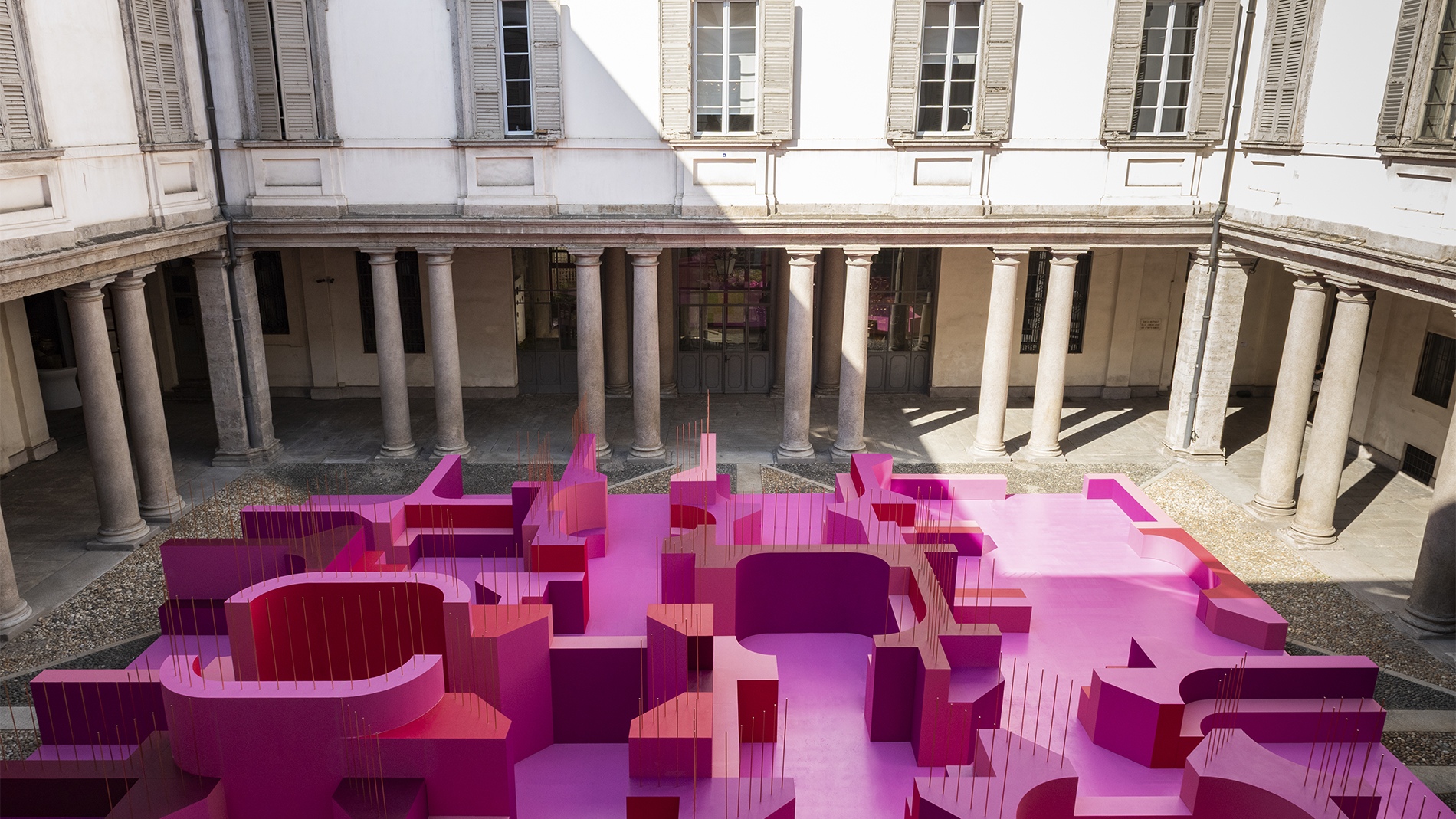
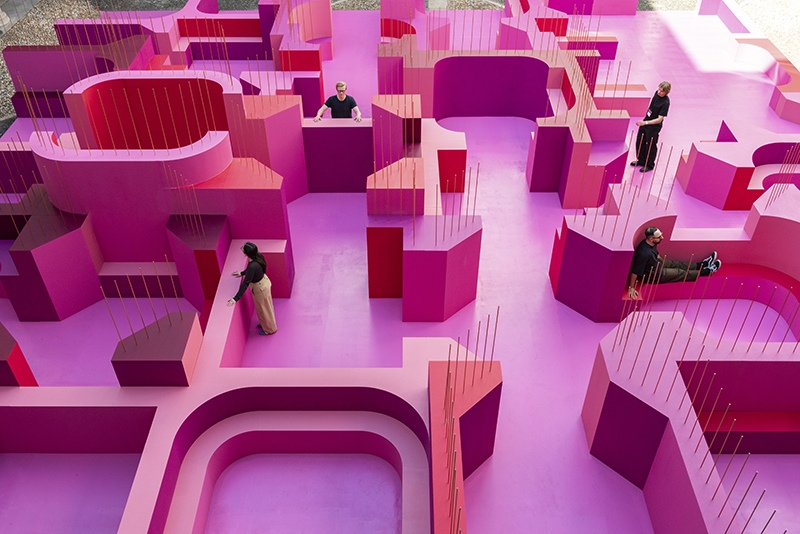
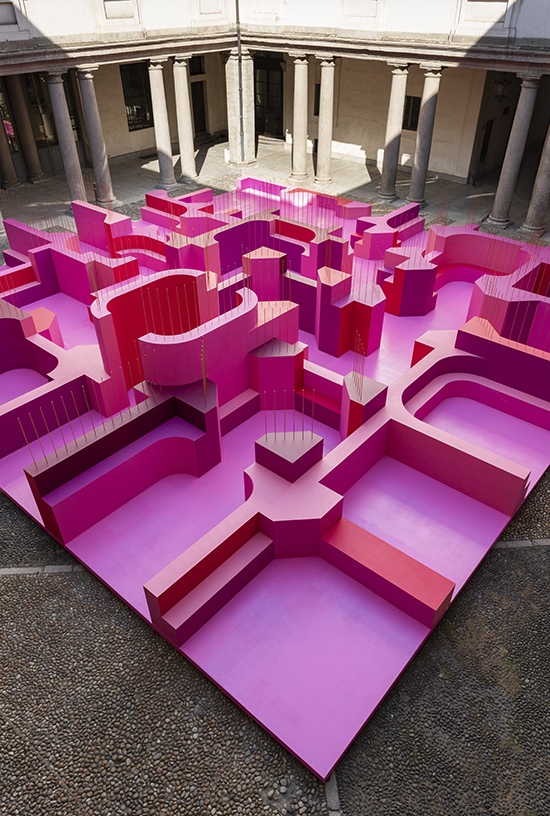
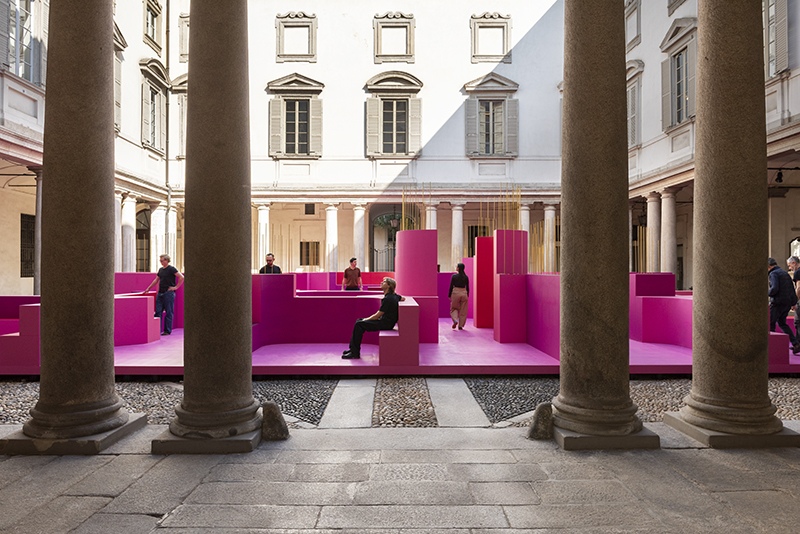
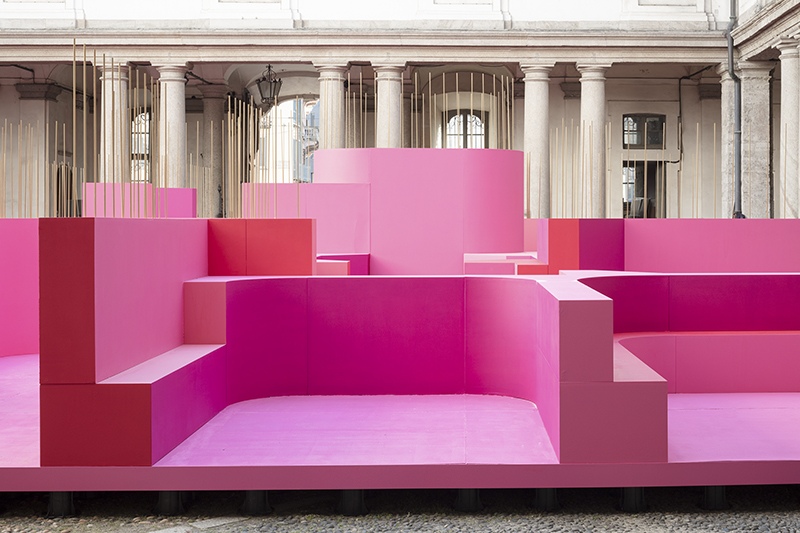
The labyrinth occupies 17 metres per side. Eighteen modular units of MDF, finished in Milesi Vernici coatings in varying textures and shades of pink — from pale lavender-rose to deep magenta and crimson — articulate a pathway that rises, descends, curves, and opens into chambers before narrowing again. Vertical golden rods ascend from the platform at irregular intervals, catching and scattering the Milanese light.
From above, the installation reads as a planimetric abstraction: part architectural plan, part topographic contour, part something that resists categorisation entirely. The curved walls introduce a vocabulary that the courtyard's straight lines and right angles do not share. The colour refuses to recede. And yet the whole composition feels inevitable, as though the palazzo had been waiting for exactly this interruption.
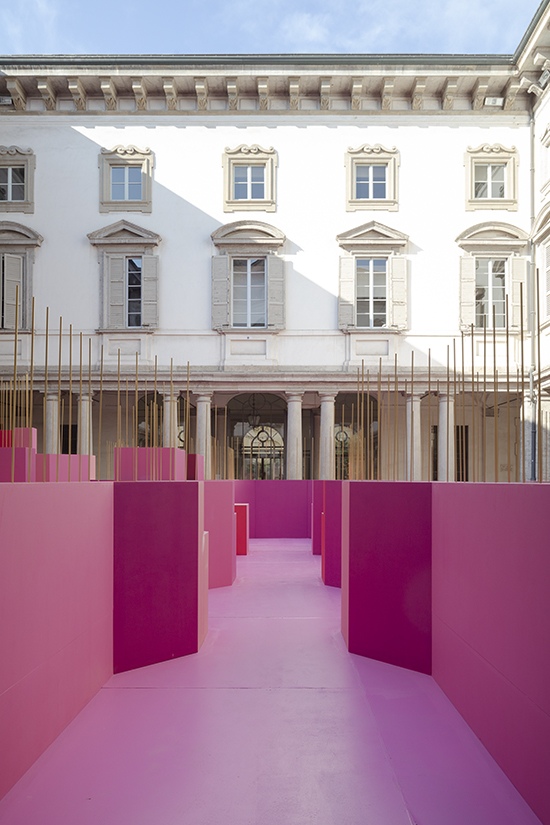
The photographs by Nathalie Krag and Takumi Ota capture this quality with precision. In the elevated views, the labyrinth appears as a dense, saturated field laid into the courtyard's pale stone surround — a chromatic event within a neutral frame. At ground level, from inside the installation itself, the scale shifts entirely. The walls rise to shoulder height. The golden rods multiply overhead. The courtyard's Baroque facade is visible only in fragments, glimpsed above the pink partitions. The visitor is no longer looking at the installation from outside. They are inside a space that moves.
The Philosophy
Ghotmeh has described her architectural practice as the Archaeology of the Future — a method that reads the historical and cultural layers embedded in a site and uses them as the material for what comes next. The practice is not one of preservation or imitation. It is one of excavation and activation: finding what is latent in a place and drawing it forward into a new spatial reality.
At Palazzo Litta, that latency is substantial. The courtyard has served for centuries as a threshold — the place where the city met the palace, where public ceremony and private life touched. It was a scenographic space before it was anything else, designed to frame entrances and orchestrate encounters. Ghotmeh's installation does not contradict that history. It extends it.
Metamorphosis in Motion is structured as a sequence of functional and sensory zones — seating areas, a dedicated talk space, a meditative chamber, an immersive sound area, and an olfactory experience curated by Scent Company using notes of cypress, frankincense, and cedar, chosen to evoke Lebanon, Ghotmeh's homeland. Each zone is defined by the modular walls rather than by enclosure, so the boundaries between them are permeable and continuously negotiated by movement. The labyrinth is not a puzzle to be solved. It is a landscape to be traversed at one's own pace, in one's own direction, with one's own encounters arising along the way.
That choreographic logic — movement as the primary medium of spatial experience — is central to Ghotmeh's thinking. Architecture, in her practice, is not primarily about form or even about programme. It is about what happens to a person moving through it: what they notice, what they feel, what they remember. The labyrinth at Palazzo Litta is designed to produce not a fixed experience but a variable one, different for every body that enters it.
The Colour
The pink requires a separate consideration.
It is easy to read Ghotmeh's choice of colour as a gesture toward softness or spectacle — the kind of reading that Milan Design Week, with its appetite for the photographable, habitually encourages. That reading is not entirely wrong. The installation photographs extraordinarily well, and its presence in the courtyard is unmissable.
But the pink in Metamorphosis in Motion is more precisely a chromatic argument about time and memory. The tones range across a spectrum — from the pale, almost dusty pink of worn surfaces and faded interiors, through the saturated magenta of something urgently present, to the deep crimson that is almost a bruise. That range is not decorative. It traces a temporal arc: something that was once vivid, has persisted, and is still alive. The colour is the memory of colour.
Ghotmeh has worked extensively with sites that carry deep historical and cultural accumulation — Beirut foremost among them, but also Venice, Rome, London, and now Milan. In each case, her architecture operates through contrast and layering rather than continuity. The new is legible as new. But it is in conversation with what it stands beside, and that conversation is the substance of the work.
At Palazzo Litta, the pink labyrinth and the white Baroque facade do not blend. They speak to each other from a distance that is precisely calibrated. The distance is the meaning.
The Context
Metamorphosis in Motion was commissioned as the conceptual centrepiece of MoscaPartners Variations 2026, the annual collective exhibition curated by Caterina Mosca and Valerio Castelli that brings together architects, designers, and international brands from across eleven countries. The edition's theme, Metamorphosis, frames transformation not as aesthetic spectacle but as a condition of design itself — an ongoing adaptation to changing materials, technologies, and environmental realities.
Ghotmeh's installation gives that theme its most precise architectural expression. A labyrinth is always already about transformation: the space changes as you move through it, your position within it changes your understanding of it, and the experience of arrival — when you find your way through — is qualitatively different from the experience of entry. There is no neutral position inside a labyrinth. There is only the next choice.
Ghotmeh is currently working on the renovation of the British Museum's western range, was named to the TIME100 Next 2025 list, and received the Gold Award for Best Architecture and Landscape for the Bahrain Pavilion at Expo 2025 Osaka. Metamorphosis in Motion is her first site-specific outdoor work in Italy, and in the context of Milan Design Week 2026 it stands as one of the most considered architectural propositions the fair has produced in recent years.
Not because it is the largest or the most technically ambitious. But because it understands — with a quiet confidence that is very difficult to achieve — that the best way to transform a space is to give it something it was already ready for.