
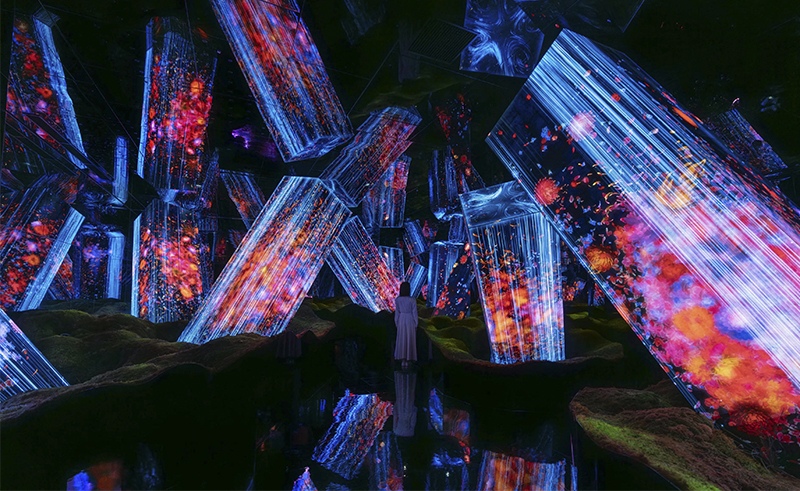
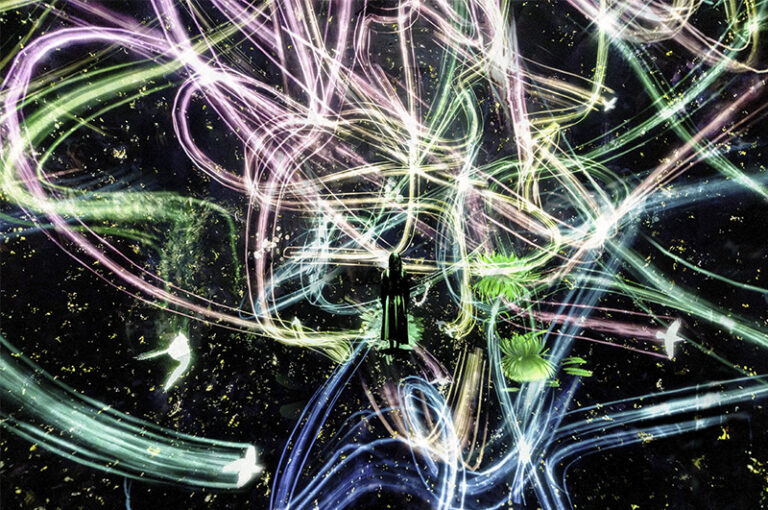
teamLab, Massless Amorphous Sculpture, 2020-, Installation, Sound: Hideaki Takahashi © teamLab, courtesy Pace Gallery
teamLab's largest exhibition in Japan opened October 7, 2025, featuring over 50 artworks across 10,000 square meters in Kyoto's Minami-ku district
A groundbreaking art experience opens on October 7, 2025, in Kyoto’s Minami ku district, within walking distance of Kyoto Station. The internationally renowned art collective teamLab, established in 2001, unveils teamLab Biovortex Kyoto, a permanent immersive museum that is part of the Kyoto Station Southeast Area Project. Spanning over 10,000 square meters, this museum marks teamLab’s largest exhibition in Japan, showcasing more than 50 art pieces. This innovative space fundamentally redefines art: its works are no longer physical objects but dynamic perceptual phenomena. Rooted in the concept of environmental phenomena, the idea is that the very environment generating various phenomena allows the artwork to exist. Here, visitors are invited to step inside the artworks, experiencing a dissolution of boundaries between the environment, the artwork, and themselves within a living, ever evolving biocosmos.
Transcending Boundaries Through Art and Technology
teamLab’s collaborative practice navigates the confluence of art, science, technology, and the natural world. This interdisciplinary group of specialists, including artists, programmers, engineers, CG animators, mathematicians, and architects, aims to explore the relationship between the self and the world, seeking new forms of perception. The collective challenges how people naturally separate the world into independent entities with perceived boundaries, instead proposing that everything exists in a long, fragile yet miraculous, borderless continuity.
The museum represents a bold experiment in what teamLab calls “High Order Sculpture” and “Cognitive Sculpture,” terms that describe artworks existing not as solid objects but as manifestations of energy patterns and perceptual phenomena. Unlike traditional museums where visitors maintain distance from displayed objects, teamLab Biovortex Kyoto encourages complete physical immersion, creating experiences where the boundaries between artwork, environment, and viewer dissolve.
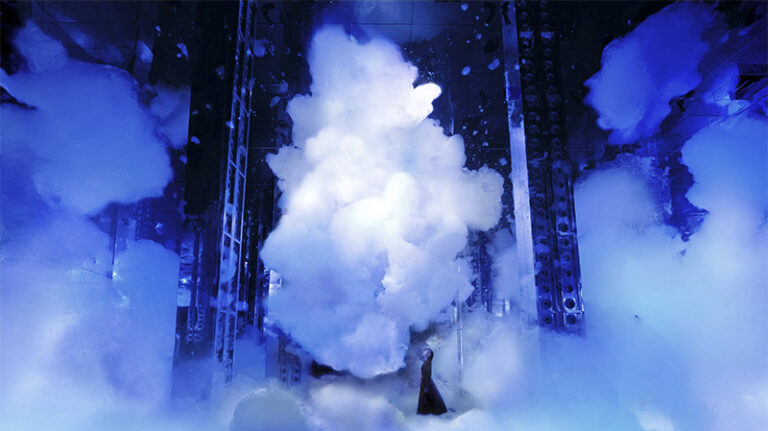
Massless Amorphous Sculpture: A Shifting Vortex
Among the most ambitious installations is Massless Amorphous Sculpture, an artwork that has never been exhibited in Japan before. This floating form emerges from a sea of soap bubbles, hovering mid-air. It neither sinks nor rises, its shape constantly morphing as it fragments and reforms. Unlike a stone that remains unchanged in isolation, this sculpture exists as a vortex, inseparable from its environment.
The work operates on principles fundamentally different from conventional sculpture. “Objects such as stones and man-made creations maintain a stable structure independently,” teamLab explains. “A stone, for instance, will remain unchanged even if placed in a sealed box, isolated from the outside world.” In contrast, the Massless Amorphous Sculpture behaves like a vortex in the ocean, an existence that cannot be separated from its environment. If visitors break the sculpture, it naturally restores itself, though destruction beyond a certain threshold causes irreparable collapse.
Physical human actions prove ineffective against this floating form. Visitors cannot push or move the sculpture through force, and attempts to stir up wind cause it to disperse entirely. The sculpture exists through what teamLab terms “the order of energy generated by the phenomena of a unique environment,” created by filling the space with soap bubbles to establish conditions where this massive form can float steadily mid-air. This dynamic creation challenges traditional notions of sculpture, embodying a fluid, living presence.
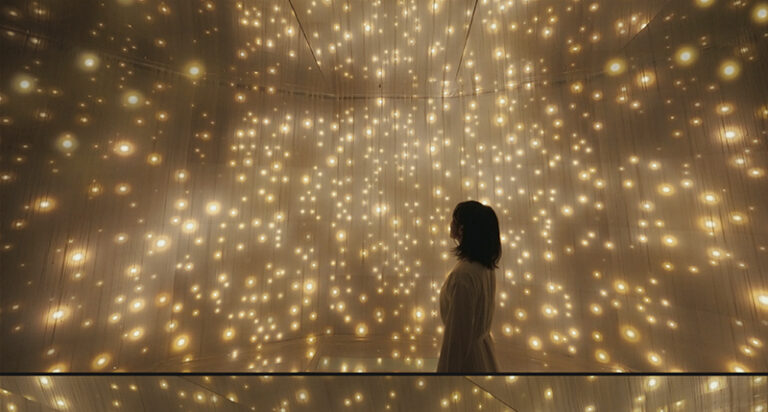
Massless Suns and Dark Suns: Light as Perception
Massless Suns and Dark Suns explores the paradox of perception. Countless spheres of light float in space, glowing brighter when touched and triggering responses in nearby spheres. Yet widening one’s field of vision reveals dark spheres as well, as if darkness itself has solidified.
The twist: neither the light spheres nor the dark spheres actually exist as physical objects. The dark spheres cannot even be captured by cameras. The light spheres contain no glass or material substance on their surfaces, being composed purely of light without material boundaries. “In this universe, light does not solidify, and light alone does not become a spherical mass,” teamLab notes. “In other words, this sphere of light does not exist.”
teamLab categorizes these as “Cognitive Sculptures” that exist only in the realm of perception. The materials are light, environment, body, and perception itself. The sculpture is shaped by the dynamic body and perception of each viewer, appearing and existing uniquely in their perceptual world. This work questions fundamental notions of existence: if something appears real to perception, does it exist? Can something that doesn’t exist physically still be considered a sculpture?

Morphing Continuum: Unity Across Time and Space
Morphing Continuum introduces another layer of conceptual complexity. This installation demonstrates how structural order can create unified entities even when individual elements are separated in space and time. Sculptural forms emerge on the ground, rise upward, or appear mid-air without support, their glowing, shifting boundaries made of countless spheres.
Like the other installations, these forms have ambiguous boundaries composed of continuously changing glowing spheres. Visitors can immerse themselves fully without destroying the sculpture’s existence. If broken, it naturally restores itself. Physical attempts to move or push these floating entities fail completely.
The installation embodies what teamLab describes as a “living universe, a biocosmos” where spatiotemporal existence is part of the whole, appears from the whole, and returns to it. Despite significant changes in shape, size, or even complete replacement of elements, the singular existence maintains itself through structural order rather than material continuity. These entities exist through structural order, not material substance, resembling a living universe where parts connect across space and time.
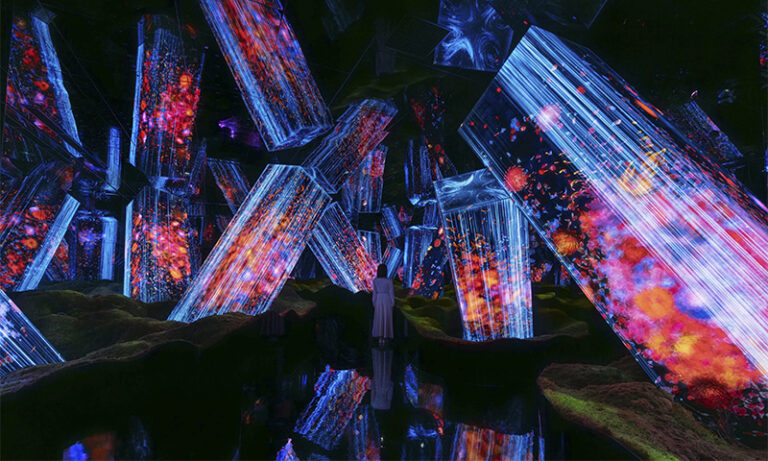
New Installations: Megaliths and Transient Abstract Life
Among the newly unveiled works are Megaliths and Transient Abstract Life and Return, adding to the museum’s exploration of existence and perception. These installations continue teamLab’s investigation into how artworks can exist through environmental phenomena rather than as fixed physical objects.
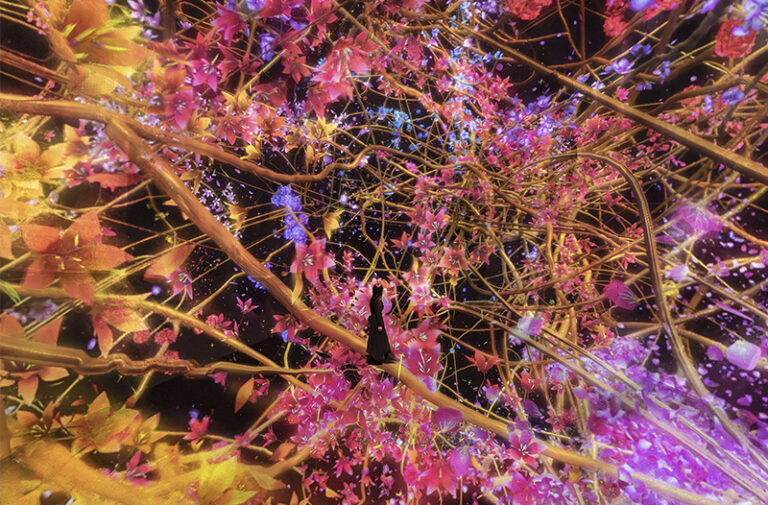
Traces of Life: Art Born from Presence
In contrast to the floating, self-sustaining sculptures, Traces of Life requires human presence to exist at all. The artwork space activates when visitors enter, their movements leaving glowing traces that form long trajectories. These traces coalesce into a singular, dynamic existence, but without people, the space remains empty. Nothing will ever be depicted.
Visitors are not just observers but co-creators, their presence shaping a world that exists only through their interaction. This work underscores teamLab’s vision of art as a collaborative, living process, where the world of the artwork is created entirely through people’s existence, reflecting the collective’s core belief in exploring the continuity of time and the relationship between self and world.
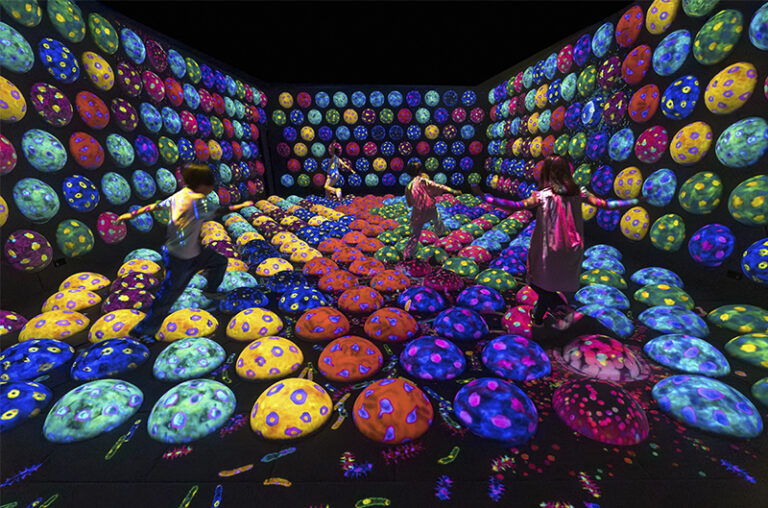
Educational Spaces: Athletics Forest and Future Park
Beyond the contemplative installations, teamLab Biovortex Kyoto includes Athletics Forest, a complex, multi-dimensional creative athletic space, and Future Park, a collaborative space for co-creation. Both are part of teamLab’s educational projects, designed to engage visitors in active participation and creative exploration. These spaces complement the museum’s philosophical installations by offering hands-on experiences that blur the lines between play, learning, and artistic creation.
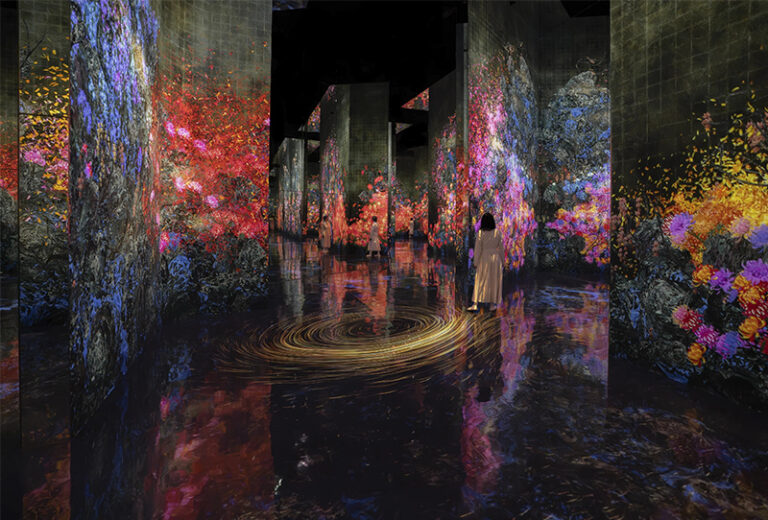
A Cultural Beacon for Kyoto
teamLab Biovortex Kyoto emerged from collaboration between several companies based in Kyoto and Osaka, establishing and operating the facility on city-owned land in the southeastern area of Kyoto Station. The complex aims to be a “creative hub for generating and disseminating new value,” featuring teamLab’s art museum alongside an art center and other cultural attractions.
The project aligns with Kyoto City’s vision for urban development centered around culture, art, and youth. As representative for this endeavor, teamLab works alongside partner companies with strong ties to the Kyoto and Osaka regions, leveraging local connections to create something that serves both the immediate community and international visitors drawn to Kyoto’s cultural offerings.
This addition to Kyoto joins teamLab’s growing roster of permanent installations worldwide. The collective’s museums and large-scale exhibitions include teamLab Borderless and teamLab Planets in Tokyo, teamLab Phenomena Abu Dhabi, teamLab Borderless Jeddah, and teamLab SuperNature Macao, with teamLab Borderless Hamburg opening soon. teamLab’s works are held in permanent collections at institutions including the National Gallery of Victoria, Art Gallery of New South Wales, Museum of Contemporary Art Los Angeles, and Asia Society Museum New York, among others.
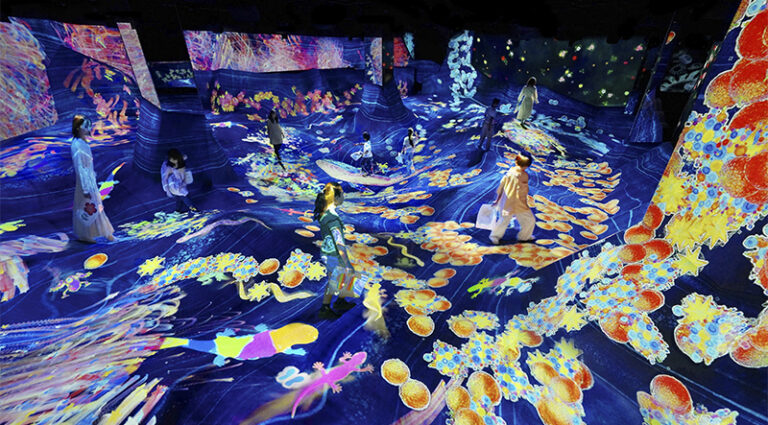
Redefining the Art Experience
What distinguishes teamLab Biovortex Kyoto from traditional museums is its fundamental reconception of the relationship between artwork, space, and viewer. Rather than objects to be observed from a distance, these installations are environments to be entered, phenomena to be experienced, and in some cases, perceptual events that exist only through the act of experiencing them.
The museum’s concept of Environmental Phenomena suggests that artworks do not exist independently but are caused to exist by the environment that produces various phenomena. Like biological organisms or meteorological phenomena, these artworks maintain themselves through continuous exchange with their environment, emerging from specific conditions and dissolving when those conditions change.
teamLab’s theoretical framework challenges Western assumptions about art and existence inherited from centuries of object-based sculpture and painting. By creating works that float without support, exist without matter, restore themselves when damaged, and appear differently to each viewer, the collective pushes toward forms of art that resemble natural phenomena more than crafted objects. This approach reflects the collective’s fundamental mission: to transcend boundaries in our perceptions of the world and reveal the borderless continuity of existence.
Plan Your Visit
teamLab Biovortex Kyoto opened on October 7, 2025, with tickets available on the official website. Located within walking distance of Kyoto Station, the museum adds a distinctive voice to Kyoto’s rich cultural landscape, complementing the city’s historic temples and gardens with radically contemporary explorations of perception, technology, and existence.
For visitors accustomed to traditional museums, teamLab Biovortex Kyoto requires adjustment. Success here means abandoning expectations of viewing art from a respectful distance. Instead, the museum invites complete immersion, encouraging visitors to walk through, touch, and become part of works that blur every boundary between observer and observed, between artwork and environment, and between what exists physically and what exists perceptually.
With more than 50 artworks spanning over 10,000 square meters, teamLab Biovortex Kyoto represents the collective’s most ambitious project in Japan. This is not just art to see, but a universe to inhabit, where existence and perception merge into a single, transformative experience. Represented by Pace Gallery, Martin Browne Contemporary, and Ikkan Art, teamLab continues to expand the possibilities of what art can be, inviting audiences to experience the world as a continuous, borderless whole.