
The First Sugar Between the Stars
Izaskun Jiménez-Serra on finding a fragile molecule near the heart of the galaxy, and what it may have carried to the early Earth
For much of modern astrochemistry, the formation of molecules has been understood as a gradual process. Simple compounds form first. Slightly larger molecules emerge by adding one carbon atom after another. Over millions of years, complexity slowly accumulates.
It is an orderly picture, and in many cases, a remarkably successful one.
Yet one small molecule has begun to challenge that assumption.
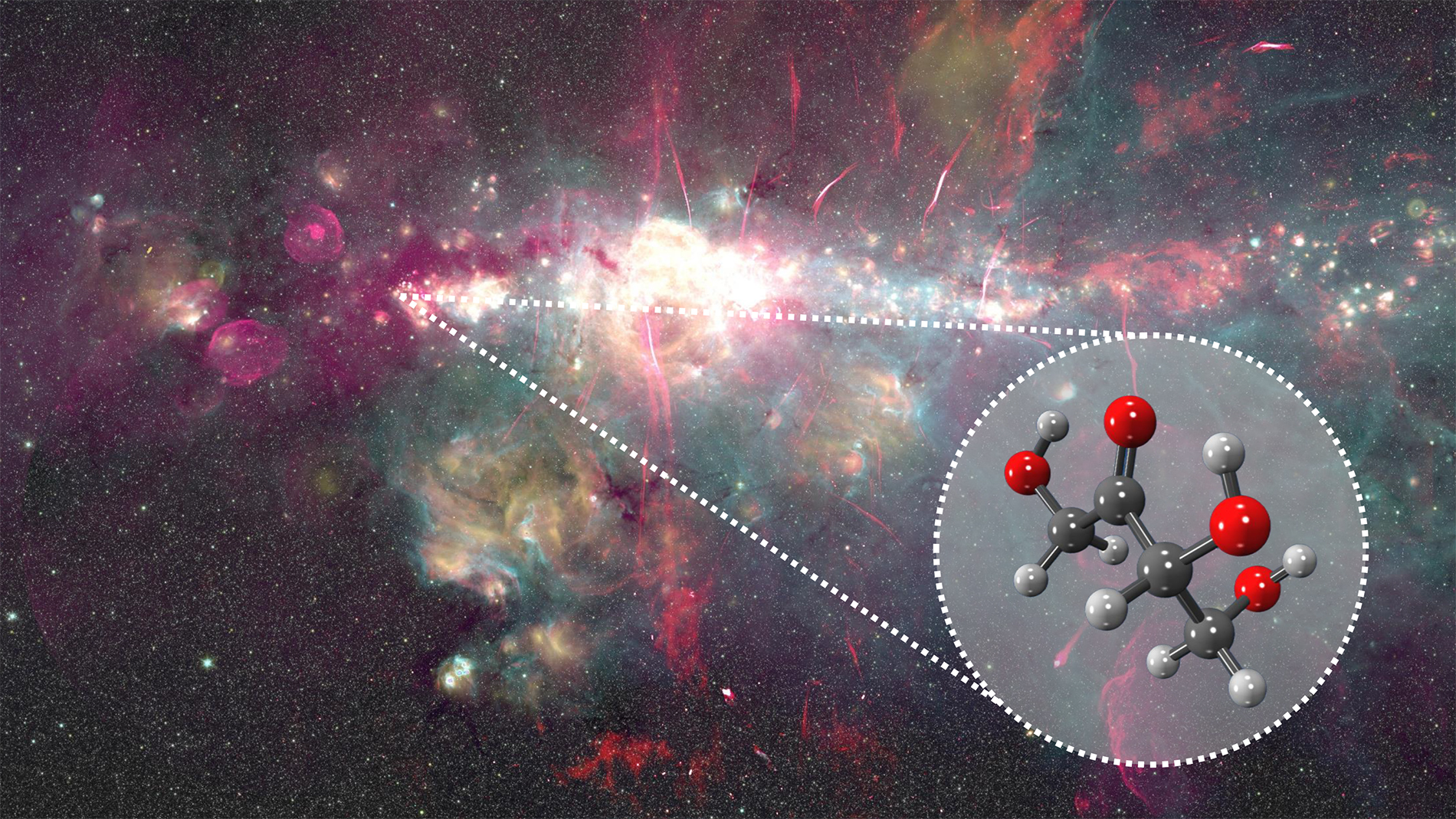
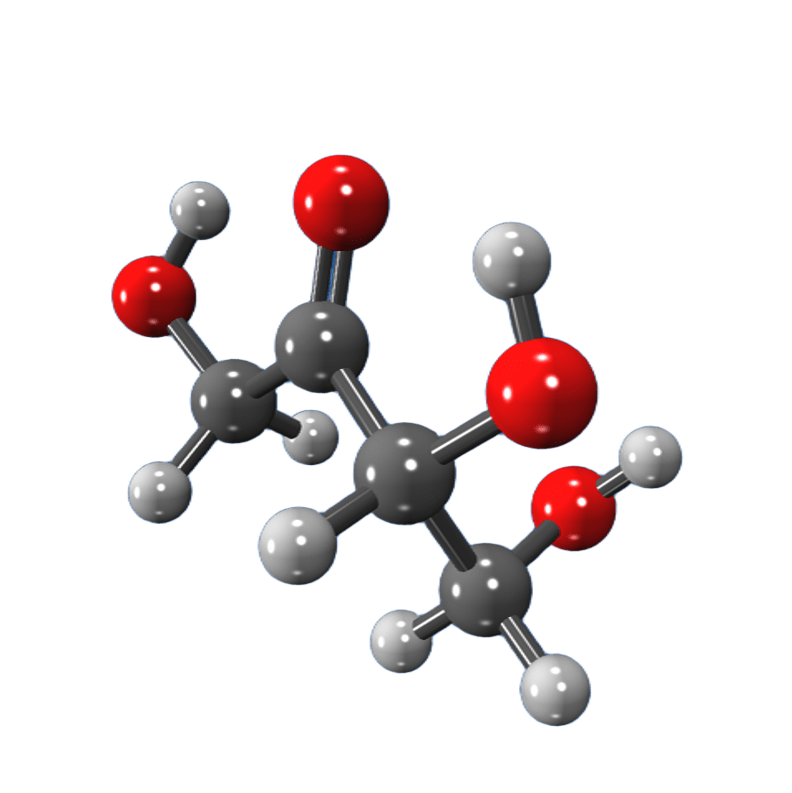
Inside the molecular cloud G+0.693−0.027, near the center of the Milky Way, Dr. Izaskun Jiménez-Serra's team detected erythrulose, the first sugar ever identified directly in interstellar space. Even more surprising, the four carbon sugar proved to be at least eight times more abundant than the simpler three carbon sugars that conventional models suggested should have appeared first. Those smaller sugars have never been detected in the interstellar medium at all.
Rather than growing one carbon atom at a time, erythrulose appears able to form by joining two smaller two-carbon molecules (glycolaldehyde and ethylene glycol) together, a pathway that may prove surprisingly efficient under interstellar conditions.
The discovery does more than add another molecule to astronomy's growing inventory of organic chemistry. Erythrulose can convert into threose in aqueous environments, a sugar considered by some researchers to be a plausible precursor to the earliest nucleic acids. If molecules like these were already present before the Solar System formed, they may have been transferred into comets and asteroids before reaching the young Earth, where they could have contributed to the chemistry that eventually led to life.
To understand how an unexpected molecule came to challenge decades of assumptions, I spoke with Dr. Jiménez-Serra about the discovery, the evidence behind it, and the long journey a simple sugar may have taken before biology ever began.
The Conversation
Izaskun Jiménez-Serra In my earlier work on this line of research, I searched for three carbon sugars and we never detected them. So when my colleague Emilio Cocinero, one of the coauthors on this study, suggested we look for erythrulose instead, I was doubtful. If we had not detected the simpler three carbon sugar, it seemed unlikely we would find the more complex four carbon one.
That was also the traditional view in astrochemistry. Molecules were thought to grow sequentially, one carbon atom at a time. I was not expecting to find erythrulose.
It was a real surprise when I began looking at the data and saw the signals appearing exactly where they should. That was the moment I realized we had found erythrulose. It was incredibly exciting.
Izaskun Jiménez-Serra Light.
These molecules exist as gases inside enormous molecular clouds at extremely low temperatures, sometimes approaching absolute zero. Under those conditions, they cannot do very much. One thing they can do is rotate. As they rotate, they emit light at radio frequencies, and that is what we observe with our radio telescopes.
I often compare the process to tuning an old analog radio. As you move across the dial, each station broadcasts on its own frequency. Molecules behave in much the same way. Every molecule has its own unique set of radio frequencies, its own fingerprint.
We searched for every one of erythrulose's frequencies, and we detected them all. That is how we know the molecule is really there.
Izaskun Jiménez-Serra The discovery changed how we think about molecule formation in the interstellar medium.
Our work shows that erythrulose can form from two smaller precursor molecules, glycolaldehyde and ethylene glycol, each containing two carbon atoms. We carried out quantum chemical calculations that simulate the icy surfaces of interstellar dust grains. When those two molecules are placed together under those conditions, they react and produce erythrulose.
It is a bit like building with Lego. Instead of adding one brick after another, you join two small structures together to make a larger one.
That pathway appears capable of producing erythrulose much more efficiently than the traditional sequential model would predict.
Izaskun Jiménez-Serra Our calculations show that the reaction is chemically viable under interstellar conditions.
The next step is laboratory work that recreates those conditions as closely as possible, using high vacuum environments and extremely low temperatures to determine whether the same reaction occurs experimentally.
Quantum chemical calculations have generally proven to be reliable predictors of laboratory results, so I expect the experiments will confirm what our simulations suggest.
Izaskun Jiménez-Serra That particular molecular cloud is extraordinarily rich, containing emission from many different molecular species.
To be certain that the signal belonged to erythrulose and not another molecule, we first identified more than 180 molecular species already present in the cloud. We then matched each of their laboratory spectra against our observations.
Only after accounting for every one of those molecules did the identified spectral lines correspond uniquely to erythrulose.
That is what gave us confidence that the detection was real.
Izaskun Jiménez-Serra It is one of the richest reservoirs of complex organic molecules we know, and one that our group has studied carefully for many years.
Only a handful of astronomical sources are known to produce this remarkable diversity of chemistry, and research groups often specialize in particular sources. This cloud has proven especially prolific, producing molecules that contain oxygen, nitrogen, sulfur, and phosphorus. That makes it an exceptional place to search for new prebiotic molecules.
Our interest in it actually goes back to the early 2000s, when my PhD supervisor mapped complex organic molecules across the Galactic Center. Among all the clouds that were surveyed, G+0.693−0.027 stood out as the brightest source. It became the obvious target for deeper investigations.
The cloud lies close to the Milky Way's central supermassive black hole. The chemistry we observe is shaped by energetic processes, including supersonic shockwaves and cosmic ray radiation, which likely release molecules such as erythrulose from the icy surfaces of dust grains back into the gas, where our telescopes can detect them.
Izaskun Jiménez-Serra There are two broad classes of sugars, ketoses and aldoses, and life uses both. Erythrulose belongs to the ketose family. Once it enters an aqueous environment, however, it can rearrange its molecular structure and become threose, which is an aldose.
Threose is the sugar found in threose nucleic acid, one of the simplest nucleic acids ever proposed. Some researchers have suggested that it may have preceded RNA during the earliest stages of chemical evolution.
That means erythrulose, if delivered to the young Earth, could have contributed to the formation of some of the first nucleic acids. It is an intriguing possibility, although one that still requires much more experimental work.
Izaskun Jiménez-Serra Although sugars are fragile, our observations show that molecules like erythrulose are capable of surviving even the energetic environment near the Galactic Center, including shockwaves and intense cosmic ray radiation.
We think these molecules form inside molecular clouds before stars and planets even exist. Later, as planetary systems begin to assemble, they become incorporated into asteroids, comets, and meteorites.
During the Late Heavy Bombardment, between roughly 4.1 and 3.8 billion years ago, enormous amounts of this material reached the surface of the early Earth, bringing with it a rich inventory of organic molecules.
Laboratory experiments have already shown that similar compounds can survive atmospheric entry and even go on to produce more complex organic molecules afterward. Glycolaldehyde, for example, has been demonstrated to survive impact and participate in additional chemistry.
If erythrulose behaves in the same way, it could have contributed directly to the reservoir of molecules available when life was first beginning to emerge.
Izaskun Jiménez-Serra Ribose is certainly one of our most exciting targets.
We already know it exists in meteorites and in samples returned from the asteroid Bennu, so there is every reason to ask whether it also forms inside the molecular clouds from which planetary systems originate.
Because ribose forms the backbone of RNA, confirming its presence in interstellar space would strengthen the idea that some of life's essential building blocks were already available before planets formed.
But ribose is only part of the story. We will also continue searching for other sugars, sugar alcohols, and sugar acids in order to understand the broader chemistry taking place inside these clouds.
At the same time, our group has recently received funding to bring more of this work into the laboratory. Together with my colleague Juan García de la Concepción (University of Extremadura), an organic chemist and coauthor on this study, we will begin exposing these sugars to conditions resembling those of the early Earth and observe what kinds of chemistry follow.
Izaskun Jiménez-Serra Yes.
Finding erythrulose in one molecular cloud immediately raises the possibility that similar sugars exist in many others throughout the Milky Way, especially those currently forming new stars and planetary systems.
That suggests the chemistry needed for life may not be unique to our own Solar System. Instead, it could already be present long before planets begin to form.
I find that possibility incredibly exciting.
Izaskun Jiménez-Serra We will certainly continue searching for sugars, but we are also expanding our attention to other prebiotic molecules, particularly amino acids.
Despite many years of searching, no amino acid has ever been detected directly in interstellar space.
For a long time I have been looking for the simplest amino acid, glycine, without success.
I think that will become one of our next major efforts.
Conclusion
The discovery of erythrulose does not tell us how life began.
It does something both more modest and, perhaps, more profound.
It reminds us that some of life's chemistry may have begun long before biology itself.
For decades, scientists imagined molecular complexity emerging step by step, each carbon atom added patiently to the last. The first sugar identified between the stars suggests nature may sometimes choose a different route, assembling larger molecules from smaller pieces already waiting to come together. It is a subtle shift in chemistry, but one that opens entirely new ways of thinking about the molecular history of life.
Equally striking is the way the discovery came about. Dr. Jiménez-Serra's team was not searching for erythrulose. They expected to find something simpler and found something more complex instead. Scientific progress often unfolds that way. Not by confirming familiar expectations, but by recognizing the significance of an unexpected signal when it appears.
The search now continues. For ribose. For glycine. For other molecules still hidden inside ancient clouds of gas and dust.
Each new detection extends the chemical inventory of the universe.
Together, they bring us a little closer to answering one of humanity's oldest questions: not whether life exists elsewhere, but how far back the story of life truly begins.