

Even when nutrients are equal, UCL research shows ultra-processed diets slow weight loss, while whole foods nearly double the results.
In the ongoing battle against obesity and diet-related health issues, a groundbreaking study from University College London challenges the conventional focus on calories alone. While nutrition labels and dietary advice typically emphasize macronutrients, sugar content, and caloric intake, new research suggests that the degree of food processing may be equally important for weight management. This shift in understanding could fundamentally change how we approach healthy eating and weight loss strategies.
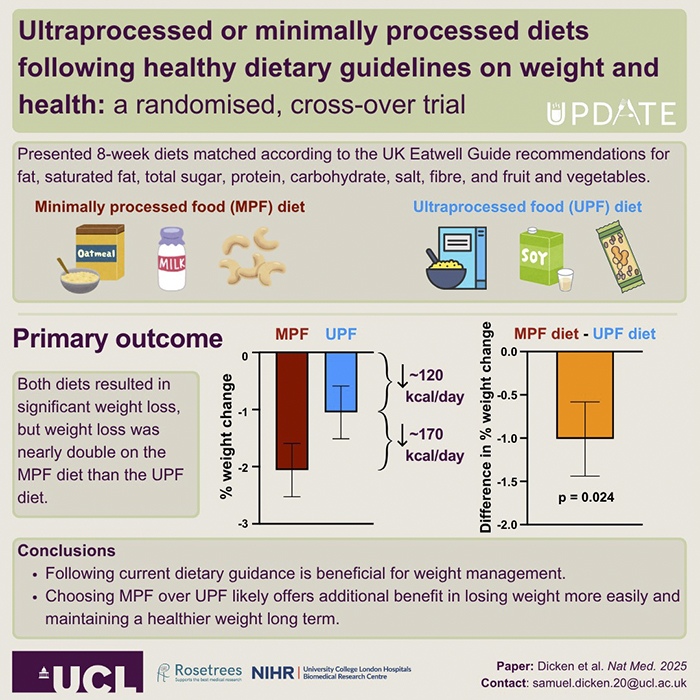
The eight-week clinical trial, published in Nature Medicine, directly compared the effects of minimally processed foods (MPF) versus ultra-processed foods (UPF) on weight loss and body composition. Fifty-five participants followed both diet types in a crossover design, with each diet carefully matched for calories, nutrients, fat, protein, and carbohydrates according to UK government guidelines. The controlled conditions allowed researchers to isolate the impact of food processing itself, rather than nutritional differences.
The results revealed that participants lost nearly twice as much weight while eating minimally processed foods compared with ultra-processed alternatives, despite identical nutritional profiles. Those following the minimally processed diet experienced a 2.06% weight reduction versus just 1.05% on the ultra-processed diet, accompanied by greater fat loss, reduced food cravings, and improved craving control. These findings suggest that choosing whole foods over packaged options may offer significant advantages for weight management, even when nutritional content appears equivalent on paper.
Recently, we spoke with Dr. Samuel Dicken, first author of the study from the UCL Centre for Obesity Research and UCL Department of Behavioural Science & Health, to explore the details.
What factors might explain why minimally processed foods led to nearly double the weight loss compared with ultra-processed foods, even when calories and nutrients were matched?
While both diets met dietary guidelines and were nutritionally superior to participants’ usual diets, several features of ultra-processed foods help explain the difference. The ultra-processed menu was more energy dense, meaning more calories per bite. This could have encouraged slightly greater intake overall. Processing also alters sensory properties: ultra-processed foods are often softer in texture and visually engineered for appeal, which can influence how quickly and how much we eat.
For context, our menus compared items such as overnight oats versus high-fiber breakfast cereals, salads with homemade flatbread versus pre-made supermarket sandwiches, and homemade cottage pie versus ready-meal versions. Although we observed significant differences in weight loss, the study was not designed to identify one single mechanism—rather, the pattern suggests that a cluster of processing-related factors made the difference.
How do differences in food processing influence satiety and appetite regulation, and what mechanisms might contribute to the greater calorie deficit observed on the minimally processed diet?
Processing affects satiety on multiple levels.
1. Energy density: Ultra-processed foods often have water and fiber removed while fat is added, producing more calories per gram and reducing volume. This lessens gastric distension, which is one of the earliest fullness signals.
2. Texture and oral processing: When foods are soft and uniform, they require less chewing and can be eaten more quickly. Faster eating makes it easier to consume excess calories before gut-to-brain feedback mechanisms signal fullness.
3. Palatability and reward: Ultra-processed foods are designed to be highly palatable, with enhanced flavor profiles that encourage intake beyond energy needs.
In our trial, participants eating the minimally processed diet reported better craving control, even though they lost more weight—a situation where cravings usually intensify. Appetite ratings were broadly similar between the diets, but taste and flavor ratings were lower for minimally processed foods. Interestingly, some participants withdrew from the minimally processed diet due to preference, whereas none withdrew from the ultra-processed diet, underscoring how palatability plays into behavior.
Packaging may also have played a role. Ultra-processed foods were provided in their branded packaging, as in everyday life. Nutrition and health claims may have influenced participants’ perception of appropriate portion sizes, leading them to consume the full packaged amount rather than stopping when satisfied.
Food cravings are often a barrier to dietary adherence. How do you interpret the greater craving control seen in the minimally processed group, and what might this mean for sustainable weight management?
The improvements in craving control on the minimally processed diet were especially important because they occurred despite greater weight loss, which usually increases cravings. We saw significant reductions in what we call hedonic appetite—essentially eating for pleasure rather than hunger.
We measured this with the Power of Food Scale, a validated tool that evaluates psychological responses to palatable foods across three contexts: when food is available but not present, when it is present but not yet tasted, and when it is tasted but not yet consumed.
Participants on the minimally processed diet also showed trends toward better appetite regulation in the immediate post-meal period. Taken together, these findings suggest that minimally processed foods help people recognize when to stop eating, easing the burden of constant self-control. That has real implications for long-term weight management: sustainable change is more achievable when natural satiety signals do the work, rather than relying on willpower alone.
Both diets followed the UK’s Eatwell Guide. What specific features of ultra-processed foods might still undermine weight loss despite being nutritionally balanced?
Ultra-processed foods can meet nutrient targets yet still drive overconsumption because of how they are made and marketed. They tend to be energy dense, soft in texture, and highly palatable. Beyond that, the branded packaging and nutrition claims encountered in real-world settings may subtly encourage people to finish larger portions than they would with a home-prepared meal. Even without “reduced calorie” labels, the overall messaging on packaging may shift perceptions of what constitutes an appropriate serving.
How can these findings be applied in real-world contexts where cost, availability, or time constraints limit access to minimally processed foods?
This is where food systems matter. We cannot expect individuals to overcome structural barriers through willpower alone. The present food environment makes ultra-processed options cheap, accessible, and convenient, while minimally processed foods are often less affordable or harder to obtain.
The study’s findings highlight the need for system-level changes. Policies that make healthier foods more available and affordable—through subsidies for whole foods, restrictions on marketing, and investments in food infrastructure—are essential. Stakeholders across health, policy, and industry must work together to reshape the environment so that healthy choices become the easy choices.
If the weight loss trajectories we observed continued for a year, participants might lose 9–13% of body weight on a minimally processed diet compared with 4–5% on an ultra-processed diet. Because most of this loss came from fat mass, the long-term implications could include lower risks of diabetes, cardiovascular disease, and other metabolic disorders, though longer studies are needed to confirm these outcomes.
Beyond weight loss, what longer-term health effects might follow from prioritizing minimally processed diets?
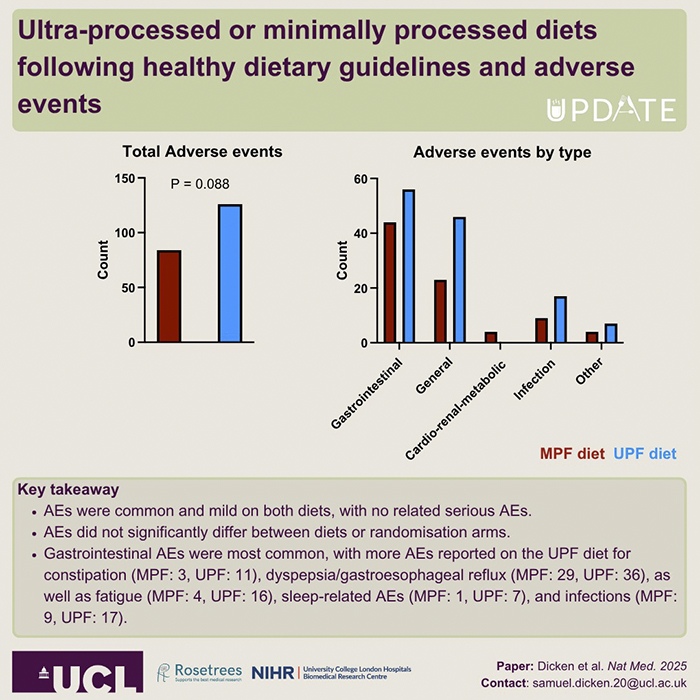
The larger fat mass reduction on the minimally processed diet is a promising sign for cardiometabolic health. Although we did not observe significant differences in secondary markers such as blood pressure or cholesterol within eight weeks, observational studies consistently link higher ultra-processed food intake to increased risk of obesity and chronic disease. Combined with better craving control, these patterns suggest that prioritizing minimally processed foods could support both sustained weight management and broader health benefits over time.
The ultra-processed diet did not show significant negative effects on blood pressure or cholesterol. Why do you think that is, and what could longer-term trials reveal?
Participants began with diets high in ultra-processed foods and generally misaligned with Eatwell Guide recommendations. When we supplied an ultra-processed diet that still met nutritional guidelines, it actually represented an improvement over many participants’ usual eating habits. That likely explains the neutral or favorable changes.
Longer studies may reveal whether the differences in fat mass and appetite regulation eventually translate into cardiometabolic outcomes. What is clear is that cost and access remain the biggest barriers. For low-resource households in particular, system-level change is more effective than asking individuals to cook from scratch or buy expensive alternatives. Taxes, subsidies, and healthier food environments will be necessary to level the playing field.
How might multinational food companies shape the availability and consumption of ultra-processed foods, and what policy measures could effectively counteract this?
Ultra-processed food production is driven by profit, and industry has strong incentives to resist restrictions. We saw this in the UK, where advertising restrictions on high fat, sugar, and salt foods have repeatedly been delayed due to lobbying.
Counteracting this requires comprehensive, coordinated action: taxation of ultra-processed products, subsidies for minimally processed foods, support for healthier outlets in underserved areas, and governance that prioritizes public health over industry profit. The sugar-sweetened beverage taxes in South America show that these policies can succeed when implemented with political will.
How can public health messaging encourage minimally processed eating while acknowledging the challenges of cooking from scratch in busy or low-resource households?
Public health campaigns must avoid approaches that widen inequalities. Many people cannot afford healthier foods, lack reliable kitchen facilities, or work multiple jobs that leave little time for preparation. Instead, interventions should reduce barriers at the population level.
Behavioral science offers tools that minimize the effort required from individuals—for example, ensuring that affordable minimally processed staples are prominent in shops, or using subsidies to shift pricing in their favor. Effective messaging recognizes that healthy eating is not just a matter of choice but of access and structure.
Conclusion
Dr. Dicken’s research underscores that food processing itself plays a crucial role in weight management, independent of calories and nutrients. Participants lost nearly twice as much weight on minimally processed diets, while also experiencing greater fat loss and improved craving control. These findings challenge the current emphasis on individual choice and nutrient counting, instead highlighting the urgent need for systemic change. True progress against obesity and diet-related disease will require policy interventions that make minimally processed foods affordable and accessible to all, rather than expecting individuals to navigate an obesogenic food environment on their own.