
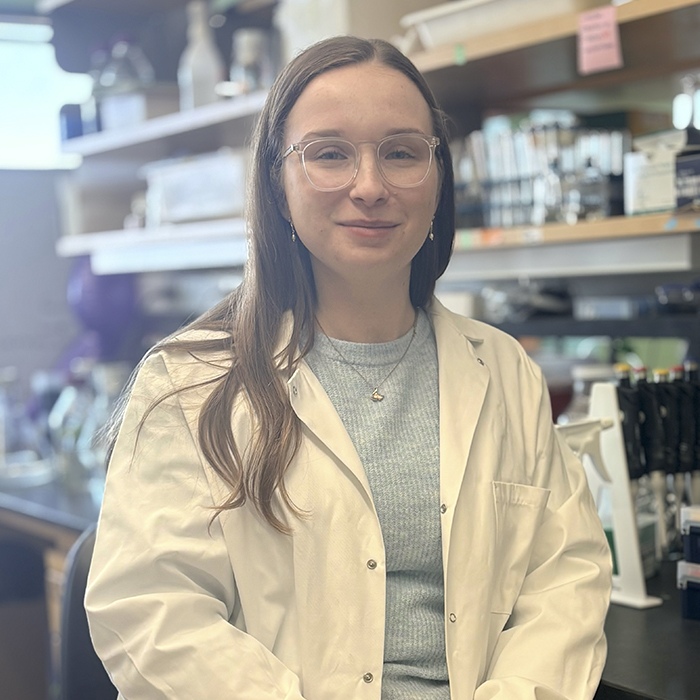
Holly Rucker on resurrecting a 3.2-billion-year-old enzyme, reading life from rocks, and what it means for an ancient mechanism to be that still
There is a version of this story that sounds like triumph. Scientists reconstruct a primordial enzyme. They insert it into a living bacterium, and the bacterium functions. They confirm that the molecular signature left in the rock record is exactly what geologists assumed it was. The assumption holds. The tool is validated.
But that is not quite the story Holly Rucker tells when she describes her work in the Kaçar Lab. The version she tells begins not with a confirmation but with a doubt: the doubt that a foundational assumption in the reading of ancient life might be wrong. It proceeds through an extraordinary methodological act: not finding a fossil, but building one from predicted sequences and watching it run inside a living cell.
And it arrives at a finding that is not only scientific but philosophical: that something can survive three billion years of molecular change, planetary upheaval, and the emergence and extinction of entire classes of life, and still do exactly the same chemistry.
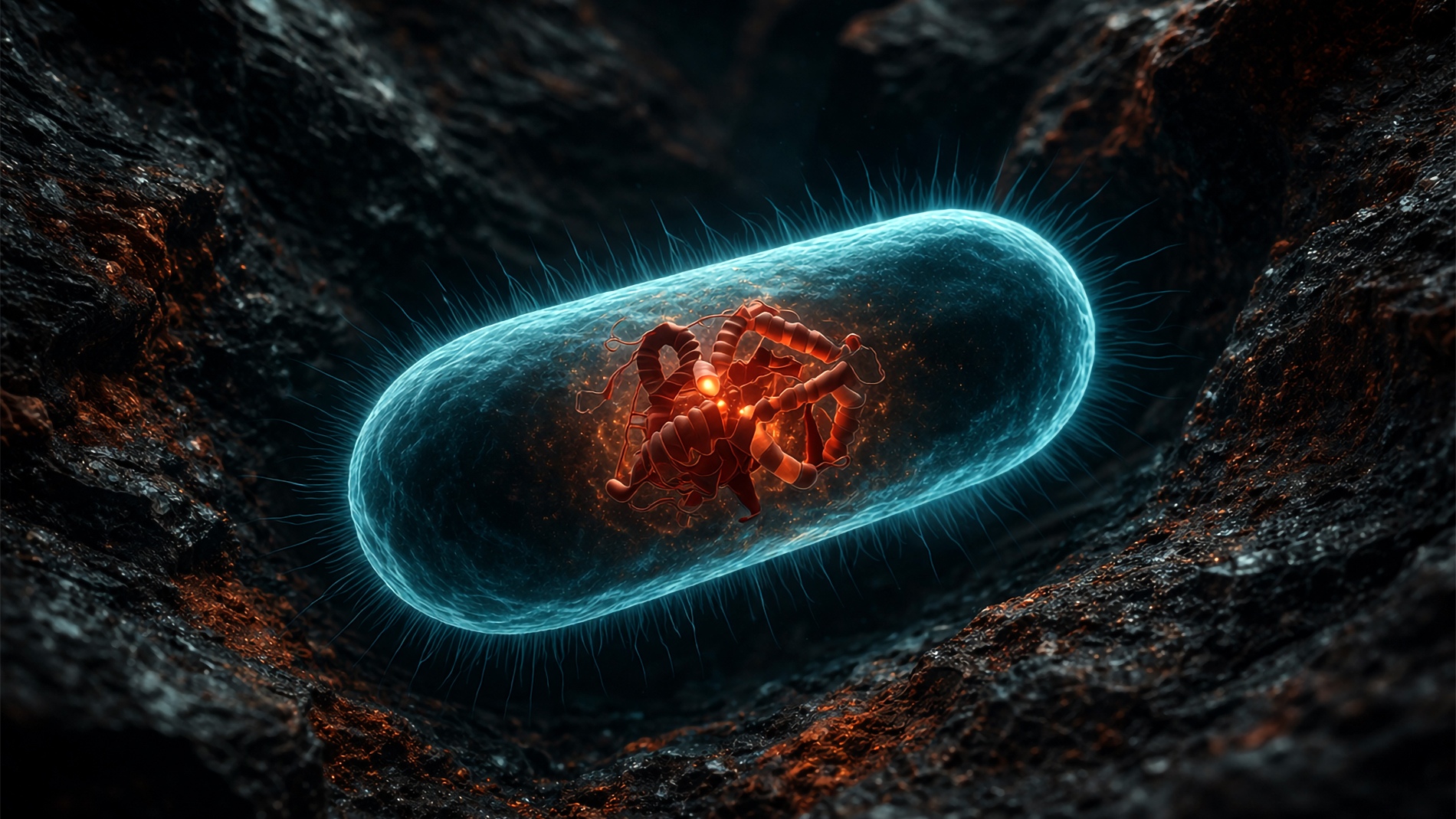
The enzyme at the center of this story, nitrogenase, is the engine that set the tone of life on this planet. There are abiotic ways to get bioavailable nitrogen — lightning-driven reactions, for instance — but it is thought that the expanding biosphere may have outpaced these abiotic sources, providing a selective pressure for biological nitrogen fixation. Without it, there would be no biological mechanism for generating bioavailable nitrogen, an element fundamental for biomolecules like DNA. It evolved more than 3.2 billion years ago in an anaerobic world thick with methane and carbon dioxide. That it is still here, leaving the same chemical fingerprint in ancient rock, is the finding. What Rucker and her collaborators are now asking is why.

The Conversation
Part I: The Act of Resurrection
Given how much time has passed from the Precambrian to now, it is rare that you get to glimpse back into the past to learn something from ancient life, and often this is restricted to the rock record. Being able to predict the ancestral sequences and resurrect these ancestors in the lab is such a powerful tool for learning more about ancient life in ways that the rock record cannot tell us.
How the modern microbe reacts to the ancient enzyme can be very variable. Often, more recent ancestors are more compatible and do not significantly change the organism's growth or enzymatic capabilities. The further back you go, the more the sequences diverge, and it can become detrimental to growth, or in some cases, the ancient enzyme ends up being non-functional. There is a tendency to think that the ancestral enzymes are always worse than their descendants. Occasionally, however, the ancestral enzymes can perform more efficiently than their more modern counterparts.
I spend a lot of time thinking about what the early Earth was like, but I remember being surprised to learn just how different our planet used to be. Life has persisted through all of these dramatic environmental changes, from a methane and carbon dioxide atmosphere devoid of oxygen with iron-rich oceans, to increasing oxygen levels and oceans where iron is often limiting to life. These changes allow us to study life throughout Earth's many phases and learn more about how planetary conditions impact biology and what signatures of life we might find on similar planets. As such, we always try to put our work within the environmental context of the past.
I think all science is, at its core, multi-disciplinary. It would be very limiting to tackle questions of early life and its evolution from a single disciplinary lens. Being able to balance multiple perspectives ultimately comes down to a comprehensive understanding of the literature, synthesis of topics from different fields, and productive collaboration with researchers across the disciplinary spectrum.
Part II: The Ghost in the Rock
The underlying assumption that isotopic fractionation values of nitrogenase had not changed across billions of years of molecular evolution was important to address because the interpretations made with this assumption are used to propose an approximate age of molybdenum-utilizing nitrogenase. One of the paradoxes of nitrogen fixation is that phylogenetic and isotopic evidence suggested that the molybdenum-nitrogenase predates the iron- and vanadium-nitrogenases, evolving at a time when molybdenum was thought to have been scarce in the environment.
Therefore, if there are issues in how we have interpreted the rock record, it could change what we understand about nitrogenase evolution. It is important to recognize, however, that this interpretation was not a misguided assumption, as modern nitrogen fixers were the only reference point geologists had until this study. From our work, we see that this assumption is likely correct, which was exciting because it provides further support for the molybdenum paradox. I find biological paradoxes, when life acts in unexpected ways, to be the most fascinating aspect of biology.
Isotopic patterns in the rock record are a bit like a shoe print in a crime scene investigation. While they do not tell us specifically who was here, the way DNA or proteins could, if only they could be preserved on such a time scale, they can give some information generally about who was present. You need to understand important contextual clues, such as depositional environment and the age of your samples. If there are too many variable types of footprints, meaning too many varied isotopic signatures from other nitrogen metabolisms, they can overprint one another, which can make interpretation difficult. Additionally, the quality of the rock, whether it has been metamorphically altered, plays a major role in your interpretations.
The results of this work suggest that whatever the feature of nitrogenase that imparts fractionation is, be that a structural feature or a step during catalysis, it has been conserved over time. In some ways, this may be constrained by the chemistry of nitrogenase, in the same way that we do not observe dramatic changes in the ancestral nitrogenase sequences for the amino acids that are near the center of enzymatic activity. However, changes that affected the delivery of the substrate, nitrogen gas through a channel to the active site, or the export of the product, ammonia, could have affected the fractionation values. Structural prediction could be used to try to predict this, but ultimately, you need to investigate for any changes through experimental work.
Part III: The Invisible Architecture of Life
I believe it ultimately stems from the challenges of imagining what is occurring at a truly microscopic level. One can look out a window, see a plant with lush green leaves, and recall that photosynthesis is occurring. But they likely do not think about the fact that that plant is relying on bioavailable nitrogen from either nitrogen-fixing microbes or industrial fertilizers, which are created by mimicking the chemistry these nitrogen-fixing microbes are doing. In many ways, biological nitrogen fixation is like the keystone of the nitrogen cycle. I am fascinated by early evolving metabolisms, like nitrogen fixation, because it is amazing to think about how life came up with such complex enzymatic machinery so early on and how many of these ancient metabolisms still exist today, billions of years later.
In astrobiology, we say that there is life as we know it and life as we do not know it. As you can imagine, searching for life as we do not know it is extremely challenging. Because of that, particular focus is given to searching for signs of life that are deemed essential or that represent evolutionary events which played a significant role in the evolution of life on Earth. While we only have one planet as a reference, searching for life similar to our own can help guide us. That is why truly understanding all that we can about the origin and evolution of life on Earth, and how our planet's environments have interacted with or been affected by biology, is critical for life detection.
I am always thinking about metal utilization and why life selected for the metal cofactors that it did. The molybdenum paradox aside, why did a vanadium-utilizing nitrogenase evolve? Vanadium and molybdenum are thought to follow similar patterns of scarcity in the early ocean, becoming the two most abundant transition metals in the oceans today. Despite these similarities, there are only two groups of enzymes that use vanadium, including nitrogenases, and yet there is a much greater diversity of molybdenum-utilizing enzymes. How would the evolution of similar enzymes on other planets be affected by the metal availability there? I find myself most inspired by the why and how types of questions related to early life and the search for life elsewhere.
Conclusion
There is something in Holly Rucker's account that keeps returning: the idea that what we are really doing, when we reconstruct an ancient enzyme and watch it function, is not recovering a fact about the past but recovering a question the past is still asking us. Why did life select this metal and not that one? Why did this mechanism stay still while everything around it changed? What does it mean to be constrained, not by failure but by something more fundamental: by the physics of a chemical reaction that has only one correct shape?
These are not questions the rock record alone can answer. They require a different kind of witness: the molecule itself, rebuilt from predicted code, inserted into a living organism, and asked to speak. What it said, in this case, was that it had been saying the same thing for 3.2 billion years.
The Kaçar Lab's work treats evolutionary history as an experimental variable rather than a fixed archive. Holly Rucker's contribution is to have asked whether a foundational assumption in geobiology was actually true. It was. But the asking of it has opened something considerably larger than a confirmation. We are, as she puts it, now better equipped to read the shoe print in the rock. And we are beginning to understand that the shoe has not changed its shape for longer than the continents have held their current positions.
Holly Rucker on resurrecting a 3.2-billion-year-old enzyme, reading life from rocks, and what it means for an ancient mechanism to be that still
There is a version of this story that sounds like triumph. Scientists reconstruct a primordial enzyme. They insert it into a living bacterium, and the bacterium functions. They confirm that the molecular signature left in the rock record is exactly what geologists assumed it was. The assumption holds. The tool is validated.
But that is not quite the story Holly Rucker tells when she describes her work in the Kaçar Lab. The version she tells begins not with a confirmation but with a doubt: the doubt that a foundational assumption in the reading of ancient life might be wrong. It proceeds through an extraordinary methodological act: not finding a fossil, but building one from predicted sequences and watching it run inside a living cell.
And it arrives at a finding that is not only scientific but philosophical: that something can survive three billion years of molecular change, planetary upheaval, and the emergence and extinction of entire classes of life, and still do exactly the same chemistry.
The enzyme at the center of this story, nitrogenase, is the engine that set the tone of life on this planet. There are abiotic ways to get bioavailable nitrogen — lightning-driven reactions, for instance — but it is thought that the expanding biosphere may have outpaced these abiotic sources, providing a selective pressure for biological nitrogen fixation. Without it, there would be no biological mechanism for generating bioavailable nitrogen, an element fundamental for biomolecules like DNA. It evolved more than 3.2 billion years ago in an anaerobic world thick with methane and carbon dioxide. That it is still here, leaving the same chemical fingerprint in ancient rock, is the finding. What Rucker and her collaborators are now asking is why.
The Conversation
Part I: The Act of Resurrection
Given how much time has passed from the Precambrian to now, it is rare that you get to glimpse back into the past to learn something from ancient life, and often this is restricted to the rock record. Being able to predict the ancestral sequences and resurrect these ancestors in the lab is such a powerful tool for learning more about ancient life in ways that the rock record cannot tell us.
How the modern microbe reacts to the ancient enzyme can be very variable. Often, more recent ancestors are more compatible and do not significantly change the organism's growth or enzymatic capabilities. The further back you go, the more the sequences diverge, and it can become detrimental to growth, or in some cases, the ancient enzyme ends up being non-functional. There is a tendency to think that the ancestral enzymes are always worse than their descendants. Occasionally, however, the ancestral enzymes can perform more efficiently than their more modern counterparts.
I spend a lot of time thinking about what the early Earth was like, but I remember being surprised to learn just how different our planet used to be. Life has persisted through all of these dramatic environmental changes, from a methane and carbon dioxide atmosphere devoid of oxygen with iron-rich oceans, to increasing oxygen levels and oceans where iron is often limiting to life. These changes allow us to study life throughout Earth's many phases and learn more about how planetary conditions impact biology and what signatures of life we might find on similar planets. As such, we always try to put our work within the environmental context of the past.
I think all science is, at its core, multi-disciplinary. It would be very limiting to tackle questions of early life and its evolution from a single disciplinary lens. Being able to balance multiple perspectives ultimately comes down to a comprehensive understanding of the literature, synthesis of topics from different fields, and productive collaboration with researchers across the disciplinary spectrum.
Part II: The Ghost in the Rock
The underlying assumption that isotopic fractionation values of nitrogenase had not changed across billions of years of molecular evolution was important to address because the interpretations made with this assumption are used to propose an approximate age of molybdenum-utilizing nitrogenase. One of the paradoxes of nitrogen fixation is that phylogenetic and isotopic evidence suggested that the molybdenum-nitrogenase predates the iron- and vanadium-nitrogenases, evolving at a time when molybdenum was thought to have been scarce in the environment.
Therefore, if there are issues in how we have interpreted the rock record, it could change what we understand about nitrogenase evolution. It is important to recognize, however, that this interpretation was not a misguided assumption, as modern nitrogen fixers were the only reference point geologists had until this study. From our work, we see that this assumption is likely correct, which was exciting because it provides further support for the molybdenum paradox. I find biological paradoxes, when life acts in unexpected ways, to be the most fascinating aspect of biology.
Isotopic patterns in the rock record are a bit like a shoe print in a crime scene investigation. While they do not tell us specifically who was here, the way DNA or proteins could, if only they could be preserved on such a time scale, they can give some information generally about who was present. You need to understand important contextual clues, such as depositional environment and the age of your samples. If there are too many variable types of footprints, meaning too many varied isotopic signatures from other nitrogen metabolisms, they can overprint one another, which can make interpretation difficult. Additionally, the quality of the rock, whether it has been metamorphically altered, plays a major role in your interpretations.
The results of this work suggest that whatever the feature of nitrogenase that imparts fractionation is, be that a structural feature or a step during catalysis, it has been conserved over time. In some ways, this may be constrained by the chemistry of nitrogenase, in the same way that we do not observe dramatic changes in the ancestral nitrogenase sequences for the amino acids that are near the center of enzymatic activity. However, changes that affected the delivery of the substrate, nitrogen gas through a channel to the active site, or the export of the product, ammonia, could have affected the fractionation values. Structural prediction could be used to try to predict this, but ultimately, you need to investigate for any changes through experimental work.
Part III: The Invisible Architecture of Life
I believe it ultimately stems from the challenges of imagining what is occurring at a truly microscopic level. One can look out a window, see a plant with lush green leaves, and recall that photosynthesis is occurring. But they likely do not think about the fact that that plant is relying on bioavailable nitrogen from either nitrogen-fixing microbes or industrial fertilizers, which are created by mimicking the chemistry these nitrogen-fixing microbes are doing. In many ways, biological nitrogen fixation is like the keystone of the nitrogen cycle. I am fascinated by early evolving metabolisms, like nitrogen fixation, because it is amazing to think about how life came up with such complex enzymatic machinery so early on and how many of these ancient metabolisms still exist today, billions of years later.
In astrobiology, we say that there is life as we know it and life as we do not know it. As you can imagine, searching for life as we do not know it is extremely challenging. Because of that, particular focus is given to searching for signs of life that are deemed essential or that represent evolutionary events which played a significant role in the evolution of life on Earth. While we only have one planet as a reference, searching for life similar to our own can help guide us. That is why truly understanding all that we can about the origin and evolution of life on Earth, and how our planet's environments have interacted with or been affected by biology, is critical for life detection.
I am always thinking about metal utilization and why life selected for the metal cofactors that it did. The molybdenum paradox aside, why did a vanadium-utilizing nitrogenase evolve? Vanadium and molybdenum are thought to follow similar patterns of scarcity in the early ocean, becoming the two most abundant transition metals in the oceans today. Despite these similarities, there are only two groups of enzymes that use vanadium, including nitrogenases, and yet there is a much greater diversity of molybdenum-utilizing enzymes. How would the evolution of similar enzymes on other planets be affected by the metal availability there? I find myself most inspired by the why and how types of questions related to early life and the search for life elsewhere.
Conclusion
There is something in Holly Rucker's account that keeps returning: the idea that what we are really doing, when we reconstruct an ancient enzyme and watch it function, is not recovering a fact about the past but recovering a question the past is still asking us. Why did life select this metal and not that one? Why did this mechanism stay still while everything around it changed? What does it mean to be constrained, not by failure but by something more fundamental: by the physics of a chemical reaction that has only one correct shape?
These are not questions the rock record alone can answer. They require a different kind of witness: the molecule itself, rebuilt from predicted code, inserted into a living organism, and asked to speak. What it said, in this case, was that it had been saying the same thing for 3.2 billion years.
The Kaçar Lab's work treats evolutionary history as an experimental variable rather than a fixed archive. Holly Rucker's contribution is to have asked whether a foundational assumption in geobiology was actually true. It was. But the asking of it has opened something considerably larger than a confirmation. We are, as she puts it, now better equipped to read the shoe print in the rock. And we are beginning to understand that the shoe has not changed its shape for longer than the continents have held their current positions.