
Unlocking Mars' Hidden Dangers: The Mission That Could Save Future Astronauts
As humanity sets its sights on Mars, one of the greatest unknowns remains the invisible dangers that await future astronauts. The Red Planet’s unique atmospheric and magnetic environment creates complex space weather patterns that could pose significant threats to both robotic missions and human explorers. Unlike Earth, Mars lacks a strong global magnetic field to shield against solar radiation and charged particles, making it crucial to understand how these forces interact with the planet’s thin atmosphere and surface conditions.
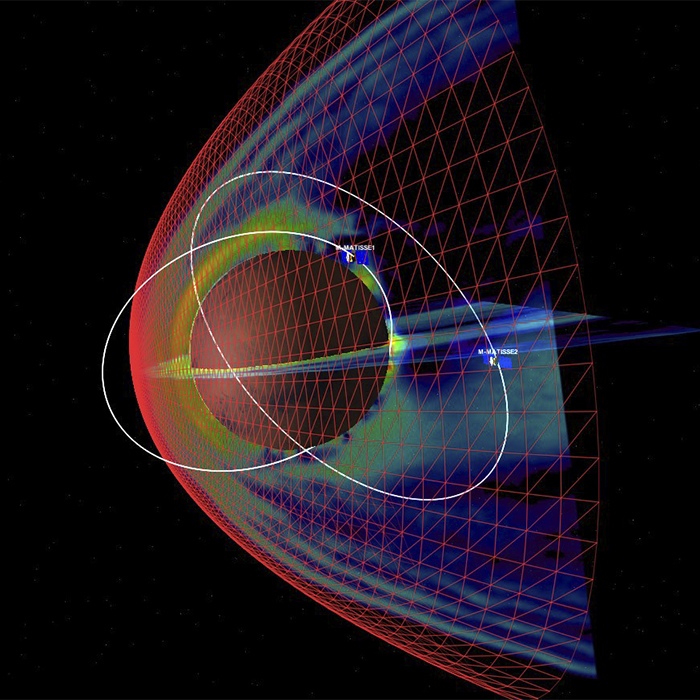
A groundbreaking mission called M-MATISSE (Mars Magnetosphere ATmosphere Ionosphere and Space-weather SciencE) could provide the answers we desperately need. Recently highlighted at the Royal Astronomical Society’s National Astronomy Meeting 2025, this ambitious project proposes launching two identical spacecraft to conduct the first comprehensive study of Martian space weather. The mission would investigate multiple atmospheric layers simultaneously, from the planet’s magnetosphere and ionosphere to its thermosphere and lower atmosphere, creating an unprecedented global picture of Mars’s dynamic environment.
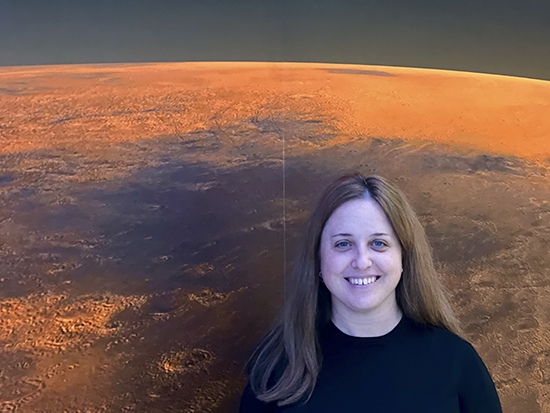
Currently competing for selection as the European Space Agency’s next medium-class mission, M-MATISSE represents more than just scientific curiosity—it could be the key to ensuring the safety of future Mars explorers. By providing the first dedicated planetary space weather monitoring system at Mars, the mission would enable accurate forecasting of hazardous conditions, protecting both spacecraft and astronauts from potentially deadly radiation exposure. If approved by mid-2026, this mission could fundamentally transform our understanding of Mars’s habitability and atmospheric evolution, paving the way for safe human exploration of the Red Planet. Recently, we had the privilege of speaking with Dr. Beatriz Sánchez-Cano of the University of Leicester, who plays a leading role in the consortium driving this groundbreaking proposal.
Mapping the Unknown
M-MATISSE aims to explore regions of Mars’s space environment that remain largely uncharted. What specific mysteries or anomalies do you hope to resolve, especially in the planet’s far tail and plasma system?
Mars’s space environment extends far beyond the planet’s surface, reaching several planetary radii into space. This vast region is filled with a variety of charged particles that become increasingly energetic the farther they are from the planet. Understanding how these different particle populations interact is crucial, as they are intricately connected and play a key role in how Mars absorbs and dissipates energy from the Sun, which otherwise, it would reach the surface. These interactions influence atmospheric escape, auroral activity, and radiation exposure, which is a phenomenon governed by what scientists refer to as the Magnetosphere, Ionosphere, and Thermosphere, collectively known as the M-I-T system.
One of the least explored regions of Mars’s space environment is its far tail—a long extension of the solar wind’s magnetic field that becomes draped around the planet. Due to its vast distance from the planet, this region remains largely unexplored. The upcoming M-MATISSE mission aims to investigate how plasma behaves in this distant tail, at the same time that the solar wind is monitored, including how energy and particles are transported and lost, and whether unknown mechanisms are contributing to the ongoing escape of Mars’s atmosphere.
Crucially, M-MATISSE will also study how solar particles are channelled back toward the planet through the tail, ultimately precipitating into the atmosphere and generating auroras. By characterizing these dynamics, the mission will offer new insights into the complex and rapid evolving relationship between Mars and its space environment.
Space Weather and Survival
Unlike Earth, Mars lacks a strong magnetic field to shield its surface. How critical is it to understand Martian space weather before sending astronauts, and what kinds of threats could they face if we don’t?
Unlike Earth, Mars lacks a global magnetic field to shield its surface from harmful space radiation. Instead, it possesses localized remnant magnetic fields embedded in the crust, particularly across parts of the equator and the southern hemisphere. These crustal fields are relics of an ancient global magnetic dynamo that once protected the Martian atmosphere, much like Earth’s magnetic field does today. Because these magnetic fields are anchored to the surface, they rotate with the planet, creating a highly dynamic and complex environment, where energetic particles are free to move. Changes in the Martian atmosphere and magnetosphere can occur on timescales of just minutes because of the variability in these fields.
The solar wind is continuously bombarding Mars with energetic particles, which are particularly intense during space weather events triggered by solar eruptions. These events deliver massive bursts of energy into Mars’s plasma system over just a few hours (up to a few days), significantly increasing radiation levels, including at the surface. Understanding how this energy is absorbed, dissipated, or transported across different regions of Mars’s space environment is essential. Without this knowledge, we cannot accurately predict how much radiation astronauts might face or whether the atmosphere and crustal magnetic fields will provide any meaningful protection during such events.
To address this, it is important to emphasize the need for multi-spacecraft missions capable of monitoring different regions of Mars simultaneously, as we do systematically on Earth. Only with this kind of coordinated observation can we track the rapid, short-term changes in the Martian plasma system and develop reliable space weather forecasts. This is not just a scientific challenge; it is a matter of astronaut safety. During a major solar event, astronauts on Mars may have as little as 30 minutes to seek shelter. Understanding and forecasting the response of Mars to these events could be the difference between mission success and serious health risks.
Habitability Beyond the Surface
The mission investigates not just the surface, but how solar particles and energy affect the entire Martian atmosphere. How might your findings reshape current thinking on Mars’s past or future potential for habitability?
Understanding how the solar wind interacts with a planet is essential to determining the nature of its surrounding space environment, and ultimately, its potential to support life. At Mars, this interaction is especially critical. We now know that Mars’s atmosphere has undergone a dramatic transformation since its formation, shifting from a thick, humid environment to the thin, arid one we see today. A major factor in this evolution is believed to be the planet’s internal cooling, which led to the loss of its global magnetic dynamo. This dynamo once generated a protective magnetic field, similar to Earth’s, and its disappearance left Mars’ atmosphere vulnerable.
Without a global magnetic shield, Mars’s upper atmosphere is directly exposed to the solar wind and leaks into space. This interaction steadily erodes the atmosphere and plays a central role in processes like atmospheric escape over time (i.e., reduction of the atmospheric pressure and eventually lost of liquid water from the surface), or the filtering of harmful radiation. These processes are deeply interconnected and occur across multiple regions of the Martian plasma system, and this is what M-MATISSE plans to analyse.
The M-MATISSE’s mission will characterise the evolution of Mars’s atmosphere and could fundamentally reshape our understanding of the processes that either preserve or erode the planet’s remaining atmospheric reservoir with a holistic perspective from multiple vantage points to get the most up to date characterisation. By tracing how the entire atmospheric column behaviour has influenced atmospheric escape over time, the mission will also shed light on Mars’s climatic past and its potential for habitability in past and future.
A Tale of Two Orbiters
Henri and Marguerite will operate from different vantage points. What advantages does this dual-spacecraft design offer that a single orbiter could not achieve?
Single-spacecraft missions have revolutionized our understanding of Mars, delivering unprecedented insights into the planet’s atmosphere, magnetosphere, and space weather environment. However, to truly grasp the evolution of the processes shaping Mars’s near-space environment, observations from multiple vantage points are vital.
The Martian plasma system is highly dynamic, with changes occurring over short timescales and across vast spatial regions. For example, a small change in the orientation of the solar wind can produce an almost instantaneous response of the magnetosphere, ionosphere and even lower atmosphere. Another example is the production of auroras on the nightside of Mars that is the result of showers of solar energetic particles on the dayside being transported into the nightside with the help of the crustal fields. Capturing this complexity requires simultaneous, coordinated measurements from multiple spacecraft equipped with the right instruments, as it is the case of M-MATISSE, which is fully tailored for this. Only then we can accurately track the temporal and spatial variability of key processes and improve predictive models based on these unknown-so far dynamics.
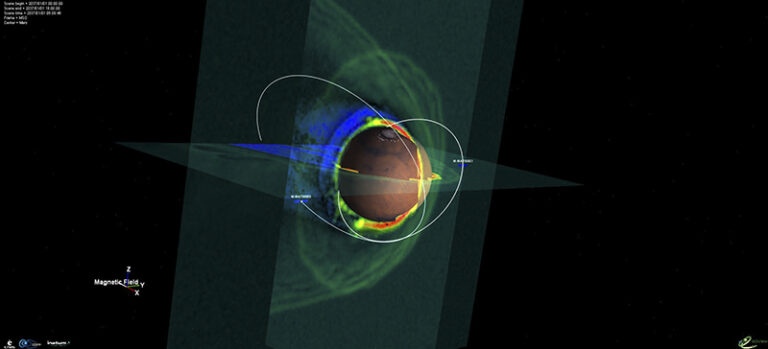
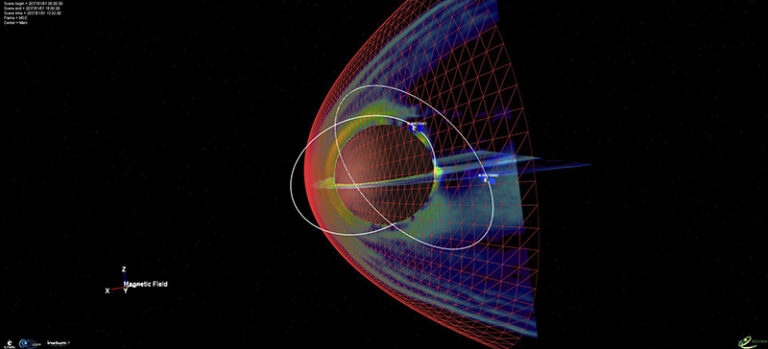
To fully capture the complexity of Mars’s space environment, M-MATISSE will deploy two spacecraft in different orbits, allowing us to simultaneously monitor multiple regions of the Martian system. This dual vantage point is essential for understanding how different parts of the atmosphere and magnetosphere respond to inputs from the solar wind.
The mission’s payload includes six instruments. Three are designed for in-situ measurements using seven sensors, and three for remote observations, capable of observing from the Martian surface all the way into space. Together, these instruments will provide a comprehensive, system-wide view of Mars’s atmospheric and plasma dynamics, enabling us to track how energy and particles move through the environment in real time. By covering the entire Martian system in both space and time, M-MATISSE will offer an unprecedented look at how Mars interacts with the Sun, and how those interactions shape the planet’s past, present, and future.
Forecasting Mars
Earth has a relatively mature space weather monitoring system. What would it take to build a similar forecasting capability for Mars, and how close would M-MATISSE bring us to that goal?
M-MATISSE builds on decades of expertise gained from multi-spacecraft Earth-orbiting missions like Cluster, THEMIS, Swarm, and MMS, which have transformed our understanding of how the solar wind interacts with Earth’s magnetosphere and ionosphere. These multi-point missions have been instrumental in developing the ability to forecast space weather, a capability that is now essential for protecting satellites, astronauts, and infrastructure in space.
Mars, however, remains far behind in this regard. While efforts like NASA’s Moon to Mars Space Weather Analysis Office are advancing our understanding, current capabilities are still limited to detecting when a space weather event has already impacted the planet, not predicting it in advance.
M-MATISSE represents a critical first step toward changing that. M-MATISSE goal is to get the best characterisation so far of the radiation environment of Mars in order to forecast accurate planetary responses to solar inputs, including understanding the dynamics and interconnections of the solar wind, the entire plasma system, the upper-middle-lower atmosphere, and potential surface and subsurface currents. In turn, this science will enable us to quantify risks to robotic systems, stable surface communication in different radio frequency bands and future human explorers. M-MATISSE will provide the data needed to understand how the planet responds to solar activity in real time. This is the missing link in developing true space weather forecasting for Mars, a capability that will be vital for assessing radiation risks and ensuring the safety of future astronauts.
Lessons from Loss
In past missions, how have space weather conditions around Mars caused unexpected issues or mission failures? How could M-MATISSE help prevent similar risks in the future?
Current missions orbiting Mars are already experiencing the severe effects of space weather. For example, the radars aboard Mars Express (MARSIS) and the Mars Reconnaissance Orbiter (SHARAD) suffer significant signal degradation whenever solar energetic particle events strike the planet. During these particle showers, high-frequency radio signals are absorbed by the Martian ionosphere, making it impossible to communicate with the surface in these frequency bands. This phenomenon is well known on Earth, where radio blackouts caused by solar activity typically last only a few hours and are confined to specific regions. But on Mars, these blackouts are global and can persist for days, even more than 10 days in some cases. These events are especially common during periods of high solar activity, but surprisingly, similar levels of radio absorption have also been observed during moderate solar conditions and during solar minimum. This suggests that interactions between crustal magnetic fields and solar wind particles may play a role, an area of complexity that remains poorly understood.
The impact of space weather on Mars missions goes far beyond radio blackouts. During solar energetic particle events, radio signal scintillation (rapid fluctuations in signal strength) can severely disrupt spacecraft operations. Even star trackers, which are essential for spacecraft navigation, can be temporarily blinded. A striking example occurred in March 2012, when Venus Express lost star tracker functionality for five days due to a solar storm. Similar risks exist at Mars, where most satellites operate in or transit through very low-altitude orbits. These orbits are particularly vulnerable to increased atmospheric drag during space weather events. A recent Earth-based example underscores the danger: several Starlink satellites experienced unexpected drag and orbital decay due to heightened solar activity.
The same could easily happen at Mars, where the thin atmosphere can expand significantly during solar storms, increasing resistance on orbiting spacecraft.
Understanding and forecasting these effects is essential, not only to protect current missions, but also to ensure the safety and reliability of future human and it can allow us to improve better design of the comms subsystems, particularly if radio blackouts can be avoided or at least knowing in advance they are happening, and in turn help future communication between astronauts. M-MATISSE is designed to provide the kind of real-time, system-wide monitoring needed to anticipate these hazards before they strike.
A UK-Led Effort
The UK is leading the development of the particle instrument suite and the mission’s Science Centre. What does this leadership mean for the UK’s future role in planetary science and interplanetary missions?
The UK has long history of strong leadership in both space weather research and Mars exploration, and M-MATISSE represents a natural convergence of these two national priorities. This mission provides, the UK, with its many European and Japanese partners, a unique opportunity for ground-breaking discovery science that will deepen our understanding of how space weather influences planetary environments, a knowledge that is essential for enabling safe human and robotic exploration across the Solar System.
The development of one of the six scientific instruments planned for M-MATISSE, along with the establishment of a dedicated science centre to coordinate data analysis, observation planning, and mission strategy, directly supports the UK’s strategic priorities in space weather forecasting and planetary exploration. This mission offers the UK a unique opportunity for cutting-edge research that bridges two major areas of national investment. The mission also promises significant benefits for both the academic and industrial communities. UK researchers, in common with our European partners and Japan, will gain access to rich datasets to study Mars’s plasma and neutral particle environment, magnetic and electric fields, and their response to solar activity. Meanwhile, UK industry will be better positioned to support future Mars missions, whether through the UK Space Agency, ESA, NASA, or other international partners, by leveraging this new scientific insight in mission design and technology development.
In short, M-MATISSE is not just a scientific mission, it is a strategic investment in the UK’s and Europe’s future in space.
Atmosphere in Disintegration
One key goal is to understand how Mars loses its atmosphere to space. What implications might this have not only for Mars, but also for Earth and exoplanets with thin or vanishing atmospheres?
It is well established that Mars once had a global magnetic dynamo, similar to Earth’s today, which generated a protective magnetic field and supported a thicker atmosphere. These are the conditions that allowed liquid water to exist on its surface. But something changed. The dynamo ceased, and Mars gradually transformed into the arid, frozen desert we see today.
Studying Mars’s climate evolution, its interaction with the solar wind, and the mechanisms behind atmospheric loss and preservation offers more than insight into a distant planet, it may provide a preview of Earth’s future. While the sudden collapse of Earth’s dynamo is unlikely, the planet does undergo magnetic polarity reversals, during which the global magnetic field temporarily weakens or disappears. During these periods, Earth could become momentarily vulnerable to the same space weather effects that have shaped Mars for billions of years.
It is even beyond this, as we know that even today a significant portion of Earth’s atmosphere is lost to space every year. By comparing with Mars, a planet that has undergone a much more drastic atmospheric evolution, we can infer the physical mechanisms that govern the loss of planetary atmospheres. Understanding these processes at Mars helps us better interpret what is happening on Earth now, and what could happen in the future.
Mars offers a unique natural laboratory for understanding how planetary atmospheres can evolve under the influence of stellar activity, insights that are directly applicable to the study of exoplanets. Just as Mars lost its global magnetic field and much of its atmosphere due to solar wind stripping, many exoplanets orbiting close to their stars may face similar challenges, particularly those near active stars. Our findings can significantly enhance the accuracy of exoplanet atmosphere models, offering a more realistic and grounded perspective on the conditions of distant worlds. By understanding how solar and stellar activity shapes planetary atmospheres using Mars as a reference, we can better assess the potential habitability of exoplanets and refine our criteria for identifying Earth-like environments beyond our Solar System.
Understanding Mars is, therefore, not just about exploring another world; it is about preparing for the long-term future of our own. Missions like M-MATISSE will help us decode the processes that govern planetary habitability and resilience, offering lessons that extend far beyond the red planet.
Solar Wind and Climate
We often think of the Sun as a life-giving force, but its influence can also be destructive. How might your data help us understand the balance between energy input from the solar wind and atmospheric loss over geological timescales?
M-MATISSE is particularly tailored for this purpose with high-accuracy instruments that will help us resolve the coupling between the main regions of the Martian space environment and study their temporal and spatial variability, ranging from very short timescales (~seconds) to very long ones (~seasons). This characterisation is essential to understand the actual role of the Sun in shaping a planetary atmosphere over time. By knowing precisely how the system behaves today, we can extrapolate into the past and begin to answer fundamental questions about Mars’s atmospheric evolution.
Science Meets Strategy
With only one mission to be selected by ESA, what do you believe sets M-MATISSE apart from the other candidates? Why is now the right time for this mission?
The three missions currently under consideration have all demonstrated exceptional scientific merit, and they are in a fair competitive selection process. We think that M-MATISSE stands out not only for its scientific goals but for the broad and interdisciplinary interest it generates.
While the mission is conceived to address key scientific questions in planetary plasma physics, it also brings together a wider scientific community including atmospheric scientists, solar physicists, Earth space weather experts, and even exoplanet researchers. This was clearly demonstrated during the M-MATISSE community workshop held in May at University College London, where over 180 participants from around the world representing all past, present, and future Mars missions gathered in support of M-MATISSE.
This level of international and cross-disciplinary backing underscores that M-MATISSE is not just a proposed mission, it is a real necessity. It is the next critical step toward advancing space weather forecasting across the Solar System, and it comes at a pivotal moment. With human exploration of Mars on the horizon, Europe has a unique opportunity to lead. M-MATISSE must happen now to place Europe at the forefront of this new era in space exploration.
Conclusion
As we stand on the threshold of interplanetary exploration, M-MATISSE represents far more than a scientific mission—it embodies our commitment to protecting human life in the cosmos. The data collected by Henri and Marguerite, the twin spacecraft, will not only advance our understanding of planetary science but will also serve as a critical safety net for the brave astronauts who will one day call Mars their temporary home. Dr. Sánchez-Cano and her international team are essentially building the first space weather forecast system for an entire planet, a technological and scientific achievement that will echo through generations of space exploration.
The stakes could not be higher. Every day we delay understanding Mars’s space weather is another day that future missions operate in dangerous uncertainty. M-MATISSE offers us the opportunity to transform the unknown into the predictable, turning the Red Planet from a hostile frontier into a destination we can navigate safely. As ESA prepares to make its decision by mid-2026, the scientific community and space enthusiasts worldwide eagerly await what could become one of the most crucial missions in the history of Mars exploration—one that may ultimately determine whether humanity’s next giant leap is a safe one.