
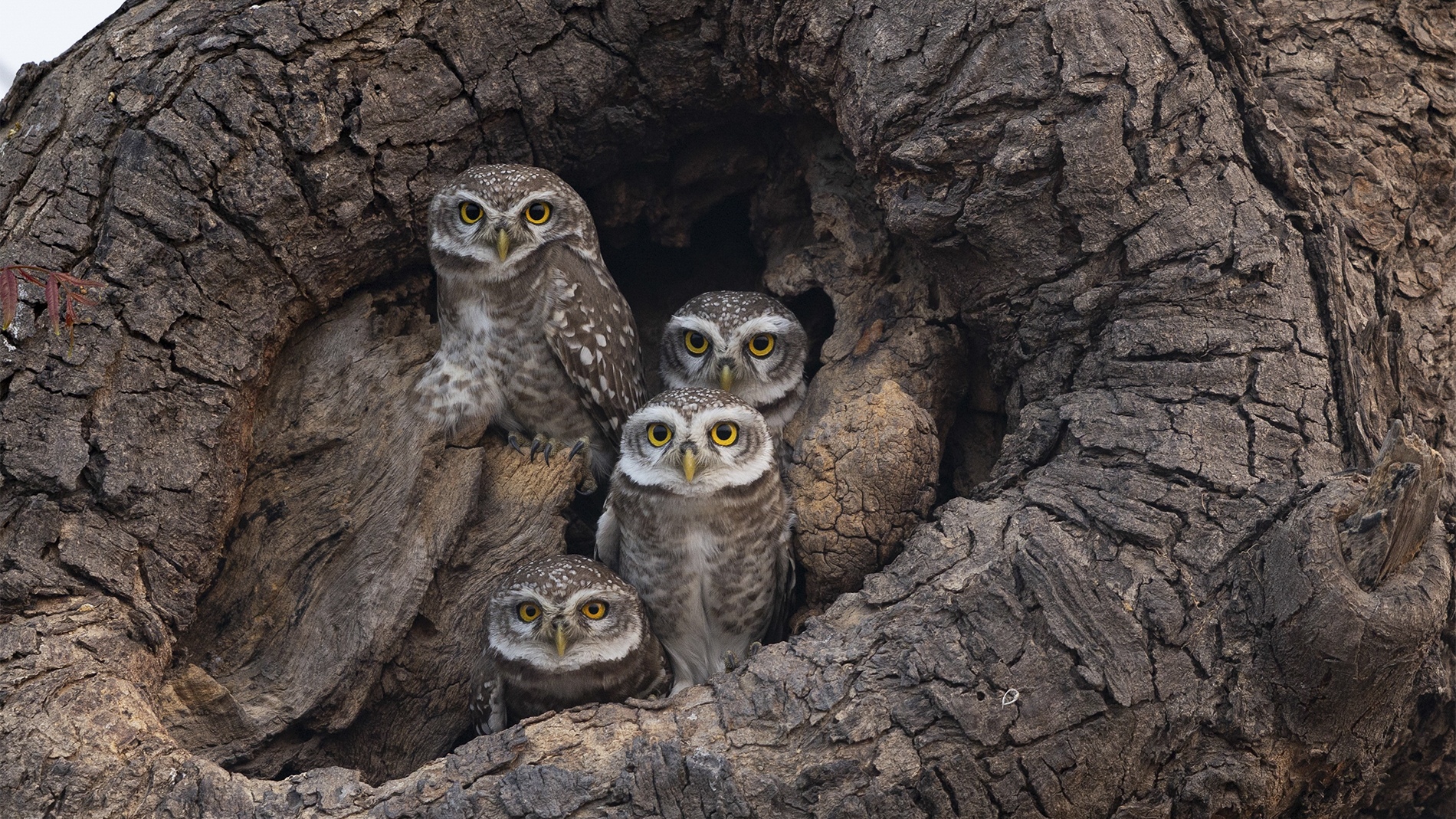
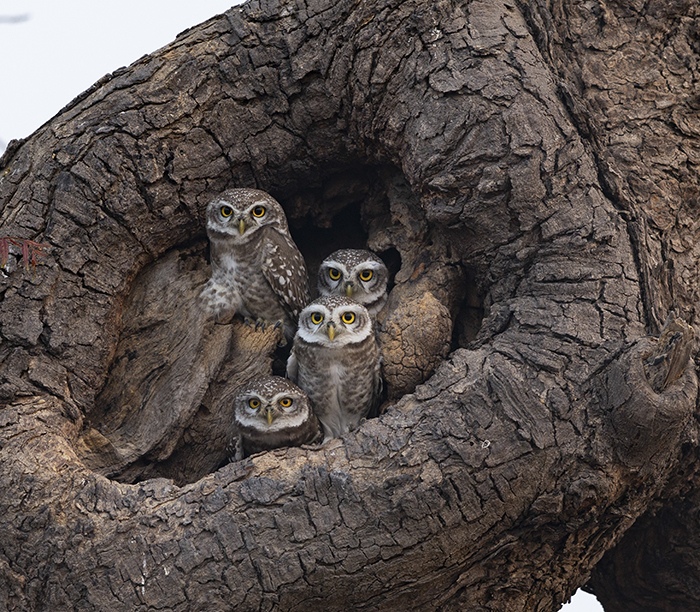
On a cold winter morning in early February 2026, the landscape beyond Ahmedabad lay quiet beneath the pale light of dawn. The fields, dry and muted, held the stillness that arrives just before the day begins to stir. Frostless, but cold enough to hold the earth in suspension between night and day. For wildlife photographer Hardik Shelat, the hour carried familiar promise. After fifteen years behind the lens, he had learned that the most meaningful encounters rarely announce themselves. They emerge slowly, from patience and attention.
Nearly seventy kilometers from the city, while walking through open countryside in search of birds, Shelat noticed an ancient tree standing alone. Its branches were bare, stripped of leaves, and its trunk carried the deep textures of age. Near its center, a large hollow opened into darkness. At first, it revealed nothing.
He moved on.
Then, from another nearby tree, came a soft, unmistakable call. A spotted owlet. Small, alert, and watchful, the bird appeared briefly before slipping from view. Shelat and his companions followed at a respectful distance. The owlet returned to the hollow.
They waited.
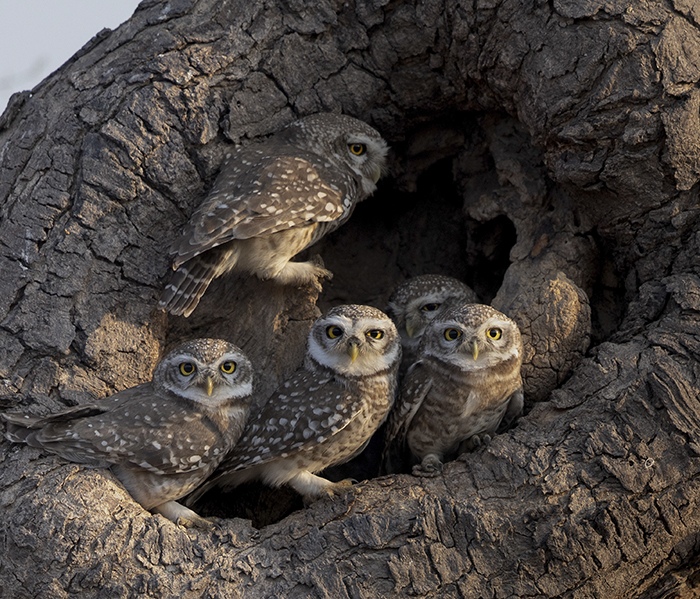
The first morning revealed only two owlets before they withdrew again into shadow. The hollow remained mostly silent, its interior concealing more than it offered.
He returned the next morning at the same hour.
Again, they waited.
An hour passed, a particular kind of hour, the sort that asks something of you. The winter air remained cool and the light shifted slowly.
“It was really a wonderful experience. I have been doing wildlife photography for fifteen years, and this was the first time I saw so many owlets together. It was a once in a lifetime moment.”
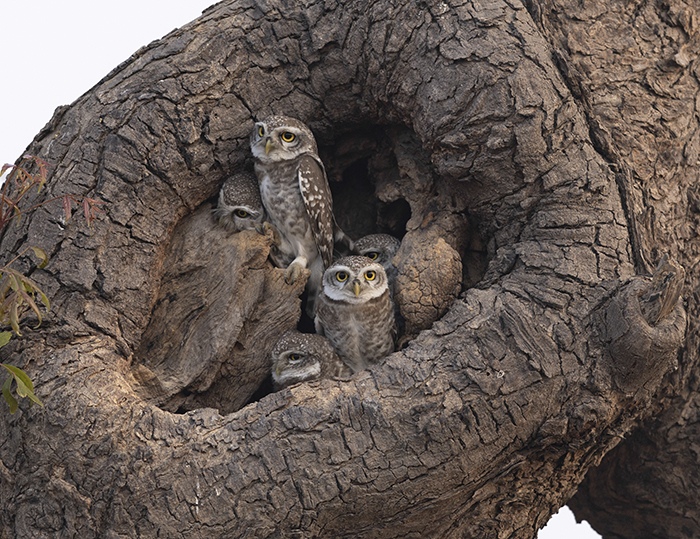
Spotted owlets (Athene brama) are small, stocky owls common across the Indian subcontinent, often found where old trees still stand at the edges of fields and open countryside.
The ancient tree, weathered and hollowed by time, had become more than wood. It was architecture. Shelter. Continuity.
For a brief but unhurried interval, the owlets remained calm, neither retreating nor displaying alarm. Their wide, luminous eyes reflected the quiet awareness of creatures accustomed to living at the threshold between concealment and exposure. They did not perform. They simply existed.
Shelat photographed from a distance, using a Canon EOS R5 Mark II paired with a 500mm lens, allowing him to observe without intrusion. The long focal length preserved the fragile boundary between observer and observed, ensuring that the owlets’ behavior remained undisturbed. Such encounters cannot be forced. They arise from a convergence of patience, timing, and restraint, qualities the owlets themselves seemed to embody.
For Shelat, the photographs fulfilled a long-held dream. Owls had always been his favorite subject, creatures of stillness and perception whose lives unfold largely beyond human awareness. To witness an entire family gathered within a single ancient hollow was not only rare, but deeply personal.
Moments like this remind us that the natural world continues to hold lives parallel to our own, often hidden in plain sight. Within the hollow of a forgotten tree, a family persisted, quiet, alert, and whole.
The tree had been standing long before the photographer arrived. It will likely remain long after he leaves.
But for one winter morning, in the gentle emergence of eight small faces from darkness into light, its hidden life was briefly revealed.
And then, as quietly as it began, the moment returned to concealment.
Species Spotted owlet (Athene brama)
Camera Canon EOS R5 Mark II
Lens 500mm