
Architecture: OMA / Shohei Shigematsu. Photograph: Rafael Gamo
At Casa Wabi in Mexico, Shohei Shigematsu, head of OMA's New York office, handed the design brief to a living organism and let the mushroom answer
Architecture: OMA / Shohei Shigematsu. Photograph: Rafael Gamo
If a building were not designed by an architect, what would it look like?
Architects rarely ask this question, because it seems to challenge the most fundamental premise of the profession.
Shohei Shigematsu asked it.
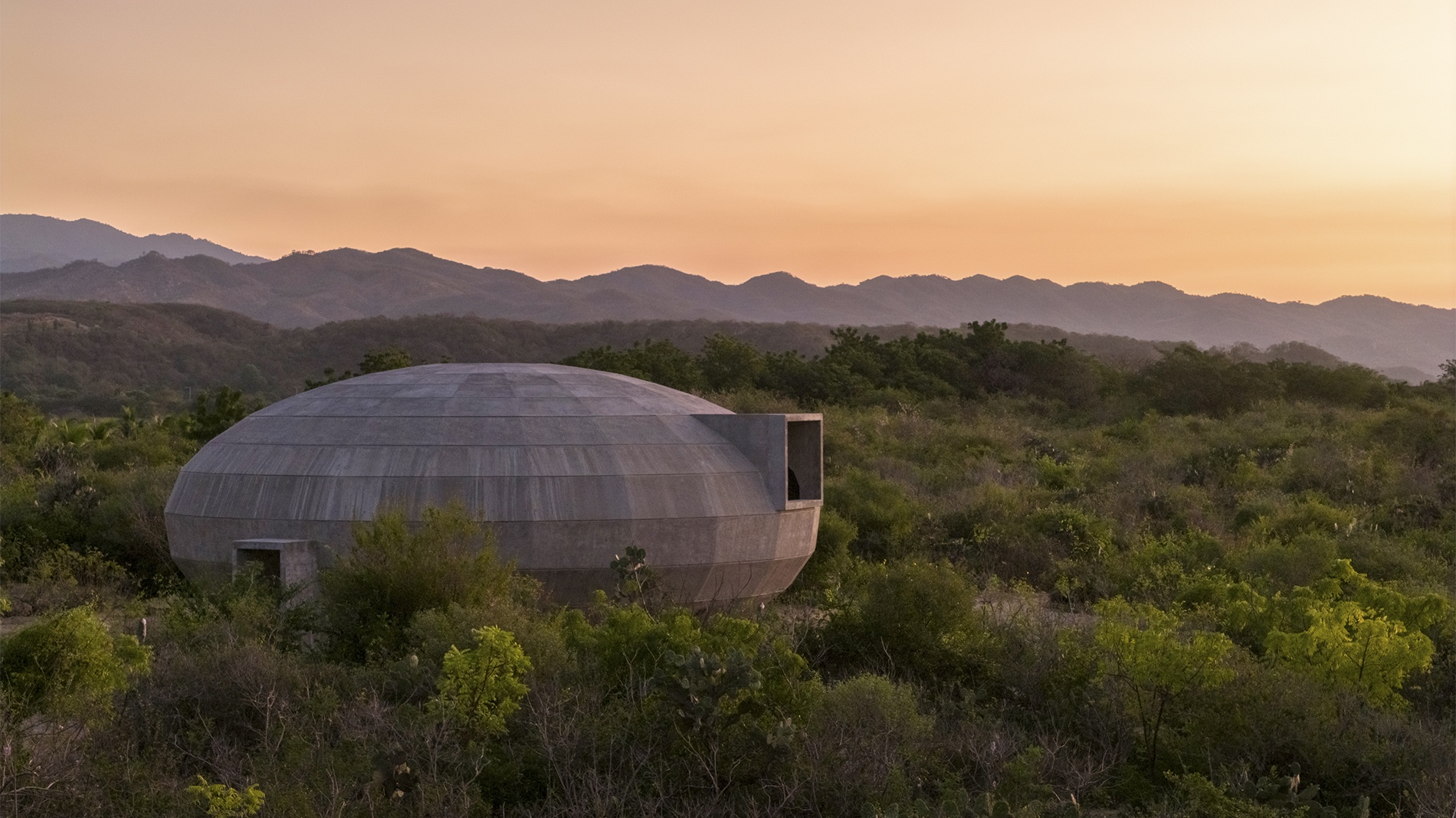
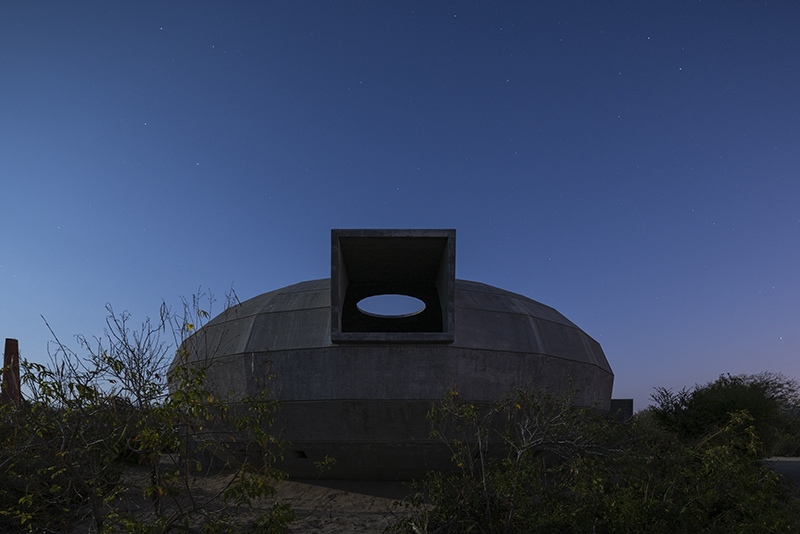
The answer now stands on the Pacific coast of Oaxaca, Mexico. A concrete shell of roughly 200 square meters, ellipsoidal and self-supporting, its form shaped directly by the spatial logic of mushroom cultivation.
The Casa Wabi Mushroom Pavilion opened on March 4, 2026, becoming OMA's first completed project in Mexico. It carries several identities at once: an agricultural facility, a gathering space for the community, and a new node within the coastal art campus founded by Bosco Sodi. At a deeper level, however, it represents something rare in architecture. The form of the building does not originate from human imagination about how architecture should appear, but from the environmental requirements of a nonhuman organism.
OMA describes the pavilion as "a basic ellipsoidal form designed to optimize the interior organization required for cultivating mushrooms." The statement is precise and quietly remarkable. In most architectural briefs, function is a constraint that must be negotiated against form. Here the two merge so completely that they are almost indistinguishable. The ellipsoid did not emerge from formal design. It emerged from mycology.
Architecture: OMA / Shohei Shigematsu. Photograph: Rafael Gamo
What Fungi Need
To understand the pavilion, one must first understand mushrooms themselves.
The cultivation of mushrooms requires careful control of humidity, temperature, airflow, and light at different stages of the fungal life cycle. The fruiting room, where mushrooms develop their visible bodies, requires conditions entirely different from the incubation room, where mycelium colonizes its substrate. Storage spaces have their own requirements as well. These are not abstract architectural zones. They are biological necessities. Without any one of them, the entire system fails.
OMA's response was to arrange three functional chambers around a central communal space, all enclosed within a continuous structural shell.
The lower half of the interior steps inward like a circular amphitheater. The terraced platforms hold hundreds of terracotta mushroom pots handcrafted by artisans in Puerto Escondido. The stepped structure combined with the ellipsoidal form creates a circular observational space where every stage of the mushroom life cycle can be seen simultaneously from the center. This transparency is not about surveillance. It is about learning. The entire process of mushroom cultivation unfolds in plain view.
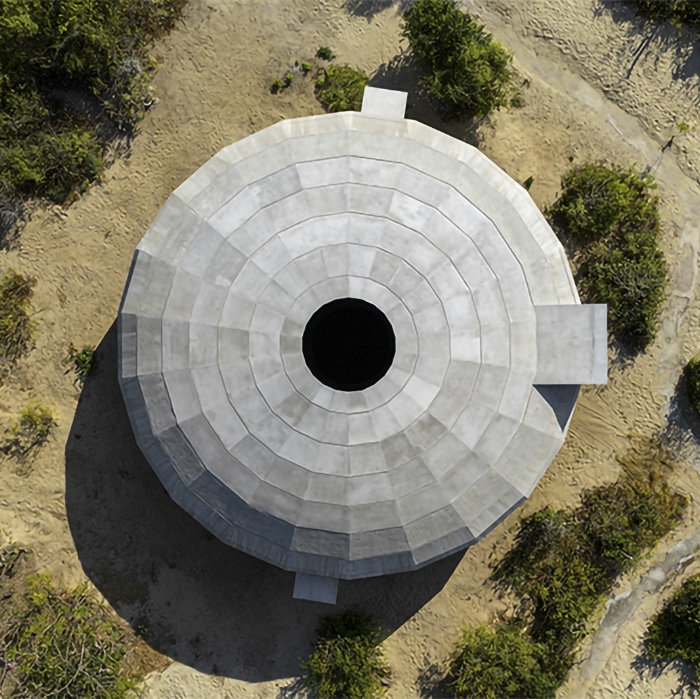
Light enters through a circular oculus at the crown of the dome, allowing the cave-like interior to shift in illumination throughout the day. Openings around the lower perimeter provide natural ventilation, serving the environmental needs of the building's two inhabitants: humans and fungi.
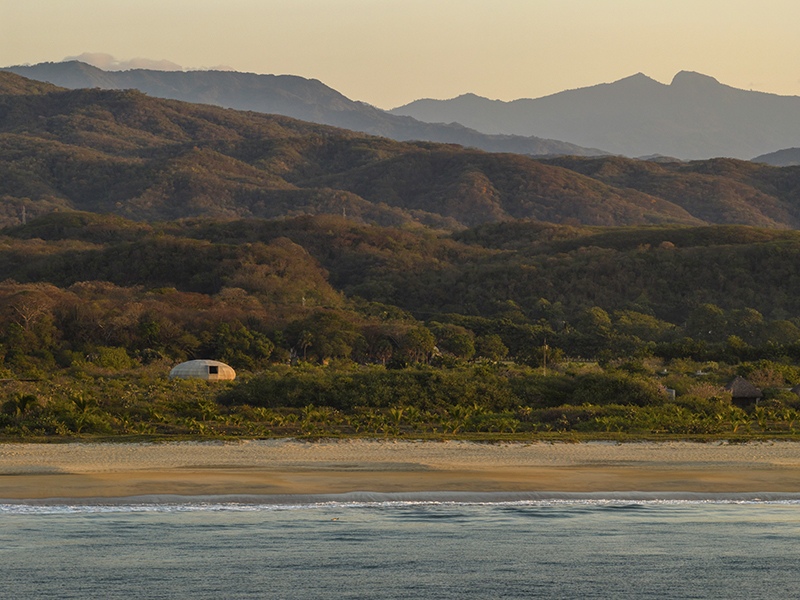
At the top of the stepped interior, a platform and opening direct the gaze above the surrounding vegetation toward the Pacific Ocean. The spatial sequence moves gradually from the dim enclosure of cultivation to the open horizon of the coast. The building seems to breathe.
Architecture: OMA / Shohei Shigematsu. Photograph: Rafael Gamo
The Land It Touches
Architecture often intervenes in a site with a certain assertion. The Mushroom Pavilion adopts a quieter approach.
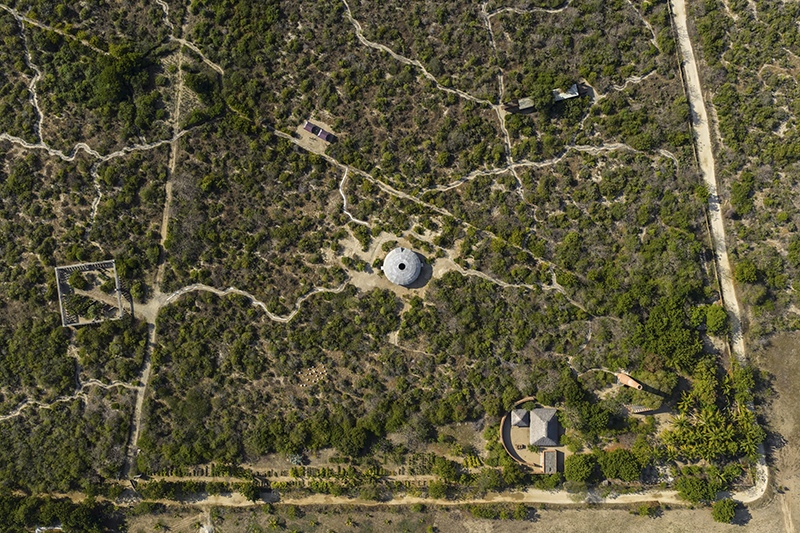
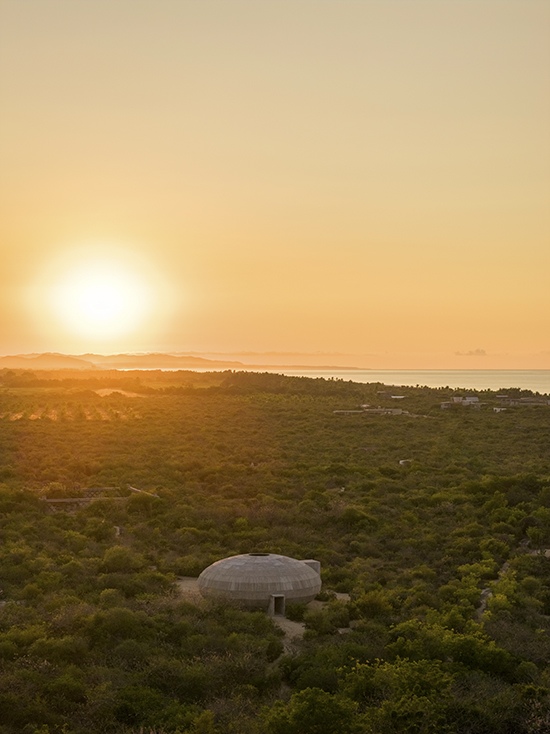
The building's volume curves inward at its base, minimizing contact with the ground and preserving the existing landscape as much as possible. In doing so, the guayacán trees on the site can continue growing undisturbed. This is not the familiar ecological gesture of green roofs or permeable paving. Instead, it reflects a more fundamental recognition: the building is only a temporary guest on land that already had its own life.
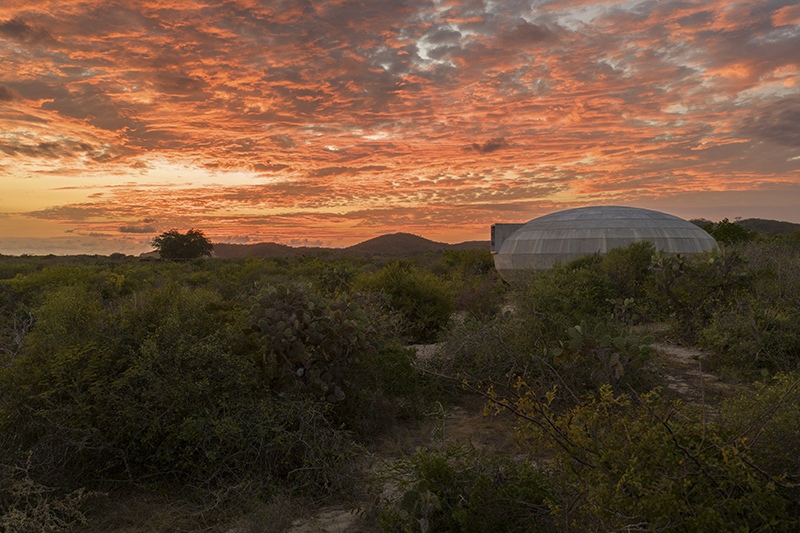
The concrete shell was constructed through on-site plastering and casting. Burlap textures were pressed into the exterior surface to absorb the site's iron-rich water. Over time the building will gradually develop rust-colored stains, its appearance shifting with weather and mineral deposits. In other words, the architecture continues to be shaped by its environment long after construction ends. In that sense the building is not truly "finished." It is slowly aging, much like the living organisms it houses.
Shohei Shigematsu trained as an architect in Japan and has led OMA's New York office for nearly two decades. In this project he also found a cultural resonance.
“We conceived a pavilion for the very specific function of mushroom cultivation while offering a space for people to come together. The result is an incubator of both food and community.”Shohei Shigematsu, OMA
Architecture: OMA / Shohei Shigematsu. Photograph: Rafael Gamo
Fundación Casa Wabi itself emerged from a dialogue with Japanese architect Tadao Ando, whose concrete building remains the central anchor of the campus. The Mushroom Pavilion now joins this architectural collection alongside a chicken coop designed by Kengo Kuma and a ceramics workshop designed by Alberto Kalach. Here, architecture serves function first and symbolism second. These structures grow food, produce objects, and sustain everyday life. At Casa Wabi, the boundary between art and agriculture has always been fluid.

Architecture: OMA / Shohei Shigematsu. Photograph: Rafael Gamo
A Double Incubator
The mushrooms cultivated in the pavilion will supply the kitchens of the foundation as well as the nearby Hotel Escondido. This is not a metaphor. The building genuinely produces food, and the art campus nourishes the surrounding community.
Shigematsu explained: "Working with Bosco Sodi and Fundación Casa Wabi, we conceived a pavilion that serves the very specific function of mushroom cultivation while also offering a place for people to gather. The result is a space that incubates both food and community, capable of supporting activities for local residents, visitors, and the foundation."
The word incubator is not accidental. An incubator does not create life directly. It simply maintains the conditions in which life can grow. From an architectural perspective, this may be the most accurate description of the pavilion. It does not attempt to express the architect's personal vision. Instead, it establishes an environment where other processes can unfold.
The project was led by OMA Partner Shohei Shigematsu, with project architects Shary Tawil and Caroline Corbett.
What it means to allow a nonhuman process to shape architectural form, how the human designer must step back within such a process, and how visitors experience the resulting space are questions that remain open. They are precisely the directions Our Narratives hopes to explore further in future conversations with Shigematsu.
For now, the pavilion stands quietly on its narrow coastal strip between the mountains and the Pacific Ocean, gradually accumulating iron stains while welcoming new seasons of mushroom growth, slowly becoming more itself over time.

Architecture: OMA / Shohei Shigematsu. Photograph: Rafael Gamo
Architecture: OMA / Shohei Shigematsu. Photograph: Rafael Gamo
OMA is an international practice operating within the fields of architecture, urbanism, and cultural analysis. Founded by Rem Koolhaas in 1975, the office is led by six partners: Rem Koolhaas, Ellen van Loon, Reinier de Graaf, Shohei Shigematsu, Iyad Tabet, and Jason Long. OMA's New York office, led by Shohei Shigematsu, focuses on cultural, civic, and arts projects across the Americas and Asia.
Architecture: OMA / Shohei Shigematsu. Photograph: Rafael Gamo
The Mushroom Pavilion at Fundación Casa Wabi opened on March 4, 2026. It is OMA's first completed building in Mexico. The project was designed by OMA Partner Shohei Shigematsu, with project architects Shary Tawil and Caroline Corbett. It is located within the coastal Casa Wabi art campus in Puerto Escondido, Oaxaca, Mexico. Created by artist Bosco Sodi, this site has continually invited architects to build structures that emphasize function rather than monumentality.
This article is based on official materials released by OMA as well as photography by Rafael Gamo. We approach the project through a central question: does the pavilion's ellipsoidal geometry originate from the biological requirements of mushroom cultivation, or from the formal design of the architect?
We are currently in communication with OMA and hope to continue the conversation with Shohei Shigematsu, publishing a follow-up interview in a future issue.
— Adelina
Architecture: OMA / Shohei Shigematsu. Photograph: Rafael Gamo
If a building were not designed by an architect, what would it look like?
Architects rarely ask this question, because it seems to challenge the most fundamental premise of the profession.
Shohei Shigematsu asked it.
The answer now stands on the Pacific coast of Oaxaca, Mexico. A concrete shell of roughly 200 square meters, ellipsoidal and self-supporting, its form shaped directly by the spatial logic of mushroom cultivation.
The Casa Wabi Mushroom Pavilion opened on March 4, 2026, becoming OMA's first completed project in Mexico. It carries several identities at once: an agricultural facility, a gathering space for the community, and a new node within the coastal art campus founded by Bosco Sodi. At a deeper level, however, it represents something rare in architecture. The form of the building does not originate from human imagination about how architecture should appear, but from the environmental requirements of a nonhuman organism.
OMA describes the pavilion as "a basic ellipsoidal form designed to optimize the interior organization required for cultivating mushrooms." The statement is precise and quietly remarkable. In most architectural briefs, function is a constraint that must be negotiated against form. Here the two merge so completely that they are almost indistinguishable. The ellipsoid did not emerge from formal design. It emerged from mycology.
Architecture: OMA / Shohei Shigematsu. Photograph: Rafael Gamo
To understand the pavilion, one must first understand mushrooms themselves.
The cultivation of mushrooms requires careful control of humidity, temperature, airflow, and light at different stages of the fungal life cycle. The fruiting room, where mushrooms develop their visible bodies, requires conditions entirely different from the incubation room, where mycelium colonizes its substrate. Storage spaces have their own requirements as well. These are not abstract architectural zones. They are biological necessities. Without any one of them, the entire system fails.
OMA's response was to arrange three functional chambers around a central communal space, all enclosed within a continuous structural shell.
The lower half of the interior steps inward like a circular amphitheater. The terraced platforms hold hundreds of terracotta mushroom pots handcrafted by artisans in Puerto Escondido. The stepped structure combined with the ellipsoidal form creates a circular observational space where every stage of the mushroom life cycle can be seen simultaneously from the center. This transparency is not about surveillance. It is about learning. The entire process of mushroom cultivation unfolds in plain view.
Light enters through a circular oculus at the crown of the dome, allowing the cave-like interior to shift in illumination throughout the day. Openings around the lower perimeter provide natural ventilation, serving the environmental needs of the building's two inhabitants: humans and fungi.
At the top of the stepped interior, a platform and opening direct the gaze above the surrounding vegetation toward the Pacific Ocean. The spatial sequence moves gradually from the dim enclosure of cultivation to the open horizon of the coast. The building seems to breathe.
Architecture: OMA / Shohei Shigematsu. Photograph: Rafael Gamo
Architecture often intervenes in a site with a certain assertion. The Mushroom Pavilion adopts a quieter approach.
The building's volume curves inward at its base, minimizing contact with the ground and preserving the existing landscape as much as possible. In doing so, the guayacán trees on the site can continue growing undisturbed. This is not the familiar ecological gesture of green roofs or permeable paving. Instead, it reflects a more fundamental recognition: the building is only a temporary guest on land that already had its own life.
The concrete shell was constructed through on-site plastering and casting. Burlap textures were pressed into the exterior surface to absorb the site's iron-rich water. Over time the building will gradually develop rust-colored stains, its appearance shifting with weather and mineral deposits. In other words, the architecture continues to be shaped by its environment long after construction ends. In that sense the building is not truly "finished." It is slowly aging, much like the living organisms it houses.
Shohei Shigematsu trained as an architect in Japan and has led OMA's New York office for nearly two decades. In this project he also found a cultural resonance.
“We conceived a pavilion for the very specific function of mushroom cultivation while offering a space for people to come together. The result is an incubator of both food and community.”Shohei Shigematsu, OMA
Architecture: OMA / Shohei Shigematsu. Photograph: Rafael Gamo
Fundación Casa Wabi itself emerged from a dialogue with Japanese architect Tadao Ando, whose concrete building remains the central anchor of the campus. The Mushroom Pavilion now joins this architectural collection alongside a chicken coop designed by Kengo Kuma and a ceramics workshop designed by Alberto Kalach. Here, architecture serves function first and symbolism second. These structures grow food, produce objects, and sustain everyday life. At Casa Wabi, the boundary between art and agriculture has always been fluid.
Architecture: OMA / Shohei Shigematsu. Photograph: Rafael Gamo
The mushrooms cultivated in the pavilion will supply the kitchens of the foundation as well as the nearby Hotel Escondido. This is not a metaphor. The building genuinely produces food, and the art campus nourishes the surrounding community.
Shigematsu explained: "Working with Bosco Sodi and Fundación Casa Wabi, we conceived a pavilion that serves the very specific function of mushroom cultivation while also offering a place for people to gather. The result is a space that incubates both food and community, capable of supporting activities for local residents, visitors, and the foundation."
The word incubator is not accidental. An incubator does not create life directly. It simply maintains the conditions in which life can grow. From an architectural perspective, this may be the most accurate description of the pavilion. It does not attempt to express the architect's personal vision. Instead, it establishes an environment where other processes can unfold.
The project was led by OMA Partner Shohei Shigematsu, with project architects Shary Tawil and Caroline Corbett.
What it means to allow a nonhuman process to shape architectural form, how the human designer must step back within such a process, and how visitors experience the resulting space are questions that remain open. They are precisely the directions Our Narratives hopes to explore further in future conversations with Shigematsu.
For now, the pavilion stands quietly on its narrow coastal strip between the mountains and the Pacific Ocean, gradually accumulating iron stains while welcoming new seasons of mushroom growth, slowly becoming more itself over time.
Architecture: OMA / Shohei Shigematsu. Photograph: Rafael Gamo
Architecture: OMA / Shohei Shigematsu. Photograph: Rafael Gamo
OMA is an international practice operating within the fields of architecture, urbanism, and cultural analysis. Founded by Rem Koolhaas in 1975, the office is led by six partners: Rem Koolhaas, Ellen van Loon, Reinier de Graaf, Shohei Shigematsu, Iyad Tabet, and Jason Long. OMA's New York office, led by Shohei Shigematsu, focuses on cultural, civic, and arts projects across the Americas and Asia.