
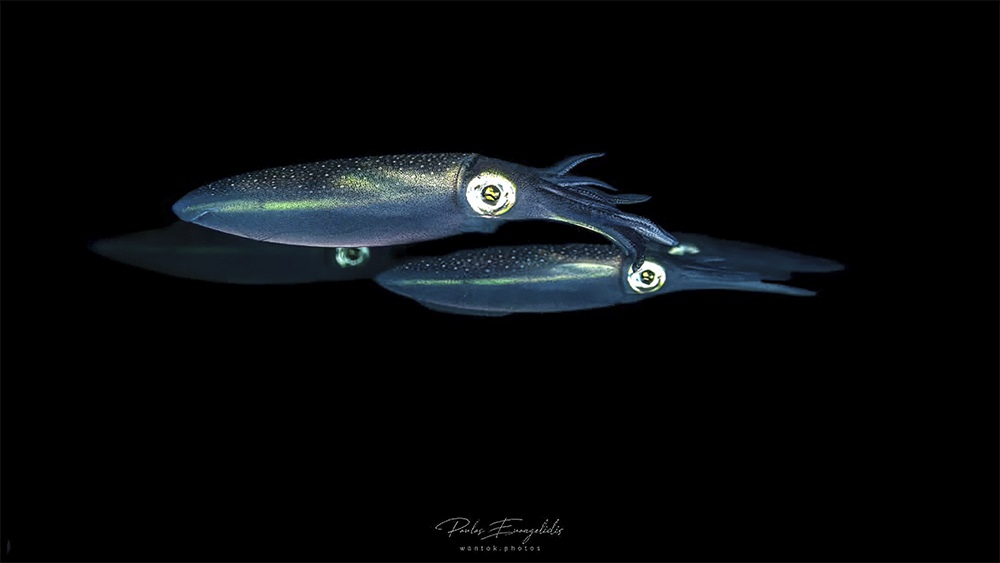
You only see them when they want to be seen
On a night dive off Mohéli in the Comoros archipelago, Pavlos Evangelidis descended into water where human vision becomes almost useless.
His light found a squid suspended in the dark, body semi-transparent, chromatophores scattered across the mantle like a map of something internal, a teal stripe running its length. It hung there and regarded him. He called it a midnight hunter. The phrase is exact: this wasn't a creature fleeing or hiding. It was assessing.
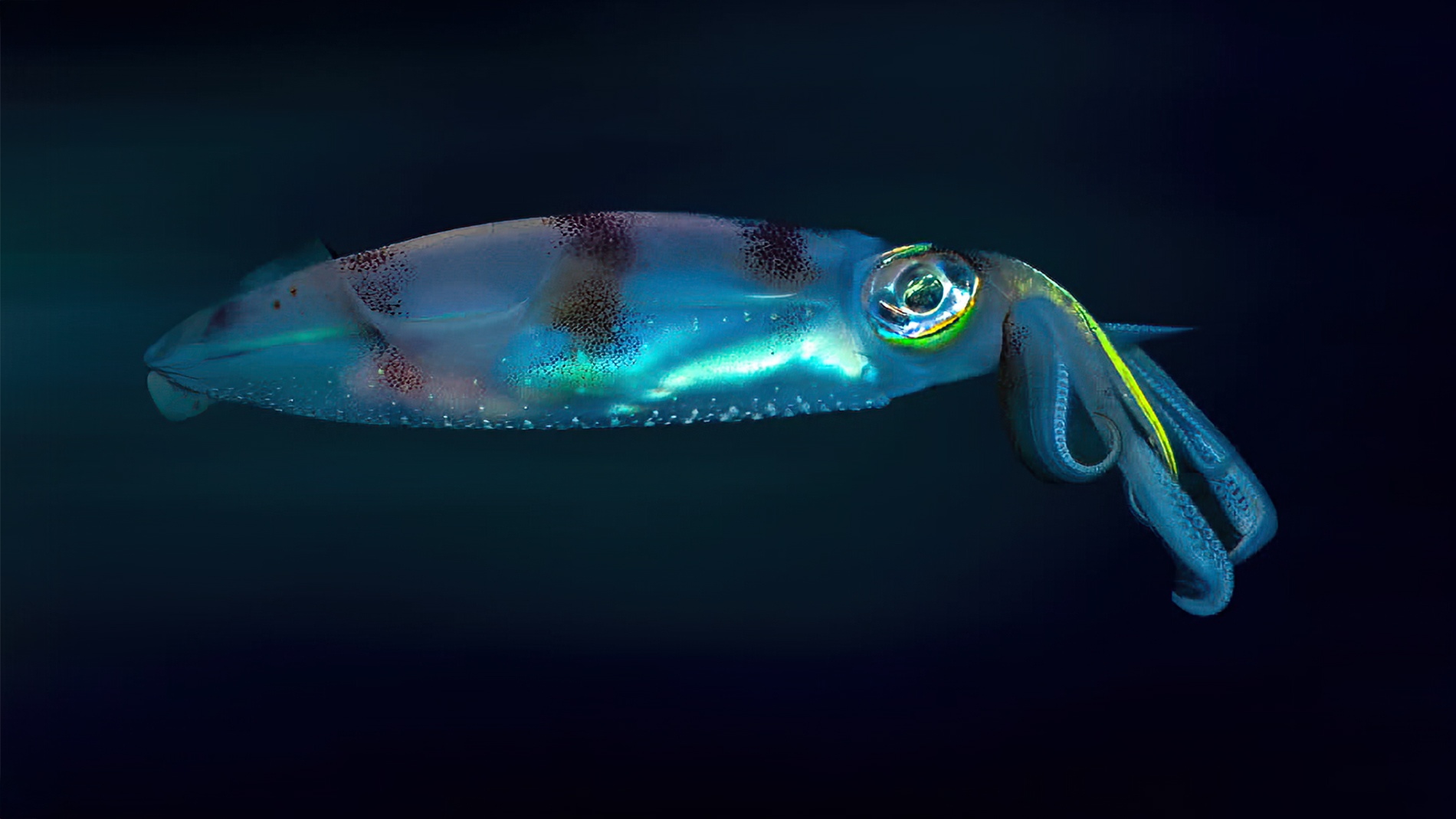
The squid eye is one of the most sophisticated optical structures in the animal kingdom. It arrived at roughly the same solution as the vertebrate eye, lens, iris, retina, through a completely independent evolutionary path. The two lineages never shared a common ancestor with working eyes, yet both converged on the same architecture across hundreds of millions of years. When Evangelidis's light caught that eye off Mohéli, what looked back had solved the same problem of seeing that we had, entirely on its own.
Off Blue Bay in Mauritius, he found them hunting together. Four squid coordinating in the dark, eight eyes between them tracking everything at once. "The Indian Ocean after dark is a different world entirely," he wrote. The squid move through it with a fluency that makes the diver feel like the less capable animal.
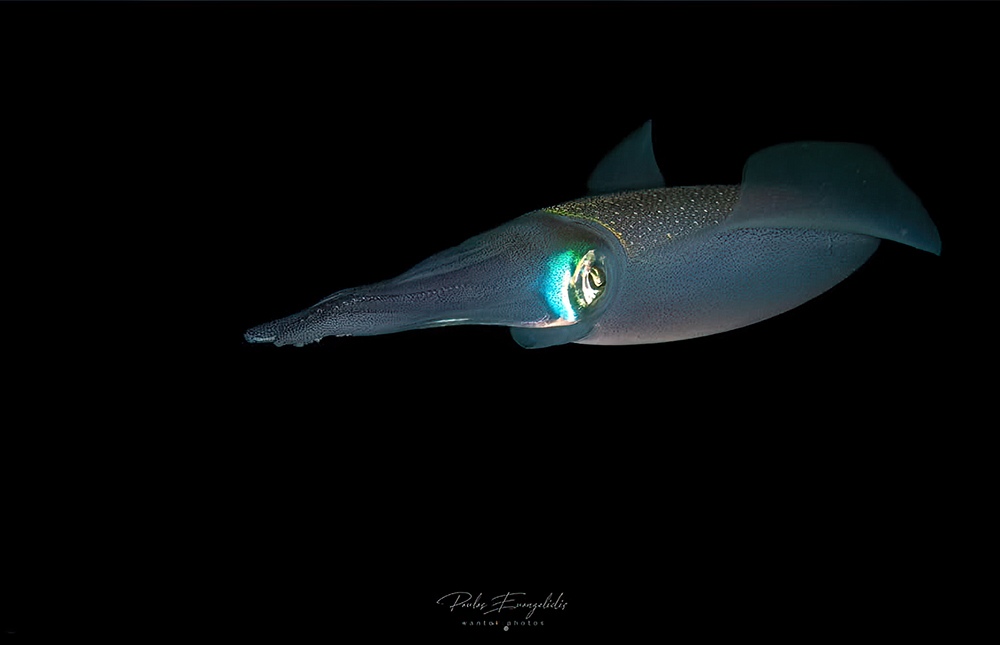
What the third image shows is why. A single squid, close, its body lit from within, the iridescence blazing at the eye, a yellow-green filament running along the fin edge, the entire surface alive with controlled light. "Iridescence like this doesn't come from cellular pigment," Evangelidis wrote of this image. "It comes from light itself, bending through microscopic structures in the skin. This isn't chemical color; it's pure physics.""
The squid can shift its appearance in milliseconds, not just for camouflage, but to communicate, to intimidate, to attract. The skin is a language. Every surface is a signal.
Three images, one Indian Ocean, one animal seen three ways: as a solitary presence in the dark, as a coordinated hunter in a group, and finally as a living system of light. The encounter was Evangelidis's. the physics was always there.
"This isn't chemical color; it's pure physics."
Photographs by Pavlos Evangelidis courtesy of wantok.photos. Captures documented off Mohéli, Comoros and Blue Bay, Mauritius.