
Where's the Catch?

Pedro Barrios Hita on what really happens when you try to write quantum mechanics with real numbers
The Conversation
Pedro Barrios Hita The field of study of my PhD is quantum resource theories, the branch of quantum information that studies the "ingredients" for quantum speedup. Or, in other words, how do the resources that make quantum tasks advantageous in some sense behave. One such resource is imaginarity. This is how we became familiar with Renou et al.'s Nature paper.
At first, we didn't think anything of the composition postulate. What motivated us to look deeper into it was the very natural thought about complex numbers being "just" two real numbers, so where's the catch? From that, everything else sprung.
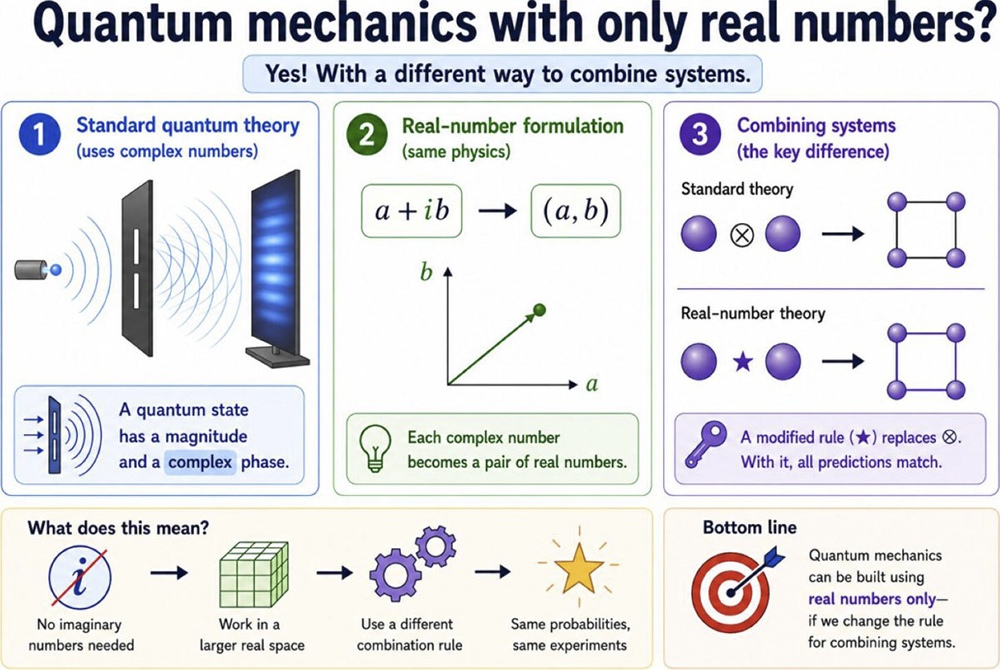
Pedro Barrios Hita One needs a mathematical object that describes a quantum system. Once we have that, we need a mathematical rule to combine the objects that describe individual systems in order to have a description of composite systems. That rule is the tensor product. As you can see, this is indeed very mathematical.
Our approach is motivated by the fact that this combination rule, the tensor product, fails when replacing the complex vector spaces for real ones. So we asked ourselves whether one can devise a different postulate with the same implications as the tensor product, but suitable to describe composite systems with real numbers.
The physical intuition is in fact quite simple. Our postulate basically says that if one has two independent systems, for example located very far apart, nothing you do to one subsystem, that is, operations, measurements and so on, can affect the other, and vice versa.
Pedro Barrios Hita The postulate we propose is certainly more physically motivated, but it is actually mathematically formulated.
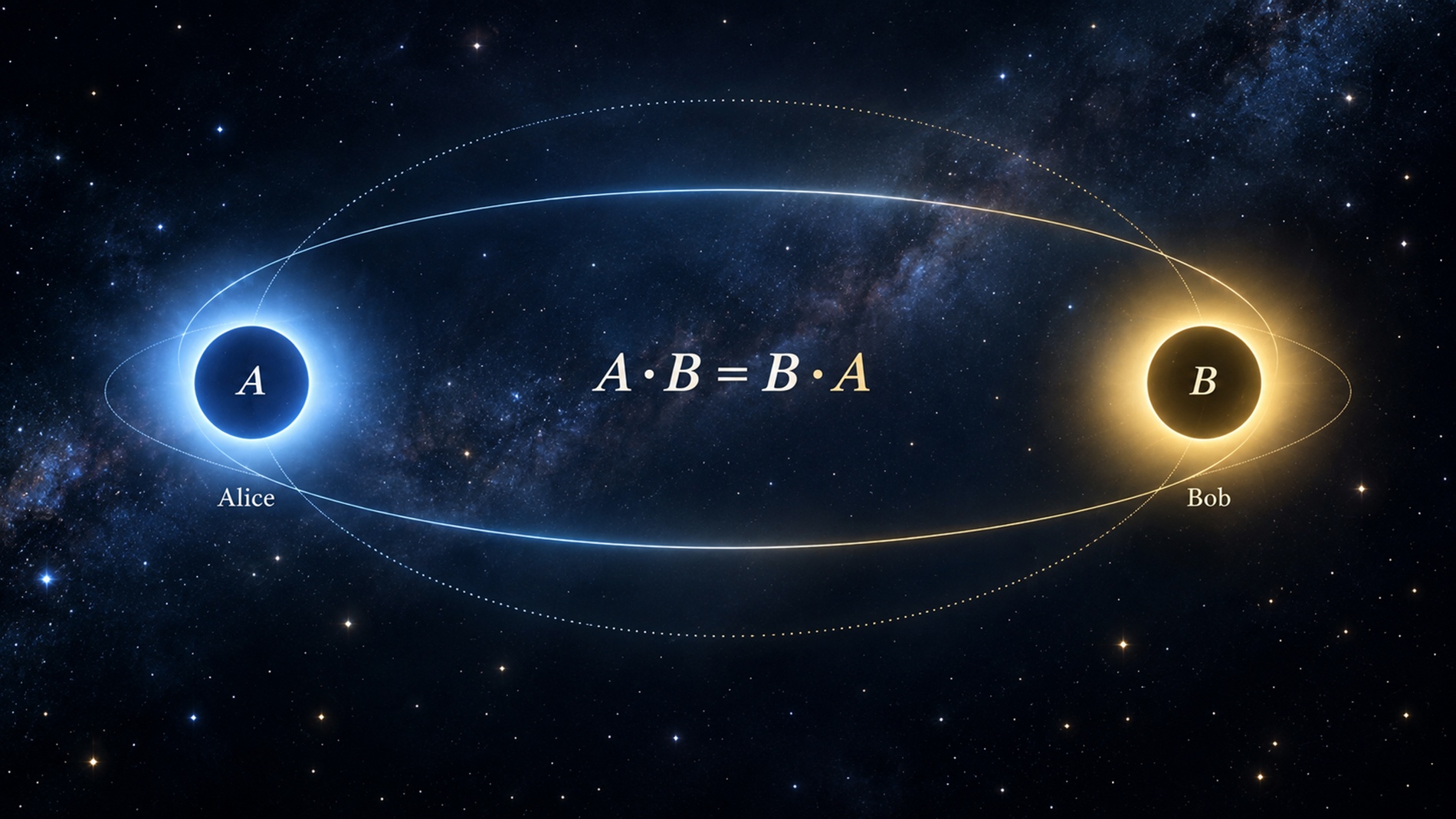
"Whatever is done to one system" is mathematically described by operators, and you can think of them as matrices acting on vectors. Consider two experimenters, Alice and Bob, one on the Earth and another one on the Moon. Let an operator that describes some action that Alice does to her particle be the operator A, and similarly for Bob let it be B.
How can we say mathematically that whatever Alice does does not affect Bob, and vice versa? A natural way is to say that A times B equals B times A, which is to say that it doesn't matter who does what first or second, because they don't affect each other. Well, this has a name in mathematics: the operators A and B commute. This is exactly the way we formalize this postulate in our paper, and we show that what we define as operators acting on independent systems fulfill this commutation rule.
Pedro Barrios Hita This is a very important point and I would like to make it very clear. Our original motivation was not to remove complex numbers from the theory. It was simply to understand what was going on, and why simply replacing complex by real numbers without modifying anything else from the theory failed.
In fact, it is true that in our theory there are no complex numbers. However, complex structure is very much present. If you notice, the matrix J that appears in our paper plays the same role as the imaginary unit i.
We make that point very clear in our manuscript. If our theory is isomorphic to quantum mechanics, and quantum mechanics has a complex structure, then it is obvious that our formalism does as well.
Pedro Barrios Hita The two frameworks represent the same theory, quantum mechanics, because they give the same experimental predictions. We call the two models isomorphic, which essentially is the mathematical term for "the same." All of this is very formal and well studied.
Our main contribution is precisely understanding what goes wrong when replacing the number field from complex to reals, how to modify the composition rule, and what consequences that has in formulating how to prepare independent systems.
Pedro Barrios Hita This topic is very prone to misunderstanding, because indeed everyone knows what a complex number is, and how it is nothing more, and nothing less, than two real numbers. This is why, from my experience, this topic is quite susceptible to being described by click-baity titles.
Thus I am personally not surprised that many people who haven't read our paper in detail, who haven't followed the discourse in the literature closely, or who are simply non-expert amateurs, deem our paper as incorrect, because they think we eliminate complex numbers and we certainly don't, or trivial, because complex numbers are just two real numbers, right?
The real contribution is, in our view, understanding what goes wrong with "real quantum mechanics" when one considers composite systems, realizing that one can fix this via changing the postulate that tells you how to compose systems, and then seeing what interesting discussions about locality and independent preparations of systems arise from modifying that composition rule.
Pedro Barrios Hita I think that if one has two equivalent formulations of the same theory, one will always try to use the one that makes one's life easier. In the case of quantum mechanics, I believe, one would always use complex.
Pedro Barrios Hita I think the very first thing that I remember being fascinated by is the immeasurable scales of the universe: its size, number of galaxies, stars, planets and so on. I first became aware of this when I was very young, maybe around ten or twelve years old, watching Carl Sagan's Cosmos.
Shortly after that, I read Stephen Hawking's A Brief History of Time, and pretty much haven't thought of anything else since then.
Conclusion
There is a particular pleasure in watching a scientist decline to be made more interesting than he is.
The story available here was obvious: imaginary numbers turn out to be unnecessary, a century of physics rests on a convenience, the mathematics we thought was built into nature is a choice. Barrios Hita takes that story apart every time it is offered to him. The complex structure is still there. The matrix J does exactly what i did. The two formulations are isomorphic, which is the mathematical word for the same. And asked which he would use, having built the real-number version himself, he says he would always use complex.
What is left when the dramatic version is removed is smaller and better. The tensor product is an abstract rule, the kind of thing that arrives in a textbook without justification and is simply accepted. What he and Bruß showed is that it can be replaced by a statement anyone can picture: Alice is on the Earth, Bob is on the Moon, and nothing either does can reach the other. In the mathematics that becomes a single line, A times B equals B times A. A formal rule exchanged for a fact about independence.
That is worth knowing, and it is not what the headlines said. He seems entirely untroubled by the gap, treating it as the ordinary weather of publishing on a subject where everyone already half-knows the punchline. But it is a useful thing for a reader to see: not a discovery being made, but a result being defended against its own publicity, by someone who would rather be understood than admired.
Explore Further
Are complex numbers part of physics, or part of our description of it?
In 2021, Renou and colleagues argued that experiments involving independent quantum sources could distinguish standard complex quantum mechanics from its real-number counterpart, suggesting that complex numbers play an experimentally indispensable role.
Earlier research Renou et al., Quantum theory based on real numbers can be experimentally falsified, Nature (2021)
Can the difference be tested experimentally?
A 2022 optical quantum-network experiment tested the distinction proposed by Renou and colleagues. Using independent photon sources, the researchers observed correlations that violated the constraints of the conventional real-valued formulation.
Experimental research Li et al., Testing Real Quantum Theory in an Optical Quantum Network, Physical Review Letters (2022)
What should it mean for two quantum sources to be independent?
Hoffreumon and Woods argue that Renou's falsification relies on a particular mathematical definition of independent sources that cannot itself be tested experimentally. They propose defining independence only through observable correlations instead. Renou and collaborators have since responded, shifting the debate toward what should count as a physically justified notion of independence.
Related research · Preprint Hoffreumon & Woods, Quantum theory based on real numbers cannot be experimentally falsified (2026)
The study discussed in this article
About the Scientist
Pedro Barrios Hita is a doctoral researcher at Heinrich Heine University Düsseldorf and the German Aerospace Center (DLR), working primarily on quantum resource theories.