Claudia Pasquero and Marco Poletto on living systems, nonhuman intelligence, and the city as an ecosystem
In 2005, when Claudia Pasquero and Marco Poletto founded ecoLogicStudio in London, the idea that a building might breathe, metabolise, or think was largely confined to biology textbooks and speculative fiction. Architecture was still overwhelmingly in the business of making static objects: controlled, finished, inert. Biology, by contrast, was in the business of something else entirely — adaptation, emergence, the patient negotiation of conditions that no single agent could fully control.
Twenty years on, ecoLogicStudio sits at the exact point where those two disciplines have begun to dissolve into each other. Their installations grow mycelium across bark-like 3D-printed shells. Their facades circulate living algae cultures that cloud and clear with the light. Their playgrounds generate clean air through photosynthesis happening, right now, in fifty-two glass bioreactors. The work is not architecture illustrating biology. It is architecture that has agreed to become biological — to accept uncertainty, temporality, and the distributed authorship that comes with designing alongside life rather than over it.
"The separation already felt artificial," Pasquero says of the moment they began. "Cities are ecosystems. Buildings metabolise energy, matter, information. The question was not whether biology belonged to architecture, but why architecture had excluded life from its processes for so long."
Unlearning Control
The first thing ecoLogicStudio had to unlearn, both founders agree, was the most foundational assumption of architectural training: that design is an act of control. The architect imposes form on matter. The building holds that form against time and weather. Completion is the goal.
Working with living systems requires abandoning this premise at the root. "You stop designing finished forms," Pasquero says, "and start designing conditions for relationships to emerge." The shift is not merely philosophical. It reshapes the design process at every practical level — how you draw, how you test, how you evaluate whether something is working, and what "working" even means when the system is alive and therefore always in motion.
Poletto describes the practice that emerges from this as conversational. "When a living installation behaves unexpectedly, you observe, measure, recalibrate environmental parameters, alter nutrient flows, change light exposure, or sometimes simply wait." The role of the designer, he says, shifts from author to curator of interactions.
This is not a small concession. Architecture has historically been deeply invested in authorship — in the legibility of a vision held by a single intelligence and executed in material. EcoLogicStudio has spent two decades dismantling this investment, project by project, organism by organism.

The Curtain and the City
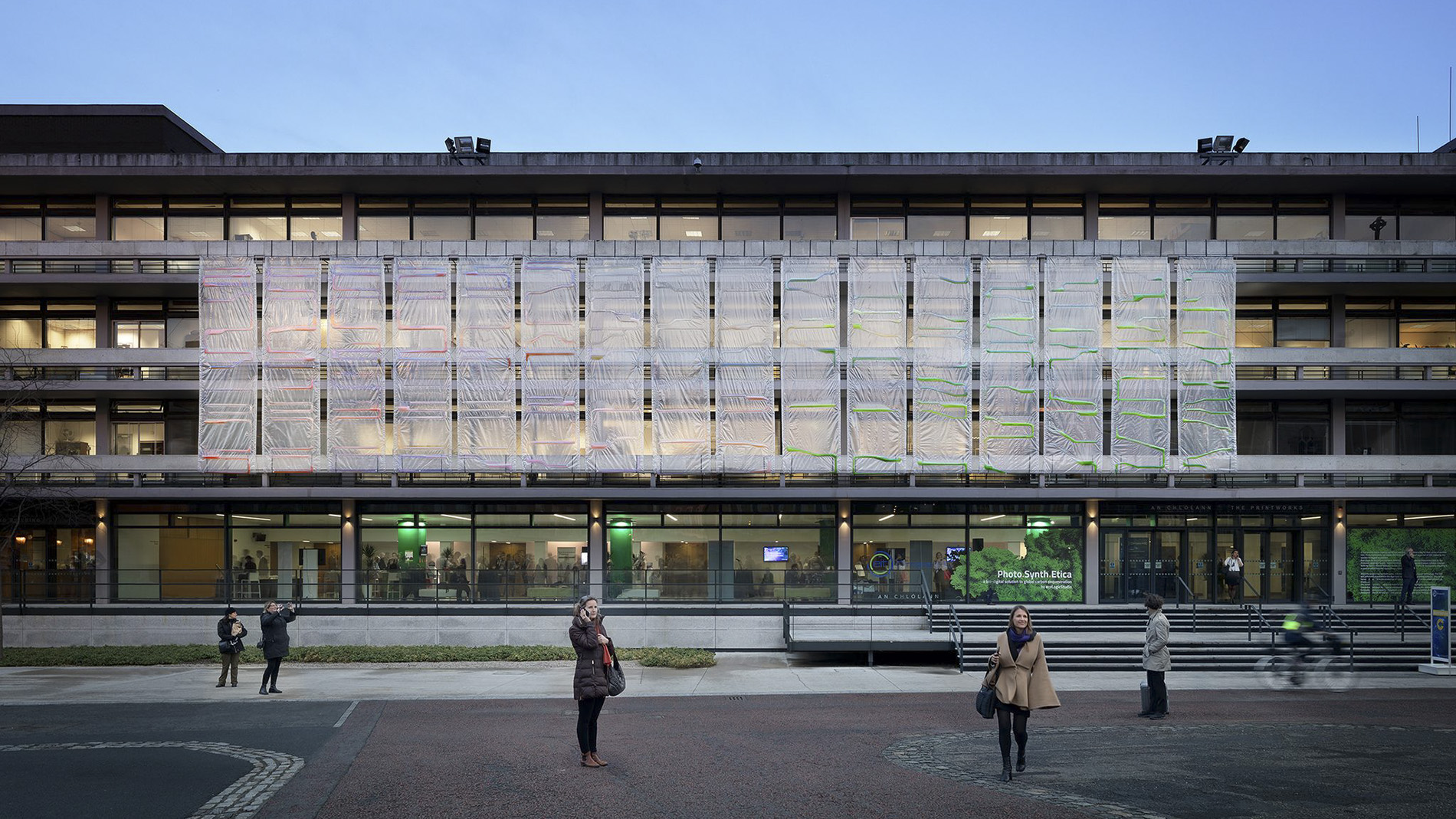
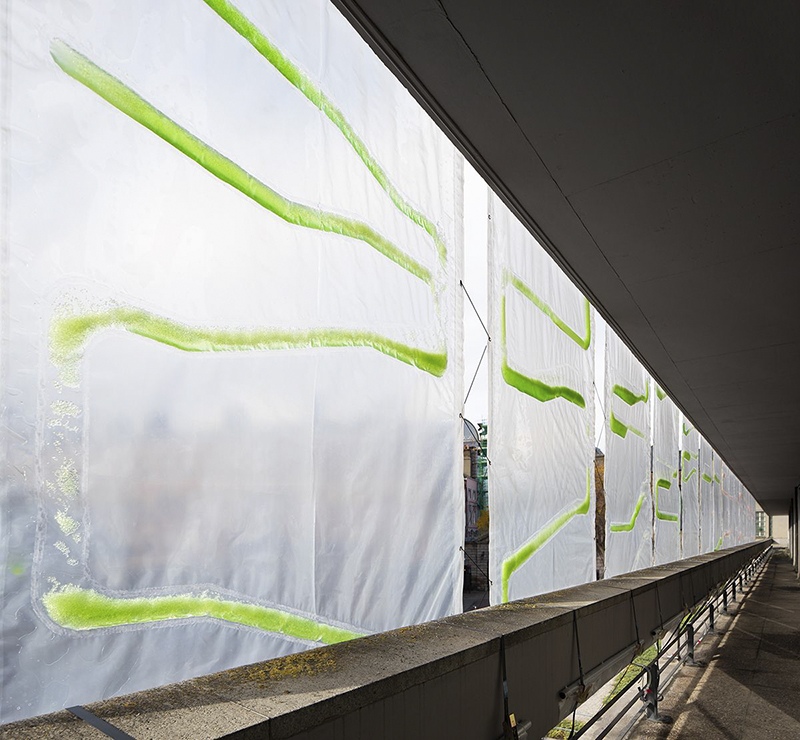
The Photo.Synthetica series, which began with an urban curtain installed across the facade of Dublin Castle in 2018, is perhaps the clearest early expression of what this shift looks like in practice. The installation is 16.2 by 7 meters of custom bioplastic modules, each functioning as a photobioreactor: a precisely designed container in which living microalgae cultures circulate in daylight, capturing CO2 from unfiltered urban air introduced at the base and releasing freshly photosynthesised oxygen at the top. The curtain absorbed approximately one kilogram of CO2 per day — the equivalent of twenty mature trees.
What made the Dublin installation philosophically significant was not only its environmental performance but its visibility. The biological process was not hidden inside a wall or routed through a mechanical system. Tubes clouded and cleared. Colours deepened toward evening. The facade changed with the light and the density of the cultures. The city's own air passed through living matter and was returned to the street transformed.
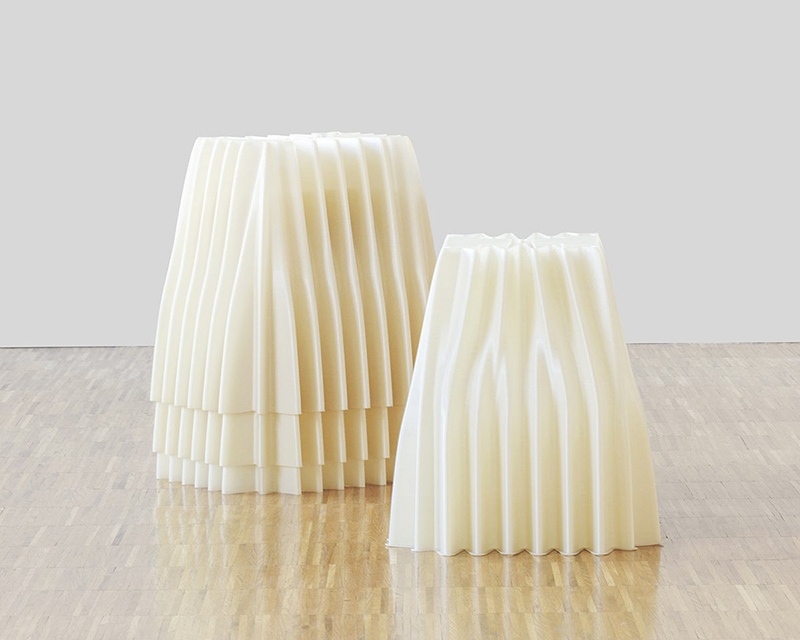
Photo.Synthetica has since evolved through a series of iterations — a design collection, a gardening collection, a commercial installation in a Turin apothecary — each exploring how photosynthetic architecture can be integrated at different scales and contexts. What has remained constant across the series is what surprised Pasquero and Poletto most in how people encountered it: not environmental performance, but atmosphere.
"Visitors often engage first through colour, humidity, smell, softness, light," Pasquero observes. "Children, especially, immediately understand these spaces as alive. They touch them carefully, they slow down, they observe change over time." The installations became, unexpectedly, cultural interfaces — environments capable of reconnecting urban inhabitants with ecological processes that are usually invisible. The architecture was not delivering a message about nature. It was staging an encounter with it.
Nonhuman Intelligence
The Deep.Forest series, first realised at the Louisiana Museum of Modern Art in Denmark in 2024 and most recently presented as DeepForest³ at the 24th International Exposition of La Triennale di Milano in 2025, presses further into territory that challenges not just how architecture is made but what it is allowed to think.
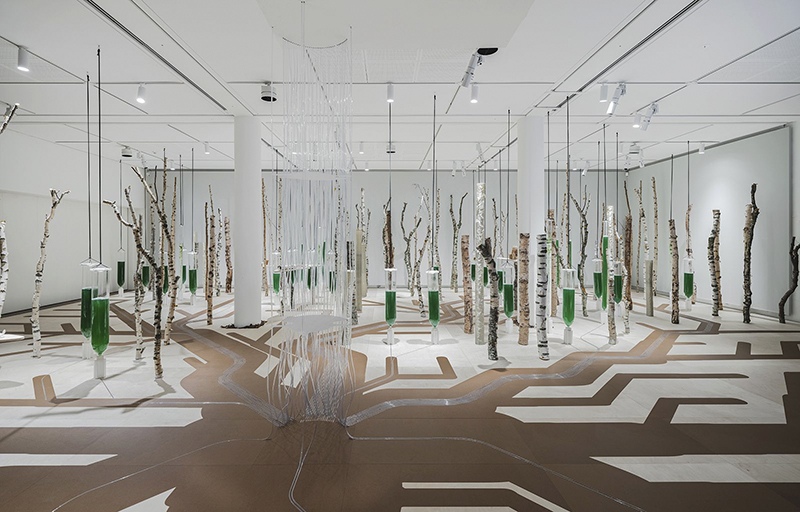
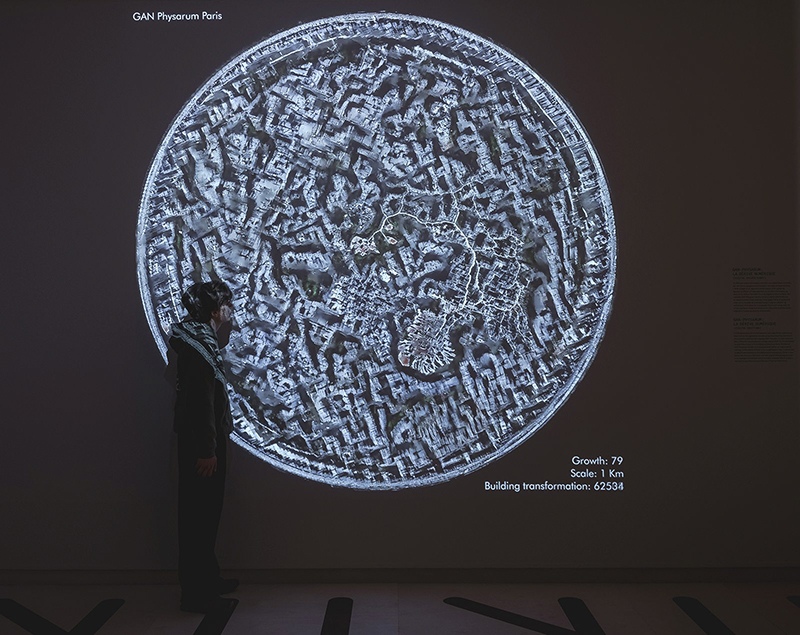
At the Louisiana, slime mould — a woodland organism capable of optimising networks without a nervous system — was given a role in the spatial organisation of the installation. Poletto describes the organism's behaviour directly: "It processes spatial information, optimises networks, distributes resources, remembers environmental conditions." In the context of the installation, slime mould was not deployed as a metaphor for urban planning. It was actively generating organisational principles through its behaviour.
"The designer's role becomes one of translation," Poletto says: "creating interfaces through which biological intelligence can inform architectural space." This is a precise claim, and it deserves to be taken at face value. EcoLogicStudio is not proposing that slime mould is conscious or that its computations are equivalent to human reasoning. They are proposing something stranger and more specific: that intelligence is not a uniquely human property, that it can exist as a spatial and ecological process, and that architecture is capable of making this legible.
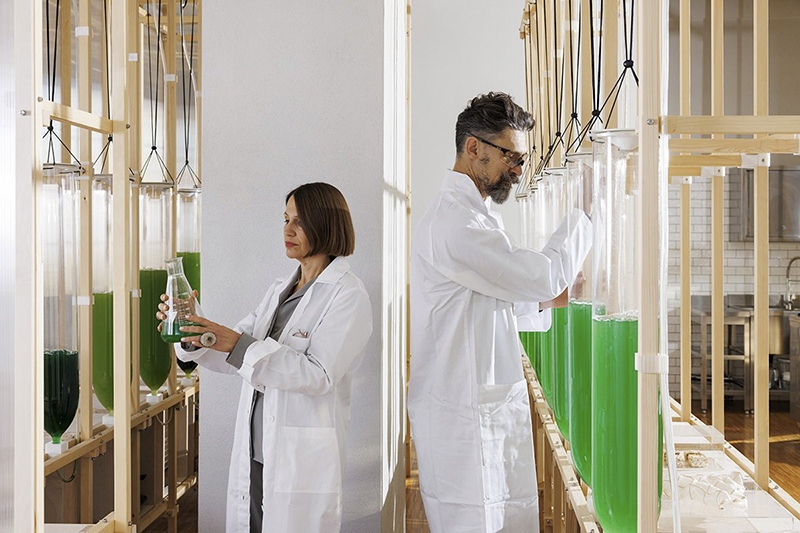
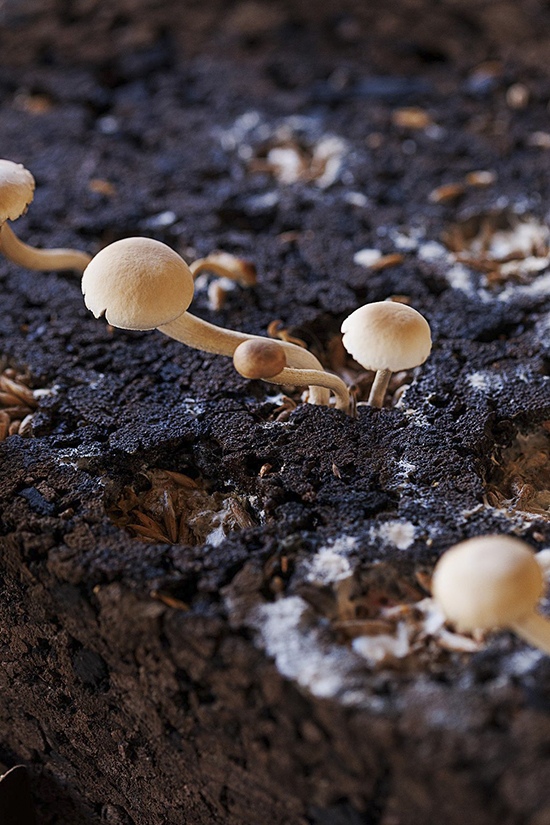
At La Triennale, DeepForest³ developed these ideas into a full domestic ecosystem. Glass vessels containing fifty litres of living cyanobacteria form a breathable membrane — simultaneously wall and filter. Biodegraders built from 3D-printed algae biopolymers host living mycelium networks fed on urban waste. Reclaimed wood and active lichen colonies stabilise and ornament the space through the aesthetics of decay. The systems are deliberately exposed: algae growth chambers, mycelial substrates, air and CO2 pumps remain visible, integrated into the architectural language rather than concealed. "Our home is our microbiome," Pasquero says. The body and the building, she argues, share a nature that is already cyborgian and collective.
The Work of Care
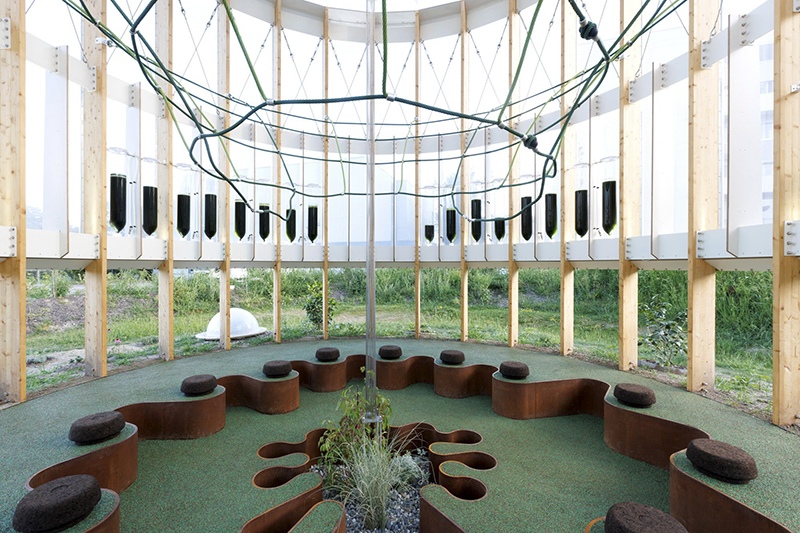
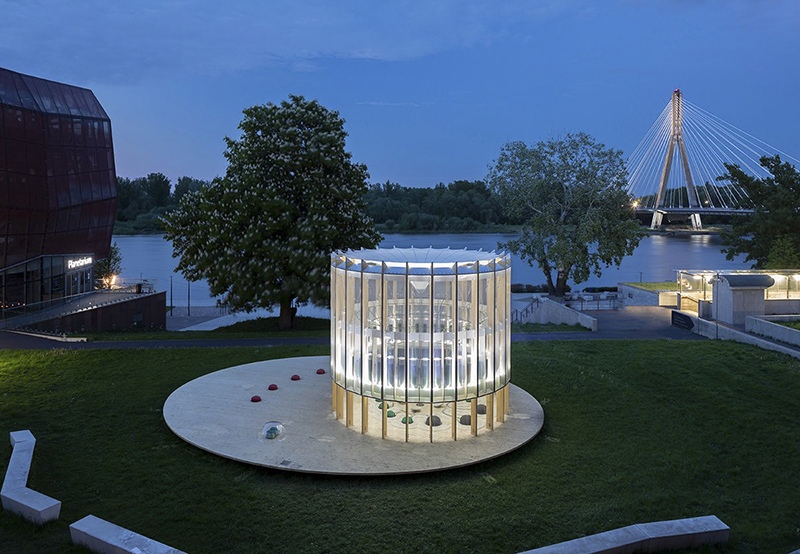
In Warsaw, AirBubble made the stakes of all this concrete in a way that was hard to argue with. The installation — a cylindrical timber structure wrapped in ETFE membrane, housing fifty-two glass bioreactors containing 520 litres of living Chlorella algae — was built for children. It created a measurable microclimate of clean air in the grounds of Warsaw's Copernicus Science Centre, where early monitoring data showed PM2.5 concentrations falling well within WHO limits, with a peak reduction rate of 83 percent against external readings. The installation addressed a fact the World Health Organization has described as the world's largest environmental health threat: 93 percent of the world's children breathe polluted air while they play.
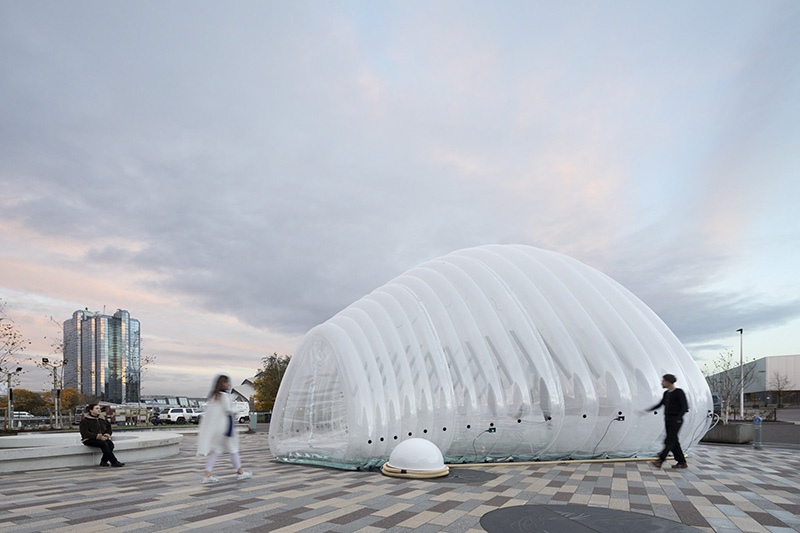
AirBubble is not a grand infrastructure. It is six metres tall, circular, intimate. Children pump air into the bioreactors with foot pumps. The white noise of the algae gardening system masks the surrounding city. The architecture asks something of those who inhabit it — attention, presence, a willingness to participate in the system's ongoing life.
This is deliberate. For ecoLogicStudio, maintenance is not a secondary condition of living architecture. It is a primary one. "Care is part of the spatial experience itself," Pasquero says. "Biological unpredictability is not a defect to eliminate; it is evidence that the system is alive." In a broader vision, she suggests, care may become one of the defining design values of the twenty-first century — not as sentiment but as practice, as the ongoing labour that sustains environments that are genuinely alive.
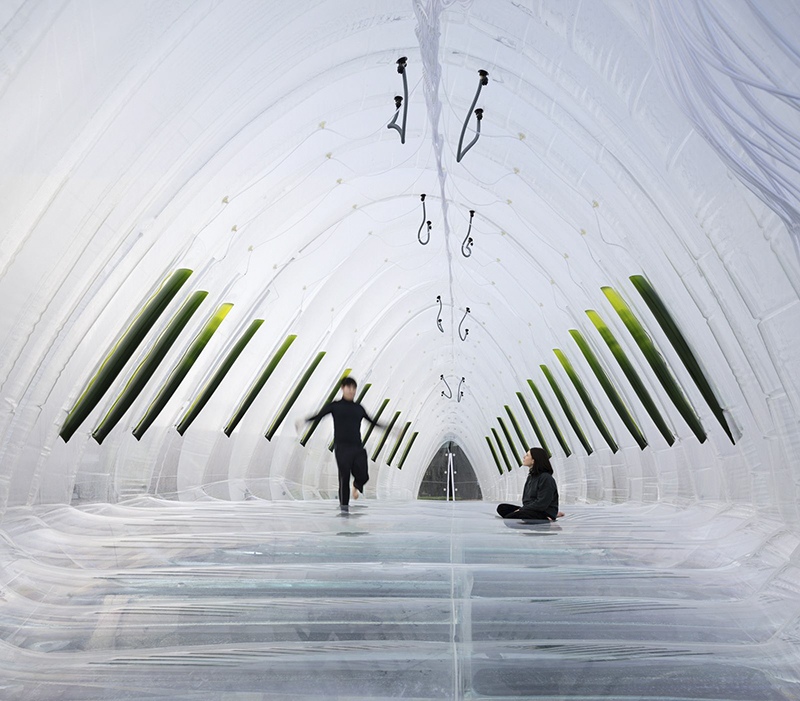
A second iteration of the AirBubble concept, a restorative space realised in Nyon, Switzerland in 2024, continues this trajectory: thirty-six bioreactors, 350 litres of Chlorella, an inverted conical roof that drives natural ventilation and continuous air recirculation. The architecture is soft-edged, defined by membrane and air pressure, entirely oriented around the act of breathing.
Planetary Scales
The most recent project to emerge from ecoLogicStudio's research, FundamentAI, presented at the 2025 Venice Architecture Biennale in collaboration with the Synthetic Landscape Lab at Innsbruck University and the Urban Morphogenesis Lab at the Bartlett, UCL, extends the studio's inquiry to a different kind of nonhuman intelligence: the living data of the Venetian lagoon. The installation integrates real-time ecological signals — acidity levels, microbial activity, light — with multimodal AI systems to generate responsive architectural forms. Bio-fabricated, biodegradable 3D-printed columns shift under subtle lighting effects that encode environmental data streams. Visitors scan a QR code and upload images of Venice; the system processes these inputs against the lagoon's own signals to generate speculative urban models.
The project's founding concept, which Poletto and Pasquero call Capsule Urbanism, imagines compact, modular, ecologically responsive architectural elements as the building blocks of a new kind of urban fabric — one in which the environment is an active participant rather than a backdrop. It is a vision with particular relevance to coastal cities facing ecological precarity, and to rapid-urbanisation contexts in the Global South where the adaptive, data-integrated models that ecoLogicStudio is developing could offer genuinely different strategies for climate-resilient development.
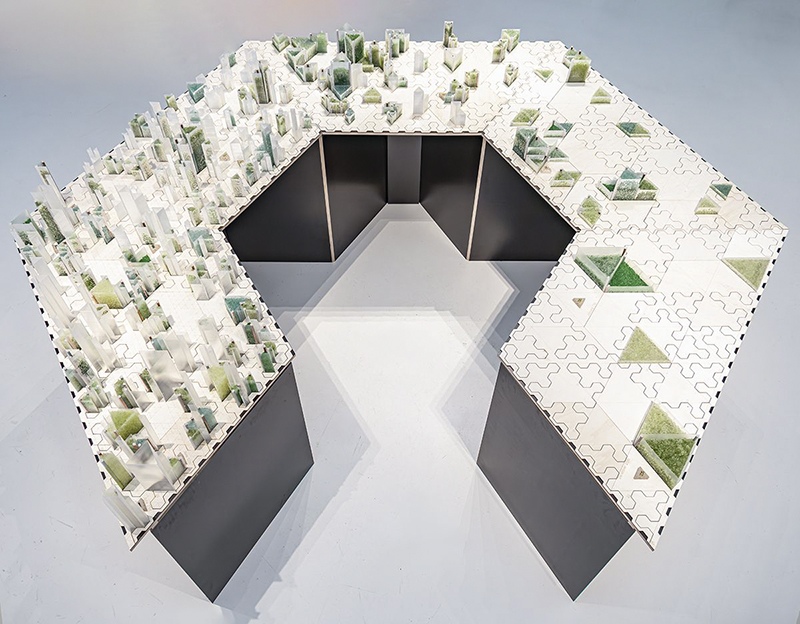
CryflorE carries this thinking to its most speculative conclusion: an entire city imagined as a distributed network of living infrastructure, where modular hexagonal units hosting photosynthetic organisms embedded in biogel panels absorb CO2, produce energy, and connect into larger networks through conductive pathways inspired by natural growth patterns. The city becomes a metabolism. Building surfaces become active environmental interfaces. Light signals and digital feedback make the exchanges visible, translating biology into spatial condition.
The Pattern Which Connects
Asked which thinker from outside architecture has most shaped their understanding of what a building can be, Pasquero and Poletto name Gregory Bateson — specifically his understanding of ecology as a "pattern which connects." They also name Timothy Morton, Donna Haraway, Frei Otto, and Slavoj Žižek. What these figures share, they suggest, is a refusal to treat ecology as a return to an idealised nature and a willingness to think ecological systems as conditions of entanglement between biology, technology, politics, and culture.
"A building is not an isolated object occupying space," Poletto says. "It is a dynamic participant within larger living systems."
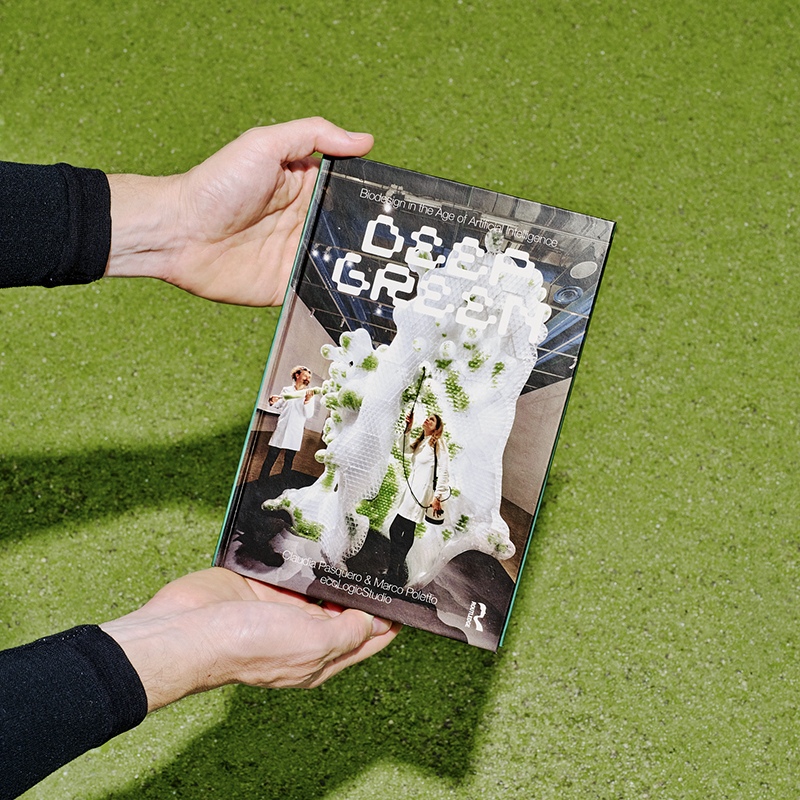
Their book Deep Green: Biodesign in the Age of Artificial Intelligence situates this conviction within a frame that is geological and geographical in its ambition — design as a force operating beyond human perception and lifespan, at the scale of planetary cycles. Yet this is not where the work is actually experienced. It is experienced by a child pumping air into a bioreactor. By a visitor standing inside a living wall, breathing air that has passed through algae. By a teenager in Warsaw photographing the bubbling green of a glass vessel catching afternoon light.
Pasquero is clear on this: "A child pumping air into a bioreactor is already participating in a planetary carbon cycle." The planetary and the intimate are not opposites. They are the same scale, seen from two different distances. Architecture, in ecoLogicStudio's vision, is what makes one legible through the other.