
Where experiences, discoveries and creative journeys meet

Tin foam

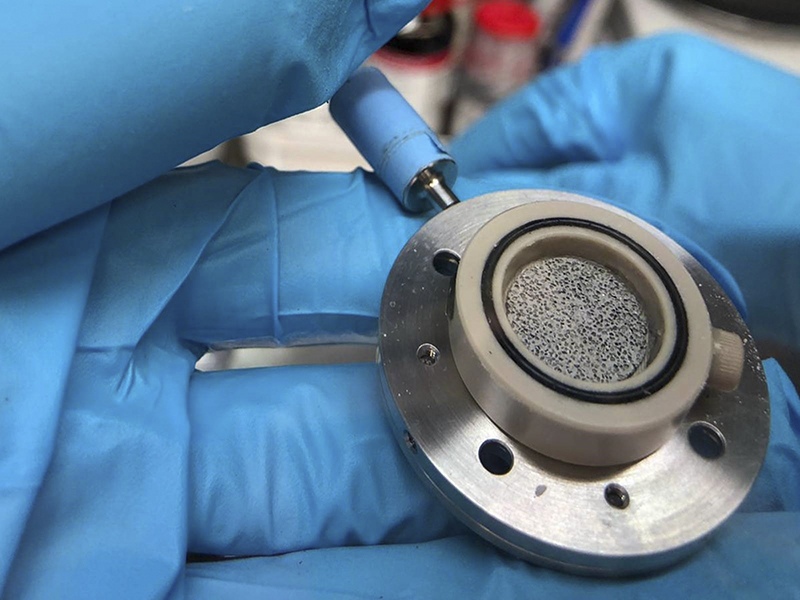
Highly porous tin foam, developed through specialized processing techniques. This material, shown in the image, was studied by an interdisciplinary team at HZB to evaluate its performance as a battery electrode.

锡泡沫电池电极内部演变:X射线成像的新发现

Dr. rer. nat. Sebastian Risse, Image credit: HZB Dr. Francisco Garcia-Moreno, Image credit: HZB 科学家通过X射线观察锡泡沫电极的“呼吸”,解决电池膨胀问题 科学家们发现,将锡转化为高孔隙率的泡沫结构或许能解决下一代电池面临的最大挑战之一。这一创新方法,来自柏林亥姆霍兹中心(HZB)的最新研究,可能为能量存储开辟新路,让相同体积容纳更多电量——想象一下,智能手机或电动车电池续航更持久。 超越石墨:金属电极的潜力 几十年来,锂离子电池依赖石墨电极在充放电时传递锂离子。石墨虽稳定,但其理论容量仅为372 mAh g⁻¹,促使研究者寻找更高能量密度的替代品。锡以993 mAh g⁻¹的理论容量——几乎是石墨的三倍——脱颖而出。“锡资源丰富、无毒,且能储存更多锂离子,”HZB的共同作者塞巴斯蒂安·里瑟博士(Dr. Sebastian Risse)说。这项研究已发表在《先进科学》上。然而,问题在于:锂离子进入时,锡体积膨胀高达260%,导致龟裂和性能衰退。 Schematic diagram illustrating the operando cell architecture used for discharge/charge experiments. The components include: (A) current collector, (B) Sn electrode, (C) Celgard separator, (D) lithium chip, (E-F) steel spacers, (G) steel […]

锡泡沫电池电极内部演变:X射线成像的新发现 Read More »

Highly porous tin foam, developed through specialized processing techniques. This material, shown in the image, was studied by an interdisciplinary team at HZB to evaluate its performance as a battery electrode.

Innovative Battery Electrode Made From Tin Foam: X-Ray Imaging Reveals Internal Evolution

Scientists have discovered that transforming tin into a highly porous foam structure may solve one of the biggest challenges facing next-generation batteries. This innovative approach, detailed in a recent study from Helmholtz-Zentrum Berlin (HZB), could pave the way for energy storage that packs significantly…

Innovative Battery Electrode Made From Tin Foam: X-Ray Imaging Reveals Internal Evolution Read More »