
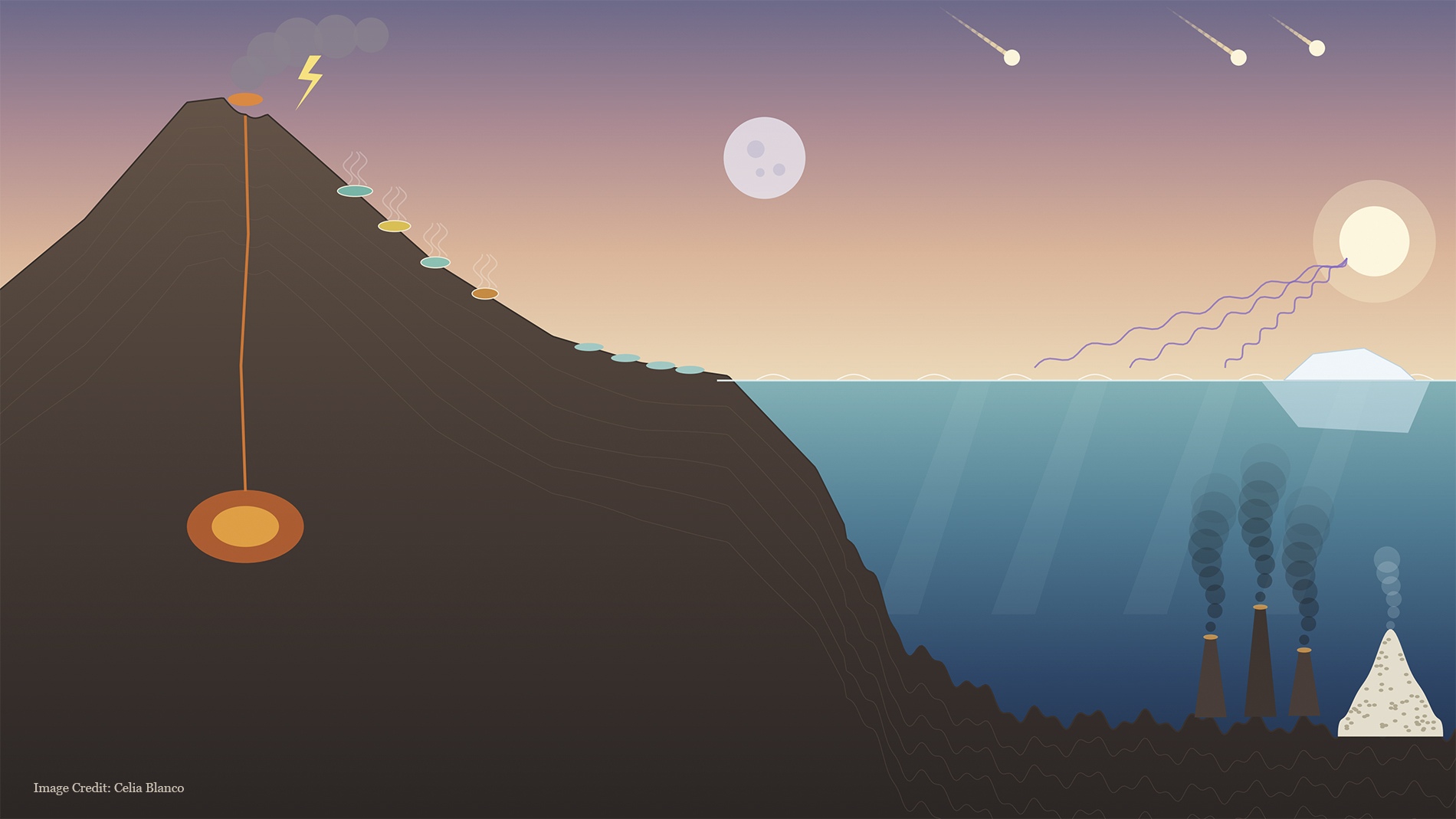
The Loop and the Silence
Astrobiologist Celia Blanco on how life begins, how civilizations last, and why a quiet galaxy may not be an empty one
Introduction
In 1950, over lunch at Los Alamos, Enrico Fermi asked a question that has never gone away. If the galaxy is old and vast, where is everybody?
For decades, most answers have taken one of two forms. Either intelligent life is rare, or it does not last. The second answer is usually expressed as a single number: the lifetime of a technological civilization, the L at the end of Frank Drake's famous equation. In this picture, a civilization switches on, broadcasts for a while, and switches off for good.
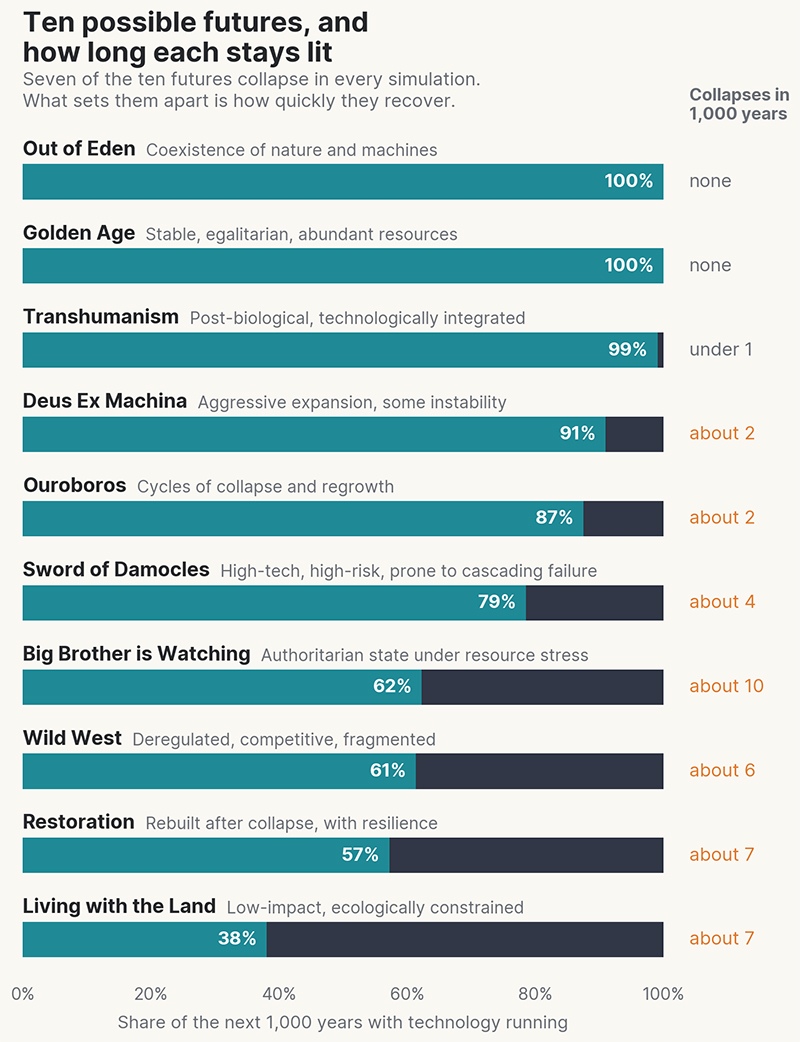
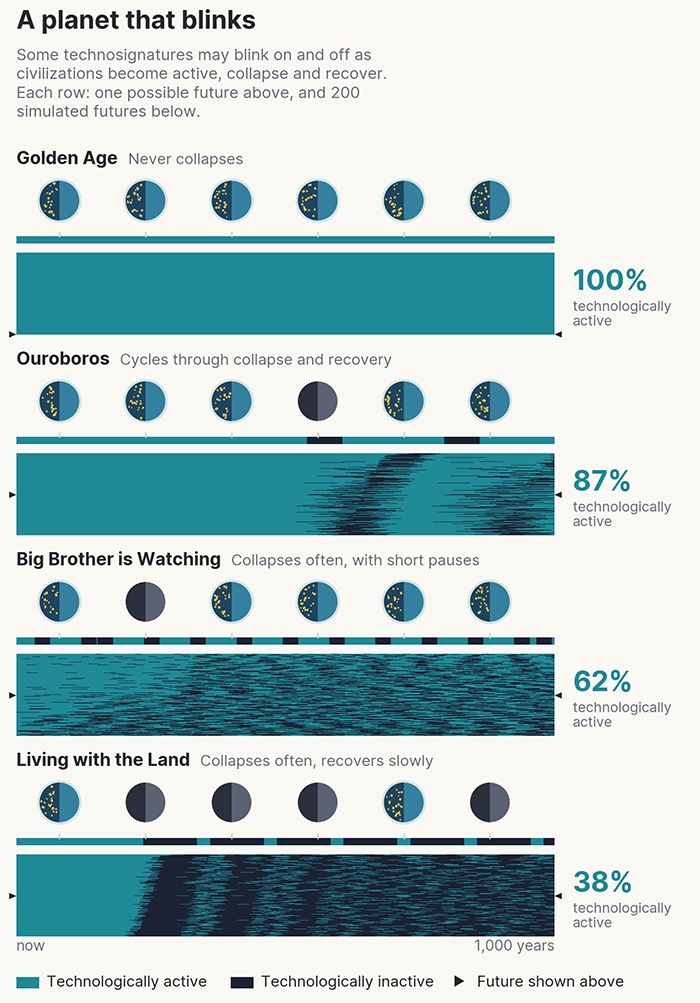
Celia Blanco's recent work asks what happens if that picture is too simple. Civilizations on Earth have always risen, fallen, and risen again. With Jacob Haqq-Misra and George Profitiliotis of Blue Marble Space, she simulated ten plausible futures for our own civilization, each run 200 times across a thousand years. The paper measures something called the duty cycle, the fraction of a civilization's lifespan during which it is technologically active. Across the scenarios, it ranged from about 0.38 to 1. Some futures never collapse. Others collapse and recover again and again.
The consequence for the search for life is sobering and also oddly hopeful. If civilizations flicker, a silent sky does not have to mean an empty one. It may only mean we are looking at the wrong time. The same logic also turns back on us. We may be living inside the detectable phase of a civilization without knowing whether it is the beginning, the middle, or the last stretch before a trough.
Blanco came to this question from an unusual direction. Trained as a theoretical physicist, she has spent most of her career on the origin of life: how the molecules of life came to share a single handedness, how chemistry became biology, and how the genetic code acquired its shape. In this conversation, she explains why she sees the first molecules and the fate of civilizations as versions of the same question. At every scale, she suggests, the answer may come down to a loop that closes and a system that manages to stay ahead of what it consumes.
The Conversation
The duty cycle as a civilizational vital sign
Celia Blanco I read in an article that Luke Kemp, from Cambridge University, had identified a series of civilizations over the history of Earth and calculated that the average duration of a civilization is 336 years. That is not surprising. We know that civilizations have risen and fallen throughout Earth's history. But it made me wonder how the pattern would transfer to a technological civilization, and in particular to futures we haven't lived yet. Obviously we can't go and look, because we can't time travel (unfortunately!), but we can simulate. And the beauty of simulation is that you actually get to peek at all the futures we can plausibly envision.
The ten futures
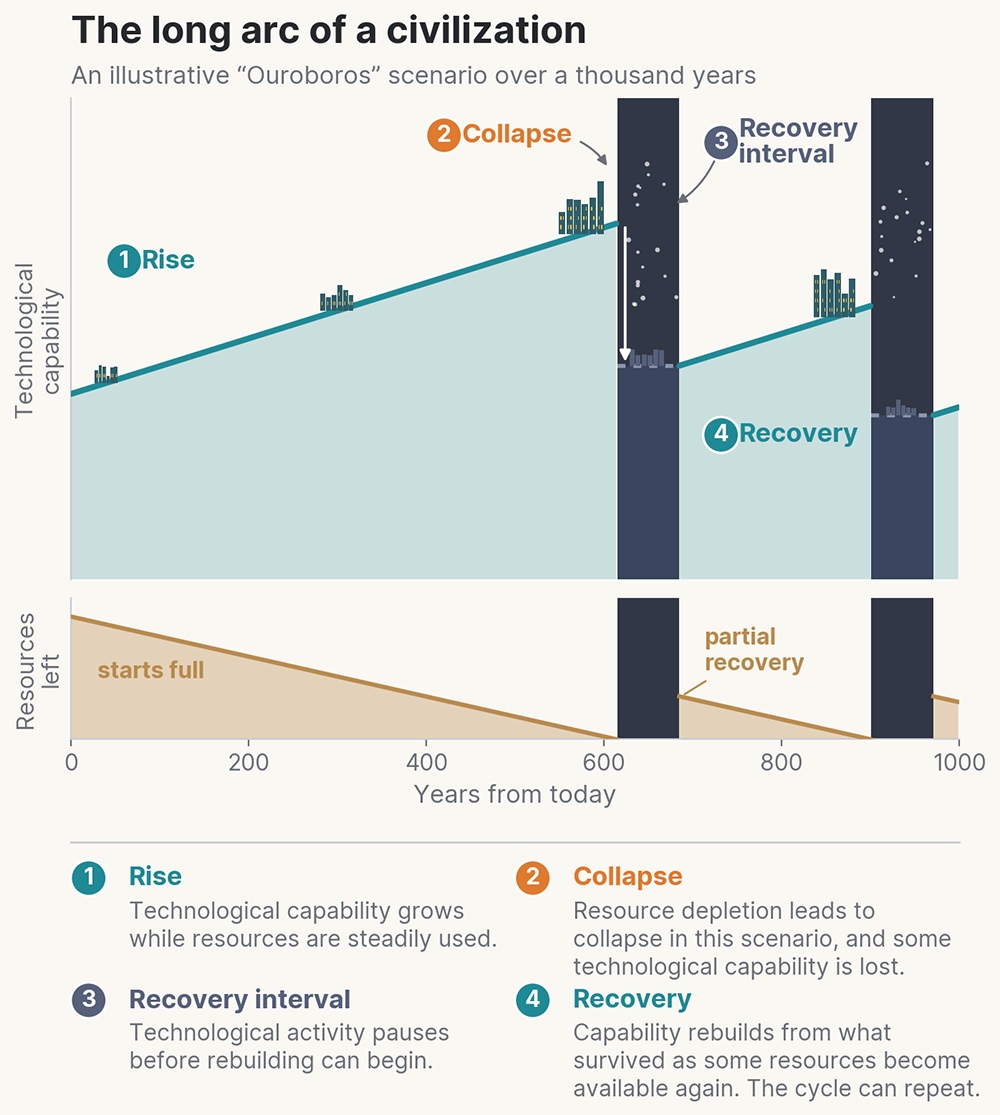
Celia Blanco To me, the most uncomfortable scenario is the one with recurrent collapse, Ouroboros, which collapses and recovers continually. On paper, it looks like a successful scenario because it stays up and running except during the collapse windows, so the duty cycle looks respectable. But for the people in it, it's a world where every few generations experience severe hardship. Every few generations, humanity loses the infrastructure the previous generations built. And that, at least to me, is uncomfortable in a way that the dramatic scenarios (like a meteorite falling) aren't, because it doesn't require a catastrophe. Nothing really ends it, but it also never gets far enough ahead of its own consumption to build anything that lasts.
Collapse as a sampling problem
Celia Blanco Yes, definitely. The main take-home message for us is that silence doesn't mean absence. We might just be looking at the "wrong" time.
I think it is actually more severe than it sounds, because the effect multiplies. If the emitting civilization is only detectable part of the time, and the listening one is only listening part of the time, the chance of overlap is the product of those two fractions, not the average. So, for example, two civilizations each active 40% of their history have roughly a one in six chance of ever being visible to each other. In other words, a galaxy full of intermittent civilizations and a galaxy that's genuinely empty can look identical from where we're sitting. I think that's a humbling conclusion for life detection, but a hopeful one for the possibility of life existing elsewhere.
The molecular and the civilizational
Celia Blanco It is indeed a vertiginous range of scales. But if we leave the scale aside, these two topics actually have a few things in common! First, there is only one type of life we know about, and there is only one technological civilization we know about. I find it very interesting to think of all the ways in which life could have emerged and all the ways in which civilizations could go.
Second, both systems exhibit persistence over time, each on its own terms. I think one of the hardest questions in prebiotic chemistry and early evolution is not so much how something starts, but how it keeps going. A chemical system that organizes itself has to keep running and keep consuming to stay organized. A technosphere does the same, at a very different scale. Its structure stays ordered only as long as energy and resources keep moving through it.
There is also something poetic about these two topics. One is about the beginning of us, and one is about the end. I feel tremendously lucky to be able to work on both ends of it.
Chirality and the puzzle of handedness
Celia Blanco I think how amplification can happen is not a big issue. We've known since the 1950s that autocatalysis plus mutual inhibition will drive a system of monomers to one hand. Since then, we've found several more routes that work: polymerization, crystallization, attrition, and others. So it's not that we don't have explanations. We might actually have too many! The field's uncertainty comes from the fact that we have no way to tell which one actually took place in the history of life on Earth. That's a different kind of uncertainty from the one caused by a missing mechanism or an unexplained step, and in some ways it's a more frustrating one.
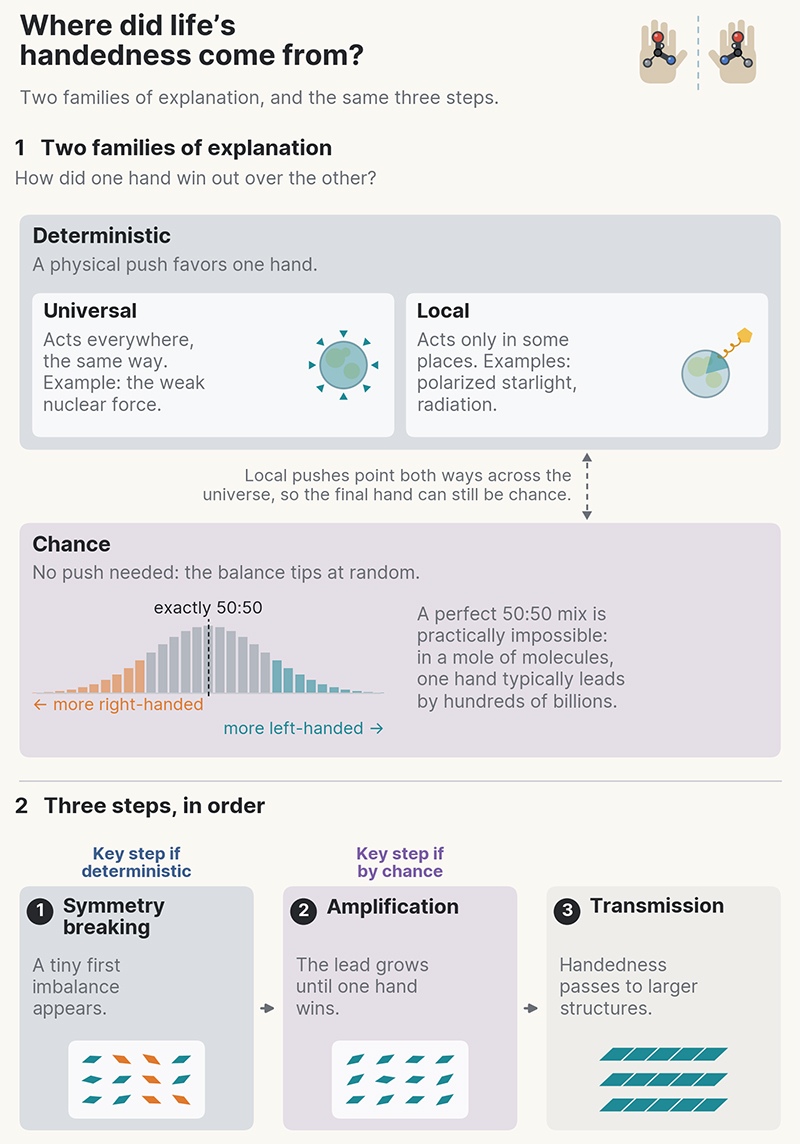
In my opinion (and I don't think this is said enough), there is a difference between breaking symmetry and breaking it everywhere. The models usually describe well-mixed systems: one vessel, one outcome. But the early Earth consisted of a huge number of partly isolated environments, and if each one breaks symmetry on its own, you'd expect roughly half to land on each hand. So you need the local outcomes to communicate somehow, through transport, or through one environment simply winning and exporting its chemistry. In other words, the mechanism that makes a pond homochiral is not the mechanism that makes a planet homochiral, and we don't usually separate those questions as much as we should.
How chemistry becomes biology
Celia Blanco As a physicist, I'd say both. Many systems change smoothly in some underlying parameters but abruptly in others, like a change of phase. Water can gradually get colder, but it doesn't gradually get more solid. I think the transition from chemistry to biology might have looked something like that. While it makes sense to think that the diversity of molecules and reactions increased gradually, I imagine closure happened suddenly. As the number of possible molecules and reactions grew, the system must have reached a critical density of interactions, at which a subset of the network could start producing everything it needed to keep itself going. I think that's the point at which the system stopped being a collection of unrelated reactions and started being a thing. All this to say, there might be nothing special or dramatic happening close to the transition, no spark or anything like that. It's just that the loop closed.
Fitness landscapes and the early genetic code
Celia Blanco I think the term "frozen accident" is actually two claims in one. "Frozen" is well supported. Once the code is used by everything in the cell, any reassignment changes the meaning of every existing gene at once, so the cost of a change is enormous. Even so, it isn't completely frozen. We know of dozens of variant codes and two amino acids that were added after the fact, and some labs have expanded the code deliberately. So it changes; it just changes rarely. "Accident" is a much weaker claim, because the fact that the code can't easily change now tells you nothing about how it got where it is. In fitness landscape terms, "frozen accident" is a statement about the depth of the valleys around the peak. It says nothing about whether we climbed to that peak or landed on it.
My view is that it's probably neither pure accident nor pure selection. Some years ago, we mapped the fitness landscape of RNA molecules that attach amino acids to themselves (a model system, not the actual ancestor). We found that evolution could easily climb the nearest peak, but the valleys between peaks were too deep to be crossed without losing function. So which peak you end up on depends a lot on where you start. That can be seen as the accident part. But in a follow-up study, we found that related RNA molecules prefer chemically similar amino acids. So if the code grew by reusing existing molecules for new amino acids, it would end up tolerant to errors as a by-product, and that tolerance is usually seen as the strongest evidence for selection. More recently, we found that the order in which amino acids entered the code tracks their molecular complexity, with the simple ones in basal positions. That's availability, not accident. It also isn't selection for translation, which is what most of this debate assumes. So it seems that translation inherited an order that was already set.
The theorist's position
Celia Blanco I think theory offers explanations and predictions, and I would argue both are as important as the measurements themselves. This is especially true in astrobiology, because we are working with one example, and you cannot do statistics on a sample of one. Theory doesn't fix that, but it lets us explore the space of what could have happened here, and of what could still happen elsewhere.
Where theory falls short is the same place the chirality field is stuck. It is much easier to produce models than to test them experimentally. I can give you three mechanisms that explain the same phenomenon, but I can't tell you which one actually took place on Earth. In some sense, theory generates candidates without ranking them; for that you need measurements. But that is also the beauty of theory. It can tell you which experiments are worth doing, because it shows you where the candidates disagree. So I don't think of it as a hierarchy. It's more like two halves of the same job.
Returning to CAB
Celia Blanco We both have changed. Everything has changed. I left CAB at the very start of my career and came back with a very different set of questions. My decade in the U.S. is where my work stretched from molecules to civilizations, and I owe a lot of that to the people I worked with there. So it feels less like going back and more like coming full circle: the same place, seen with different eyes.
The question underneath all the questions
Celia Blanco The honest answer is that I think it's the same answer at every scale, which is part of why I work on all three. Something begins when a loop closes, and it lasts as long as it can stay ahead of what it consumes. That's true of a chemical network, and I think it's true of a civilization. If that's right, then understanding how the first molecules kept going might teach us something about how we can keep going.
Conclusion
Celia Blanco's thinking has a subtle symmetry. In her account, a collection of molecules does not become life through a sudden spark. The real transition comes when the loop closes, when a network can produce what it needs to sustain itself. The persistence of a civilization seems to follow a similar logic. What matters is not avoiding every disaster, but whether a civilization can stay ahead of its own consumption long enough to build structures that outlast a single generation.
That is why the most unsettling future in her simulations is not a world destroyed by some great catastrophe, but Ouroboros: a civilization that looks relatively successful on paper, yet every few generations loses what those before it have built. At the same time, her work leaves open a more hopeful possibility: silence does not mean absence. The galaxy may contain many civilizations that are simply dark for now, and we may happen to be looking when they are not shining.
In the end, what Blanco leaves us with is less a prediction about the future than a question about ourselves. If the earliest life had to find a way to keep going, perhaps the challenge before us is not fundamentally different, only larger in scale: to close the loop, and to stay ahead of our own consumption.
Explore Further
How long a civilization lasts
Celia Blanco's question began with a simple count. Defining a civilization as a society with agriculture, multiple cities, military dominance in its region and a continuous political structure, the Cambridge researcher Luke Kemp surveyed civilizations from 3000 BC to 600 AD and found that they lasted, on average, about 336 years. The longest endured for more than a thousand.
Background Luke Kemp, Are we on the road to civilisation collapse? , BBC Future (2019)
Do states grow more fragile with age?
Whether collapse is a matter of chance or of age is still debated. A survival analysis of premodern states asked whether the risk of a state coming to an end stays constant over time or changes as it grows older, a question that sits close to the idea of civilizations that rise, fall and rise again.
Further Reading Scheffer, van Nes, Kemp and Xu, The vulnerability of aging states: A survival analysis across premodern societies , Proceedings of the National Academy of Sciences 120, e2218834120 (2023)
Tipping the mirror
The idea that a tiny imbalance between left-handed and right-handed molecules could grow until one hand took over comes from a short 1953 paper by the physicist Charles Frank. He showed that autocatalysis combined with mutual inhibition could drive a mixed system to a single hand, the mechanism Blanco describes as known since the 1950s.
Earlier Research F. C. Frank, On spontaneous asymmetric synthesis , Biochimica et Biophysica Acta 11, 459 (1953)
The frozen accident
In 1968, Francis Crick suggested that the genetic code might be a "frozen accident": an arrangement that became fixed early in life's history because any later change would disrupt every protein at once. Blanco's answer separates the two halves of that phrase, and much of the debate since has turned on how much of the code was accident and how much was shaped.
Earlier Research F. H. C. Crick, The origin of the genetic code , Journal of Molecular Biology 38, 367 (1968)
The Study Discussed in This Article
Celia Blanco, Jacob Haqq-Misra and George Profitiliotis, Projections of Earth's Technosphere: Civilization Collapse-Recovery Dynamics and Detectability , arXiv:2604.13774 (2026)
About the Researcher
Dr. Celia Blanco is a theoretical physicist and astrobiologist and a Ramón y Cajal Fellow at the Centro de Astrobiología (CAB, CSIC-INTA) in Madrid, where she works in molecular evolution. She is also affiliated with Blue Marble Space in Seattle. Her career began at CAB and continued for more than a decade in the United States, at UCLA, UC Santa Barbara, and Blue Marble Space, before she returned to Madrid. Her research sits at the intersection of biophysics and biomolecular evolution. Using theoretical and computational approaches, she studies how molecular handedness emerges and is amplified, how chemistry makes the transition to biology, and how fitness landscapes shaped the early genetic code. She received a NASA SCoPE Seed Grant in 2024.