
The Pattern Life Leaves Behind

The search for life beyond Earth is looking in a new place: the statistical order hidden in molecules
For decades, the search for life beyond Earth has frequently relied on a deceptively simple premise: find the right molecules. For example, amino acids or fatty acids. The chemical signatures of biology. But the presence of these compounds alone has never been enough. They form naturally in space, in meteorites, in laboratory simulations of early planetary chemistry. Life produces them — and so does the universe, without any help from life at all.
A study published in Nature Astronomy proposes a different kind of question. Not what molecules are present, but how they are organized. Researchers found that living systems leave behind a distinctive statistical pattern in related organic compounds — one that nonbiological chemistry does not replicate. The signature is not carried by any single molecule. It emerges from the relationship between them.
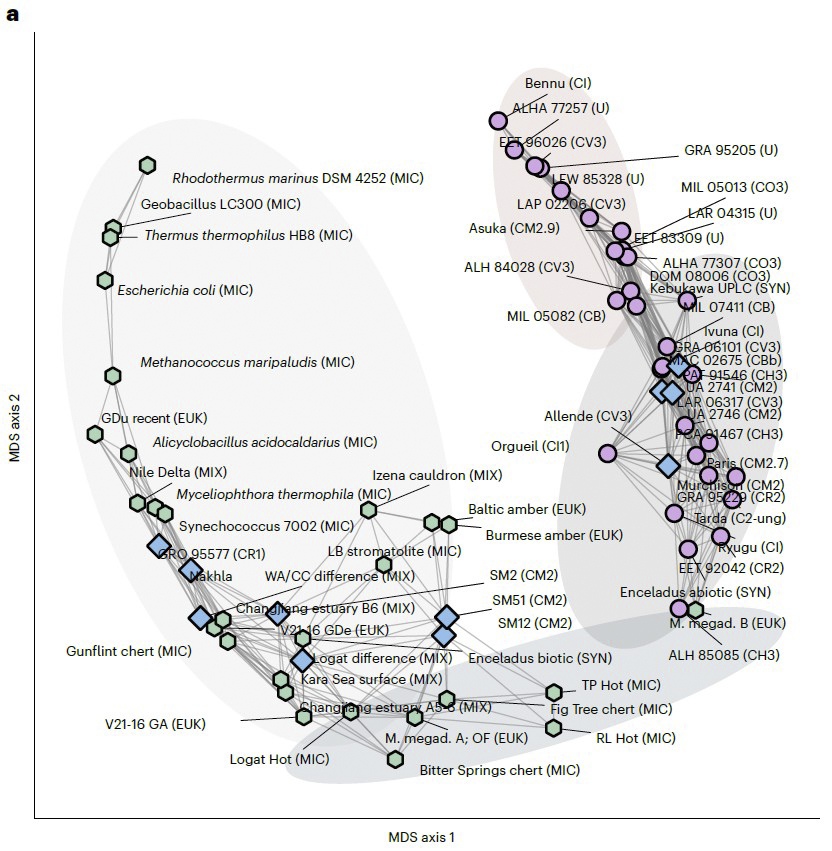
The method borrows from an unlikely source: ecology. The same diversity metrics used to measure species richness and evenness in ecosystems turn out to describe something real at the molecular level too. Applied to roughly a hundred datasets — spanning microbes, soils, fossils, meteorites, and synthetic laboratory samples — the framework consistently separated biological materials from abiotic ones. Even heavily degraded samples, including fossilized dinosaur eggshells, retained detectable traces of the pattern.
We spoke with Fabian Klenner, co-author of the study, about what this organizational signature reveals — and what it means for the search for life on Enceladus, Europa, and other planetary bodies.
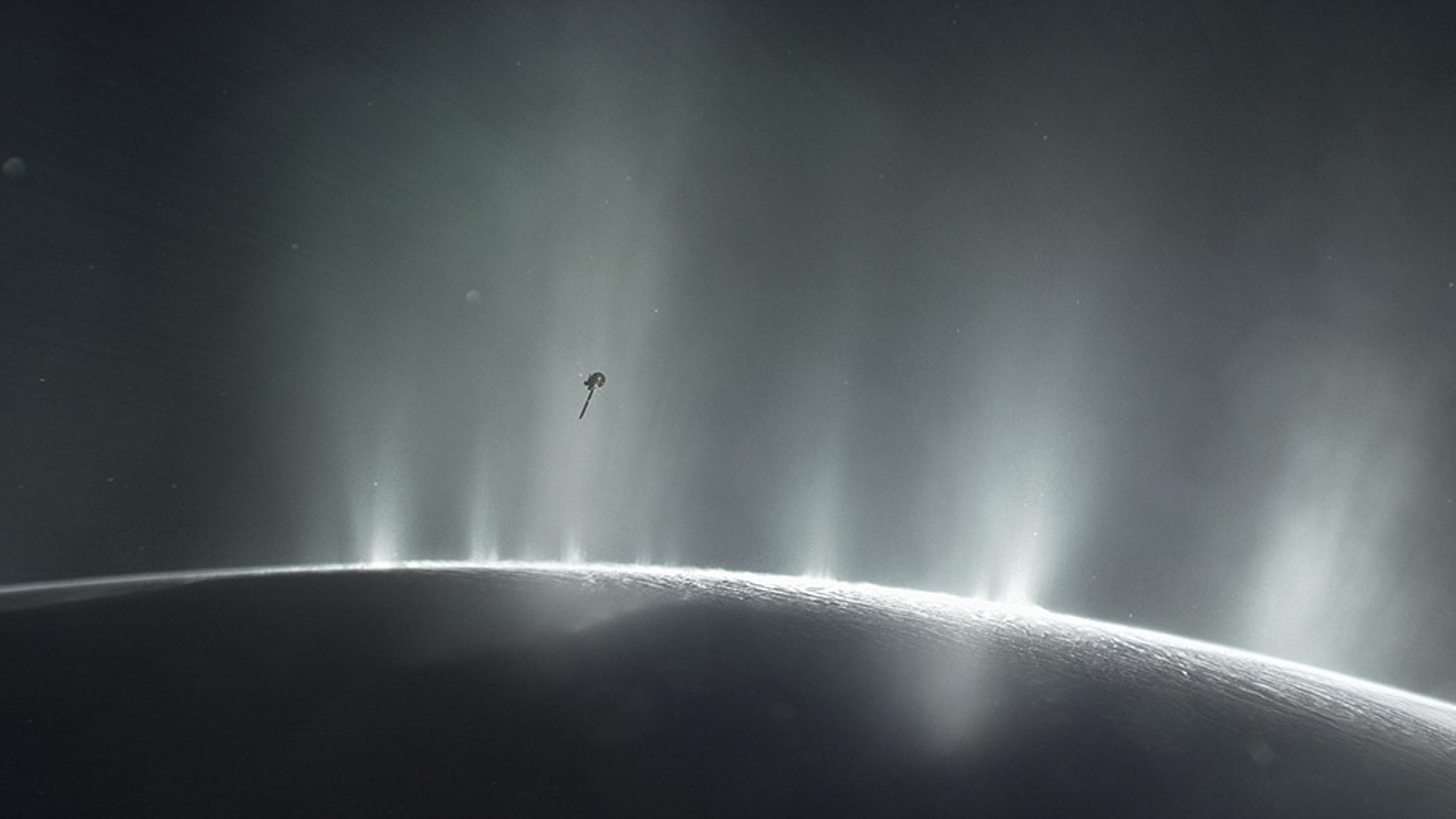
Cover image: Artist's impression of the Cassini spacecraft flying through the plume of Enceladus, one of Saturn's moons · Image credit: NASA/JPL-Caltech
The Conversation
On the Statistical Biosignature Paper
Fabian Klenner It is both. Life is made of particular building blocks, including amino acids, fatty acids, DNA, and many other molecules. And these building blocks must be organized in a particular way. Our study suggests that this organization leaves a detectable imprint.
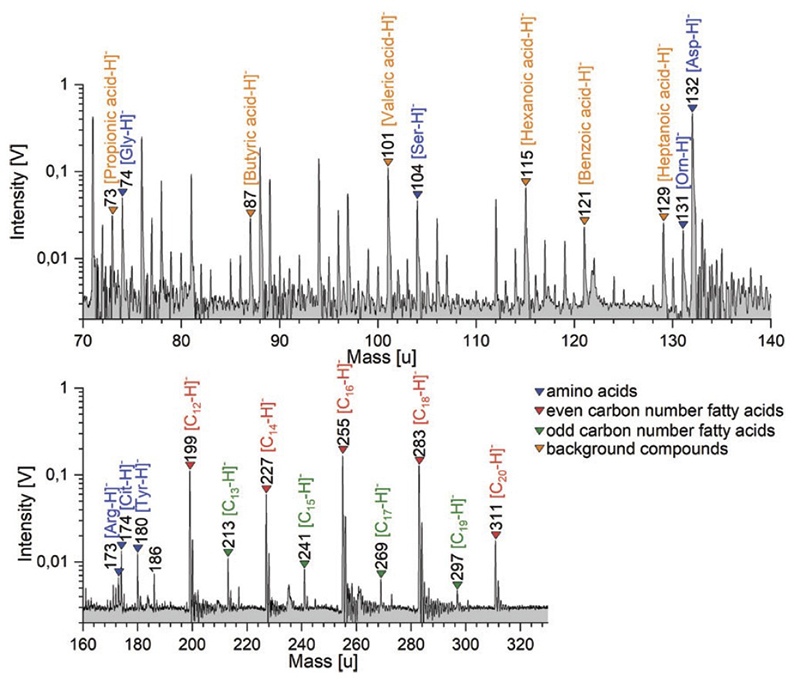
Consider amino acids. Abiotic chemistry typically favors a relatively small subset because some amino acids form more easily than others. Biology, however, does not simply produce the molecules that are easiest to make. It produces molecules according to functional needs, even when they are energetically expensive. Fatty acids provide a complementary example. Life uses only a limited subset because membrane function benefits from chemical selectivity. In both cases, biology organizes molecules around function rather than simply around what chemistry would produce on its own. This is organization.
That said, I would be careful not to conclude that organization alone is sufficient for life. Our study shows that biological systems leave characteristic organizational patterns, but it does not tell us whether organization by itself defines life. If I arrange a pile of rocks in a particular pattern, I have created organization, but not biology.
Fabian Klenner These are very interesting questions, and I really enjoy thinking about them. It may be possible that the success of ecological diversity metrics at the molecular level reflects a deeper connection, but I do not think that our study is sufficient to establish that. After all, these metrics were developed to characterize distributions of species within ecosystems, not to distinguish life from non-life.
At the same time, it is intriguing that the same statistical framework can be applied across different scales. One possible interpretation is that biological organization leaves statistical signatures that emerge at multiple levels, from molecules to cells, organisms, and even ecosystems. Whether that reflects a deeper organizing principle of life remains an open question.
In our study, we do not attempt to define life. What we do show is that biological systems leave characteristic organizational patterns in molecular abundances. Living systems maintain local order by consuming energy, but life encompasses many other properties as well, including metabolism, evolution, adaptation, and information processing. I do not think we yet have a single universally accepted definition of life that captures all of these aspects.
Fabian Klenner This is one of the most important aspects of our study for planetary exploration because these environments are often harsh and organic molecules are expected to degrade over time. In astrobiology, we are not only searching for extant life but also for extinct life. One of the strengths of our approach is that it can detect biological signatures even when the original material has been substantially altered.
Carrying the trace of life long after the life itself is gone is not a new concept. Fossils are perhaps the most obvious example. We show that degraded fossilized dinosaur eggshells carry the trace of life on the molecular level but we knew beforehand that these are, in fact, dinosaur eggshells.
This suggests that biosignatures can survive longer than individual molecules. This is encouraging for planetary exploration because we expect potential biological material on Mars, Europa, Enceladus, or another planetary body to be altered by radiation, oxidation, geological processes, and other processes. Rather than searching only for pristine biological compounds, we may also be able to search for the organizational patterns that life leaves behind.
Fabian Klenner My favorite example of what would count as convincing evidence of life is the following: imagine looking through a telescope and seeing living beings walking across the surface of another planet. Most people would agree that this would be compelling evidence. But the search for extraterrestrial life is not that easy.
We do not have a definition of life that everybody accepts, nor do we have a definition of biosignature that everybody agrees on. So, how do we look for something that we cannot even define properly? That is one reason why the field relies on many different approaches.
I do not think astrobiology currently has a universally accepted equivalent of the legal standard of "beyond a reasonable doubt." Instead, confidence grows when multiple independent lines of evidence converge on the same conclusion. To have convincing proof of life, we will need several independent lines of evidence that must be interpreted in the appropriate geochemical context. When life emerges as the simplest and most convincing explanation for all available evidence, then we can say "this is probably life."
Our method is not the ultimate proof of life. It is rather one of those independent lines of evidence that contribute to a broader case.
On Enceladus, Europa, and the Ocean Worlds
Fabian Klenner Based on our current knowledge, Enceladus and Europa are among the most promising places beyond Earth to search for life because they appear to combine three key ingredients: liquid water, organic chemistry, and sustained energy sources. Other icy moons are also intriguing, most notably Titan, but Europa and Enceladus are thought to have oceans that interact with rocky interiors, potentially providing access to nutrients and chemical energy.
In my opinion, the greatest advantage of Enceladus is accessibility. The moon actively ejects material into space that is thought to originate from its subsurface ocean, allowing spacecraft to sample ocean-derived material without landing or drilling. Europa's greatest advantage may be time. Its ocean may have existed for a very long period, potentially giving life more time to emerge and evolve.
What is happening in these oceans remains one of the central questions of my research. We have evidence for water-rock interactions, dissolved salts, organic compounds, and transport processes linking the interior to the surface. However, many important details remain unknown, including the chemistry of the oceans, the availability of energy, and whether these environments have ever supported life. Answering those questions is one of the main reasons why major space agencies are currently exploring these worlds or developing future mission concepts.
Fabian Klenner I am certain that what we sample is a biased subset. This makes the exploration of Enceladus's ocean more difficult but also more interesting. Some compounds are likely to be altered, fractionated, or preferentially transported during plume formation, meaning that the plume represents an incomplete sample of the ocean. Understanding what really happens when the plume forms and the material travels through the subsurface conduits and is emitted into space is essential for interpreting the plume measurements correctly.
We should acknowledge how remarkable this opportunity is. Enceladus is effectively providing access to material from its interior without requiring a lander or a drill. Even an incomplete sample can reveal a tremendous amount about the ocean's chemistry and habitability. I would argue that one of the most important questions to address in planetary science is to characterize the moon's plume and ocean in detail. Even if we conclude at some point that there is no life on Enceladus, we will have learned a lot.
That said, I do think there is something fundamentally valuable about eventually going there and landing on the surface. Missions that can analyze freshly deposited material on the surface, or perhaps one day access the subsurface more directly, would provide an even more complete picture of the ocean environment.
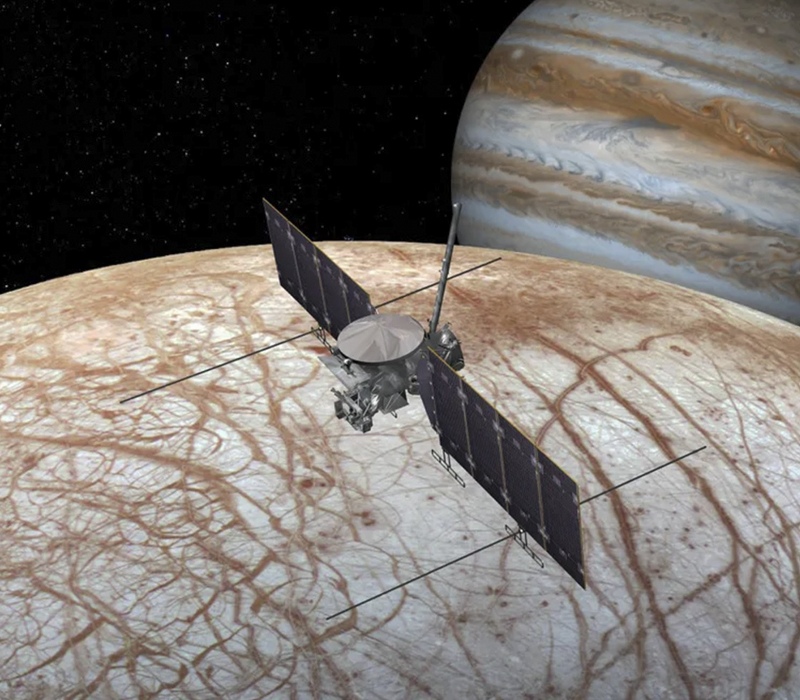
Fabian Klenner Honestly, I feel incredibly grateful to have the opportunity to contribute to space missions, including Europa Clipper, which is, in my opinion, one of the most exciting astrobiology missions of our time. I am surrounded by many brilliant people, and it is humbling to know that some of the work I do today may help interpret data that will be collected years or even decades from now.
Space exploration operates at unusual timescales. A mission takes decades to develop, launch, and return data. That requires a certain degree of patience and long-term waiting, but also provides you with a deep connection to the mission. I am aware that I am building on the work of people who started these efforts long before me, while also laying the groundwork for future generations of scientists.
Personally, I find that inspiring rather than frustrating. Fifteen years ago, I would never have imagined that I might contribute to real space missions. The idea that an experiment or model I work on today could one day help answer one of humanity's oldest questions — Are we alone? — is something I find remarkable.
On the Broader Questions
Fabian Klenner In our study, we demonstrated that amino acids and fatty acids, key building blocks of life on Earth, exhibit statistical patterns that can be used to distinguish life from non-life. It is possible that our method may also be sensitive to similar patterns produced by extraterrestrial life that does not share our biochemistry, provided that such patterns exist and that we are able to detect relative abundances of related molecules.
However, when thinking about Enceladus and Europa, I would not immediately assume a completely unfamiliar form of biochemistry. There is liquid water, organic chemistry, and substantial energy — key ingredients that are also important for life on Earth. I personally think that it is a very good approach to look for life as we know it on Enceladus and Europa because these moons share the same key building blocks. If life exists there, it may share some broad similarities with terrestrial life, even if it evolved independently.
More broadly, it is important to distinguish between detecting life and understanding life. Detecting a statistical biosignature might tell us that biology is present, but not necessarily what that biology looks like. Even so, such a discovery would be profound. Knowing that life emerged independently in another environment would fundamentally change our understanding of life's place in the universe and demonstrate that biology may not be unique to Earth.
Fabian Klenner Astrobiology is not only about the search for life beyond Earth. It also includes the origin and evolution of life on Earth, the distribution of life, and the future of life. Finding life beyond Earth would probably be the most remarkable discovery in human history, but it is not the only question being addressed in astrobiology.
Of course, the absence of a confirmed extraterrestrial example shapes how the field thinks. We currently have only one known example of life, namely life on Earth. The questions we ask and address change over time. Astrobiology is a dynamic and highly interdisciplinary field. New discoveries, technologies, and missions continually reshape our understanding of where life might exist and how we can search for it. Fifty years ago, many questions in astrobiology were closer to philosophical speculation and sometimes science fiction. Today, we are testing some of those questions with real measurements.
Fabian Klenner Your questions go to the heart of life detection. Absence of evidence is not evidence of absence. You always have to be aware of the potential for false positive and false negative detections. The field traditionally pays a lot of attention to false positive detections, meaning that we incorrectly claim the discovery of extraterrestrial life. However, false negatives are equally important. Recently, I, together with a great team of scientists, published another paper on false negative detections — the failure to detect life that is actually present. This is why I think it is difficult to define a single failed detection. If an instrument does not detect a biosignature, that may mean life is absent, but it may also mean that the biosignature was not preserved, not sampled, or not detectable with the instrument that was used. Understanding those limitations is a critical part of astrobiology.
Ultimately, I do not think we will recognize extraterrestrial life through a single observation. We need many independent lines of evidence. Conversely, a convincing non-detection would require confidence that, if life were present, we would reasonably expect to have seen its signal.
Conclusion
What Klenner's research ultimately proposes is a shift in how we think about the evidence life leaves behind — away from the presence of particular compounds, and toward the organizational logic that governs how those compounds relate to one another. It is a subtler kind of signature, one that persists even through degradation, even across geological time.
The field does not yet have a universal standard for what constitutes proof of extraterrestrial life. But it is building one, incrementally, from many independent directions — each adding a line of evidence, each narrowing the space between we cannot rule it out and this is probably alive. The statistical biosignature is one such line. The ocean worlds of Enceladus and Europa, with their liquid water and organic chemistry, are among the most compelling places to look for convergence.
Whether the answer is there remains unknown. But the question, as Klenner frames it, is no longer purely philosophical. It is becoming testable.